Show your Bird Portraits

Rienzphotoz said:
Click said:
Rienzphotoz said:
Here is an image from Healesville Sanctuary in Melbourne, during Spirits of the Sky show ... as I was more interested in capturing these birds, I did not pay attention to the Sanctuary staff when they mentioned the name of this Owl ... can someone help with the name?

Very nice shot Rienzphotoz. Nicely done Sir!
Thanks for the kind words Click ... I'm still hoping someone can help me out with identifying the name of that Owl.


Barking Owls are native to Australia, Indonesia and Papua New Guinea.

Barking Owls are most common in savannah woodland, although they also inhabit well-forested hill and riverine woodlands. They are widely distributed throughout Australia, but are absent from central areas. They are found in every Australian state/territory except Tasmania. They are not found in the Centre or western deserts.

Although moderately common, Barking Owls are more often heard than seen (typical of most nocturnal birds). Apart from a bark, they may utter a chilling ‘scream’ when they feel threatened.

The Barking Owl is a medium-sized (35 to 45 cm) hawk-owl. They weigh around 700 grams.
 
Upvote 0
serendipidy said:
Rienzphotoz said:
Click said:
Rienzphotoz said:
Here is an image from Healesville Sanctuary in Melbourne, during Spirits of the Sky show ... as I was more interested in capturing these birds, I did not pay attention to the Sanctuary staff when they mentioned the name of this Owl ... can someone help with the name?

Very nice shot Rienzphotoz. Nicely done Sir!
Thanks for the kind words Click ... I'm still hoping someone can help me out with identifying the name of that Owl.


Barking Owls are native to Australia, Indonesia and Papua New Guinea.

Barking Owls are most common in savannah woodland, although they also inhabit well-forested hill and riverine woodlands. They are widely distributed throughout Australia, but are absent from central areas. They are found in every Australian state/territory except Tasmania. They are not found in the Centre or western deserts.

Although moderately common, Barking Owls are more often heard than seen (typical of most nocturnal birds). Apart from a bark, they may utter a chilling ‘scream’ when they feel threatened.

The Barking Owl is a medium-sized (35 to 45 cm) hawk-owl. They weigh around 700 grams.
Thanks for the detailed info and the name ... much appreciated.
 
Upvote 0
Love all the new posts. Keep it up.

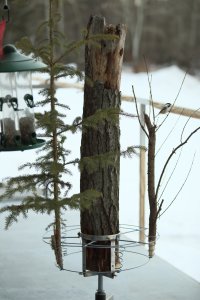
Here is the newest addition that I'm excited about. Plan to add set screws above each receptacle and that'll be it. A very tedious job it was yesterday, holding pieces in place with one hand and welding with the other - a bit haywire but surprisingly straight considering. The big loops are surplus 3/16" diameter welding wire that's almost like spring steel. A labor of love.

I've posted this thinking that there may be others that will get similar ideas and benefit.

Jack
 

Attachments

  • More props_1494.JPG
    More props_1494.JPG
    718 KB · Views: 665
Upvote 0
Great Grey Owl

GGO1.jpg


GGO2.jpg
 
Upvote 0
Thanks Skatol,

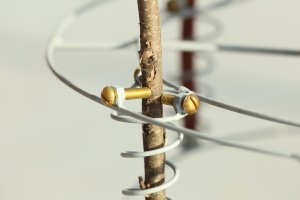
That seems to be the consensus from a couple others close to home. I'm thrilled with the quick change aspect now that a tedious two days of work is over. Have added screw clamps to three recepticals so branches stay in place and removed the excess hight of the vertical tube. My projects take form based on scrap I have (nothing purchased) and my welding experience, but I'm sure the same idea could be accomplished by a handiman another way. Sure has made me more enthusiastic - all thanks to CR folk! ;)

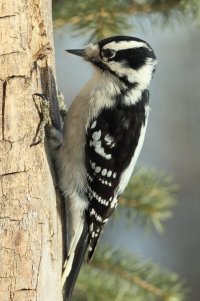
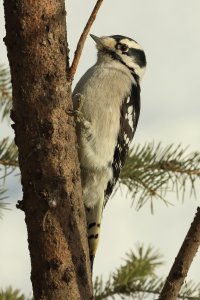
Here's one of the side props and a shot of the clamp.

Jack
 

Attachments

  • Downy_F_prop_1573.JPG
    Downy_F_prop_1573.JPG
    821.5 KB · Views: 583
  • clamp_1547.JPG
    clamp_1547.JPG
    348 KB · Views: 612
Upvote 0
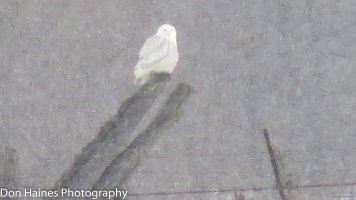
Snowy Owl, 650 meters away, taken with an SX-50 in "green box" mode, 50X zoom and 4X digital zoom (equivalent of 4800mm !), handheld, in poor light, in a snowstorm.... and heavily cropped to boot....

The IQ is so bad that this is art :)
 

Attachments

  • IMG_1004.jpg
    IMG_1004.jpg
    204.2 KB · Views: 591
Upvote 0
Jack Douglas said:
Thanks Skatol,

That seems to be the consensus from a couple others close to home. I'm thrilled with the quick change aspect now that a tedious two days of work is over. Have added screw clamps to three recepticals so branches stay in place and removed the excess hight of the vertical tube. My projects take form based on scrap I have (nothing purchased) and my welding experience, but I'm sure the same idea could be accomplished by a handiman another way. Sure has made me more enthusiastic - all thanks to CR folk! ;)

Here's one of the side props and a shot of the clamp.

Jack

You, Jrista and Don have inspired both in your images and your handiwork!
Now, I am looking for a stump in the middle of Houston...
 
Upvote 0
Jack Douglas said:
Thanks Skatol,

That seems to be the consensus from a couple others close to home. I'm thrilled with the quick change aspect now that a tedious two days of work is over. Have added screw clamps to three recepticals so branches stay in place and removed the excess hight of the vertical tube. My projects take form based on scrap I have (nothing purchased) and my welding experience, but I'm sure the same idea could be accomplished by a handiman another way. Sure has made me more enthusiastic - all thanks to CR folk! ;)

Here's one of the side props and a shot of the clamp.

Jack

Sweet stuff, man! I love those little branch holders. That welding skill of yours is incredibly handy! :)

One recommendation...try creating some of those holders such that you can hold branches parallel to the ground. Well, not exactly parallel...pointed upwards by a small angle, maybe 10-20°. The general idea with setups is that you create the perch the birds will rest on, then you surround that one perch with more stuff to create an interesting depth of field.

Lets take a pine branch with multiple fronds, held maybe 12° above parallel to the ground, a few feet up. You then either place that maybe 10-15 feet or so in front of actual pine trees for a nice blurry pine-green backdrop, or if you don't have that option, then you could use your vertical branch holders and a bunch more pine branches to create that backdrop. Array them out in a cone behind your branch, at a great enough distance to appropriately blur into creamy pine-green boke...and there you have it. Perfect chickadee perch! :D

Oh, and the real trick is to get the Chickadees to land just on your perch. There are a few things you need to do in order to encourage that. First, close off or take indoors ALL your other feeders. Then, set up some small open tray feeders a foot or so below your horizontal branch(es). You might want to set out a few feeders with different types of seed underneath multiple branches of differing kinds with different background setups to attract a wider variety of birds to a greater variety of perch setups. Since you have these small trays, preferably with covers that have a small hole cut into them that would effectively only allow one bird at a time to find and pull out a seed...you force the birds to queue up on the branches, waiting their turn. THOSE are your moments, when the birds are all queued up.

(It is actually quite amazing, birds are EXCELLENT at waiting patiently for their turn and sharing! Of course, every so often a squabble erupts, but then they go right back to patiently waiting on your setup branches until they have their turn at the feeder trays. :D)
 
Upvote 0
Don Haines said:
The IQ is so bad that this is art :)
;D ;D ;D ... good one! ... one small question, what is your opinion on the SX50 ... thinking of getting one as the price seems to be very reasonable (under $350 now) ... I was thinking more for some short videos of birds perched far away on trees, bushes etc in good lighting conditions ... what do you think of its IQ?
 
Upvote 0