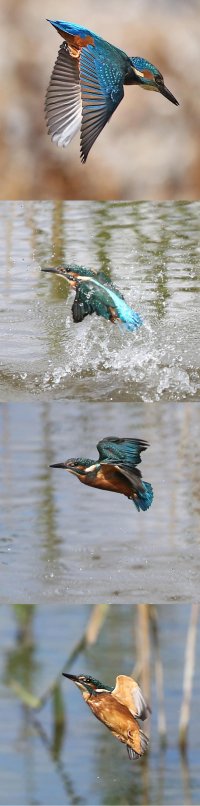
Show your Bird Portraits

A very nice shot, there BobG.
If you think an hour is a long time, then my wife will correct you on that ;D
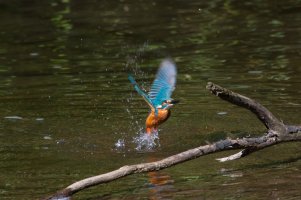
As for getting shots coming out of the water, reaction time is everything and there is no substitute for that! Well, there is if you buy these laser triggers and bait the water with a submerged bucket of fish...

My only tactic was when they were perched I took a guess at where they would dive and pre-focussed on that point so the camera focus time was reduced, so when they dived I could quickly focus on the point they hit the water. I also practiced like crazy on picking an object and seeing if I could put the camera to my eye and have the centre spot right on it.
What camera and lens are you using? When I got my 7D2 to replace the 7D I was hoping that case 5 may have helped (focus on things entering the focus area - in this case, emerging from the water) but that year our kingfishers went all shy and I hardly saw them, so there are potentially ways the gear can help.

I see you are using a 40D (so the AF area option is out for you) but also the 600mm f4L - that gives you a very narrow field of view so getting them in frame is harder and you may be better using a 400mm lens to make it easier to get them in the VF.

Your settings were f4.5, 1/500 and ISO 320.
With a 600mm lens your DOF is thin - I would try and get f8 as an absolute minimum and shutter speed over 1/1500.
The shot below was f8 at 560m (100-400 with 1.4tx), 1/750 at ISO 800 on the 7D MkI (not far removed from from the 40D in ISO capacity). You can see the splash is in focus but the tip of the beak isn't so f4.5 on 600mm will be even shallower DOF. At 1/750 the wings are a blur so focus is critical - the wing blur may not matter but these critters move fast and if your panning is not top-notch their movement across the frame will blur them.

Obviously if light is a premium then attempting with the setting you have is better than nothing but I would put ISO to at least 1600 with shutter speed at 1/1000 minimum and let the aperture fall where it may.

Oh...and enjoy the environment while waiting for the blighters to show up and do something!

 

Attachments

  • Kingfisher emerging-101.JPG
    Kingfisher emerging-101.JPG
    373.5 KB · Views: 96
Upvote 0
Bob and Mike your photos are very nice. The closest encounter with kingfisher flying - in close distance because I have one or two so far away that they are not worth mentioning - just barely enabled me to see that ... it was a king fisher. I was shooting happily flamingos with my camera/lens on tripod and I just saw a kingfisher flying very low close to water surface. Needless to say I just had time to ... just open my mouth with excitement ;D
 
Upvote 0
We had a very rare occasion last year, when a kingfishier couple nested by a river close by. Unfortunately it was fishing on the other side of the river and even with 1.200mm it was too far away, so no images worth having.

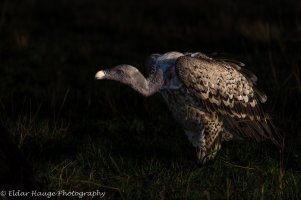
This is a white backed vulture, waiting for access to the remains of a gnu.
 

Attachments

  • _V4I6127-2.jpg
    _V4I6127-2.jpg
    2.3 MB · Views: 96
Upvote 0
AlanF said:
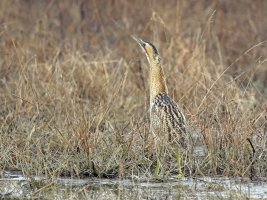
Great shot of a bittern. It is very rare to get one that well.

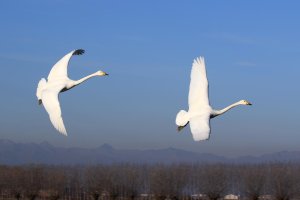
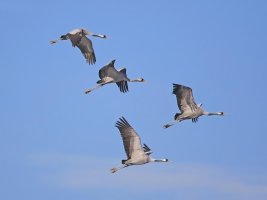
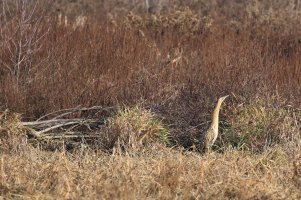
At Racconigi (Cuneo, Piemonte, Italy) there is a famous center for recovery and reintroduction of the Storks, formed by a wide marsh with many small wooden huts.
The Bittern goes all around a couple of times a day to inspect the territory, even in the full (winter) sun .
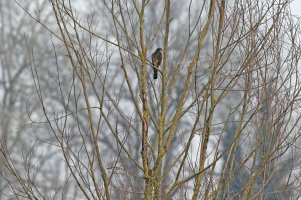
It's also possible to photograph (with lots of patience) Cranes, Herons and many other birds of the wet zone (As the Sparrow-hawk) in full freedom.
 

Attachments

  • Immagine 293modG.jpg
    Immagine 293modG.jpg
    49.1 KB · Views: 86
  • Immagine 173mod.jpg
    Immagine 173mod.jpg
    50.3 KB · Views: 86
  • Immagine 050modG2.jpg
    Immagine 050modG2.jpg
    133.9 KB · Views: 78
  • BH3A8876mod.jpg
    BH3A8876mod.jpg
    339.8 KB · Views: 83
  • BH3A8949mod.jpg
    BH3A8949mod.jpg
    262 KB · Views: 76
  • BH3A8838mod.jpg
    BH3A8838mod.jpg
    352.9 KB · Views: 75
Upvote 0
Lovely Kingfisher, Bob!

Here's a very not-amused American robin from a camping trip with my sons last summer. It hung around the campsite cleaning up my sons' crumbs and scraps.

51083e703dae442159bc2394de9a1f1f
 
Upvote 0
GP.Masserano said:
At Racconigi (Cuneo, Piemonte, Italy) there is a famous center for recovery and reintroduction of the Storks, formed by a wide marsh with many small wooden huts.
The Bittern goes all around a couple of times a day to inspect the territory, even in the full (winter) sun .
It's also possible to photograph (with lots of patience) Cranes, Herons and many other birds of the wet zone (As the Sparrow-hawk) in full freedom.

Very nice series. I especially like the 5th picture. Well done, GP.Masserano.
 
Upvote 0
Mikehit said:
A very nice shot, there BobG.
If you think an hour is a long time, then my wife will correct you on that ;D
As for getting shots coming out of the water, reaction time is everything and there is no substitute for that! Well, there is if you buy these laser triggers and bait the water with a submerged bucket of fish...

My only tactic was when they were perched I took a guess at where they would dive and pre-focussed on that point so the camera focus time was reduced, so when they dived I could quickly focus on the point they hit the water. I also practiced like crazy on picking an object and seeing if I could put the camera to my eye and have the centre spot right on it.
What camera and lens are you using? When I got my 7D2 to replace the 7D I was hoping that case 5 may have helped (focus on things entering the focus area - in this case, emerging from the water) but that year our kingfishers went all shy and I hardly saw them, so there are potentially ways the gear can help.

I see you are using a 40D (so the AF area option is out for you) but also the 600mm f4L - that gives you a very narrow field of view so getting them in frame is harder and you may be better using a 400mm lens to make it easier to get them in the VF.

Your settings were f4.5, 1/500 and ISO 320.
With a 600mm lens your DOF is thin - I would try and get f8 as an absolute minimum and shutter speed over 1/1500.
The shot below was f8 at 560m (100-400 with 1.4tx), 1/750 at ISO 800 on the 7D MkI (not far removed from from the 40D in ISO capacity). You can see the splash is in focus but the tip of the beak isn't so f4.5 on 600mm will be even shallower DOF. At 1/750 the wings are a blur so focus is critical - the wing blur may not matter but these critters move fast and if your panning is not top-notch their movement across the frame will blur them.

Obviously if light is a premium then attempting with the setting you have is better than nothing but I would put ISO to at least 1600 with shutter speed at 1/1000 minimum and let the aperture fall where it may.

Oh...and enjoy the environment while waiting for the blighters to show up and do something!

I got everything wrong for my one set of shots of a kingfisher diving. Well, by mistake I had my 5DIII and 300mm f/2.8 + 1.4xTC instead of 2x, and then it was set to jpeg rather than raw. Here is a collage of successive shots, each of which is a 900x900 crop from the original. In retrospect, the 1.4xTC gave twice the shutter speed and faster focussing, so perhaps not all bad.
 

Attachments

  • KingfisherDiving and Leaving_Collage.jpg
    KingfisherDiving and Leaving_Collage.jpg
    301.2 KB · Views: 92
Upvote 0
Mikehit said:
An excellent quality series, there Alan.

Thanks Mike, Alan
Great shots, that's just the sort of thing I was after. I've got a 100-400, so I'll give that a try at the weekend. I didn't have it with me last week and I did miss it because a few times the kingfisher came inside the 600's minimum focus. Hopefully the bird will be back as well :)
 
Upvote 0
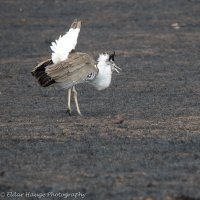
The world´s heaviest bird, who can actually fly, is the Kori Bustard, weighing in at around 45/21 pound/kilo. This is a male showing off his impressive feathers, on a part of the Ngorongoro crater floor, where the grass has been burned. This is part of an ecological burning program, which entails annual or biannual controlled burns of up to 20 percent of the grasslands, to improve future growth.
 

Attachments

  • _V4I8619.jpg
    _V4I8619.jpg
    3.4 MB · Views: 89
Upvote 0
Eldar said:
The world´s heaviest bird, who can actually fly, is the Kori Bustard, weighing in at around 45/21 pound/kilo. This is a male showing off his impressive feathers, on a part of the Ngorongoro crater floor, where the grass has been burned. This is part of an ecological burning program, which entails annual or biannual controlled burns of up to 20 percent of the grasslands, to improve future growth.

Great shot as usual, Eldar!
A bird that it's very hard to guess how big it is. That weight is about twice that of a common Swan! Impressive! Trying to figure out what it would like in an oven - knowing how crammed it can be with a goose or turkey stuffed into it.

Natural or controlled fires is a necessity for quite a few species: Birds, insects as well as plants. Hopefully this is a species that will be around long enough for me to one day be able to see it.
 
Upvote 0
DominoDude said:
Eldar said:
The world´s heaviest bird, who can actually fly, is the Kori Bustard, weighing in at around 45/21 pound/kilo. This is a male showing off his impressive feathers, on a part of the Ngorongoro crater floor, where the grass has been burned. This is part of an ecological burning program, which entails annual or biannual controlled burns of up to 20 percent of the grasslands, to improve future growth.

Great shot as usual, Eldar!
A bird that it's very hard to guess how big it is. That weight is about twice that of a common Swan! Impressive! Trying to figure out what it would like in an oven - knowing how crammed it can be with a goose or turkey stuffed into it.

Natural or controlled fires is a necessity for quite a few species: Birds, insects as well as plants. Hopefully this is a species that will be around long enough for me to one day be able to see it.

+1

Jack
 
Upvote 0