




Upvote
0
You are using an out of date browser. It may not display this or other websites correctly.
You should upgrade or use an alternative browser.
You should upgrade or use an alternative browser.
Show your Bird Portraits
- Thread starter 1982chris911
- Start date

For some reason, our neighborhood's female Cardinals played hard-to-get for me and my 5DMkIII/100-400II+1.4XIII set-up during the 2023 calendar year.
But in March 2024, love is in the air.
13 seconds elapsed between the two images that follow:


...the young lady seems to staring intently at the guy (Love In Action!?) before flying off together.

But in March 2024, love is in the air.
13 seconds elapsed between the two images that follow:
...the young lady seems to staring intently at the guy (Love In Action!?) before flying off together.

Upvote
0



I’m curious regarding using the EVF to judge accurate exposure, something that seems to lend itself to efficient use of the Fv mode. How much do the higher model EVFs improve this ? The only FF EVF camera I had was the RP (excluding a brief and unsatisfactory relationship with a Sony 7) and I didn’t find that cameras viewfinder brilliant for judging accurate exposure. The RP is a budget model; I’d be interested to know the views of someone who has experience with both low end and high end FF mirrorless cameras such as @neuroanatomist to see if seeing the exposure accurately is another benefit of the higher end EVFs.I've been tantalised by Siskins trying to get a shot, but managed yesterday (800mm). (@Sporgon - an example of my getting the right exposure for heavily backlit by dialing +2.3 ev to the exposure just by judging through the viewfinder).
View attachment 215353View attachment 215354
Upvote
0
Sporgon: can you define 'accurate exposure' in terms of your own particular usage?I’m curious regarding using the EVF to judge accurate exposure, something that seems to lend itself to efficient use of the Fv mode. How much do the higher model EVFs improve this ? The only FF EVF camera I had was the RP (excluding a brief and unsatisfactory relationship with a Sony 7) and I didn’t find that cameras viewfinder brilliant for judging accurate exposure. The RP is a budget model; I’d be interested to know the views of someone who has experience with both low end and high end FF mirrorless cameras such as @neuroanatomist to see if seeing the exposure accurately is another benefit of the higher end EVFs.
I have a quite distinct memory at my amazement at the effectiveness of utilizing the tiny wheel on the back of a Canon S95 to rapidly adjust exposure compensation while attending several rock concerts...concerts at which we had front-row (or near front-row) seats...concerts at which the lighting changes were extreme.
This was nearly 15 years ago. The tiny 'low-res' LCD screen on the S95 was more than adequate for my own 'accurate exposure'.
Upvote
0
It doesn't have to be particularly "accurate". If it's backlit then you don't get bleached highlights if you overexpose a bit, and so there is plenty of latitude to correct RAW in post. It so happens 2.3ev was pretty much spot on. If I was using a DSLR and OVF, I would have guessed 1.7ev from experience. 0.6ev is trivial to push in post. Here's a shot I grossly under exposed and pushed through 2.3 ev in post processing, before I twiddled +2.3 during shooting. On the other hand, if you shoot jpegs, then you have to get it right.I’m curious regarding using the EVF to judge accurate exposure, something that seems to lend itself to efficient use of the Fv mode. How much do the higher model EVFs improve this ? The only FF EVF camera I had was the RP (excluding a brief and unsatisfactory relationship with a Sony 7) and I didn’t find that cameras viewfinder brilliant for judging accurate exposure. The RP is a budget model; I’d be interested to know the views of someone who has experience with both low end and high end FF mirrorless cameras such as @neuroanatomist to see if seeing the exposure accurately is another benefit of the higher end EVFs.

 .
.
Upvote
0
Well I suppose my definition in this sense is to be able to optimise exposure to save highlights and shadow detail at the same time. For this I found the RP’s EVF unsatisfactory, but I thought that would be as much to do with the 8 bit jpeg rendering as it was the limitations of the EVF. If it’s just a consequence of the former then a better EVF won’t help whilst it’s displaying 8 bit jpeg images.Sporgon: can you define 'accurate exposure' in terms of your own particular usage?
I have a quite distinct memory at my amazement at the effectiveness of utilizing the tiny wheel on the back of a Canon S95 to rapidly adjust exposure compensation while attending several rock concerts...concerts at which we had front-row (or near front-row) seats...concerts at which the lighting changes were extreme.
This was nearly 15 years ago. The tiny 'low-res' LCD screen on the S95 was more than adequate for my own 'accurate exposure'.
Upvote
0
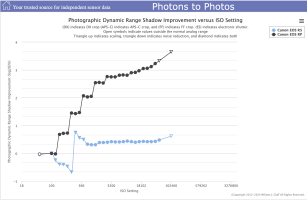
The R5, which I use, is basically isoinvariant from about iso 600-700 onwards. What that means is there is the same shadow detail after pushing in post processing an underexposed image than there is in getting the exposure right. On the other hand, the RP's sensor loses shadow detail horribly in pushing. I tend to use a base iso of 800-1000 so to be in the isoinvariant region. Here are are the shadow improvement plots from photons to photos. Maybe your problems were with the RP's sensor and not the EVF.Well I suppose my definition in this sense is to be able to optimise exposure to save highlights and shadow detail at the same time. For this I found the RP’s EVF unsatisfactory, but I thought that would be as much to do with the 8 bit jpeg rendering as it was the limitations of the EVF. If it’s just a consequence of the former then a better EVF won’t help whilst it’s displaying 8 bit jpeg images.
Upvote
0

What a great example. DR is something Canon sensors can handle now - for sureIt doesn't have to be particularly "accurate". If it's backlit then you don't get bleached highlights if you overexpose a bit, and so there is plenty of latitude to correct RAW in post. It so happens 2.3ev was pretty much spot on. If I was using a DSLR and OVF, I would have guessed 1.7ev from experience. 0.6ev is trivial to push in post. Here's a shot I grossly under exposed and pushed through 2.3 ev in post processing, before I twiddled +2.3 during shooting. On the other hand, if you shoot jpegs, then you have to get it right.

Upvote
0




The EVFs of the EOS RP and EOS R fail in high contrast situations, much less the R5 and R3 EVFs. This is a field where a major progress has been achieved, even though an OVF beats them all. But the EVF has other advantages, as you know.Well I suppose my definition in this sense is to be able to optimise exposure to save highlights and shadow detail at the same time. For this I found the RP’s EVF unsatisfactory, but I thought that would be as much to do with the 8 bit jpeg rendering as it was the limitations of the EVF. If it’s just a consequence of the former then a better EVF won’t help whilst it’s displaying 8 bit jpeg images.
Upvote
0



Thanks! Most of these are Sony A1 + 200-600mm. I think the last one was Nikon Z9 + 400mm F/4.5. You can see full exifs and geotags on Flickr if you click on the photos.Lovely shots! What body and lens(es) did you use?
Upvote
0
Thank you, ISv! Yes, I loved my Canon R5 (as well as 5Dm3/4 before). They are excellent cameras, but I started to look in different directions mostly because of lenses. EF 100-400 and RF 100-500 are too short and too slow for me. What I need is a reasonably fast lens in the 600-800mm range. I hope I'll be back to Canon (whatever will be available on the market) when I retire and leave this lovely desert.ISv: Non Canon as he says! But he has the same quality photos with Canon equipment too! Very consistent in what he is doing (well, I'm talking photos since I don't know him in the "normal" live)!
Upvote
0
Put the RF 100-500 on the R7 and it is a match for the RF 200-800mm on the R5. I took the R7 combo out today for the first time for a couple of months - 800g lighter than the R5/200-800m - and caught a Siskin close to home, dining on an alder. Then, lunch for me.Thank you, ISv! Yes, I loved my Canon R5 (as well as 5Dm3/4 before). They are excellent cameras, but I started to look in different directions mostly because of lenses. EF 100-400 and RF 100-500 are too short and too slow for me. What I need is a reasonably fast lens in the 600-800mm range. I hope I'll be back to Canon (whatever will be available on the market) when I retire and leave this lovely desert.


Upvote
0






These are fun to watch and you got them right! Taking photos of them sometimes is not easy...R5 + RF 100-500L @ 1/4000s, f/7.1
View attachment 215418
View attachment 215417
View attachment 215419
View attachment 215420
Upvote
0





Similar threads

- Replies
- 118
- Views
- 99K
