The 1-inch Sensor Myth (Fraud?)

I agree with Ken Rockwell on this one. 1 inch sensors are a fraud because it's clearly misleading since none of dimensions are even close to 1 inch.

If it was up to me, camera manufacturers should immediately rename the sensor size to something more realistic. In addition to that, every person who bought a 1 inch sensor camera in the past 2 years should be entitled to choose between a full refund or a replacement for a camera with a sensor that is actually at least 1 inch in it's diagonal.

This reminds me of the 4k screens. When it was 1080p, the 1080 was the number of vertical pixels on the screen. To keep consistency, 4k displays should be actually called 2160p. Even if they count the horizontal pixels, it's actually 3840 (with few exceptions) which is still less than 4000.

Corporations should not be allowed to sell stuff with misleading names and labels, I can't believe that some people don't see anything wrong with 1 inch sensors.
 
Upvote 0
Mancubus said:
If it was up to me, camera manufacturers should immediately rename the sensor size to something more realistic. In addition to that, every person who bought a 1 inch sensor camera in the past 2 years should be entitled to choose between a full refund or a replacement for a camera with a sensor that is actually at least 1 inch in it's diagonal.

Lol. Next, Canon should refund everyone who's ever bought an APS-C camera 10% of their purchase price because Canon's APS-C is 10% smaller than Nikon's APS-C.

How much do car manufacturers owe you because you don't get the gas mileage promised by the EPA label?

Read my lips, no new taxes.

We get it, it's someone else's fault you didn't read the fine print.
 
Upvote 0
Mancubus said:
I agree with Ken Rockwell on this one. 1 inch sensors are a fraud because it's clearly misleading since none of dimensions are even close to 1 inch.

Can I get my money back for all the 135 format film I bought? It's nowhere close to 135mm or inches, even along the perimeter.
 
Upvote 0
neuroanatomist said:
Mancubus said:
If it was up to me, camera manufacturers should immediately rename the sensor size to something more realistic. In addition to that, every person who bought a 1 inch sensor camera in the past 2 years should be entitled to choose between a full refund or a replacement for a camera with a sensor that is actually at least 1 inch in it's diagonal.

Lol. Next, Canon should refund everyone who's ever bought an APS-C camera 10% of their purchase price because Canon's APS-C is 10% smaller than Nikon's APS-C.

How much do car manufacturers owe you because you don't get the gas mileage promised by the EPA label?

Read my lips, no new taxes.

We get it, it's someone else's fault you didn't read the fine print.

for that matter not even the 1.5 crop ones are as big as an APS-C (3:2 ratio) film frame, so they all owe us money
 
Upvote 0
Mt Spokane Photography said:
This is no different from the 2/3 in sensor. Its been the standard way for 50 years of describing the P&S Sensors and consistent with all other P&S Cameras.

I suppose that some do not understand how P&S sensors are specified and re-discover it over and over.

DSLR's use a different method to describe sensor size but even APS-C sensors are not a standard size.

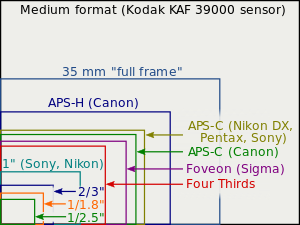
300px-Sensor_sizes_overlaid_inside.svg.png

From where I photograph, this is much ado about nothing. 1" is just a name to me. I care about IQ. I know that a larger sensor of high quality and many pixels will provide a better image that a lesser one. I can see by the graphic that 1" is generally going to be better than 1/1.8, but not as good as APS-C or full frame.

I shoot 1", 1.5", APS-c, and FF cameras, but not 1/1.8, because I didn't like the results I got from a G9. While I accept that I won't have a 6 X 4.5 again, today's FF is adequate for the landscapes I shoot and print, APS-C is useful for wildlife, and 1" and 1.5" are easy to travel with and photograph family events. I hope that Canon improves the sensor in the G1X Mk2, because the camera it comes in is easy to travel with and has a good lens, but I'm not holding my breath. 1" seems to be where companies are putting energy into because it differentiates them from phones, so I expect to see more progress in IQ.

If I want more data to back up those conclusions, I will take the actual measurements of the sensor dimensions of each, perform some calculations, and graph the results. 1" is just a name.
 
Upvote 0
neuroanatomist said:
monkey44 said:
Kinda reminds me of buying a 2x4 at the lumber yard, and measuring it when you get it home. 1-1/2" x 3-1/2" is the actual size today.

Years ago, when rough-sawn was the norm, the actual dimension was 2" x 4", but as the milling changed, the dimensions changed. It first went to 1-5/8 x 3-5/8, then shaved off to 1-1/2 x 3-1/2 ... but pricing per board foot still counts it as 2 x 4 when calculating $$$$...

Sure, and if you take the pseudobeefpinkslime patty from a McD 'Quarter Pounder' and weigh it, it's not 4 oz after they give it to you.

The point remains, people who care about such things can look up the details.

And the only reason builders cared was because it threw off the layout we had memorized over the years. But, we knew it, adjusted for it, and moved on ... course, the price remained the same, but the code said: 2x4, and the invoice said, 2x4 and the house still came out looking the same ... so, it's about using what the "label' says, and using it properly according to your training. If the sensor is really 3/4" and you've been shooting with a 3/4", nothing changes just because you suddenly realize what you read on the label it's different - you don't change your technique because of the label.

In fact, I never even look at the sensor size with any frame of reference except one is larger than another - but I learn what the camera will produce by looking at the results, not reading the tech specs. Nice to know specs, but the specs do less for the shot than the experience you get shooting with it.
 
Upvote 0
neuroanatomist said:
Mancubus said:
If it was up to me, camera manufacturers should immediately rename the sensor size to something more realistic. In addition to that, every person who bought a 1 inch sensor camera in the past 2 years should be entitled to choose between a full refund or a replacement for a camera with a sensor that is actually at least 1 inch in it's diagonal.

Lol. Next, Canon should refund everyone who's ever bought an APS-C camera 10% of their purchase price because Canon's APS-C is 10% smaller than Nikon's APS-C.

How much do car manufacturers owe you because you don't get the gas mileage promised by the EPA label?

It's not the same thing. APS-C does not mean X mm by Y mm.

The gas mileage is subject to many variables that can affect the consumption, it might even be better than the specs. However, under no circumstances the 1 inch sensor will actually have 1 inch, this is why I call it a fraud.
 
Upvote 0
Mancubus said:
neuroanatomist said:
Mancubus said:
If it was up to me, camera manufacturers should immediately rename the sensor size to something more realistic. In addition to that, every person who bought a 1 inch sensor camera in the past 2 years should be entitled to choose between a full refund or a replacement for a camera with a sensor that is actually at least 1 inch in it's diagonal.

Lol. Next, Canon should refund everyone who's ever bought an APS-C camera 10% of their purchase price because Canon's APS-C is 10% smaller than Nikon's APS-C.

How much do car manufacturers owe you because you don't get the gas mileage promised by the EPA label?

It's not the same thing. APS-C does not mean X mm by Y mm.

The gas mileage is subject to many variables that can affect the consumption, it might even be better than the specs. However, under no circumstances the 1 inch sensor will actually have 1 inch, this is why I call it a fraud.

APS-C means 25.1 x 16.7mm , or at least it used to until digital.
 
Upvote 0
O.K. I agree performance is far more important than labels. However, I think most folks here would be upset if the new 70-200 mm f2.8 zoom they bought turned out to be only 40-120 mm at f3.5! Maybe not?!

At MFD most 70-200's other than Canon seem to fall way short (typically 135-150mm due to focus breathing) and there doesn't appear to be a global revolt. So it seems many people just don't notice or care?

Manufacturers do tend to keep most lenses to within about 10% of the stated values for FL (at infinity) and aperture (f-stop, not T-stop). But I don't know any that "promise" to be that close. There's probably an ISO standard for those however.
 
Upvote 0
Can I get my money back for all the 135 format film I bought? It's nowhere close to 135mm or inches, even along the perimeter.
[/quote]

I assume your just kidding, but nice try, but no one ever said it was 135 mm film. 135 is the Kodak assigned number for the packaging of dual sprocket 35mm film in cassettes of typically 24 or 36 exposures. The Kodak numbers had nothing to do with the dimension of the film as far as I know. Common still today is 120 roll film while most of the others have faded into history. (108, 110, 126, 828, 620, 127, etc. all long ago favorites I used at some point.)
 
Upvote 0
Mancubus said:
It's not the same thing. APS-C does not mean X mm by Y mm.

The gas mileage is subject to many variables that can affect the consumption, it might even be better than the specs. However, under no circumstances the 1 inch sensor will actually have 1 inch, this is why I call it a fraud.

It's exactly the same thing.

Which measured physical dimension of Canon's 35mm f/1.4L II lens is 35.0 mm - length? width? diameter?

Ever taken a vitamin supplement? Why does 100 International Units (IU) of vitamins A, C, D, and E represent wildly different actual physical amounts of each molecule?

We define a convention and stick to it, unless and until it is changed. If you need to know that 100 IU of vitamin C is 5 mg of ascorbic acid, you can look it up.
 
Upvote 0
old-pr-pix said:
Can I get my money back for all the 135 format film I bought? It's nowhere close to 135mm or inches, even along the perimeter.

I assume your just kidding, but nice try, but no one ever said it was 135 mm film. 135 is the Kodak assigned number for the packaging of dual sprocket 35mm film in cassettes of typically 24 or 36 exposures. The Kodak numbers had nothing to do with the dimension of the film as far as I know. Common still today is 120 roll film while most of the others have faded into history. (108, 110, 126, 828, 620, 127, etc. all long ago favorites I used at some point.)

I'm half kidding. Point being, just like nobody said 135-format was 135mm film, nobody ever said a 1"-format sensor had any linear 1" dimensions. It's the name of the format.
 
Upvote 0
They could call it a 'barleycorn' or a 'shaftment' sensor because those measures have nothing to do with the imaging area, either. Or a 'pole sensor'. Using an inch in the name really leads all but the Enlightened to think that there is something related to 25.4 millimetres in that object while there isn't.
It would be nice if they'd start using square millimetres in these things so that they would actually give regular people something to go by. Of course it is cool to know the modern monk latin and be In The Know while others aren't.
But caveat emptor and canem also. Could Coca-Cola call their 1.5 litre bottle a 'gallon on Coke'. No way? And why not? Because women do most of the household shopping and they would not tolerate that kind of BS. Men do.
 
Upvote 0
martti said:
They could call it a 'barleycorn' or a 'shaftment' sensor because those measures have nothing to do with the imaging area, either. Or a 'pole sensor'. Using an inch in the name really leads all but the Enlightened to think that there is something related to 25.4 millimetres in that object while there isn't.
It would be nice if they'd start using square millimetres in these things so that they would actually give regular people something to go by. Of course it is cool to know the modern monk latin and be In The Know while others aren't.
But caveat emptor and canem also. Could Coca-Cola call their 1.5 litre bottle a 'gallon on Coke'. No way? And why not? Because women do most of the household shopping and they would not tolerate that kind of BS. Men do.

Anyone who cares what size the sensor in their camera is, knows what a 1" sensor means, or will find out in their research prior to purchasing. It's just such a non-issue.

I highly doubt a single person in the history of digital camera purchasing, has heard a camera had a 1" sensor and immediately thought:

"By golly, that's probably 25.4mm wide which makes it bigger than an APS-C sensor camera that's a few mm smaller! TAKE MY MONEY PLEASE"
 
Upvote 0
To beat the dead horse... here is a quote directly from the Canon marketing material for the G9 X:

"At 1.0 inch, the image sensor on the PowerShot G9 X camera is larger than the ones on most other compact cameras. This allows it to capture a greater range of light, so bright areas of the image, like clouds on a sunny day, can be more detailed and less likely to be washed or blown out... The 20.2 Megapixel* resolution is outstandingly high, giving you the option of printing out bigger photos or cropping in to highlight the best part."

And, from the detailed specifications: "Image Capture Device - Type 20.2 Megapixel*, 1.0-inch CMOS (sensor aspect ratio: 3:2) *Image processing may cause a decrease in the number of pixels."

Even the Specification section of the user manual (p. 204) declines to identify the actual dimensions of the sensor defining instead: 'Image size - 1.0 type'"

I can find no information in the Canon material for this camera that admits to the sensor being 13.2 mm x 8.8 mm, although the DPReview clearly states that as its size. (The presumed industry standard for 1" size vacuum tube sensor would be 16mm on the diagonal, so this sensor at 15.86 mm diagonal is 'close enough.') If Canon does disclose the actual dimensions it is buried somewhere I haven't found.

To me it is clear that Canon wants to mislead potential buyers into believing this camera's sensor is somehow 1" in dimension. Technically, by constantly referring to it as "1.0 inch" they are also implying a certain level of accuracy in that dimension. 1 inch is an approximation. "1.0 inch" should be a much more accurate measurement.
 
Upvote 0
old-pr-pix said:
To beat the dead horse... here is a quote directly from the Canon marketing material for the G9 X:

"At 1.0 inch, the image sensor on the PowerShot G9 X camera is larger than the ones on most other compact cameras. This allows it to capture a greater range of light, so bright areas of the image, like clouds on a sunny day, can be more detailed and less likely to be washed or blown out... The 20.2 Megapixel* resolution is outstandingly high, giving you the option of printing out bigger photos or cropping in to highlight the best part."

And, from the detailed specifications: "Image Capture Device - Type 20.2 Megapixel*, 1.0-inch CMOS (sensor aspect ratio: 3:2) *Image processing may cause a decrease in the number of pixels."

Even the Specification section of the user manual (p. 204) declines to identify the actual dimensions of the sensor defining instead: 'Image size - 1.0 type'"

I can find no information in the Canon material for this camera that admits to the sensor being 13.2 mm x 8.8 mm, although the DPReview clearly states that as its size. (The presumed industry standard for 1" size vacuum tube sensor would be 16mm on the diagonal, so this sensor at 15.86 mm diagonal is 'close enough.') If Canon does disclose the actual dimensions it is buried somewhere I haven't found.

To me it is clear that Canon wants to mislead potential buyers into believing this camera's sensor is somehow 1" in dimension. Technically, by constantly referring to it as "1.0 inch" they are also implying a certain level of accuracy in that dimension. 1 inch is an approximation. "1.0 inch" should be a much more accurate measurement.

By compact cameras, do they mean smart phones?
 
Upvote 0
tr573 said:
Anyone who cares what size the sensor in their camera is, knows what a 1" sensor means, or will find out in their research prior to purchasing. It's just such a non-issue.

Unless you're a writer for CNET.
http://www.cnet.com/uk/products/sigma-sd-quattro/

the sd Quattro H uses the same sensor technology in the larger APS-H format, which has a focal-length equivalent of 1.3x of full frame, about the same size as the 1.5-inch sensor Canon uses in its G1 X series.
 
Upvote 0
neuroanatomist said:
Mancubus said:
If it was up to me, camera manufacturers should immediately rename the sensor size to something more realistic. In addition to that, every person who bought a 1 inch sensor camera in the past 2 years should be entitled to choose between a full refund or a replacement for a camera with a sensor that is actually at least 1 inch in it's diagonal.

Lol. Next, Canon should refund everyone who's ever bought an APS-C camera 10% of their purchase price because Canon's APS-C is 10% smaller than Nikon's APS-C.

How much do car manufacturers owe you because you don't get the gas mileage promised by the EPA label?

Read my lips, no new taxes.

We get it, it's someone else's fault you didn't read the fine print.
the word VW springs to mind
 
Upvote 0
Something very strange happened to my post where I suggested having a 'T' as a unit of the area of a photographic sensor. Like thousands of square millimetres. An 'inch' sensor would be 0.21, 4/3 0.37 and finally FF 0.9.


Or being a bit crude, call the FF 'T' and then the 'inch' sensor a a fifth T and a 4/3 as a third T.

It is just that the manufacturers do not want us to know what the sensor size is.
Ken is right. They are lying.
 
Upvote 0