The Canon EOS-1D X Mark II Coming in at 24mp? [CR2]

Mt Spokane Photography said:
3kramd5 said:
dilbert said:
3kramd5 said:
gregory4000 said:
BSI sensor....probably not, Canon doesn't have the tech.

Probably wouldn't be much of a point. Even at 24MP, you're still in the realm of diminishing returns.

If you look at what Sony have been able to achieve with BSI in the RX100IV, it isn't just IQ that benefits but also sensor readout speed.

Per Sony, the increased readout speed is due to the use of copper wiring rather than aluminum, not due to the location of the wiring layer.

dilbert said:
Canon's "current" process is a .5 micron process. For a 24MP sensor, the pixel pitch is 6 microns. At the very least, the traces around the pixels represents 8.33% of the surface space lost to "wires".

So maybe you could get an 8.33% increase in light gathering between a FSI sensor which lack light guides, etc. But given FSI sensors in canon's SLRs, I assume diminishing returns at 24MP. The 5DS would be a better candidate for BSI.

I think that BSI brings other potential benefits besides the trace situation. There is a serious problem with the inductance of long leads to ground. A ground plane on the back of the sensor could reduce the inductance. High inductance in the leads is one of the barriers to fast readouts, a stacked sensor as in the sony RX10 II goes a step further in reducing inductance and allowing extremely fast readouts.

Canon is well aware of this, and issued a patent years ago. They probably found it expensive or impractical to manufacturer. Canon is very methodical and slow. when they finally do come out with a product, its well thought and tested. Its also way behind some of the competition who are willing to take more risks.

Expensive certainly. Aptina's FSI v BSI white paper has some good info, though it's a bit dated.

I'm not an EE, but couldn't you ground around the perimeter rather than through vias to a ground plane (not argumentative, purely curious)?
 
Upvote 0
Mt Spokane Photography said:
3kramd5 said:
dilbert said:
3kramd5 said:
gregory4000 said:
BSI sensor....probably not, Canon doesn't have the tech.

Probably wouldn't be much of a point. Even at 24MP, you're still in the realm of diminishing returns.

If you look at what Sony have been able to achieve with BSI in the RX100IV, it isn't just IQ that benefits but also sensor readout speed.

Per Sony, the increased readout speed is due to the use of copper wiring rather than aluminum, not due to the location of the wiring layer.

dilbert said:
Canon's "current" process is a .5 micron process. For a 24MP sensor, the pixel pitch is 6 microns. At the very least, the traces around the pixels represents 8.33% of the surface space lost to "wires".

So maybe you could get an 8.33% increase in light gathering between a FSI sensor which lack light guides, etc. But given FSI sensors in canon's SLRs, I assume diminishing returns at 24MP. The 5DS would be a better candidate for BSI.

I think that BSI brings other potential benefits besides the trace situation. There is a serious problem with the inductance of long leads to ground. A ground plane on the back of the sensor could reduce the inductance. High inductance in the leads is one of the barriers to fast readouts, a stacked sensor as in the sony RX10 II goes a step further in reducing inductance and allowing extremely fast readouts.

Canon is well aware of this, and issued a patent years ago. They probably found it expensive or impractical to manufacturer. Canon is very methodical and slow. when they finally do come out with a product, its well thought and tested. Its also way behind some of the competition who are willing to take more risks.


Your making a good point, However Sony's risk on the A7S paid off.
The Panasonic GH4 has Paid off.
If I was a large company, I would be paying close attention to the next big breakthrough and
what the consumers response. Giving what the consumer wants with quality always pays off.
Take Costco instance.
My concern is that maybe it isn't Canon being Methodical or slow, But lagging
in their sensor tech ( as an example ) finding it hard to play catch -up.
To me, Advancements in the sensor tech appears to offer the most noticeable improvements
to a cameras performance. Otherwise, film cameras with great focus and speed would not be
near worthless.
 
Upvote 0
dilbert said:
privatebydesign said:
dilbert said:
unfocused said:
privatebydesign said:
Mdshirajum said:
I mainly shoot weddings and low ISO DR is vital for wedding photographers. If I was a sports photographer, I would have been happy with Canon offerings. But I guess no point explaining that. You fanboys will be trolling anyways.

Can you show me some of your examples where your Canon camera low ISO DR has caused you problems for your wedding shooting?

I'm curious about this as well, especially since this forum was filled with wedding photographers singing the praises of the 5DIII for its low noise at high ISOs when it came out. I don't recall anyone complaining about dynamic range at low ISOs.

Two different aspects of wedding photography.

Low noise high ISO is useful for indoors, at the reception. This is random and unplanned (kind of.)

Low ISO high DR is useful for outdoors, where you're doing set shots/poses. This often involves travelling to specific places chosen by the wedding party after consultation with the photographer. In the past this would have been done with medium format photographers.

They are two very different modes of photography. The former almost anyone can do with a fast lens and a good camera. The latter requires a lot more planning and thought and intimate knowledge on behalf of the photographer about the local landscape, where the sun will be, etc.

Thanks for that Dilbert. So where are your examples of your wedding photography where your Canon low ISO DR has let you down.

Let me refer you to this thread: http://www.canonrumors.com/forum/index.php?topic=24760.0 and the review therein.

Personally, I've deleted all of the wedding shots where DR failed me because they weren't keepers and not shots I could give to the couple.

Also note that he recently reviewed the 5DSR, and that he's no longer interested in the A7RII despite the assumed DR and sensitivity advantages ;)
 
Upvote 0
Will the next 1D use a Sony sensor? I'm gonna go out in a limb... nay a twig... and say no. :P


As for whether the BSI structure versus material selection is the primary driver in readout, I am out of my element, so must defer to what they (Sony) say.
 
Upvote 0
privatebydesign said:
gregory4000 said:
Great, They threw me a bone...
But what else?
BSI sensor....probably not, Canon doesn't have the tech.
How do you know that?

gregory4000 said:
IS sensor ...why when they have me paying extra for 'IS' in every lens I buy
Canon have stated many times the numerous advantages of in lens stabilisation and their commitment to it in the EF line.

gregory4000 said:
Unless Im shooting high action sports or wildlife, Am I really getting a better camera?
If you aren't shooting them then you probably have the wrong camera. Canon can't help buyer ignorance.

gregory4000 said:
ISO will only marginally better which kinda s**ks for a 4 year upgrade.
If you look at the advancement from the competition, its as if Canon is riding on its name for success
and not trying to give us something to WOW over.
Sorry, how high do you want/need to go? It seems to me usable 50,000 iso is a very real advantage over cameras a few years old.

gregory4000 said:
I wanna WOW!!!!
Not a bone

So don't buy one, it doesn't sound like you are in the target market anyway so who cares? Certainly not Canon, or me.

Well, that was polite of you.
I'm sure if Canon introduced a BSI sensor to improve low light performance, you would not knock it.
How about a camera with IS build in. Is that really so bad. Oh, and by the way. A good IS in the camera is Just as effective as in the lens. And if Canon introduced this and stated that theirs was just as effective. Would you criticize this also.
I know you have strong allegiance, but people speaking their wants is never a reason to be rude or say what they say doesn't have merit. It may push a great company to invest in even better improvements.
It certainly can't hurt.
 
Upvote 0
3kramd5 said:
Will the next 1D use a Sony sensor? I'm gonna go out in a limb... nay a twig... and say no. :P


As for whether the BSI structure versus material selection is the primary driver in readout, I am out of my element, so must defer to what they (Sony) say.

Actually, Canon has a patent where they point to basically the same thing, but it gives a much more technical discussion as to why its a issue. Their solution is a BSI sensor with leads feeding thru much like the sony stacked sensor.

Canon can certainly do it, but they are so conservative and spend years checking and double checking that its well established technology by the time they adapt it.
 
Upvote 0
+1

Trolls go home.

Mt Spokane Photography said:
Mdshirajum said:
Unless Canon does something with low ISO DR, they won't get any business from me anymore.... It's time for them to catch up at least!

To all Canon fanboys (before they step in to defend their beloved company), no matter how you defend, I have seen a bunch of fellow photographers switching to something else. You are happy with Canon's offerings? Good for you! But there will be less and less people in your boat. The only thing holding me a bit is the glass lineup. But the way Sigma stepped up, I believe Art lineup will be complete in 2 years and I will have the option to select any body. Good luck Canon :)

Does Sigma pay you to Troll here? (You accuse us of being paid by Canon to post here) You now have 14 posts, all of them trolling and none of them useful or helpful to anyone. If all of your friends are switching, that's fine, they are going to find out that the grass is not always greener, but if they find a system that works for them, that's great. The main reason that different camera companies exist is that one camera or system does not meet the needs of all.

Pro photographers look for a camera that plays well as a system, and consider service support, reliability. If those are of little value to you, and you don't mind waiting for 3 months for a repair, go for it.
 
Upvote 0
Actually, I would love to see your portfolio. You sound like you are the greatest photography expert ever, so your work will certainly be worth a critical look.

Put up or move on bridge troll.


Mdshirajum said:
Mt Spokane Photography said:
Mdshirajum said:
Unless Canon does something with low ISO DR, they won't get any business from me anymore.... It's time for them to catch up at least!

To all Canon fanboys (before they step in to defend their beloved company), no matter how you defend, I have seen a bunch of fellow photographers switching to something else. You are happy with Canon's offerings? Good for you! But there will be less and less people in your boat. The only thing holding me a bit is the glass lineup. But the way Sigma stepped up, I believe Art lineup will be complete in 2 years and I will have the option to select any body. Good luck Canon :)

Does Sigma pay you to Troll here? (You accuse us of being paid by Canon to post here) You now have 14 posts, all of them trolling and none of them useful or helpful to anyone. If all of your friends are switching, that's fine, they are going to find out that the grass is not always greener, but if they find a system that works for them, that's great. The main reason that different camera companies exist is that one camera or system does not meet the needs of all.

Pro photographers look for a camera that plays well as a system, and consider service support, reliability. If those are of little value to you, and you don't mind waiting for 3 months for a repair, go for it.

lol! So Canon bodies have lackings and I'm a troll if I point that out? GREAT! I should ask, does Canon pay you to TROLL here? And wait a min, I am looking trough your posts. Lemme see how many worlds you have saved by your 'useful' posts in a rumor forum!

I mainly shoot weddings and low ISO DR is vital for wedding photographers. If I was a sports photographer, I would have been happy with Canon offerings. But I guess no point explaining that. You fanboys will be trolling anyways.
 
Upvote 0
dilbert said:
unfocused said:
privatebydesign said:
Mdshirajum said:
I mainly shoot weddings and low ISO DR is vital for wedding photographers. If I was a sports photographer, I would have been happy with Canon offerings. But I guess no point explaining that. You fanboys will be trolling anyways.

Can you show me some of your examples where your Canon camera low ISO DR has caused you problems for your wedding shooting?

I'm curious about this as well, especially since this forum was filled with wedding photographers singing the praises of the 5DIII for its low noise at high ISOs when it came out. I don't recall anyone complaining about dynamic range at low ISOs.

Two different aspects of wedding photography.

Low noise high ISO is useful for indoors, at the reception. This is random and unplanned (kind of.)

Low ISO high DR is useful for outdoors, where you're doing set shots/poses. This often involves travelling to specific places chosen by the wedding party after consultation with the photographer. In the past this would have been done with medium format photographers.

They are two very different modes of photography. The former almost anyone can do with a fast lens and a good camera. The latter requires a lot more planning and thought and intimate knowledge on behalf of the photographer about the local landscape, where the sun will be, etc.

Is this the wedding photography masterclass?
 
Upvote 0
dilbert said:
3kramd5 said:
gregory4000 said:
BSI sensor....probably not, Canon doesn't have the tech.

Probably wouldn't be much of a point. Even at 24MP, you're still in the realm of diminishing returns.

If you look at what Sony have been able to achieve with BSI in the RX100IV, it isn't just IQ that benefits but also sensor readout speed.

Canon's "current" process is a .5 micron process. For a 24MP sensor, the pixel pitch is 6 microns. At the very least, the traces around the pixels represents 8.33% of the surface space lost to "wires".

Theoretically it can take advantage of wider apertures too. I'm anticipating reports of exposure differences between BSI and regular sensors at f1.4 and faster.
 
Upvote 0
lol some funny stuff on this forum :P

Guess next wedding I go to the photographer will be wearing a Sony vest and have three iPhones hanging from his neck... 8) :o

Just kidding...lol

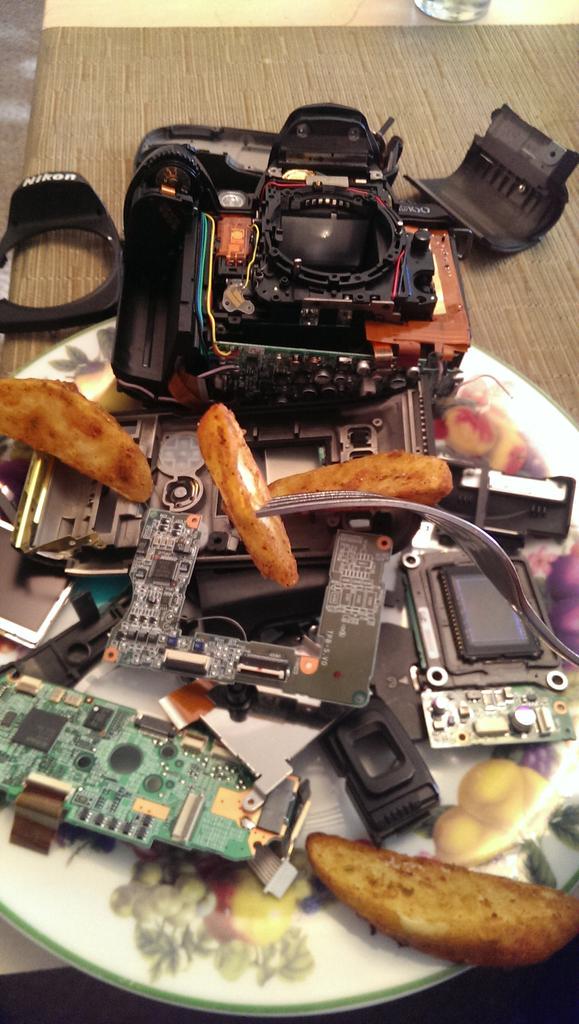
I was surprised how many "sony", "mitsubishi", "copal" and "other" parts you find in some brands of DSLR, seems the badge on the front only tells some of the story..

Anyway I am keen to have a whirl on the new 1DX Mk2, shame it will not be in my bag as I can not justify such a wonderful tool! But my friends who shoot pro will be hard pushed to keep my hands off..haha

Right I'm off for elevensies :D
CImjz-6WEAA_8bc.jpg

"burp"

Sorry to poke fun and spoil a sensible debate :)
 
Upvote 0
Mt Spokane Photography said:
3kramd5 said:
dilbert said:
3kramd5 said:
gregory4000 said:
BSI sensor....probably not, Canon doesn't have the tech.

Probably wouldn't be much of a point. Even at 24MP, you're still in the realm of diminishing returns.

If you look at what Sony have been able to achieve with BSI in the RX100IV, it isn't just IQ that benefits but also sensor readout speed.

Per Sony, the increased readout speed is due to the use of copper wiring rather than aluminum, not due to the location of the wiring layer.

dilbert said:
Canon's "current" process is a .5 micron process. For a 24MP sensor, the pixel pitch is 6 microns. At the very least, the traces around the pixels represents 8.33% of the surface space lost to "wires".

So maybe you could get an 8.33% increase in light gathering between a FSI sensor which lack light guides, etc. But given FSI sensors in canon's SLRs, I assume diminishing returns at 24MP. The 5DS would be a better candidate for BSI.

I think that BSI brings other potential benefits besides the trace situation. There is a serious problem with the inductance of long leads to ground. A ground plane on the back of the sensor could reduce the inductance. High inductance in the leads is one of the barriers to fast readouts, a stacked sensor as in the sony RX10 II goes a step further in reducing inductance and allowing extremely fast readouts.

Canon is well aware of this, and issued a patent years ago. They probably found it expensive or impractical to manufacturer. Canon is very methodical and slow. when they finally do come out with a product, its well thought and tested. Its also way behind some of the competition who are willing to take more risks.

There is no such thing as a ground plane on an IC. The wiring layers are used for alternating horizontal and vertical routing channels (Metal 1 [bottom layer] is usually omnidirectional, since the logic cells have priority use of M1).

As for inductance being a problem, I'm a bit curious (I haven't read the patent that Mt Spokane is talking about). Normally the wiring is considered RC-transmission lines (regardless of Al or Cu metalization). From what I recall from years of yore, you need to get up to multi-GHz range before you need to consider inductance for signals.
For power/ground, yes, inductance can be a problem which is solved my either going to flip-chip (even internally) or having a lot of parallel bonding wires.
 
Upvote 0
I'm patiently waiting for a 1DXII. For me to upgrade (currently shoot 1DX and 7D2 (5D3, 1D4 sometimes)) I think this camera needs more than just a MP and FPS bump.

I would like to see a couple things in order to really motivate me to be a early adopter at say $7000 price point:
1) Some improvements to AF...should have at minimum all x-type points like 7D2 and ideally could give us many more f/8 points.
2) Improvements to high-ISO Dynamic Range...who cares about low-ISO DR in a camera designed for sport and wildlife...we need DR above ISO 400, not below it...
3) Continuing high ISO noise improvements although I still find the 1DX high ISO noise to be very good and I could live without improvement in this area.
4) Would be nice to see pricing return to 1D4 levels and hopefully at least not expand to 1Ds3 levels.

I also would think this camera will need to adopt CFAST cards as the CF are already saturated at 1DX speeds/resolution. If we do need CFAST to get higher FPS at higher MP then I hope Canon just goes all in and puts dual CFAST slots even though that will mean extra entry cost to buy new cards. I really hope they don't go the Nikon route and mix the slots (one CFAST, one CF)...I hate mixed slots on 5D3 and 7D2.

Anyways, I've avoided trying out the 5DS/R and will try to avoid any 5D MkIV/X temptation and save my pennies for this 1DX2 camera.
 
Upvote 0
arbitrage said:
I'm patiently waiting for a 1DXII. For me to upgrade (currently shoot 1DX and 7D2 (5D3, 1D4 sometimes)) I think this camera needs more than just a MP and FPS bump.

I would like to see a couple things in order to really motivate me to be a early adopter at say $7000 price point:
1) Some improvements to AF...should have at minimum all x-type points like 7D2 and ideally could give us many more f/8 points.
2) Improvements to high-ISO Dynamic Range...who cares about low-ISO DR in a camera designed for sport and wildlife...we need DR above ISO 400, not below it...
3) Continuing high ISO noise improvements although I still find the 1DX high ISO noise to be very good and I could live without improvement in this area.
4) Would be nice to see pricing return to 1D4 levels and hopefully at least not expand to 1Ds3 levels.

I also would think this camera will need to adopt CFAST cards as the CF are already saturated at 1DX speeds/resolution. If we do need CFAST to get higher FPS at higher MP then I hope Canon just goes all in and puts dual CFAST slots even though that will mean extra entry cost to buy new cards. I really hope they don't go the Nikon route and mix the slots (one CFAST, one CF)...I hate mixed slots on 5D3 and 7D2.

Anyways, I've avoided trying out the 5DS/R and will try to avoid any 5D MkIV/X temptation and save my pennies for this 1DX2 camera.

+1
While you are at it add a -3 EV or greater sensitivity on the majority of focus points!
 
Upvote 0
As far as Canon...yes, they are SLOW. But as others have said already, Canon does do a lot more testing, they make sure what they develop actually works. Nikon and others are quicker to market. But they take risks. The D750 is on it's second recall notice.

In the end, you get technology that might not be cutting edge - but it just plain works. Canon builds machines for pro photographers and enthusiasts. They don't put out gear as quickly as they can to win on 'specs' for the tech junkies that only care about tech - not photography.

The proof of that is simply observing the popularity level (volume of discussion, praise, recommendations) of the brands amongst the TECH world. By tech world, I'm talking the guys who review computer gear mostly and electronics secondly. Sony and Nikon probably have by my estimates, a 10:1 advantage here or more. I rarely see a technology blogger or vlogger talk much about or ever recommend a Canon. It is almost always Sony or Nikon. Why are these guys even relevant? Because they outnumber camera and photography related review sites, and they are more dominant across the web.

Ok, but why then is Sony/Nikon more popular? Because on paper and on geeky tech specs, the Sony/Nikon looks better than the Canon. They don't take any account for the final image results, selection of lenses by those who know what they're doing, how it works as a system as a whole, ergonomics and controls for working pros having to hold the thing for hours, etcetera, etcetera.

What's that saying? If you're a hammer, everything looks like a nail? To the tech geeks, everything is about tech. Photography is a tech gear subject. But that doesn't quite work out to determining what works best.

Sony has an excellent, very advanced sensor. Wonderful! Bravo. Too bad its surrounded by an inferior camera with inferior lenses. To the point of far outweighing any minor advantage it may have had. Serious users always think SYSTEM. Your system is only as good as its weakest point. Canon is behind on sensor tech in some respects, but it is very minor and if that is the perceived "weak point" that's great. Because for real photography, it is a non-issue. Canon's Achilles Heel is the inability to underexpose a photo at ISO 100 to the point of it looking like total darkness, then doing a 5+ stop lift. Oh darn. Junk!


ANYWAY - back to the 1DX MARK II


24MP would be awesome. I'm thinking they're going to go 20 or 22 at the most. I suppose the whole question comes down to this: does upping the pixels come at the expense of ISO/Noise performance. If they answer is YES, the next question is - how much as Canon's sensor tech improved to be able handle a megapixel increase?

There's a few scenarios -

1. Up the megapixels and improve ISO noise
2. Up the megapixels keeping the same ISO noise
3. Up the megapixels, lose ISO noise performance

We know #3 isn't happening, so out with that.

If Canon can go to 24MP on it AND increase the ISO performance, wow - that's having our cake and eating it. Total win.

If they can go to 24MP but keep noise about the same, then there is a debate. It will be a battle between those who need cleaner images vs. those who want more resolution.

If Canon can go to 20 or 22MP and lower the noise and up the ISO, that is great too - since there will be a resolution increase, although a small one, and lower noise is always welcomed.

I think lower noise wins out on resolution amongst those who buy cameras of this caliber. No one really complains or has a problem with 18MP as real pros and experts know you can print huge with 18MP. But fixing noise is another post-processing step (time waster), and cleaner images are always better than noise-repaired images.

On the other hand, going to 24MP gives this flagship much needed resolution boost. 24MP dramatically increases the cropping ability. The extra resolution will be immediately apparent in the images at 1:1, but not in prints unless you get 19x13" or more. That ability to get more crop is appealing.

I'll probably be criticized for this statement, but at 24MP -- this would threaten the "add on" sales of the 5DS amongst pros. Many pros already use the 18MP 1DX as a studio camera and don't have issues. Going to 24MP would give them that extra boost in close-up details and they might just skip getting a 5DS for the studio.

This is why I think 20MP is going to be the 1DX2's sensor size. It's incremental which is Canon's path. I think they will not sacrifice a meaningful boost in low noise for the sake of megapixels. Think about it from sales perspective. The buyers of flagships - which will they prefer - going to 24MP or getting one stop cleaner? Easily one stop cleaner. And the small boost in resolution to 20mp will be gravy.

 
Upvote 0
K said:
On the other hand, going to 24MP gives this flagship much needed resolution boost. 24MP dramatically increases the cropping ability. The extra resolution will be immediately apparent in the images at 1:1, but not in prints unless you get 19x13" or more. That ability to get more crop is appealing.

I'll probably be criticized for this statement, but at 24MP -- this would threaten the "add on" sales of the 5DS amongst pros. Many pros already use the 18MP 1DX as a studio camera and don't have issues. Going to 24MP would give them that extra boost in close-up details and they might just skip getting a 5DS for the studio.

Personally, this is my main problem with the 1Dx. Don'get my wrong, it is an amazing camera and the perfect tool for my uses but I just wish it was 22mp just like the 5D III. Cropping an 18mp image is not very forgiving compared to the 5D III's 22mp. And the difference is very noticeable. Just for the 24 MP alone I would ditch both my 1Dx and 5D III to go for a pair of 1Dx II bodies and probably never upgrade for 6+ years.
 
Upvote 0
I'll gladly take the moniker of a Canon "fanboy" any day.
When I can walk into the Canon CPS facility at the Super Bowl, Kentucky Derby, Indy 500 or whatever and pick up a 200-400 f4L with just a signature, smile and "bring it back when you're done" that makes me a "fanboy."
When I get my repairs back in less than a week, that makes me a Canon "fanboy."
When my camera has been in repair multiple times for repair and they can't figure it out and they send me a re-furb of a newer model for free, that makes me a Canon "fanboy."
When I complain about my 24-70 f2.8L II hood that has broken several times and they just hand me a new one with a smile ($60 value) that makes me a Canon "fanboy."
I'll never leave Canon and people can call me all the names they want because considering how Canon has treated me over the years and the fantastic equipment they release, I'll always be a Canon fanboy.
 
Upvote 0