The Next Lens from Canon & NAB Announcements

infared said:
paulrossjones said:
Mancubus said:
Canon Rumors said:
<p>We have been told that this lens will not replace the EF 85mm f/1.2L, and that the classic 85L will remain current in the lineup for the foreseeable future.</p>

Why? Who would buy such lens?

Heavier, older, no IS, probably a lot less sharp at any aperture and maybe more expensive. Pretty sure the 1.4 will have weather sealing too.

The difference between f/1.4 and 1.2 is insignificant.

the look of 1.2 compared to stopping down to 1.4 really is significant. I find the 85 1.2 at 1.2 , canons prettiest lens. I am sure the new 1.4 will be sharper, but when you use the 85 1.2 its the feel of the lens thats the most important thing.

Don't look now...but the "experts" are about to set you straight on that comment. Good luck!

Yes, the thread will continue. ;) But infact, the f1.2 look is different from f1.4... that's physics. The only question is if it's neccesary in the picture or is it visible in the picture. Let's see how the new 85mm f1.4 IS will perform in the field... it is a common problem that the high-resultion Distagondesigns can have some backdraws in the bokeh as the immense amount of elements and groups are sometimes visible in the OutOfFocus areas. Onionrings inclusive. Furthermore the T-Stop can be worse for this reason... the Sigma 85mm f1.4 ART is "only" @t1.8 while the old one had t1.6. Let's see how much an optional Blueelement is taking away or the additional IS-Elements.
 
Upvote 0
Aside from the 1/2 stop difference between 1.4 & 1.2 the technical differences can be down to various variables such as optical design, coatings, glass types, iris type etc. that affect the final image quality. Bokeh is one of the main attributes that people nail the 1.2L lenses for over the current 1.8 85mm and Canon is most likely lining the 1.4 lens up to compete with the Zeiss Otis and the Sigma Art lenses so sharper and higher contrast. Sharpness & contrast can be altered by filters so applied when required, removed if not but this does not materially change bokeh (personally I prefer sharper and then filtrate if its too sharp for the subject).
Personally I believe photographers should have choices, that one sizes doesn't fit all and we all have our likes & dislikes. In the end though if we live by equipment its our clients perceptions that matter not ours we are supplying a service. If its purely amateur usage then again its about personal choice (or financial) so not one is right or wrong.
 
Upvote 0
As much as I'd like to try this new 85mm f1.4 LIS lens, I think Canon have missed a trick. Nikon has the fantastic 105mm f1.4. That would have been an interesting concept, a 105mm f1.4 IS lens on a Canon mount. It wouldn't divide the 85IIL sales, but add something to Canon's lens catalogue. Then it would become a question of 105mm vs 85mm focal lengths and not a discussion about f1.2 vs f1.4, AF speed, size and weight etc. But the discussion would be a creative choice between the 2 different looks that these lenses would offer. It would also take some of the strain off the 135IIL's development.
 
Upvote 0
Larsskv said:
Luds34 said:
Larsskv said:
I wish you had read my posts more carefully, and with good intentions, and you wouldn't have made all these false claims about what I mean.

That said, I don't think it would be impossible to pick out the 85LII shots. I wouldn't get them all right, but I would pick out more of them than coincidence would indicate.

Don't get so hung up on the word magic. We're not talking Harry Potter here. Replace magic with better look, and you should get the idea.

Well, I apologize if missed the nuance of your specific points. By the time I responded a lot of discussion had gone by and at that point one's response can kind of be a general response to the entire discussion, even though I specifically responded to you. In short, of course the "magical" 85mm f/1.2 can produce a "better look", I'm not disagreeing. I just think as pros and enthusiasts we get too caught up in the gear and exaggerate how much better it is. My point is that, more often than not, it's not much.

We can settle our little dispute here. The 85LII won't look special in every image, far from it, and that is why illustrating it's qualities is difficult. I hope people reading this thread has noted that many owners of the 85LII find it to be unrivaled in certain situations, despite its chromatic aberrations and slow focus. And yes, it is a speciality lens that works best for portraits.

I have no experience [shooting] with the 85mm f1.2L II, however, I have read much about it and viewed many, many photos taken with it. And to borrow a phrase from Dustin Abbott's descriptive jargon in reviewing, in particular, Zeiss lenses, with the 85L II it's all about the "drawing" of the lens (or rendering if you will). Now, with other lenses in the same circumstances - same aperture, same camera settings, lighting, etc. - you can capture an outstanding image, but I dare say, it will not have quite the same rendering (or look), especially when you open it up. And let's face it, most people buying this lens and using it (properly) are typically going to use it most at the wider aperture end - say 1.2 to 2.8 or 3.5. in a portrait, food, or other studio work, where your purpose is to isolate the subject or a specific feature of the subject. I will also freely admit, that this "look" is or can be subtle, again, depending on subject matter, lighting, etc. but it is there. For those that have a hard time understanding what I mean, go find some reviews of the 85L II, or check out Dustin's website and see his review of the Zeiss OTUS 85mm f1.4 or his more recent review of the Zeiss Milvus 85mm f1.4. Ditto for his review of the OTUS 55mm. Or Bryan Carnathan's review of these lenses at TDP.
 
Upvote 0
Is it just me, or has the past couple weeks waiting for the end of April (i.e. new product announcements from Canon for this lens and the 6D Mk II) just dragging by like molasses in January? :o :o 8)
 
Upvote 0
Yeah, the 6D2 is the all-eclipsing event this year. It's shaping up to be *the* enthusiast's camera, so at a site like this, it's kind of the earth moon and stars to some regular readers/posters here.

I believe the 6D2 will be (compared to the 6D1) what the 5D3 was compared to the 5D2 -- a comprehensive step forward that ticks all the major boxes people have been asking for. In the 6D2's case, I see that coming in the form of better AF, DPAF + tilty-flippy + touch, on-chip ADC, nice bump in fps (6 is no joke for 'entry level FF'), etc. The 6D2 will be a better rig than the 5D3 -- not just with the sensor but on aggregate -- and enthusiasts should be pretty geeked about that.

- A
 
Upvote 0
ahsanford said:
Yeah, the 6D2 is the all-eclipsing event this year. It's shaping up to be *the* enthusiast's camera, so at a site like this, it's kind of the earth moon and stars to some regular readers/posters here.

I wont buy the 6D2, but I am interested how its sensor will perform, as I think that might be a first glimpse into Canon's FF MILC.
 
Upvote 0
Crosswind said:
I wont buy the 6D2, but I am interested how its sensor will perform, as I think that might be a first glimpse into Canon's FF MILC.

It's a sensor. Canon makes a lot of them and will make more. But Canon's success / failure in mirrorless has a lot more to do with ergonomics, form-factor, controls, AF performance, native lens offerings, etc. than how well it stacks up against EXMOR. Consider: we presently get floor-mopped by other APS-C sensors in testing yet EOS M is selling very well.

And, FWIW, the first glimpse into FF MILC is already here. It's the EOS M5. In broad strokes, unless they go with a fixed lens offering, expect Canon's first mirrorless FF rig to a bigger version of the M5, possibly with that extra real estate delivering us a chunkier grip, another dial up top, a top LCD, etc.

- A
 
Upvote 0
ahsanford said:
Crosswind said:
I wont buy the 6D2, but I am interested how its sensor will perform, as I think that might be a first glimpse into Canon's FF MILC.

It's a sensor. Canon makes a lot of them and will make more. But Canon's success / failure in mirrorless has a lot more to do with ergonomics, form-factor, controls, AF performance, native lens offerings, etc. than how well it stacks up against EXMOR. Consider: we presently get floor-mopped by other APS-C sensors in testing yet EOS M is selling very well.

And, FWIW, the first glimpse into FF MILC is already here. It's the EOS M5. In broad strokes, unless they go with a fixed lens offering, expect Canon's first mirrorless FF rig to a bigger version of the M5, possibly with that extra real estate delivering us a chunkier grip, another dial up top, a top LCD, etc.

- A
What did you mean by a fixed lens offering?
 
Upvote 0
StudentOfLight said:
What did you mean by a fixed lens offering?

I mean an autofocusing FF digital camera without an interchangeable lens mount -- i.e. with a fixed (in place) lens.

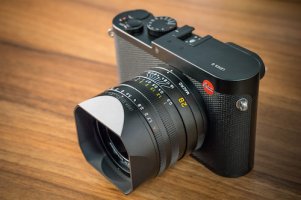
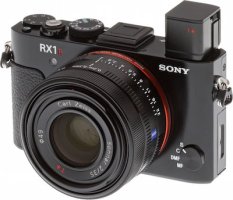
It's not like it hasn't been done before. See pictures. These sort of rigs are not typically aimed at folks like us, I see these rigs aimed at globe-trotting trust-funders and wealthy gadget folks who want to take great pictures but don't necessarily know what all the knobs and switches on a FF SLR or Leica rangefinder are for.

Offering one of these might have made sense a year or two ago as Canon was learning the mirrorless basics, ergonomics, how LiveView should ideally work for through-the-viewfinder stills capture, etc. But now that the M5 is out, though an FF rig would have more bells and whistles than the M5 does, there's less of an opportunity for Canon to learn from a niche product like a fixed lens FF rig. They may not do it at this point.

- A
 

Attachments

  • LeicaQ.jpeg
    LeicaQ.jpeg
    58 KB · Views: 1,083
  • RX1R II.jpeg
    RX1R II.jpeg
    36.4 KB · Views: 1,073
Upvote 0
ahsanford said:
StudentOfLight said:
What did you mean by a fixed lens offering?

I mean an autofocusing FF digital camera without an interchangeable lens mount -- i.e. with a fixed (in place) lens.

It's not like it hasn't been done before. See pictures. These sort of rigs are not typically aimed at folks like us, I see these rigs aimed at globe-trotting trust-funders and wealthy gadget folks who want to take great pictures but don't necessarily know what all the knobs and switches on a FF SLR or Leica rangefinder are for.

Offering one of these might have made sense a year or two ago as Canon was learning the mirrorless basics, ergonomics, how LiveView should ideally work for through-the-viewfinder stills capture, etc. But now that the M5 is out, though an FF rig would have more bells and whistles than the M5 does, there's less of an opportunity for Canon to learn from a niche product like a fixed lens FF rig. They may not do it at this point.

- A
Ah that makes sense, you lead the paragraph talking about MILC then, jumped to "FF rig"
and I didn't follow that "FF rig" was disconnected from MILC so I was confused (Wasn't sure how a MILC would have a fixed lens.)

Thanks for the clarification.

So fixed lens...
Focal length? Max aperture?
A test bed for sensor stabilization perhaps?
 
Upvote 0
StudentOfLight said:
Thanks for the clarification.

So fixed lens...
Focal length? Max aperture?
A test bed for sensor stabilization perhaps?

Leica and Sony (and just about any cell phone) have it right. If you only have one lens, it should be 28-35mm FF and as quick as you can make it without making it huge. Leica opted for 28mm f/1.7 and Sony opted for 35mm f/2. Either would be fine.

As far as why Canon would do this, it's a test bed for anything, but presumably for things Canon doesn't already have in its pocket. IBIS comes to mind, sure, but step back from a feature and think about the user experience at a higher level. The general handling of a device with a different form factor is... different. The EOS M1, M2 sort of 'flat brick' design doesn't work well once full frame + quicker lenses get attached (e.g. Leica rangefinders feel like Lego handles in a not good way, Fuji X-Pro 1/2 are bricky and not fun to handle). There's a delicate balance of 'mirrorless is all about being thin' ::) vs. 'I just bought it and slapped a 70-200 f/2.8 on it and my wrist hurts and I'm really disappointed about this experience' ::) ::) ::) that Canon must shrewdly navigate.

And then, on top of that, presuming the FF ILC that is coming doesn't come with an integral EF mount -- a conversation we will not further here as it's on 100 other threads at CR -- the top of the camera will be 'busier' / tighter for space, so knobs / buttons and such need to be carefully located while honoring the FF SLR controls people love so much. You don't want to speak two different 'control languages' with a 5D on one shoulder and FF mirrorless on another. Again, a 'test' fixed lens body might give them some user insights to leverage for the bigger deal FF ILC to come later.

- A
 
Upvote 0
ahsanford said:
StudentOfLight said:
Thanks for the clarification.

So fixed lens...
Focal length? Max aperture?
A test bed for sensor stabilization perhaps?

Leica and Sony (and just about any cell phone) have it right. If you only have one lens, it should be 28-35mm FF and as quick as you can make it without making it huge. Leica opted for 28mm f/1.7 and Sony opted for 35mm f/2. Either would be fine.

As far as why Canon would do this, it's a test bed for anything, but presumably for things Canon doesn't already have in its pocket. IBIS comes to mind, sure, but step back from a feature and think about the user experience at a higher level. The general handling of a device with a different form factor is... different. The EOS M1, M2 sort of 'flat brick' design doesn't work well once full frame + quicker lenses get attached (e.g. Leica rangefinders feel like Lego handles in a not good way, Fuji X-Pro 1/2 are bricky and not fun to handle). There's a delicate balance of 'mirrorless is all about being thin' ::) vs. 'I just bought it and slapped a 70-200 f/2.8 on it and my wrist hurts and I'm really disappointed about this experience' ::) ::) ::) that Canon must shrewdly navigate.

And then, on top of that, presuming the FF ILC that is coming doesn't come with an integral EF mount -- a conversation we will not further here as it's on 100 other threads at CR -- the top of the camera will be 'busier' / tighter for space, so knobs / buttons and such need to be carefully located while honoring the FF SLR controls people love so much. You don't want to speak two different 'control languages' with a 5D on one shoulder and FF mirrorless on another. Again, a 'test' fixed lens body might give them some user insights to leverage for the bigger deal FF ILC to come later.

- A
On the G 7X & G 7X MKII they have the FF equivilent of 24-105 to me that makes great sense, never understood a fixed 28mm or 35mm so limiting.
 
Upvote 0
jeffa4444 said:
On the G 7X & G 7X MKII they have the FF equivilent of 24-105 to me that makes great sense, never understood a fixed 28mm or 35mm so limiting.

A fixed zoom lens in FF, especially one with a large FR, would put the camera in a space that not many people would buy, IMO. I mean, imagine if the 5D4 came in at $1300 but it could only have a 24-105L -- I sure wouldn't buy it, because the 24-105L is inferior to the 24-70 in every way except FR and massively inferior to all primes in IQ. And, it would be way too expensive as a carryaround consumer camera.

Now, imagine if you could buy the a 50/1.2L fixed on 5D4 body for $1300. I don't know about you, but I'd be super excited, because it would be like carrying around a 5D4 and a 50 1.2 always attached. If the body were rebel sized but had all the capabilities and features of a 5D4, I'd buy it in a heartbeat, because I'd never take the body off the lens anyhow.

Sure, it would make a lousy only camera. But I think most people who are would consider FF have just one camera anyhow.

So, it all depends on the cost and IQ. If Canon releases a fixed-lens, mirrorless prime that is close to the price of the lens by itself, it becomes an exciting value proposition for today, and a gateway and learning experience of Canon into the future, for tomorrow.
 
Upvote 0
sulla said:
EF 85 1.2L II VD USM
OK, to prevent a shitstorm, this was just a joke, through which I was trying to point to the fact that, due to its enormous weight, the f/1.2 lens is vibrationally damped (VD) about 1 stop over the lighter f/1.8 lens through sheer inertia...
Genuine IS in a fast prime of this focal length is highly welcome, of course! Perhaps, one day, we will see ahsanford's 50mm 1.4 IS lens...
 
Upvote 0
ahsanford said:
sulla said:
I honestly cannot understand, why canon produces 2 image-stabilised lenses of the same focal length and similar aperture,
the EF 85 1.4L IS USM and the EF 85 1.2 II VD USM...

The same answer as why a dog licks its own junk. Because it can.

- A

But, this time a serious answer:

  • The Otuses and Art (primes) don't offer IS. This is simple feature-based differentiation.

  • A new lens is needed every 8-10 years or in of the staple professional varieties (24-70 2.8, 70-200 2.8, a fast 85 for portraiture, etc.), so Canon needed to make a new 85 to keep up with the Joneses. The current 85 is dreamy but not sharp throughout the frame -- DXO (I know, ack, nasty) has tested it on multiple bodies and rated it for 18/22 P-MPix at DXO on a 5D3 but only gets up to a 23/50 on a 5DS R. It could use a step up for a 50 MP+ sensor. And we all know the AF is both FBW and slooooow. There is ample room to improve it.

  • Video folks would love an f/1.4 IS lens. You could do some Kubrickian Barry Lyndon lighting levels with that.

So a new 85L is a lock. Why the old one isn't obsoleted in a year or so is the $64,000 question. Perhaps it might be (I'm speculating) that Canon has some market intel that no matter how sharp/wonderful/amazing the new 85 f/1.4L IS is, some nontrivial fraction of photographers will never buy it, instead opting to spoon with their current 85 f/1.2L IIs like folks did with their Amiga computers back in the day. To some, the 'magic' is real and they'll never give it up.

- A
 
Upvote 0