
The State of the Canon Full Frame Mirrorless Development

neuroanatomist said:
Canoneer said:
It wouldn't hurt Canon to debut a fixed lens full-frame mirrorless like the Sony RX1R, or the Leica Q. They could conceivably undercut the competition from a pricing standpoint by a huge margin if they used the 6D II sensor and a mirrorless variant of the 40mm F/2.8 STM. It could essentially become the Canonet QL18.

Give it the 5DIV sensor and an f/2 lens, and I'd be tempted.

Exactly. And a leaf shutter -- both the Q and RX1R lenses have them.

I don't do much portraiture, but 1/2000 sync would be lovely.

- A
 
Upvote 0
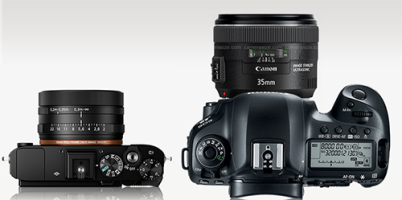
And fixed lens is where the 'mirrorless is all about being smaller' camp (FTR that I am not a member of) can truly drop the mic.

Lens inset to the body
+ Lens FL/speed is the homerun sweet spot of size (a 24 2.8 or 50 1.8 would work as well)
+ No need for a chunky grip as large glass is never going to be held by this
+ No need for a wide body to create finger space between the chunky grip and the lens barrel

= a SUPER tiny camera. See attached.

- A
 

Attachments

  • Screen Shot 2018-04-04 at 8.17.29 AM.png
    Screen Shot 2018-04-04 at 8.17.29 AM.png
    126.9 KB · Views: 532
Upvote 0
ahsanford said:
neuroanatomist said:
Canoneer said:
It wouldn't hurt Canon to debut a fixed lens full-frame mirrorless like the Sony RX1R, or the Leica Q. They could conceivably undercut the competition from a pricing standpoint by a huge margin if they used the 6D II sensor and a mirrorless variant of the 40mm F/2.8 STM. It could essentially become the Canonet QL18.

Give it the 5DIV sensor and an f/2 lens, and I'd be tempted.

Exactly. And a leaf shutter -- both the Q and RX1R lenses have them.

I don't do much portraiture, but 1/2000 sync would be lovely.

- A

I don't see why they couldn't do both (if the market demand is there). An entry-level fixed lens point and shoot full-frame with a 6D II sensor and a redesigned, somewhat slow, relatively inexpensive 40mm F2.8 STM. Then go after the high-end crowd with a 5D IV sensor and 35mm L-series leaf shutter lens at the $3k segment.

It's a big ask for Canon to deliver any fixed lens full-frame camera, though. I think they'll put their eggs in the ILC basket for full-frame and maybe they'll give us a fixed lens APS-C mirrorless camera that might have a real optical rangefinder on it.
 
Upvote 0
Canoneer said:
I don't see why they couldn't do both (if the market demand is there). An entry-level fixed lens point and shoot full-frame with a 6D II sensor and a redesigned, somewhat slow, relatively inexpensive 40mm F2.8 STM. Then go after the high-end crowd with a 5D IV sensor and 35mm L-series leaf shutter lens at the $3k segment.

It's a big ask for Canon to deliver any fixed lens full-frame camera, though. I think they'll put their eggs in the ILC basket for full-frame and maybe they'll give us a fixed lens APS-C mirrorless camera that might have a real optical rangefinder on it.

I also wonder how much Leica and Sony (and Fuji with the X100 rigs) are charging is actually a deliberate markup to smite us for buying something with no future lens sale pullthrough. ::)

- A
 
Upvote 0
ahsanford said:
Canoneer said:
I don't see why they couldn't do both (if the market demand is there). An entry-level fixed lens point and shoot full-frame with a 6D II sensor and a redesigned, somewhat slow, relatively inexpensive 40mm F2.8 STM. Then go after the high-end crowd with a 5D IV sensor and 35mm L-series leaf shutter lens at the $3k segment.

It's a big ask for Canon to deliver any fixed lens full-frame camera, though. I think they'll put their eggs in the ILC basket for full-frame and maybe they'll give us a fixed lens APS-C mirrorless camera that might have a real optical rangefinder on it.

I also wonder how much Leica and Sony (and Fuji with the X100 rigs) are charging is actually a deliberate markup to smite us for buying something with no future lens sale pullthrough. ::)

- A

If you look up deliberate markup in the thesaurus, it will point you to Leica.
 
Upvote 0
I am not sure what Canon would gain by going to anything other than an EF mount for a full-frame mirrorless camera. Canon currently offers 28 "L" lenses in the EF line; Sony currently has 6 lenses in G-Master line. Yes, because of the flange-to-sensor distance with the Canon EF line (44mm), a full-frame Canon mirrorless for EF lenses would technically have to be an inch thicker than Sony's E-mount mirrorless cameras, but comparable Sony E-mount lenses are usually designed longer because of Sony's short flange-to-sensor distance (18mm), so the difference in camera and lens length between the two brands is relatively insignificant. Besides, having a little extra thickness would certainly give the Canon EF mirrorless some ergonomic advantages especially with bigger lenses and allow them to add extra room for other features like better grips, increased battery capacity, memory card space, etc. What advantage would it be for Canon to produce a slightly thinner alternative-mount camera and then have to re-engineer all their remarkable glass with more length to allow for a shorter flange-to-sensor distance? I'd rather have a fractionally thicker camera and shorter lenses than a thinner camera and longer lenses. The difference is even more insignificant when you realize that presently a Canon 5D Mark IV is only one-tenth of an inch deeper than a Sony a7R III.
 
Upvote 0
3kramd5 said:
If you look up deliberate markup in the thesaurus, it will point you to Leica.

Sure, expected of course. But let's test my nutty theory:

X100F = $1,299
X-E3 (with I believe the same sensor) = $899

+$400 for a 22 f/2 leaf-shutter lens and a hybrid VF. That actually seems reasonable!

----------------

RX1R II = $3,298
A7R2 (with I believe the same sensor) = $2,398

+$900 for a 35 f/2 leaf shutter lens. I'm calling that a minor smiting.

So either Fuji is delivering more pure horsepower value than Sony (absolutely not), or there is a dearth of options (besides Leica) in FF fixed lens offerings that allows Sony to gouge folks here. My money is firmly on the latter.

- A
 
Upvote 0
glness said:
I am not sure what Canon would gain by going to anything other than an EF mount for a full-frame mirrorless camera. Canon currently offers 28 "L" lenses in the EF line; Sony currently has 6 lenses in G-Master line. Yes, because of the flange-to-sensor distance with the Canon EF line (44mm), a full-frame Canon mirrorless for EF lenses would have to be an inch thicker than Sony's E-mount mirrorless cameras, but comparable Sony E-mount lenses are usually designed longer because of Sony's short flange-to-sensor distance (18mm), so the difference in camera and lens would be relatively insignificant. Besides, having an extra inch of thickness would certainly give the Canon EF mirrorless some ergonomic advantages especially with bigger lenses and allow them to add extra room for other features like increased battery capacity, memory card space, etc. What advantage would it be for Canon to produce a thinner alternative-mount camera and then have to re-engineer all their remarkable glass with more length to allow for a shorter flange-to-sensor distance? I'd rather have a little thicker camera and shorter lenses than a thinner camera and longer lenses.

Agree in broad strokes, but remember you can decouple thin/thick camera from big/little grip, i.e. you could have a thin mount and a huge grip that handles large glass well. Sony were just too obsessed with size to seize that opportunity.

I agree that EF is the way to go -- I'm just saying that mount depth and grip size are independent design decisions.

- A
 
Upvote 0
The fixed lens discussion reminds me that many of the best pictures I have made were with a Yashica rangefinder camera with a 45mm lens.

An advantage of that consistent view was that I could have my shots framed in mind before I even looked through the viewfinder, almost as if the lines of the frame edges were etched into my brain. I think it contributed to my appreciation of beauty that I saw before me even when I didn't have the camera along.

To an extent now, the reverse process works in my head, I guess. I see a desired field of view, and then I look through the camera and zoom to fit.
 
Upvote 0
ahsanford said:
I agree that EF is the way to go -- I'm just saying that mount depth and grip size are independent design decisions.

- A

Why not go the whole way and have a grip that wraps round the front and converts the EF-M FF mount to a native EF mount? Of course would have to be done properly so it's rock solid and weather-sealed.

Then everyone can be happy. Smaller body for those times you need it, and for when you dont you attach the grip and use your arsenal of L lenses.

Jolyon
 
Upvote 0
jolyonralph said:
ahsanford said:
I agree that EF is the way to go -- I'm just saying that mount depth and grip size are independent design decisions.

- A

Why not go the whole way and have a grip that wraps round the front and converts the EF-M FF mount to a native EF mount? Of course would have to be done properly so it's rock solid and weather-sealed.

Then everyone can be happy. Smaller body for those times you need it, and for when you dont you attach the grip and use your arsenal of L lenses.

Jolyon

I'd rather just have 2 bodies, personally. A larger body has certain potential advantages other than ergonomics like more space for additional processors, larger batteries, and heat dissipation.

I don't have a problem buying a small B-Camera that has an adapter, that can double as a mini travel camera, as long as the most important controls are in all the same places as my primary.
 
Upvote 0
jolyonralph said:
ahsanford said:
I agree that EF is the way to go -- I'm just saying that mount depth and grip size are independent design decisions.

- A

Why not go the whole way and have a grip that wraps round the front and converts the EF-M FF mount to a native EF mount? Of course would have to be done properly so it's rock solid and weather-sealed.

Then everyone can be happy. Smaller body for those times you need it, and for when you dont you attach the grip and use your arsenal of L lenses.

Jolyon

yes. a much more modular approach would generally be highly welcome in imaging gear. Unfortunately not likely to happen ...

A "slim mount", square sensor version of such a camera cube ....
canonms.jpg


with sensor unit, DIGIC/imaging pipeline and AF module each separately tool-less swappable / upgradable by end-user ... and all sorts of EVF and LCD options plus mount add-ons, grips, battery/power attachments, communications modules ...

will take a non-japanese, truly "innovative" company. Maybe someone could get "Elon Musk"-types interested to have a go at it ? :-)
 
Upvote 0
Talys said:
jolyonralph said:
Why not go the whole way and have a grip that wraps round the front and converts the EF-M FF mount to a native EF mount? Of course would have to be done properly so it's rock solid and weather-sealed.

Then everyone can be happy. Smaller body for those times you need it, and for when you dont you attach the grip and use your arsenal of L lenses.

I'd rather just have 2 bodies, personally. A larger body has certain potential advantages other than ergonomics like more space for additional processors, larger batteries, and heat dissipation.

I don't have a problem buying a small B-Camera that has an adapter, that can double as a mini travel camera, as long as the most important controls are in all the same places as my primary.

+1 to Talys. And Canon wants to sell us two bodies anyway, if we're honest about it.

- A
 
Upvote 0
neuroanatomist said:
Canoneer said:
It wouldn't hurt Canon to debut a fixed lens full-frame mirrorless like the Sony RX1R, or the Leica Q. They could conceivably undercut the competition from a pricing standpoint by a huge margin if they used the 6D II sensor and a mirrorless variant of the 40mm F/2.8 STM. It could essentially become the Canonet QL18.

Give it the 5DIV sensor and an f/2 lens, and I'd be tempted.
I will even settle for 28mm f2.8 with a mini grip for smaller size. Both the RX1 and RX1X are too smooth(no grip). I am afraid that they will slip off my fingers.
 
Upvote 0
Let's not lose sight of the beauty or ugliness of user interfaces.

We are all well versed in the marvelously mature UI of Canon EOS. The others are, well, ugly...

The Leica Q is always with me for several reasons which Canon might consider:
1. User interface is almost perfect. Leave the aperture on "A", leave shutter on "A" ands you get a "program mode" with exposure comp readily available on thumb wheel. Want a different depth, merely shift the aperture ring as desired. It becomes Av mode, no fuss.
2. The 28mm f/1.7 Summilux may be the best single lens in my kit, and it has a leaf shutter as well as the camera's electronic shutter.
3. Image quality is superb because the lens and sensor were developed together.
4. Image creation is ideal since the EVF is perfection and it shows the actual image, after exposure comp or aperture changes, in real time. No OVF can do that.

I am a changed photographer since getting the Q.
I love my Canon 6D and "L" glass. I was about to buy a 5D-IV when a friend gave me the Leica Q -- now I anxiously await the Canon EOS FF Mirrorless. Pray for a perfect EVF, EF mount, 5D-IV sensor, dual SD slots, and our simple EOS interface!
 
Upvote 0
ahsanford said:
If Canon does this (and they may), they will go premium and chase the wealthy crowd like Sony's RX1R II and Leica's Q did.

- A

Maybe so, and maybe not. I have felt for a long time that a fixed lens and a high megapixel sensor is an interesting combination for a small lightweight camera, and that 28-35mm was the sweetspot for focal length. With a high megapixel sensor, you can easily crop to get a 70mm+ equivalent focal length, and you avoid the weight and cost penalties associated with using interchangeable lenses. If Canon decides to go that route, I am not sure that they would decide that the price sweetspot for max profit will be at RX1R II and Q levels, especially since there are already two pretty decent competitors at that level, and there isn't much brand loyalty for a fixed lens camera. Why not undercut them (even undercut them bigtime) after they proved the design concept and demonstrated that their price point is an issue for a lot of people (including me)?
 
Upvote 0
stevelee said:
The fixed lens discussion reminds me that many of the best pictures I have made were with a Yashica rangefinder camera with a 45mm lens.

An advantage of that consistent view was that I could have my shots framed in mind before I even looked through the viewfinder, almost as if the lines of the frame edges were etched into my brain. I think it contributed to my appreciation of beauty that I saw before me even when I didn't have the camera along.

To an extent now, the reverse process works in my head, I guess. I see a desired field of view, and then I look through the camera and zoom to fit.

Good if that works for you. Versatility in lenses is often my need. Having said that a full frame camera with a fixed 3mmm f1.8 lens with 5 stop stabilisation would be my third camera immediately if the size was compact.
 
Upvote 0
BillB said:
Why not undercut them (even undercut them bigtime) after they proved the design concept and demonstrated that their price point is an issue for a lot of people (including me)?

Because Canon doesn't leave money on the table. When is the last time Canon undercut Sony?

Also, the price on the RX1R II (to my knowledge) is still sitting at the initial asking from a couple years ago. Name me a single Sony product of that age that can say that. I read that as Sony doing decent business on a product without a same-segment competitor, and that reads that this market is underserved. I see Canon potentially jumping in here with an eye-popping price offering, somewhere in the $3k / 5D4 going price sort of neighborhood.

- A
 
Upvote 0
sanj said:
stevelee said:
The fixed lens discussion reminds me that many of the best pictures I have made were with a Yashica rangefinder camera with a 45mm lens.

An advantage of that consistent view was that I could have my shots framed in mind before I even looked through the viewfinder, almost as if the lines of the frame edges were etched into my brain. I think it contributed to my appreciation of beauty that I saw before me even when I didn't have the camera along.

To an extent now, the reverse process works in my head, I guess. I see a desired field of view, and then I look through the camera and zoom to fit.

Good if that works for you. Versatility in lenses is often my need. Having said that a full frame camera with a fixed 3mmm f1.8 lens with 5 stop stabilisation would be my third camera immediately if the size was compact.

I'm assuming that you mean 35mm? :)

The problem I have with a fixed prime is that it's almost guaranteed to be pretty wide, and that causes perspective problems for me even especially when I get in closer. For example, if two people are sitting near each other, a 35mm full frame makes them seem far apart; or if I take a photo of someone from above or below, it will exaggerate their body shape.


ahsanford said:
BillB said:
Why not undercut them (even undercut them bigtime) after they proved the design concept and demonstrated that their price point is an issue for a lot of people (including me)?

Because Canon doesn't leave money on the table. When is the last time Canon undercut Sony?

Also, the price on the RX1R II (to my knowledge) is still sitting at the initial asking from a couple years ago. Name me a single Sony product of that age that can say that. I read that as Sony doing decent business on a product without a same-segment competitor, and that reads that this market is underserved. I see Canon potentially jumping in here with an eye-popping price offering, somewhere in the $3k / 5D4 going price sort of neighborhood.

- A

Right. It makes no sense for Canon to undercut Sony on camera bodies and start a price war on that front.

First, they don't have to -- At $3k, they'll barely be able to keep up with demand (or perhaps fall behind) on their full frame mirrorless anyways. And second, the people who weren't going to buy a $3k Canon wouldn't buy a $2,500 Canon, either.
 
Upvote 0
Talys said:
The problem I have with a fixed prime is that it's almost guaranteed to be pretty wide, and that causes perspective problems for me even especially when I get in closer. For example, if two people are sitting near each other, a 35mm full frame makes them seem far apart; or if I take a photo of someone from above or below, it will exaggerate their body shape.

One lens = it has to be wide/standard. (It's the cell phone problem -- most of those are 28-30mm-ish FF equivalent, right?)

If that's the case, IMHO around 35mm you can capture more types of images than other FLs, but obviously certain types of photography are problematic. I hope you have long arms for selfies, I hope you don't plan to do head/shoulders portraiture, etc.

So, for me, there is no comprehensive win for a fixed lens setup unless (a) size / simplicity is a really high priority for you and (b) you love the chosen FL. I'd love to try a Leica Q like camera, but I just can't justify the spend vs. other gear I'd like to own someday. Perhaps I'll rent one on a future trip and try it out.

- A
 
Upvote 0