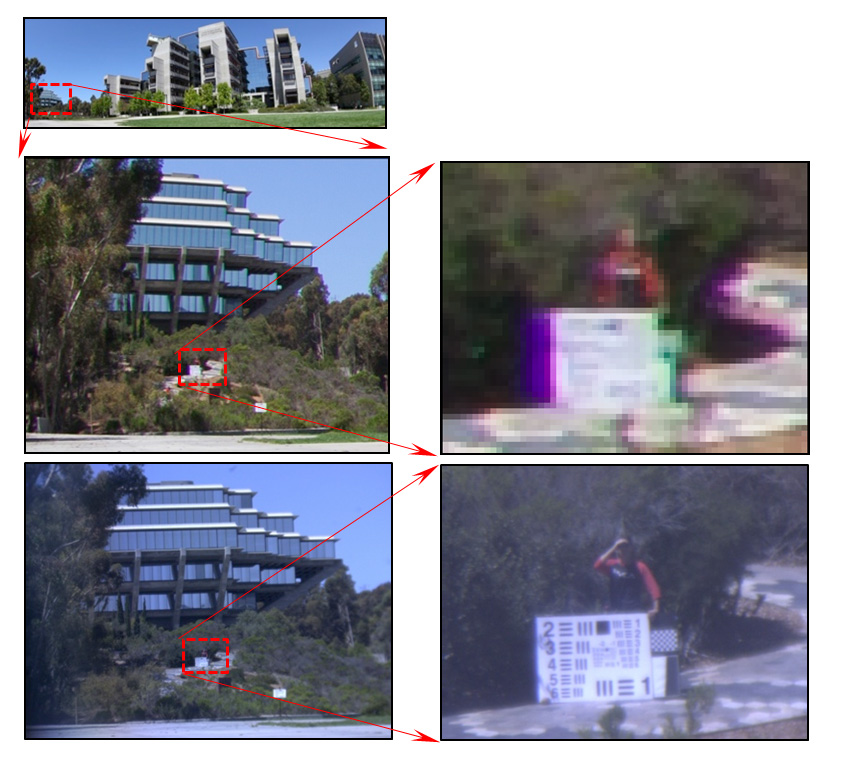
UCSD Science FAIL

Status
Not open for further replies.
Jim Saunders said:
More information required, surely.

Jim

That's for sure. Heh, this isn't a site I'd normally go to for valid scientific reporting. Let me see what the science guys at ArsTechnica can dig up maybe.

EDIT: I ended up finding a bit more info from a USCD release: http://ucsdnews.ucsd.edu/pressrelease/new_miniaturized_wide_angle_lens_captures_images_in_high_definition. Interesting, it looks like they basically used a bundle of fiber optics polished in a certain way to meet the incoming light exactly to funnel the light down to the sensor. So instead of having to use extra lens elements to 'straighten' out the light coming in so it could be focused down onto a square chip they used fiber optics to guide the light.

They also fail to mention the fact that DSLR lenses need to be so much bigger in part because they need to project light onto a much bigger sized sensor chip.

EDIT2: Oh, and the caption on the image shows that the bottom one is taken by a high-magnification microscope with light from a monocentric lens being funneled to it. Not the 5MP sensor with light from the fiber optic bundle. Wow, that OP link really got it wrong.
 
Upvote 0
The article on that site is pure nonsense. Two camera/lens combos with the same field of view. One is pixelated much more than the other. Neither looks great optically, even though it's meant to be a showcase of lens technology, not sensor technology. But the one which is pixelated is claimed to be a 22MP 5D3, and the one which isn't is claimed to be an 8MP iPhone 5s. Nonsense.
 
Upvote 0
KyleSTL said:
http://www.tomsguide.com/us/marblelike-lens-smartphone-slr,news-17607.html

I'm not even sure where to begin with this article. If anyone can find the paper on which this is based, I would love to pick apart their scientific method.

Allow me to start... I you look at the "expanded" section of the 5D3 image you can count pixels... that image is about 80 pixels wide, making the "full image" around 600 pixels wide. The image was probably saved as the smallest supported file size and the worst compression possible..... in other words, the 5D3 image was doctored to be as poor as possible.... possible resampled afterwards and saved at an even higher level of compression. They had to work hard to make the image that bad..

So we have a cooked comparison... everything else they say is automatically suspect and must be discarded.
 
Upvote 0
You, I read the USC article. The Toms Hardware writer made subtle modifications and left out relevant facts to make it fit his views.

The image had nothing to do with any cell phone.

USC Science did not fail, and if the OP had read the USC article first, he should have spotted the alteration of the USC paper. Its not fair to blame USC for a article written by someone else that is misquoted and omits crucial information. The blame falls on Toms Hardware and their employment of a incompetent writer who set out to prove a point.
 
Upvote 0
Mt Spokane Photography said:
You, I read the USC article. The Toms Hardware writer made subtle modifications and left out relevant facts to make it fit his views.

The image had nothing to do with any cell phone.

USC Science did not fail, and if the OP had read the USC article first, he should have spotted the alteration of the USC paper. Its not fair to blame USC for a article written by someone else that is misquoted and omits crucial information. The blame falls on Toms Hardware and their employment of a incompetent writer who set out to prove a point.

Yup, very much. I decided to post a comment declaiming the article and linking to the original. We'll see if it stays up.
 
Upvote 0
Mt Spokane Photography said:
You, I read the USC article. The Toms Hardware writer made subtle modifications and left out relevant facts to make it fit his views.

The image had nothing to do with any cell phone.

USC Science did not fail, and if the OP had read the USC article first, he should have spotted the alteration of the USC paper. Its not fair to blame USC for a article written by someone else that is misquoted and omits crucial information. The blame falls on Toms Hardware and their employment of a incompetent writer who set out to prove a point.
I'd like to point out that UCSD is the public University of California-San Diego while USC is the private University of Southern California located in Los Angeles.
 
Upvote 0
Mt Spokane Photography said:
You, I read the USC article. The Toms Hardware writer made subtle modifications and left out relevant facts to make it fit his views.

The image had nothing to do with any cell phone.

USC Science did not fail, and if the OP had read the USC article first, he should have spotted the alteration of the USC paper. Its not fair to blame USC for a article written by someone else that is misquoted and omits crucial information. The blame falls on Toms Hardware and their employment of a incompetent writer who set out to prove a point.

USC is University of Southern California, a private university in Los Angeles.

The article is about work from UCSD, the University of California San Diego, a part of the the Californian state university system.

Edit - these two mails were posted simultaneously.
 
Upvote 0
AlanF said:
The article is about work from UCSD, the University of California San Diego, a part of the the Californian state university system.

Technically, UCSD is part of the University of California (UC) system; the California State University (CSU) system is a separate system although both are public university systems supported by the State of California. Generally speaking, the UC's are the highest tier of the public university in the state, with the CSU's being the next tier down. When you see a city name after the UC designation (e.g. UCSD) it's referring to that campus, while "the University of California" refers to UC Berkeley (aka Cal), which was the first campus in the system (and the genesis of others - their medical school became UC San Francisco, their university farm became UC Davis).

Probably TMI, but then, I went to UC Berkeley (and as we said at UCLA games, "There's only one Cal, and it's in Berkeley. Get your own colors, get your own fight song, get a real bear!").

 
Upvote 0
OK, maybe the science isn't quite as horrible as Tom's lead me to believe. I read through the link posted by Drizzt321 and still think the images provided have a very skewed control. We could rename the paper:

"UCSD Discovers Using Higher Pixel Density Results in Pictures with Greater Detail"

Read through it, what I took away from it is that they created a 12mm lens (what is the effective image circle?) much smaller than the Canon 8-15mm Fisheye - definitely an impressive feat. However the article talks about 5MP sensors (what size are said sensors?) with an unknown pixel pitch being used with this lens. The graphic and caption read:

9936096755_be65548d51_o.jpg


Advantages of a monocentric lens. Top: This image was captured with a conventional wide-angle lens, a Canon EOS 5D Mark III DSLR with a 12mm focal length. Middle: An inset of the image above. A close-up (right) of the man holding the board shows that this picture, taken with a conventional wide-angle camera with 12mm focal length, does not have very high resolution. Bottom: An image taken with a monocentric lens relayed onto a high-magnification digital microscope. This system did not include the fiber coupling developed by the researchers for their prototype camera, but the clarity of the detail shows the potential of using monocentric lenses to take images with both high resolution and a wide field of view.

So why is there no level playing field, say, each lens tested with the same sensor (or at least of the same pixel pitch), like shown in the test bench?:

9936195763_ae2cac8d92_c.jpg


I'm not knocking the fact that they have created a pretty impressive lens, especially considering its size (and also the apparent lack of chromatic aberation), but the picture shown, I feel, is extremely misleading and implies that the absolute most the 8-15mm can resolve is 22 MP (which I don't believe for a second).
 
Upvote 0
neuroanatomist said:
AlanF said:
The article is about work from UCSD, the University of California San Diego, a part of the the Californian state university system.

Technically, UCSD is part of the University of California (UC) system; the California State University (CSU) system is a separate system although both are public university systems supported by the State of California. Generally speaking, the UC's are the highest tier of the public university in the state, with the CSU's being the next tier down. When you see a city name after the UC designation (e.g. UCSD) it's referring to that campus, while "the University of California" refers to UC Berkeley (aka Cal), which was the first campus in the system (and the genesis of others - their medical school became UC San Francisco, their university farm became UC Davis).

Probably TMI, but then, I went to UC Berkeley (and as we said at UCLA games, "There's only one Cal, and it's in Berkeley. Get your own colors, get your own fight song, get a real bear!").
I hope to get into Cal in 2 years! 8)
 
Upvote 0
thgmuffin said:
neuroanatomist said:
AlanF said:
The article is about work from UCSD, the University of California San Diego, a part of the the Californian state university system.

Technically, UCSD is part of the University of California (UC) system; the California State University (CSU) system is a separate system although both are public university systems supported by the State of California. Generally speaking, the UC's are the highest tier of the public university in the state, with the CSU's being the next tier down. When you see a city name after the UC designation (e.g. UCSD) it's referring to that campus, while "the University of California" refers to UC Berkeley (aka Cal), which was the first campus in the system (and the genesis of others - their medical school became UC San Francisco, their university farm became UC Davis).

Probably TMI, but then, I went to UC Berkeley (and as we said at UCLA games, "There's only one Cal, and it's in Berkeley. Get your own colors, get your own fight song, get a real bear!").
I hope to get into Cal in 2 years! 8)

UC Berkeley is a very great institution, and I have been fortunate to have been hosted there on several occasions, as well as UCSF, UCSD and UCLA. In general, the UC system is one of the treasures of the USA and a scientific powerhouse. I hope you are successful in getting into Cal.
 
Upvote 0
OK, now it's starting to make sense. Thanks for sharing the link, Pi. This does seem like an interesting technology. I just wonder what that section of the image would look like if you put a Pentax Q + shift adapter (for the higher pixel density ~ 250MP FF equivalent) on the Canon 8-15mm.

Also, here's a presentation:
http://psilab.ucsd.edu/publications/(presentation_2013)_stamenov_(OSA_IS).pdf
 
Upvote 0
KyleSTL said:
OK, now it's starting to make sense. Thanks for sharing the link, Pi. This does seem like an interesting technology. I just wonder what that section of the image would look like if you put a Pentax Q + shift adapter (for the higher pixel density ~ 250MP FF equivalent) on the Canon 8-15mm.

Also, here's a presentation:
http://psilab.ucsd.edu/publications/(presentation_2013)_stamenov_(OSA_IS).pdf

Thanks for that link.

Their lens is interesting but the comparison with conventional lenses is misleading and shows no photographic experience. I am not sure how they get that awful pixelated image with the EF lens - you can see somewhere the lens mounted on their device, and in the presentation - mounted on the 5D. Also, their lens is small on the front but huge on the back, and in a huge enclosure, as far as I can tell. Light gathering is good only in relative terms - compared to its size but I do not see why is that of any interest. It still gather much less light than an EF lens. And finally - they say no geometric distortions, which is very misleading as well. You project (say, a plane) to a sphere. If you final goal is to have a planar projection, you got a huge distortion already. The way the fix it is not clear - either mechanically (with the fibers) or with software but that would create the known problems near the borders.
 
Upvote 0
Status
Not open for further replies.