Why do you have a rain gauge at hand? This made my day.The comparison is perfectly valid, but apparently you don't understand the principle of the rain gauge. I happen to have one handy...
View attachment 229713
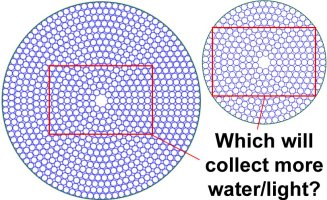
A rain gauge measures the linear 'depth' of falling water per unit area, not the volume. To determine the volume of water that falls, you need multiply the linear depth by the area over which the water falls. A larger area will collect a greater volume.
You state, "The same amount of water falls on the area." If I put the rain gauge that I was holding in the above picture on my lawn and we get 1 cm of rain where I live, then there will be 33 ml of water in the gauge (I just measured that). So by your logic of 'the same amount of water falls on the area', my 2,000 m² front lawn would get 33 ml of water from that rainfall. No, just...no.
The total amount of rainwater collected is proportional to the area over which it is being collected. It's not a hard concept, and I would think it was intuitive but evidently not to everyone. If I want to collect and store rainwater for later garden use, should I put my rain barrel with it's 0.5 m² top opening out in the middle of my patio, or should I put it under the downspout from a rain gutter that collects runoff from a 50 m² portion of my roof? By your logic, there's no difference. Anyone with a modicum of common sense would put the barrel under the downspout.
Similarly, the total amount of light collected by a sensor is proportional to the area of that sensor. A larger sensor collects more total light than a smaller sensor, and the image noise is inversely proportional to the total amount of light collected.

(I fully agree with all you said and have nothing to add on that front.)

Upvote
0