What’s Coming Next from Canon?

The comparison is perfectly valid, but apparently you don't understand the principle of the rain gauge. I happen to have one handy...

View attachment 229713

A rain gauge measures the linear 'depth' of falling water per unit area, not the volume. To determine the volume of water that falls, you need multiply the linear depth by the area over which the water falls. A larger area will collect a greater volume.

You state, "The same amount of water falls on the area." If I put the rain gauge that I was holding in the above picture on my lawn and we get 1 cm of rain where I live, then there will be 33 ml of water in the gauge (I just measured that). So by your logic of 'the same amount of water falls on the area', my 2,000 m² front lawn would get 33 ml of water from that rainfall. No, just...no.

The total amount of rainwater collected is proportional to the area over which it is being collected. It's not a hard concept, and I would think it was intuitive but evidently not to everyone. If I want to collect and store rainwater for later garden use, should I put my rain barrel with it's 0.5 m² top opening out in the middle of my patio, or should I put it under the downspout from a rain gutter that collects runoff from a 50 m² portion of my roof? By your logic, there's no difference. Anyone with a modicum of common sense would put the barrel under the downspout.

Similarly, the total amount of light collected by a sensor is proportional to the area of that sensor. A larger sensor collects more total light than a smaller sensor, and the image noise is inversely proportional to the total amount of light collected.
Why do you have a rain gauge at hand? This made my day. :D

(I fully agree with all you said and have nothing to add on that front.)
 
  • Like
Reactions: 1 user
Upvote 0
Rain Gauge (Pluviometer) Principle
A rain gauge is an instrument used to measure the amount of liquid precipitation (rain, snow, hail) that falls over a given period at a specific location.
Basic Principle
The most common type is the standard manual rain gauge (often called a Hellmann rain gauge or similar):
It consists of a funnel with a precisely known opening area (usually 200 cm² or 500 cm² in professional gauges) that collects rainwater.
The funnel directs the water into a narrow measuring cylinder (inner tube) to amplify the height of the water column for easier and more accurate reading.
The collected water is measured manually with a graduated scale, typically in millimeters (mm).
How it works:
Rain falls into the funnel → flows into the measuring tube → the height of the water column is read. Thanks to the funnel's known area and the calibrated tube, the height directly corresponds to the depth of rainfall.
Modern versions include:
Tipping bucket rain gauges (automatic) – a small bucket tips every time it fills with a fixed amount (e.g., 0.1 mm or 0.2 mm), sending an electrical pulse.
Weighing rain gauges – continuously weigh the collected water.
Optical/displacement sensors – used in professional meteorological stations.
Conversion of Fallen Water to Area (Rainfall Depth → Volume)
Rainfall is always expressed as a depth in millimeters (mm). This is a very practical unit because:
1 mm of rainfall = 1 liter of water per square meter
Mathematical explanation:
1 mm = 0.001 m (depth)
Area = 1 m²
Volume = depth × area = 0.001 m × 1 m² = 0.001 m³
1 m³ = 1000 liters → 0.001 m³ = 1 liter
Examples of conversion:
10 mm of rain on 1 m² = 10 liters
25 mm of rain on 1 hectare (10,000 m²) = 250,000 liters = 250 m³
50 mm of rain on 1 km² (1,000,000 m²) = 50,000,000 liters = 50,000 m³
General formula:
Volume (liters) = Rainfall (mm) × Area (m²)
Or more precisely:
Volume (m³) = Rainfall (mm) × Area (m²) / 1000
This is why meteorologists love the mm unit — it makes hydrological calculations extremely simple without needing complex conversions.
Would you like me to also explain different types of rain gauges or how to calculate runoff, evaporation, etc.?
 
Upvote 0
In my opinion, you are mixing apples and pears. The comparison with rain and area is wrong. The same amount of water falls on the area. That's the principle of the rain gauge, gentlemen 😀

I really don't know what you're talking about here. I know the R7 takes nice pictures of animals. And that's why I bought it.


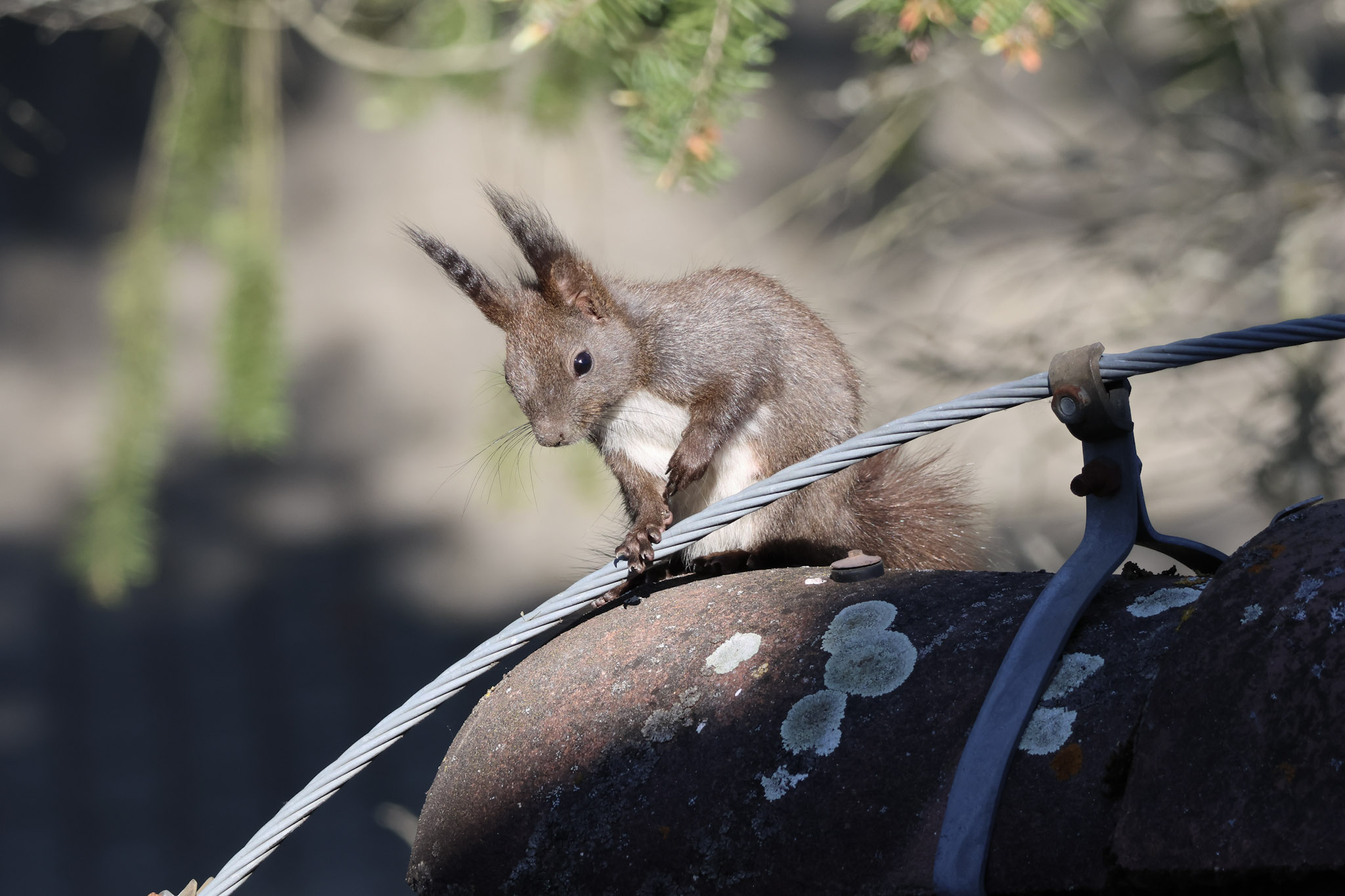
Here you have a squirrel, for example.

Do you see her fine whiskers? Are those the buckets of water?
I don't think anyone is trying to knock on APS-C cameras. They are great tools and take wonderful pictures in the the right hands. There is enough space for them in the market, as pricing and size of crop-native lenses alone justify them; and I am sure there are also MP-on-subject arguments to be made.

People were simply trying to help cast away sensor-size misconceptions.
 
Upvote 0
Volume (liters) = Rainfall (mm) × Area (m²)
So does a larger area exposed to rainfall collect more total water than a smaller area exposed to the same rainfall? Yes. And by analogy, does a larger sensor with a given set of exposure settings collect more total light than a smaller sensor with the same exposure settings? Yes. That's been the point all along. What part of that simple relationship confuses you?
 
Upvote 0
I really don't know what you're talking about here.
Well, you added this after I replied but yes, you've made it abundantly clear that you don't understand the relevant concepts here. Thanks for acknowledging that. You should stop arguing about them, lest you make yourself appear even more foolish.

I know the R7 takes nice pictures of animals.
It certainly can, yes. No one has said otherwise. Do you have any other irrelevancies you'd like to bring to the discussion? :rolleyes:
 
Upvote 0
Why do you have a rain gauge at hand? This made my day. :D
We had an arborist out last fall, to evaluate some plantings and arrange for pruning of some lovely, old Japanese maples on our property (not something I'm willing to do myself or have our regular landscapers handle). He left a bunch of literature and the rain gauge with us, the papers went in the filing cabinet and for no reason other than laziness the rain gauge has been sitting on the second desk in my home office since then. But I had to put some water in it (then weigh that water) in making my point, so after drying it off (ironic, right?) I did put the rain gauge out in the garden shed where it should have been put in the first place, last fall.
 
  • Love
  • Haha
Reactions: 1 users
Upvote 0
Aha ... So by your logic, the crop suddenly becomes less efficient in measuring light, but the same amount of photons hit the cropped area of the sensor as the entire sensor ... Brilliant. 🙄
I said it's less efficient if there are smaller pixels, which my example of R3 and R5 perfectly illustrates. It is the same efficient if the pixel size is the same. Area does not affect sensor pixel efficiency.
Sure, if you count the complete sensor area and you compare different pixel sizes, then yeah, a full-frame sensor measures more accurate values of light, cause more photons arrive on one pixel, duh.
I'm not talking about that, I simply said if you compare the same area and pixel size, the noise of FF and APS-C is the same.

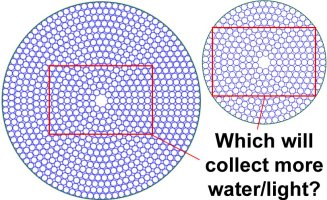
AreaMatters.jpg

You're not losing any light/rain per square inch; you're just losing resolution (or total test tubes).
This is where the confusion often arises in sensor discussions.

Shot noise (perceived grain or noise in an image) is determined by the signal-to-noise ratio of the light hitting the sensor. If you crop a full-frame image to match the exact field of view of the APS-C sensor with the same pixel size, the noise performance within that cropped area is identical to that of the APS-C sensor. So it really comes down to interpretation. But saying "you lose light" is incorrect and misleading when framed as a loss of resolution or a drop in pixel efficiency.
 
  • Sad
Reactions: 1 user
Upvote 0
We had an arborist out last fall, to evaluate some plantings and arrange for pruning of some lovely, old Japanese maples on our property (not something I'm willing to do myself or have our regular landscapers handle). He left a bunch of literature and the rain gauge with us, the papers went in the filing cabinet and for no reason other than laziness the rain gauge has sitting on the second desk in my home office since then. But I had to put some water in it (then weigh that water) in making my point, so after drying it off (ironic, right?) I did put the rain gauge out in the garden shed where it should have been put in the first place, last fall.
When the forum helps you! :)
 
  • Like
Reactions: 1 user
Upvote 0
I said it's less efficient if there are smaller pixels, which my example of R3 and R5 perfectly illustrates. It is the same efficient if the pixel size is the same.
The R5 in crop mode has less dynamic range than the R5 in full frame mode. Same pixels, same pixel efficiency, less area used to capture the image, less total light gathered...therefore more noise and thus less DR.

You're not losing any light/rain per square inch
Of course not. But the point was about image noise. Light per unit area determines the exposure, total light gathered determines image noise.

This is where the confusion often arises in sensor discussions.
Yes, clearly you are confused.

So it really comes down to interpretation.
Sure, you want to measurebate individual pixels and compare two images of different resolutions with both viewed at 100%. You can also print an R3 image at 13 x 20" and an R5 image at 18 x 27", hang them side by side and compare them (viewed from the same distance...or not, however you want to do it). Neither is the conventional and accepted way to compare two pictures.

The interpretation I am using is the one that is generally accepted in the field – compare pictures at the same output size and viewing distance. The interpretation you are using is not the one that is generally accepted.

But saying "you lose light" is incorrect and misleading when framed as a loss of resolution or a drop in pixel efficiency.
You are the one framing it as a drop in pixel efficiency. You are the one using a non-conventional method to compare images, and that is misleading.

I am simply talking about the total amount of light captured by a sensor, i.e. the number of photons. Under the same exposure conditions, a larger sensor will collect more light and have lower noise in the resulting image. A smaller sensor sensor will collect less light and have more noise in the resulting image.

The smaller sensor collects less total light, and it is completely accurate to say that light is 'lost' with the smaller sensor relative to the larger one.
 
Upvote 0
Rain Gauge (Pluviometer) Principle
A rain gauge is an instrument used to measure the amount of liquid precipitation (rain, snow, hail) that falls over a given period at a specific location.
Basic Principle
The most common type is the standard manual rain gauge (often called a Hellmann rain gauge or similar):
It consists of a funnel with a precisely known opening area (usually 200 cm² or 500 cm² in professional gauges) that collects rainwater.
The funnel directs the water into a narrow measuring cylinder (inner tube) to amplify the height of the water column for easier and more accurate reading.
The collected water is measured manually with a graduated scale, typically in millimeters (mm).
How it works:
Rain falls into the funnel → flows into the measuring tube → the height of the water column is read. Thanks to the funnel's known area and the calibrated tube, the height directly corresponds to the depth of rainfall.
Modern versions include:
Tipping bucket rain gauges (automatic) – a small bucket tips every time it fills with a fixed amount (e.g., 0.1 mm or 0.2 mm), sending an electrical pulse.
Weighing rain gauges – continuously weigh the collected water.
Optical/displacement sensors – used in professional meteorological stations.
Conversion of Fallen Water to Area (Rainfall Depth → Volume)
Rainfall is always expressed as a depth in millimeters (mm). This is a very practical unit because:
1 mm of rainfall = 1 liter of water per square meter
Mathematical explanation:
1 mm = 0.001 m (depth)
Area = 1 m²
Volume = depth × area = 0.001 m × 1 m² = 0.001 m³
1 m³ = 1000 liters → 0.001 m³ = 1 liter
Examples of conversion:
10 mm of rain on 1 m² = 10 liters
25 mm of rain on 1 hectare (10,000 m²) = 250,000 liters = 250 m³
50 mm of rain on 1 km² (1,000,000 m²) = 50,000,000 liters = 50,000 m³
General formula:
Volume (liters) = Rainfall (mm) × Area (m²)
Or more precisely:
Volume (m³) = Rainfall (mm) × Area (m²) / 1000
This is why meteorologists love the mm unit — it makes hydrological calculations extremely simple without needing complex conversions.
Would you like me to also explain different types of rain gauges or how to calculate runoff, evaporation, etc.?
Have you just copied + pasted from Wikipedia or an AI response?
 
  • Like
Reactions: 1 users
Upvote 0