IS is definitely useful, but not mandatory, and it will definitely depend on your shooting style.
Have a look at your shots taken with the EF-S 60mm, and look at the EXIF data to see the shutter speed.
Under normal conditions (ie, shooting people and big things), the general rule of thumb is that you should try to stay above 1/60s with a 60mm lens, 1/100s with a 100mm lens, to get rid of *your* shake.
Get down to macro sizes, and all of that gets thrown out the window. You're probably looking more at needing 1/120s for a 60mm lens, 1/200s for a 100mm lens, or more.
Now, for shooting non-moving bugs and flowers, having IS will reduce that a lot (although IS isn't as good at macro either), the 100mm L IS is still good for 2-stops of stabilisation at macro-distances, so should be handholdable at roughly 1/30s for 1:1 macro.
But for taking purely-moving and flying insects, shoot them at 1/30s and they're going to be blurry, even if the IS is negating all the shake from you. So you'll need to keep the shutter back up at 1/200s or more anyway.
That said, IS will definitely help with framing, and is useful for the more still-subjects anyway. So whether it's worth it comes down more to your wallet than anything. The 100 L IS is the newest, weather sealed, and the IS will help in most situations, so it's definitely the one to get if you can afford it.
The 180L and the 100 USM non-L are both older, and no, they have no IS. But the IQ differences between the 3 are almost negligible, the 100 non-L is sharper than the L for some combinations of settings, softer for others. So if you think you can get away without IS, the 100 non-L is very good for the price...



 .
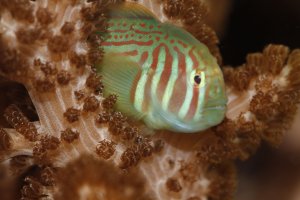
. Also the depth of field, in my case with F9, it's around 1cm if you are around 15 cm away from the object (measured from the front of the lens). Attached is an example, the fish is around 1,5 cm long. The image was resized to fit the forum rules.