Will Canon Withdraw from the Megapixel War?

Status
Not open for further replies.
unfocused said:
Anyway, thanks for taking the discussion seriously. I enjoy reading what others think (although, since I live in the middle of the U.S., I am very jealous of someone living on an island in the Mediterranean. :))

Thanks ! well, I am jealous of you for living in a large country with so many variety around you. Here is nice, but sometimes feels too small.
 
Upvote 0
motorhead said:
Warstreet talked on the previous page of current DR's of 12 stops and a possible future DR of 16 stops. If I could routinely achieve these theoretical laboratory figures in real life I'd be over the moon.

But that's the problem, these inflated figures cannot be achieved in the rough and tumble of real photography. I get at the most 6 real stops of DR, no more.

I'm not sure what settings you are using but I can easily get 11-12 stops from a properly exposed RAW image through lightroom. Of course, I always expose to the right to retain the most information without clipping...
 
Upvote 0
Human eye has about 100Mpx res more or less... then cameras, I think, must be call to try getting at least, our specifications. :-\
And it seems it should be posible in not to many years... Take a look!


http://www.dpreview.com/news/1008/10082410canon120mpsensor.asp

I'm specting FF bodies in the next generation grow up to near 40Mpx,this wil be funy to exile medium format cameras,to be replaced thanks to nano-tech. :)
 
Upvote 0
motorhead said:
Warstreet talked on the previous page of current DR's of 12 stops and a possible future DR of 16 stops. If I could routinely achieve these theoretical laboratory figures in real life I'd be over the moon.

But that's the problem, these inflated figures cannot be achieved in the rough and tumble of real photography. I get at the most 6 real stops of DR, no more. I was out yesterday shooting a steam train. As this is the UK, The day was "changeable". That is to say the sky was mostly white cloud with some pale blue in a very few places. The engine, Oliver Cromwell, is black. I have to resort to producing two TIFF versions in DPP which I manipulate seperately in photoshop before finally flattening to get anything like the DR my eyes registered at the time.

I will not repeat my argument which is based on the very weird shape of the sensor response curve because I have already aired it in a seperate thread, which can be found if anyone can really be bothered. But a Canon with a real DR of 12? YES PLEASE! And 16 stops in future? I've died and gone to heaven!


I think you're missing something here, that is your monitor cannot display the dynamic range you seek so it's doing the best that it can squashing the dynamic range in an attempt to accomodate it. If you want to display your images properly then you should be using (Assuming a 27") something costing a minimum of £1000. Perhaps the Dell U2711 or if you can afford it an Eizo or Lacie. These will cost considerably more. They will also need calibration as screens are normally far too bright, a screen calibrator will pay for itelf by the reduced energy consumption, calibrated screens acheive.

Trying to view images from a decent DSLR on a cheepo 24" TN panel is never going to be a satisfying experience, the better S or H-IPS panels cost significantly more, as do decent backlights which are also important (avoid LED).
 
Upvote 0
Slides aside: Output DR always was less then impressive, even the cheapest monitors beat photo paper. But you need proper input to get something nice to print or view. Sadly the matrix metering doesn't apply the zone system but simply exposes for a weightend average of neutral gray. That can pointlessly cost you quite a lot of DR. Only 2 stops of EC isn't ideal either.
 
Upvote 0
Flake,

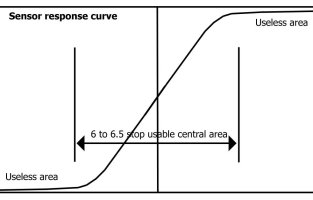
While I know my monitor is not the best, I do have a fully calibrated workflow. However I'm not basing my "real" 6 stops on the monitor display or prints. I plotted out my sensor response curve which shows a centre section with a gentle S shaped curve as we might expect, roughly similar to film response curves. Where it differs is that at the top and bottom it artificially drags out running almost horizontally for ever.

It's this absolutely useless top and bottom that confuses the lab tests because the tests find there is "information" in these areas, just not information that we can make any use of.

So the 6 stops I know I can achieve are from the centre area, excluding the extreme limits. To exploit it I have reduced the contrast of the RAW capture opening display in DPP which I then adjust using levels or whatever other tool in Photoshop seems appropriate to expand the image back out to the full 0 - 255 contrast range.
 

Attachments

  • graph.jpg
    graph.jpg
    27.4 KB · Views: 354
Upvote 0
Msot of the posts here seems to be quite polarized. Either they want the mega Pixel War keeps going on to 120MP or they want It to stop. Or they try to draw the line for High Mp for hobbist and lower pixel count for Pros. The following is my own personal opinion and not the intention for another battle front. For hoobist, not that many people can affort to have a few $2000 lens. So using a 18 MP sensor will be a waste of computer power without any real gain in reolution. Pros have the advantage of deeper bugget (tax write off). So Canon should use their sensor technology ( low noise sensor, gapless micro lens etc) to produce a lower Pixel count sensor( 12 to14 Mp ??) to give hobbist a camera that have better dynamic range and does not strain the resolution of a reasonable price lens. How many hobbist need bigget than 14 X 12 enlargement???So Canon, are you listening ????
 
Upvote 0
I'm sorry Motorhead but in isolation the graph is pretty meaningless. How did you measure it and how did you remove the sensor from the camera to measure it? Is this an amalgam of all three channels measured seperately and merged to give an average? RAW setting jpeg? and what exactly is the camera?
 
Upvote 0
Motorhead I'm still not getting useless extremes (nor fully understanding your logic)... can you post this in a brand new thread and give examples maybe a link to a DNG or raw file along with the outputs you're getting. I'm really interested and I'd really like to know what you are saying.
 
Upvote 0
Don't over complicate the sensor response curve fella's. It's very simple to do.

I followed the procedure explained in the July 2008 edition of Amateur Photographer. Using a a mid grey target, under a steady light source, Lock the aperture and simply take a normal exposure. Then using that as a base setting, go up and down in shutter speed from there in 1/3rd stops until the images at the extremes are pure black and pure white (or as close as it will ever be possible to get). From memory I went from plus 8 stops to minus 8.

That was easy, now comes the more time consuming bit. In photoshop, I used the eye dropper tool to make sure I was reading true tonal differences image by image and plotted the results on the graph, image by image. I've shown an "idealised" graph, in reality my graph showed odd little lumps and bumps.

I did not want a "lab" test, I wanted a simple and straightforward real world test and this seems as close to it as I'm ever going to get.

The graph is an idealised curve because I thought it would explain what I meant better than the real one, which apart from the humps and bumps is also a little scruffy after a couple of years tucked into my camera manual!
 
Upvote 0
I'm sorry Motorhead but that test isn't going to show real world results. Sensors output is variable across the colours, but that most important component, the image processor smoothes everything out into a perfect 45° from 0 to 255 on each of the colours.

http://www.baslerweb.com/imgs/2749596_84aa3944e3.gif

Taken from http://www.baslerweb.com/beitraege/faq_en_28974.html

Shows how the image processor uses the most linear portion of the sensors output, this is in marked contrast to the graph which you have shown.
 
Upvote 0
Flake,

I admit its a very simple test and to me that's its beauty. Its showing me the results I actually get in real life, not an artificial situation. I could do three seperate graphs showing the RGB tonal response but while I'm sure there would be differences I don't have any problems tweaking colour balances after the event.

The results I have are the output from the camera, processor included, which is perfect. Trust me, the weird and completely useless virtually horizontal tails that stretch out to infinity are real, AP even showed the same response in the graph that accompanied their article.

I stick to my story, my camera gives me 6, maybe 6.5 stop DR. I'd love it to be more and hopefully Canon will address that over time, but it's not the 12 stop DR that the lab tests would claim. It's one of the areas that digital has still got ground to make up on film.
 
Upvote 0
Flake said:
I'm sorry Motorhead but that test isn't going to show real world results.

I agree, for more than one reason. First off, altering the exposure as suggeted in that article is not the best approach - the real question is the DR that can be captured in a single exposure. Motorhead, if you really went from +8 to -8 stops, bravo - you pretty much spanned the full range of shutter speeds (you'd have to have had a metered exposure of 1/15 or 1/30 s, and your longest exposure would have been 15 or 30 seconds).

It's true that even looking at a RAW file, you're getting 'mixed' data, or rather unmixed, in the sense that it's demosaiced and the different transmissivities of the windows in the Bayer array are already baked into the image (unless you're using more sophisticated software, e.g. Rawnalyze).

I do think that DR is usually measured badly by many testers. DxOMark does quite thorough tests, but their measurement of ~11-12 stops of DR for most Canon bodies is overstated, and real-world DR is less than that (at the dark end, they're quantifying noise as signal).

In practice, I see about 8.5 stops of useable DR with the 5DII, and about 8 stops with the 7D (at ISO 100, and DR drops a bit at high ISOs). That's less than DxO's claimed DRs, but more than motorhead's claimed 6ish stops. My data are based on testing with a backlit transmission step wedge, right side of the image frame bounded by the magenta line in this test setup:


I ran a set of exposures where the clear part of the step wedge (a Stouffer 21-step wedge, where each step is 0.5 stops) was just shy of clipping, and the bare backlight was clipped. The DR tests were done with the goosenecks off, so the only light was the backlight for the wedge. 'Analysis' was qualitative, looking pixel values under the dropper in ACR, seeing where the steps could no longer be distinguished.

Overall, though, I think the key points are that DR could definitely be improved, and for starters it would be nice to see Canon getting somewhere near to utilizing the full 14-bit depth of their ADCs (DxOMark's optimistic measurements fall 2 stops short of that for Canon, whereas Nikon and Pentax 14-bit cameras deliver a full 14 stops of DR in DxOMark's tests).

 
Upvote 0
neuroanatomist,

Now that's a lot nearer my results. I'm still using a 30D, so if you are seeing 8 and a bit from a 5D2 then progress is being made, if slowly. You also understand my hatred of tests that are in fact measuring random noise and insisting it's information.

I will happily admit that I don't have any scientific knowledge about sensors, I'm simply a user of the camera. I needed to know how far I could push the shadows and/or highlights before I risked clipping and I'm happy that my 6 and a bit stops is right for me - its exactly how my camera really behaves.
 
Upvote 0
All the testing represents best case results under perfect conditions. I see it as being kinda similar to the advertised gas milage for cars, no one really achieves it, but under perfect circumstances its possible.

I also agree that some testers are achieving results that are nonsense, I had to deal with that in my own company, where, for example, a organization believed that light loss in a fiber optic cable should include light loss in the outer buffer of the cable even though only light from the core can be used. Doing this made it theoritically impossible to use the cable termination when in fact, it exceeded everyones expectations because there was very little light loss in the core, which was what counted.
 
Upvote 0
The 30D is a 12 bit camera so the later 14 bit processed images are going to produce better dynamic range. I have a thing that too many people concentrate on the sensors and not anything like enough on the image processor which is the real keystone of a digital camera. Manufacturers didn't name their sensors (well OK some did) but all of them name their image processors. Good image processing affects so many camera functions, and yet hardly anyone ever seems interested. Sad really.

BTW the Cokin - Lee etc graduated filter system were made in the days of film exactly for this problem, and they're still useable with digital, you should consider using them. Then there's HDR which you could never do with film this way you can manage ridiculous dynamic ranges.

Our eyes can see a huge dynamic range, and they acheive this by scanning a scene and adjusting the pupils, persistence of vision means we see the whole scene, and don't even realise what our eyes have done. A camera cannot do this, but one interesting solution is adaptive Iso where the sensor is read using different Iso settings.
 
Upvote 0
Flake said:
Then there's HDR which you could never do with film this way you can manage ridiculous dynamic ranges.

Actually there are some extreme high dynamic ranges taken with film. Photos of nuclear tests were taken with XR extended range film.

While photographic negatives have long been capable of capturing
a wide dynamic range of scene information, and HDR-capable
film, called XR for extended range, was created with multiple fast
and slow emulsions to photograph atomic and nuclear bomb
explosions


http://www.cis.rit.edu/fairchild/HDRPS/CIC15HDRSurvey.pdf
 
Upvote 0
Flake said:
The 30D is a 12 bit camera so the later 14 bit processed images are going to produce better dynamic range. I have a thing that too many people concentrate on the sensors and not anything like enough on the image processor which is the real keystone of a digital camera. Manufacturers didn't name their sensors (well OK some did) but all of them name their image processors. Good image processing affects so many camera functions, and yet hardly anyone ever seems interested. Sad really.

BTW the Cokin - Lee etc graduated filter system were made in the days of film exactly for this problem, and they're still useable with digital, you should consider using them. Then there's HDR which you could never do with film this way you can manage ridiculous dynamic ranges.

Our eyes can see a huge dynamic range, and they acheive this by scanning a scene and adjusting the pupils, persistence of vision means we see the whole scene, and don't even realise what our eyes have done. A camera cannot do this, but one interesting solution is adaptive Iso where the sensor is read using different Iso settings.
If the sensor is saturated with high light or noise, the processor cannot do anything about it. On paper, a 12 bit processor will give us at least 12 stops of dynamic range, a 14 bit processor will give us at least 14 stops of dynamic range. None of us can get that kind of dynamic range out of our DSLR. This is a good proof of the sensor dynamic range is the limitation, not the processor.
Graduated filter is an excellent idea to make the picture look better under certain condition by compressing the dynamic range of the scenery to a point that the sensor can handle it easier.
As for human eyes, the dynamic range is much higher than the sensor. couple with our brain's "cheating power" (We still see a white shirt under the ordinary light bulb while the digital camera sees as yellowish even with automatic white ballance. The camera will see it really yellow if the white balance is set to day light) We will have dynamic range that no camera plus software correction can match.
There are posts talking about diffraction limitation. We should also look at it from a different angle. The diffraction limit is cause by the lens, not the sensor. At lower resolution sensor, we just never see it. With high resolution sensor, the diffraction limitation just reduce the high resolution sensor to a lower resolution sensor. Example: 18 Mp diffraction limit is f 6.3 while 10 mp diffraction limit is f 10.6 (??) . If you set the lens at f11 with a 18 mp sensor, you just reduce the actuall resolution of the 18 Mp to be 10 Mp, assuming a good lens is used.
 
Upvote 0
why stop the megapixel growth if you can keep the noise down.

phase 1 have gone to 80MB now, right.
did the engineers at phase 1 a few years ago said to themselves, oh i think 50 is too much, let's redraw from the megapixel war. oh, the pro want less megapixels, they are happy as it is?

NO NO NO.

canon should give us more, more, more.
I love to zoom on my 30 inch monitor and look at the detail of the photo.
 
Upvote 0
Status
Not open for further replies.