The Best and Worst of 2025

The light that is digitally corrected to fill the corners when required still falls on the sensor.

But the ability to pull apart some of the individual beams is lost.

To go to an extreme point, why even bother with a full frame lens if all we need to do is put an APS-C lens on the front of a full frame model and then stretch that image such that it "fill the picture".. Afterall, what's a few dark corners/boundary between friends if digital corection is ok? Where's the cutoff point between too much stretching vs acceptable stretching?

Canon's asking people using its equipment to take it on good faiith that the dark corners from various lens is acceptable. Or at least I say that because I haven't see Canon say anything with authority on this subject matter and I'm pretty sure if you had then you'd have quoted it by now.

The detail that gets lost in the squashed iamge (it doesn't fill the srnsor, so I'm using "squash" as the term to refer to it being made small) can't be made to reappear with some magic process. Even if you take into account the blur from the AA, there must be less refined data to work from in an image that's only 19.96mm "high".

The difference is that I’ve provided empirical evidence to support my points. Have you? Has anyone who claims that optical correction of geometric distortion is inherently superior to digital correction.

You've eyeballed some images and made some claims that you're asking us to accept on no better grounds than faith.

I don't trust humans to be a good judge of the evidence because humans are unreliable and all too frequently plagued by biases.

So you shoot RAW, and you don’t use a lens profile in your RAW converter? I’m skeptical. Especially after your intentionally evasive reply to @AlanF.

Correct. Using a lens profile is not a requirement of using a raw converter, nor is using CA correction.

Faith is an interesting word to being up in the discussion of this topic because there is practically no verifiable analysis done on it but we're alll excepted to accept the new lay of the land as being ok. Summary, Canon's asking us all to take a huge leap of faith in it.
Upvote 0

The Best and Worst of 2025

The point of the question is to lead to a discussion of what happens when we process RAW data and the choice of RAW converters. If you are unaware of your software doing correction, then how on earth could that make you a liar? (Lying is deliberately telling an untruth.)

Good software that does raw conversion gives you the option of whether or not to do correction based on known lens profiles or CA elmination. I leave those check boxes to the default software position - off.. Maybe DPP turns it all on by default, IDK 'cause I don't use it. As I said above/previously, I don't use lens profiles/CA correction and I said that knowing that the software I use doesn't have those things turned on for images that I process.
Upvote 0

Canon Eyes a Canon RF 50-150mm F2.8

It would likely depend on the comparison. For example, I’m not sure that comparing the digitally corrected corners of the inexpensive RF 16/2.8 to the optically corrected RF 15-35/2.8 would be valid, because the base quality of the two lenses is very different. Having said that, it is interesting that the digitally corrected corners of the RF 16/2.8 deliver similar IQ to the optically corrected corners of the far more expensive (but also much older) EF 14/2.8L II.

Now you get it.

I see. So you’re belief that optical correction is superior is akin to faith – belief without evidence.

If I was to believe that digital correction was the equivalent to or better than optical correction then that too would be akin to faith because I have no evidence to support it.
Upvote 0

Canon Eyes a Canon RF 50-150mm F2.8

As @neuroanatomist has written many times, he has the same charts as the digital-picture and has got them to correct some results. You can do digital-picture type charts for free by downloading them from the bobatkins site. However, to measure lp/mm with precision you need to use IMATEST or similar, which is done by opticallimits, lenstip, ephotozine etc.

To get meaningful results, I think dedicate software such as IMATEST or similar is required. Otherwise there's too much subjetivity.
Upvote 0

From 5D Mark III to R5 Mark II - photographer review - first 1 month and a half - 12k shots

I kept digging regarding the lack of 28mms and found this review. Such a shame that Canon doesn't offer a similarly sized 28mm but with at least the image quality of the EF IS and fast autofocus. Sadly their pancake has great image so it will never happen, there are just not enough people looking for a great autofocus on this focal length.

- It may seem a bit strange but these days full-format 28mm prime lenses are almost exotics. The unpopularity probably relates to the perception that such lenses aren’t wide enough for landscapes or architecture and too wide for everything else.
[...]
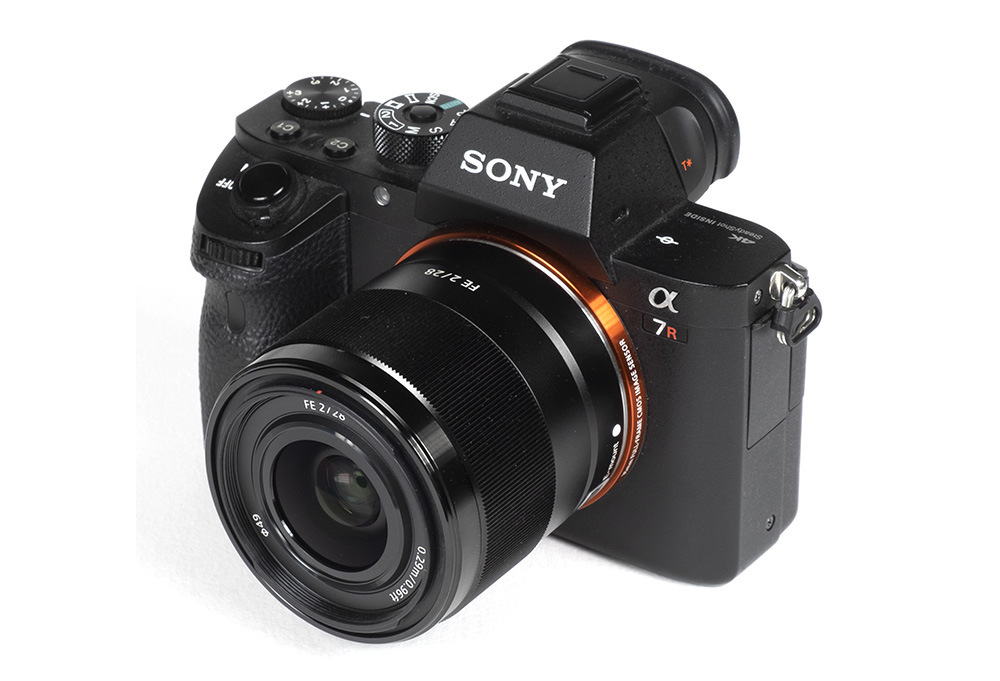
As already hinted in the introduction, direct competitors to the Sony FE 28mm f/2 (shown to the left below) don’t exist.
Upvote 0

The Story of the Canon RF 45mm f/1.2 STM: The Tale of Different Reviews

I bought the EF 50 1.4 just before this lens was announced. Fits better in my bunch of EF lenses and can be used with a variable ND adapter.
R7 destroys that lens wide open - on FF with 24MPix it is very usable wide open. What I like is that the older EF version has low distortion and moderate CAs without any correction.
Now about the RF 1.2 45: It is close to these older designs in IQ, suffers from strong distortion and it has AF which is not the case for 3rd party lenses, a huge advantage!
Now my opinion about IQ wide open etc:
If you can use f/2.8 or f/4.0 and the lens is sharp, contrasty, gives good colors you can use it for landscape, lots of portrait situations, nature, architecture.
With f/1.2 or f/1.4 you have the option for low DOF or night shots which are not accessible with e.g. a f/4 or f/2.8 zoom. Some degradation in sheer sharpness is traded in to get the photo which is not possible with f/4 or f/2.8.
Upvote 0

Canon Looking for a Prosumer RF-S Zoom? Finally?

I would be satisfied with a well corrected (not relying on computational correction for good results) RF-S 15-60 4.0 IS USM with a good close focus range (1:3 reprod. ratio would be stunning).
But maybe three lenses?
→ f/2.8 High End Z type 15-60
→ f/4.0 High quality fixed aperture 15-60
→ f/2.8...5.6 good quality var aperture 15-85 like the older EF-S version
And the EF-S 15-85 is of really good quality, very low noise AF, IS and reasonably sharp at least for 4k video - the R7s 32 MPix sensor reveals the non-perfect sharpness but photography is more than just pixel peeping.
Upvote 0

The Story of the Canon RF 45mm f/1.2 STM: The Tale of Different Reviews

The Canon RF 45mm f/1.2 STM, which was announced towards the end of 2025, brought a fresh outlook to Canon's RF mirrorless system. With a price tag of about $469, this small lens (78 x 75mm, 346g) promised to deliver shallow depth of field, beautifully blurred backgrounds, and nighttime performance without the high-end price tag […]

See full article...

Canon Eyes a Canon RF 50-150mm F2.8

I might also be inherently against "one lens solution" type of lenses. It's rarely if ever the best tool for the job.
IMO, sometimes the ‘one lens solution’ is the best tool for the job. For me, when the ‘job’ is a family trip where I want good quality photos including memory shots, but don’t want to detract from time with the family by carrying a bag full of lenses and changing them out, the best tool is often the R8 and RF 24-240mm.
But yeah, if I’m being honest then I will add that I often also carry a fast, wide prime (24/1.4, 24/1.8 or 20/1.4) and the 10-20/4 since that kit fits in a bag small enough that it isn’t excluded from venues (museums, etc.) that don’t allow backpacks.
  • Like
Reactions: 1 user
Upvote 0

Filter

Forum statistics

Threads
37,258
Messages
966,566
Members
24,621
Latest member
Dopamine-junkie

Gallery statistics

Categories
1
Albums
29
Uploaded media
353
Embedded media
1
Comments
25
Disk usage
982.4 MB