Upvote
0
Yeah, on the last photo.WOW!!! That's the FISHERMAN! Did it really swallow that fish?!
Take a camera such as the R6 and expose a grey card (or something else like a brick wall that is 18% reflectance) illuminated with full sun (after two hours from sunrise and before two hours from sunset) and shoot the ‘sunny 16’ rule at 100 ISO and 1/100 sec f/16. The resulting converted file will be underexposed. Do it again but use 1/60 and it will be correct.Except all of those cameras that have 67 ISO as measured by DxO, et al also include instructions in the EXIF info to 'push' development by 1/3 stop (or whatever the ratio is needed) when converting from raw to a viewable image. They do this precisely to protect the highlights from overexposure. If you expose +1/3 (or whatever the ratio calls for) to compensate on your own, you'll lose details in the brightest highlights.
Digital sensors have linear response all the way to full saturation, unlike film which rolls off response as most grains absorb enough photons to reach the point where they will be "switched on" when developed thus leaving fewer grains to absorb additional photons. It's perhaps ironic, but film grains are either "on" or " off" when developed, while digital sensors absorb the energy of each photon striking it in a more analog way before analog amplification and ADC.
I already gave up my hope that I could upgrade my R7 before I leave for a birding trip in June. Well I'll survive with the R7 and R5II. My R7 is really a strange package: shooting birds in flight against blue and or overcast skies is quite a challenge - the camera's object recognition quite frequently fails in a mind-boggling way. On the other hand, with a vivid background when the old 7D II would have struggled, the R7 can really shine. Here are two fighting skylarks, they were quite far away, this image is heavily cropped. So they were mere quite small spots on the sensor. I just lifted my lens and took a series of shots w/o hope to get any in-focus hit. But then I found a whole series in focus, this is one of the best. Shot with the EF 600mm f/4.0 III, f = 6.3 and 1/1250 s shutter speed. So, the original R7 is always good for a surprise, either a bad or a really great one.View attachment 229073

I know, I loved to follow his blog for many years. But in real life, the old EF 300mm f/4.0 L IS USM worked quite well even with my 5D4. Interestingly, my old EF 500mm f/4.5 L USM from 1995 worked still surprisingly well with my R7, in contrast to my 300mm, a lens that was introduced in 1997.
Yes but this doesn't explain the light dependent behavior, noise (and contrast on the AF sensor) does.
I'd have to presume it is to some degree, given the discord between the build/positioning of the R7 to the 7D series.
I had the 7D and 7DII for many years. My R7 is a huge upgrade over both cameras in every way that matters to me.
My Nikonian friend tells me that she thinks Nikon has basically given up on the crop bodies. Nothing really since the D7500. 7200 really since they went with less pixel density in later models. Birders aren't all that happy, though they're still great cameras.
If their financial models indicate that they can’t make a profit on the product, then ultimately it would be yes - write it off.
I actually think the ‘supply chain crunch’ is a very plausible explanation of the situation. The rumored R7II is basically an R5II with an APS-C sensor rather than a FF sensor. You almost certainly aren’t going to save $1k+ on a camera just by switching to APS-C so the R7II was already going to have narrower margins - price increases in RAM and associated electronics could easily squeeze those margins to the point where it just doesn’t make economic sense to proceed at this time.
If this is the case, then it’s highly likely that they aren’t abandoning the project, but instead putting it on hold for 6 or 8 months to see what happens with the supply chain landscape.
Thanks for that update. I have the Canon R6ii. Do you know where on those websites I can find the iso data?
Beware the Sunny 16 rule with digital cameras !
As has been correctly stated, the ‘rule’ is when the subject is lit frontally and evenly in full sunlight, from two hours after sunrise to two hours before, if your shutter speed is the ‘same’ as your iso then f/16 gives the correct exposure.
The problem with this rule and most digital cameras is that their stated iso is not the real iso. So to use the ‘sunny 16’ with a digital camera you have to know what, say 100 iso on your camera really is. This information is available at both dxomark and photonstophotos.
To use a Canon R6 as an example, the camera stating 100 is really 63.
So to use the sunny 16 rule when your R6 is set to 100 iso, on a full sunny front lit day set 1/60th, not 1/100 at f/16 and you’re exposure will be spot on.
On my 5DS the 100 iso setting is really 77.
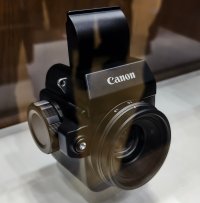
Honestly, I thought these concepts were horrible and made a Sigma BF look user-friendly.What I'd like to see is something innovative based on this concept camera but without the weird mirror system instead have a massive upward facing EVF (or a magnified EVF) instead of just another horrible retro repackaging of a modern camera with crappy ergonomics and nasty sharp edges.
Even better ditch the retro camera entirely and release a high end R7ii this year![]()

Whereas the "flagship APS" R7 is 4 years old and lacking many advanced features(can't even put a grip on it!).
As I’ve stated before, the 7-series historically has been the least frequently updated.In the DSLR days, sometimes lower tier models were updated more frequently than higher ones, this is nothing new.