Opinion: Love it or Hate it, Digital Correction is here to Stay

And I thought that these 'digital correction' allows for a better image quality as most writers assume. And now I can only use these expensive 'digital correction' lenses after stopping down?? That doesn't make sense!
I'm just curious how vignetting ruined landscape shots. Apart from the astro landscape niche discussed at length on other threads, my understanding is most landscapes shots are taken stopped well down - regardless of the lens used - so vignetting shouldn't be an issue?
  • Like
Reactions: 1 user
Upvote 0

Opinion: Love it or Hate it, Digital Correction is here to Stay

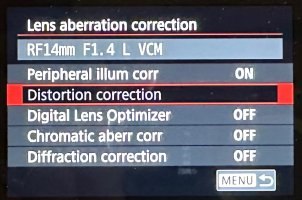
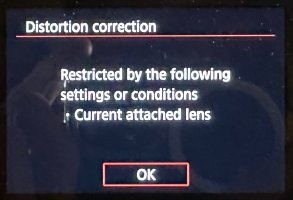
The types of corrections being discussed here result from the image circle being smaller than the sensor. Notice how we're talking about lenses like the RF 14/1.4, the RF 14-35/4, etc. With telephoto lenses, that typically does not happen so your proposals of 150-180mm lenses with a 'need for correction' is a red herring. They won't need it. Even a correction-requiring lens like the RF 24-105/2.8L Z covers the full image circle by 28mm, it's only at the very wide end that it needs digital correction to fill the corners.
The choice of my examples is not great, here you are right,, long focal lengths are easyer to correct - So lets think about 18mm f/4.5: I would not accept the need of digital correction. For a compact 15mm f/2 I would accept moderate digital correction.

About filling the image: this is in my opinion a consequence of correcting strong distortions which is the primary goal of digital corrections.
By the way the RF 24 105 Z lens has surprisingly strong pin cushion distortion at the long end too but that is a design choice of Canon outsourcing distortion correction to the image processing ... but that's a zoom specific compromise, I think.
Upvote 0

Opinion: Love it or Hate it, Digital Correction is here to Stay

That's absolutely right. As you wrote, in film times, optical correction was a necessity, lens manufacturers didn't have a choice.
Yet, when I see how good the VCM lenses have become, "despite" software correction, I wonder how long the debate optical vs. software can still go on...
I guess the progress in computer based design, new optical materials and coatings will go hand in hand with a deeper digital correction, and users will definitely profit from that progress.
  • Like
Reactions: 1 user
Upvote 0

Opinion: Love it or Hate it, Digital Correction is here to Stay

Rejecting software correction implies rejecting also DXO, LR etc… editing.
What matters is how good the picture you obtain is, whether optically or electronically corrected. Period!
I would go one step further...

Your entire image with digital cameras is created with a series of digital corrections. Your sensor is not recording the colors as you will see them, they have to go through a demosaicing, in other words a digital correction. The tones from dark to light are not recorded on the sensor as you will see them after converting the RAW image, they need to go through a tonal correction algorithm. Same with White Balance, and many, perhaps most most now apply noise reduction in the RAW conversion. Your RAW file is not a negative. So your converted image is a,series of Digital Corrections. So, why the big deal when it comes to lenses? Makes no sense.
  • Like
Reactions: 1 users
Upvote 0

Here We Go Again, More EOS R3 Mark II Chatter

My take, Canon is trolling us, knowing someone would take a pic, but just using an R1 casing for testing out features for future cameras in general, not the R3 II specifically. No way the R3 is going to have all those features and cannibalize the bodies above and below it. I'm really dubious of any R3 II though.
  • Like
Reactions: 1 user
Upvote 0

Opinion: Love it or Hate it, Digital Correction is here to Stay

And I thought that these 'digital correction' allows for a better image quality as most writers assume. And now I can only use these expensive 'digital correction' lenses only after stopping down?? That doesn't makes sense!
Yes, what you say makes no sense.

I’m not sure who is saying the image quality is better, there is a difference between better and not worse. Yes, in some cases it is better and in others, it is worse. It depends on the lens. In most cases, the difference is probably not enough to have a meaningful effect, at least in most use cases.

No one is forcing you to use any particular aperture. As I pointed out, there are ‘optically corrected’ EF mount lenses with >5% distortion and/or >4 stops of vignetting. No one forces users of those lenses to only use them zoomed out or stopped down.

But…straw men are fun to stand up, right?
Upvote 0

Opinion: Love it or Hate it, Digital Correction is here to Stay

Can you stack uncorrected subframes? Something like: process raw without the lens profile, then stack, then apply the corrections to the finished stack, if you want?
That is my work-around at the moment. And that is also the reason why I worry that a much stronger image correction might create additional problems when stacking.
  • Like
Reactions: 2 users
Upvote 0

Opinion: Love it or Hate it, Digital Correction is here to Stay

Main thing I don’t understand with the Digital Corrections is how they can clearly make a physical crop of the original image and discard that data, yet still show 6000x4000 pixels in the final image.
Yes, it’s cropped…after the distortion correction stretches it out. Because of the 3:2 aspect ratio, correcting the distortion stretches the image more horizontally than vertical. In the case of a 24 MP sensor, it’s cropped down to 6000 pixels wide. For example, if you don’t crop to the original aspect ratio then the resulting corrected image is wider than 6000 pixels.

Note that this is just how barrel distortion correction works, even on EF lenses (example here).

I mean, conceptually I get that they’re stretched and interpolated. But not all of the original pixels are there. It’s a crop of what was captured.
Yes, stretched and interpolated just enough to get to the full sensor height, then the sides are (optionally) cropped off down to the full sensor width.

The other point is that all of the original light is there, it just didn’t initially cover all of the available pixels of the sensor.
Upvote 0

Opinion: Love it or Hate it, Digital Correction is here to Stay

Were you not stopping down? I thought that was typical for landscape shooting?

....
And I thought that these 'digital correction' allows for a better image quality as most writers assume. And now I can only use these expensive 'digital correction' lenses after stopping down?? That doesn't make sense!
  • Like
Reactions: 1 user
Upvote 0

Opinion: Love it or Hate it, Digital Correction is here to Stay

Main thing I don’t understand with the Digital Corrections is how they can clearly make a physical crop of the original image and discard that data, yet still show 6000x4000 pixels in the final image.

I mean, conceptually I get that they’re stretched and interpolated. But not all of the original pixels are there. It’s a crop of what was captured.

I’m not saying it bothers me a lot. I just don’t understand it. But some of my favorite travel shots were taken with the much maligned 24-240 (which I think, based on the comments at release, invented distortion and lens corrections).
Upvote 0

Opinion: Love it or Hate it, Digital Correction is here to Stay

I see that there is an advantage with the digital correction for many applications, but there is also a disadvantage for other applications. It would be nice if we would have a larger selection of RF lenses so that each user would be able to select according to his needs (like in the good old 'EF-time').
Yes, let's go back to the good old days when men were men and lenses were lenses. When real men looked through real viewfinders. When sensors could be film and a manly man's lens knew it. Back then, we had optically corrected lenses that didn't need no stinkin' badges or digital correction. Manly man lenses like the Canon EF 11-24mm f/4 that had manly barrel distortion of 4.5%, or the even more manly manny Sigma 12-24mm f/4 Art with an even more massively manly 5.3% barrel distortion (the same as the Canon RF 14-35 that 'requires' correction, oh my!).

Lenses for MEN.png

Meh. I'll stay here in the present, thanks.
  • Haha
  • Like
Reactions: 6 users
Upvote 0

Opinion: Love it or Hate it, Digital Correction is here to Stay

I have had landscaped photos ruined because of not realizing the amount of corner vignetting correction that was taking place.
Were you not stopping down? I thought that was typical for landscape shooting?
That said, I hate the concept of digital correction because of not where it is today but rather than where it could go tomorrow. What is stopping them from making smaller lenses yet that have an APS-H image circle and then they stretch/scale it back to your full frame resolution.. should we care if ultimately the image is cleaner, sharper, etc.. I would on principle.. but if they took away the toggle to see the file without corrections we would probably never know.
Slippery slope fallacy?
  • Like
Reactions: 1 user
Upvote 0

Opinion: Love it or Hate it, Digital Correction is here to Stay

Concerning the distortion correction: When I apply the classical 'distortion correction' before stacking (e.g. startrails), I get ugly moire pattern in the stack. So it seems that stretching is introducing subtle variations into the image which will only show up when stacking.
Can you stack uncorrected subframes? Something like: process raw without the lens profile, then stack, then apply the corrections to the finished stack, if you want?
  • Like
Reactions: 1 user
Upvote 0

Opinion: Love it or Hate it, Digital Correction is here to Stay

Hi!

As mentioned by some contributors before: The vignette is pretty strong and limiting the use of such lenses for certain applications like night photography. I have a lot of experience with different lenses and a vignette of around 3EV is the limit for my work of panoramas at night.

Concerning the distortion correction: When I apply the classical 'distortion correction' before stacking (e.g. startrails), I get ugly moire pattern in the stack. So it seems that stretching is introducing subtle variations into the image which will only show up when stacking.

I see that there is an advantage with the digital correction for many applications, but there is also a disadvantage for other applications. It would be nice if we would have a larger selection of RF lenses so that each user would be able to select according to his needs (like in the good old 'EF-time').
  • Like
Reactions: 1 user
Upvote 0

Opinion: Love it or Hate it, Digital Correction is here to Stay

Definitely in the “hate it” side of this argument.. sure barrel distortion correction is lovely, and the ability to crop anywhere in an image to make a smaller also perfect image is something I do constantly… and you would think that being a EE with a specialization in DSP and image processing I would be all about this technology and pushing the boundaries….

But at the end of the day it all boils down to awareness of whats actually happening in the processing pipeline so that I, the photographer, can make the correct decision regarding exposure.. I have had landscaped photos ruined because of not realizing the amount of corner vignetting correction that was taking place. Now to be fair, I’m a hobbyist and those photos being ruined cost me nothing more than frustration..

That said, I hate the concept of digital correction because of not where it is today but rather than where it could go tomorrow. What is stopping them from making smaller lenses yet that have an APS-H image circle and then they stretch/scale it back to your full frame resolution.. should we care if ultimately the image is cleaner, sharper, etc.. I would on principle.. but if they took away the toggle to see the file without corrections we would probably never know.

I know I’m on the minority side of this argument.. and also that I shouldn’t care how the proverbial sausage is made.. but I’d like the believe that the these lenses don’t rely on post processing to stretch and brighten the image back to something acceptable to view.
  • Like
Reactions: 2 users
Upvote 0

Opinion: Love it or Hate it, Digital Correction is here to Stay

The VCM lenses are crazy good! I love my 50mm and find myself reaching for the 85mm F2 a lot less...
Does the VCM 50/1.4 require digital corrections to stretch image corners that do not cover the entire sensor? or just some geometry correction and lightening up vignetting?
I believe people on the internet will keep the debate going forever, just so they have something to complain and talk about.
or what, should we do away with forum such as CR? :p
Upvote 0

Opinion: Love it or Hate it, Digital Correction is here to Stay

I've given up on Topaz for upscaling (and for everything else as well)- its more recent AI "improvements" invent too much. PS is much more realistic. I posted some examples comparing them on a thread somewhere, which I can't find.
Thanks. I upscale so rarely, I haven’t used Topaz in months.
Upvote 0

Opinion: Love it or Hate it, Digital Correction is here to Stay

Well over a decade ago, I wondered how long the DR debate would go on.

Some debates will never die, they feed too many click loving "experts". ;)
Upvote 0

Opinion: Love it or Hate it, Digital Correction is here to Stay

As does Topaz. I have not used and have no intention of ever using Canon's digital tele-converter.
I've given up on Topaz for upscaling (and for everything else as well)- its more recent AI "improvements" invent too much. PS is much more realistic. I posted some examples comparing them on a thread somewhere, which I can't find.
Upvote 0

Opinion: Love it or Hate it, Digital Correction is here to Stay

I want to make clear my discussion pertains to in-camera lens correction for JPEG output. My attachment sample is for chromatic aberration, but my point also applies to vignetting and geometric distortion.

Canon lens designers, with their Computer Aided Design (CAD) software, know exactly how a theoretical lens design performs regarding various aberrations. The lens design process involves numerous compromises to get to a marketable product.

One important lens design consideration is how easy it is to manufacture. A follow on from this is how consistent is unit to unit performance.

The in-camera lens correction software algorithm uses a ‘model’ of the lens to modify the internal RAW sensor data for JPEG engine output. Any ‘deviation’ of a particular lens being corrected from the model of that lens will result in a sub optimal corrected result.

My attachment is an EF 17-40mm f/4 L lens at 17mm and f/4. Top is software correction off and bottom is chromatic aberration correction on. The left and right sides are magnified crops of the left and right sides of an image of two framed photos – the frame is black and the matte board is white.

The uncorrected image clearly shows evidence of chromatic aberration with magenta and green fringing along the photo frame edges. However, on the corrected image, the magenta and green flip sides, albeit with a better result than non-corrected.

My conclusion is that my copy of the EF 17-40 doesn’t conform to the software model exactly. It’s overcorrected, so my copy is ‘better’ than the model, ha ha.

I understand post processing RAW gives one more flexibility regarding corrections, but my workflow is mostly JPEGs. In that regard, I’m greatly appreciative of in-camera software corrections.

Attachments

  • chromatic_abberation_OFF-ON.jpg
    chromatic_abberation_OFF-ON.jpg
    251.9 KB · Views: 6
  • Like
Reactions: 1 user
Upvote 0

Opinion: Love it or Hate it, Digital Correction is here to Stay

That's absolutely right. As you wrote, in film times, optical correction was a necessity, lens manufacturers didn't have a choice.
Yet, when I see how good the VCM lenses have become, "despite" software correction,
The VCM lenses are crazy good! I love my 50mm and find myself reaching for the 85mm F2 a lot less...
I wonder how long the debate optical vs. software can still go on...
I believe people on the internet will keep the debate going forever, just so they have something to complain and talk about.
Personally, I´ve made up my mind: I love digital correction! The results with the 16mm, 14-35mm and now 50mm are just marvelous! The weight savings are amazing and very welcome.
  • Like
Reactions: 1 user
Upvote 0

Opinion: Love it or Hate it, Digital Correction is here to Stay

What some are missing is that the 14-35L is an absolutely phenomenal lens. It is the best UW zoom I've ever owned/tried (I'm not including UUW lenses like the 11-24/10-24, which I have never used), and it's better than the 15-35L, which I also owned. As others have mentioned, the uncorrected lens is wider than 14mm (it may be closer to 13mm than to the 13.5mm already mentioned), so I struggle to find problems with the corners that are "cutoff" with correction
I agree to 100%. I have owned both, I chose the 14-35mm and sold off the 15-35mm. Never regretted it.
  • Like
Reactions: 1 users
Upvote 0

Filter

Forum statistics

Threads
37,419
Messages
972,781
Members
24,777
Latest member
EJFUDD

Gallery statistics

Categories
1
Albums
29
Uploaded media
372
Embedded media
1
Comments
25
Disk usage
1 GB