They grow so fast!Good Lord, my camera is already 7?!![]()
There was the Light L16, a bizarre camera that had 16 lenses (hence its name), although it had multiple lenses of only 3 focal lengths. The concept was that it'd use computational software to make high quality images of your desired focal length. It cost $65 million to develop and was a complete failure. Not because it didn't sell (well, yes actually) but because it didn't even work. It'd crash, fail, freeze, etc. If you happened to actually get photos, they looked lousy.I don't understand why no one hasn't came up with an iphone-like camera that would fix the issues that a smartphone has – because it also needs to serve as a smartphone.
Unlike all compact cameras, it would use multiple FIXED lenses or some combination of a zoom and fixed. Compact cameras rarely have anything wide because it is hard to make a small zoom that goes from ultra-wide to tele. But a combination of a zoom and fixed ~16mm would work or an array of fixed lenses. Digital zoom between them.
They are (pics where screen grabs, not even exports, to show lens used), it's just I don't have any medium/long distance shots, because I only used the combination indoor for closeup art nudes details, so the DoF is always razor thin, and it's not easy to show you examples because I have to censor the parts that are actually in focus.
I guess the following belly button, that I can post full size (hope it opens that way when you click and then zoom) and with no censor, show how sharp it felt (it's f11 in this instance), on the very thin focus plane you can see single body hairs, and the texture of the skin
View attachment 226697
This instead is the EF 70-200 f2.8 L classic (non-IS) with the same EF2.0 II extender, again at f11
View attachment 226698
CNCI don’t know how canon does things, but microstepping is a thing for stepping motors.
Good Lord, my camera is already 7?!Well, Canon's not really going to appease to a camera that is 7 years old.
IS adds size and cost, and that seems to be against the two big things about this design. This is also f/1.2......
I was looking at the physical size, but the result is important too. I had a 50/1.4 Canon for several years. It wasn't stellar but it wasn't as soft as the images you've provided. And by f/2, it was very sharp in the middle. 2.8, sharp across the field.This is what EF 50 1.4 look on Canon R against RF 50 1.8 and Sigma 40 1.4 Art
And no, it's not sharp![]()
Rain donutsAnother very nice series, Dragon. Pretty cool with the raindrops.


Anche al mio si erano allentate le viti e ballava un po' dopo 6 mesi circa dall'acquisto (nuovo), me l'han sistemato in garanzia anche se era europea e non italiana (per questo motivo non ho potuto portarlo direttamente in assistenza, l'ho dovuto spedire a Galaxiastore, da cui l'avevo comprato, con etichetta prepagata mandata da loro, lo han fatto poi riparare loro e me lo hanno rimandato, turnover totale circa 3 settimane), da lì ha lavorato quasi 10 anni senza mai più un problema. Venduto solo per passare al 40 Art, ma lo ricomprerei domattina, obiettivo splendido.I've had a hefty sigma 50 1.4 ART for a few years, worked with it on 5D3 and 4, then R6 and R6II, I've never been happier trading a lens than this one: it never matched the image quality of my L lenses fleet, you could easily tell which photos were shot with it, and not in a pleasant way. Finally found a EF 50 1.2 at an irresistible price, it's easily the best 50mm i've ever used: it is plenty sharp at any aperture above 1.6, in any part of the image, it's very three-dimensional even at f4 or 5.6 when shooting group photos. unbelievable. the only downside is, it's an old lens with an old focus motor, it does not support the full burst capabilities of the EOS-R cameras, it's blackout time between shots is a little bit more noticeable than more recent lenses, but that is it. it's half the size of the 50ART, which, I almost forgot, happened to fail me twice, on paid jobs: once, the lens mount screws got loose, luckily I found a hardware store halfway between the wedding ceremony and reception, and fixed it while my assistant covered the aperitivo (hello from italy!). another time, again working at a wedding, one screw got loose and the whole lens group moved inside the barrel. luckily, everything worked anyway, it did focus (thanks mirrorless system!), so I could keep on working. I was checking focus a lot more often than i normally do.
if this 45 is real, its image quality matches the EF 50 1.2, has good 2026 focusing capability, and it's not going to break the bank, i think i'm going to have one permanently mounted to my R6.
With the GH5S Panasonic made the same no-IBIS decision, because that's what videographers wanted.If only c50 could have IBIS I believe that would a different story! Now this is a c50 without fan but with IBIS! I know you can't have it all with Canon but at least that is something..!
www.fujirumors.com
I've had a hefty sigma 50 1.4 ART for a few years, worked with it on 5D3 and 4, then R6 and R6II, I've never been happier trading a lens than this one: it never matched the image quality of my L lenses fleet, you could easily tell which photos were shot with it, and not in a pleasant way. Finally found a EF 50 1.2 at an irresistible price, it's easily the best 50mm i've ever used: it is plenty sharp at any aperture above 1.6, in any part of the image, it's very three-dimensional even at f4 or 5.6 when shooting group photos. unbelievable. the only downside is, it's an old lens with an old focus motor, it does not support the full burst capabilities of the EOS-R cameras, it's blackout time between shots is a little bit more noticeable than more recent lenses, but that is it. it's half the size of the 50ART, which, I almost forgot, happened to fail me twice, on paid jobs: once, the lens mount screws got loose, luckily I found a hardware store halfway between the wedding ceremony and reception, and fixed it while my assistant covered the aperitivo (hello from italy!). another time, again working at a wedding, one screw got loose and the whole lens group moved inside the barrel. luckily, everything worked anyway, it did focus (thanks mirrorless system!), so I could keep on working. I was checking focus a lot more often than i normally do.On par with the EF 50mm f/1.2L USM, huh? So sharp in the middle, not so much in the corners. Too bad, was hoping to replace my hefty Sigma 50mm 1.4, which is sharp corner to corner but heavy enough on its own, let alone with the mount adapter.
I can see how digital vs optical corrections is an issue for some. I guess, for me, it isn't. I mainly do portraits. I like a little vignette sometimes. I never peek at anything. Thank you.I’m not one of those “believers”. Yes I would like to have optically corrected lenses, but those have a cost, in price, size and weight. @neuroanatomist frequently challenged those who would state that optical corrections are superior to digital corrections, but AFAIK, no one could deliver the ‘evidence’.
I can only speak from experience of the EF 11-24mm f4 lens, optically corrected, and the RF 10-20mm f4, which relies on digital corrections a.o. to fill the corners of the frame from 10-13mm and correct distortion and vignetting. When you pixel peep at corners, it is hard to tell them apart. Corner image quality of the EF lens was not it’s strong point.
The EF lens weighs 1180 gram and is big, the RF 10-20mm weighs 570 gram and is compact. I frequently left the EF lens at home because of the weight and size (it would not fit into my 40 liter backpack when filled with 2 bodies and 3-4 other lenses and filters). I know which lens I prefer.
Uses cases where optical corrections can be superior:
To be exact: It is Adobe Camera RAW that has the lens profiles, not Photoshop (sorry couldn’t resist
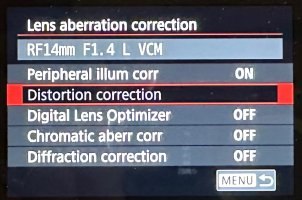
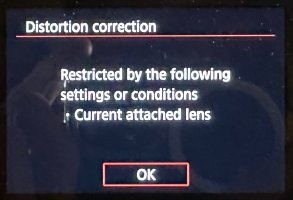
- Astrophotography where ‘stretching’ the image corners to fill the frame might result in distorted stars. The RF20mm f1.4 VCM shows that digital corrections without distortions are possible (see this thread by @neuroanatomist).
- Stitching panorama’s and focus stacking.
- Severe lens vignetting (3-4 stops) needs a lot ‘
burning’ ‘dodging’ to lighten the image corners. This causes noise in the corners of the image. When you need to lift the shadows of the image by 1 -2 stops, you would get 4-6 stops of brightness correction in the corners of the image. This would have a visible negative impact on image quality.).