Report: New Canon Super Telephoto Lenses Coming in May

- Lenses
- 119 Replies
I'll reply for the benefit of others who may read this thread, in the hope that your cluelessness doesn't engender false hope in others. Spreading misinformation seems to be a pattern for you, among other distasteful habits that you exhibit.
The only way in which your statement would be correct would be for a lens to be designed to take a drop-in TC, like a really fat drop-in filter holder. There would need to be optics behind that big hole in the lens barrel. Moreover, in these expensive lenses the TCs are designed for optimal performance with each lens' optics. For example, the TC group in the Nikkor 600/4 + 1.4x has an SR element (their equivalent of Canon's BR elements aka 'blue goo'), whereas the TC group in the Nikkor 400/2.8 + 1.4x does not.
In other words, each supertele lens would need it's own specific drop-in TC, rather than having a generic drop-in TC for a series of lenses that would have more of a negative optical impact than tailor-made TCs for each lens. So even the kludgy idea you are suggesting (well, that you would have suggested if you actually understood optical design) would not happen. A dedicated TC for each lens...why make a drop-in version at all, then? That would be foolish, something that manufacturers' lens designers are not. That's why both Canon and Nikon have made lenses with flip-in TCs, not completely removable drop-in TCs.
And not separate flip-in TCs...because physics. The nice thing about physics is that it remains true even when people like you don't understand it.
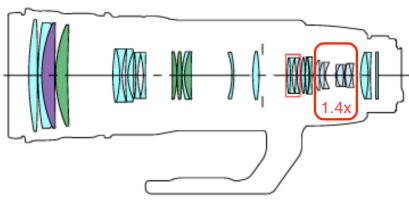
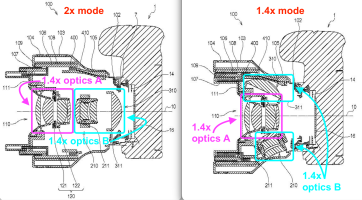
I will try to simplify with a picture of the Canon patent design that perhaps you can understand. Only one set of 1.4x TC optics flips out of place, though it does so in two pieces to minimize the size of the overall optic. When the rear split 1.4x group ('B') moves out of the optical path, the front 1.4x group ('A') slides further back into position but remains in the optical path. At no time is there an empty tube.
This is still not the thing you think is happening, i.e. there is no 1x form for this design or any other. As already stated, an extension tube precludes infinity focus, so a '1x' option in a switchable TC would require reducing optics to flip in when the TC optics flip out.
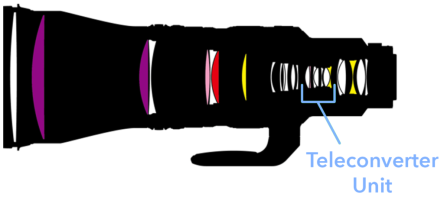
Yes, it does have to be different. A flip-out TC works when the TC is added within the lens. Notice how in the block diagram of the EF 200-400/4 that I posted above, there is a (weak) converging group behind the TC optics. The same is true for any lens with a flip-in TC. Here's the Nikon 600/4 + 1.4x, which has even more optics (but still net weak convergence) behind the TC group.A 1.4x TC built into a lens does not have to be any different to a separate 1.4x TC added to a lens. The lens is simply designed to focus onto the sensor without the 1.4x TC in place, and the 1.4x TC optics are designed so that they don't screw with that.
The only way in which your statement would be correct would be for a lens to be designed to take a drop-in TC, like a really fat drop-in filter holder. There would need to be optics behind that big hole in the lens barrel. Moreover, in these expensive lenses the TCs are designed for optimal performance with each lens' optics. For example, the TC group in the Nikkor 600/4 + 1.4x has an SR element (their equivalent of Canon's BR elements aka 'blue goo'), whereas the TC group in the Nikkor 400/2.8 + 1.4x does not.
In other words, each supertele lens would need it's own specific drop-in TC, rather than having a generic drop-in TC for a series of lenses that would have more of a negative optical impact than tailor-made TCs for each lens. So even the kludgy idea you are suggesting (well, that you would have suggested if you actually understood optical design) would not happen. A dedicated TC for each lens...why make a drop-in version at all, then? That would be foolish, something that manufacturers' lens designers are not. That's why both Canon and Nikon have made lenses with flip-in TCs, not completely removable drop-in TCs.
And not separate flip-in TCs...because physics. The nice thing about physics is that it remains true even when people like you don't understand it.
No. Clearly, you don't understand what I posted, or the underlying Canon patent application. More importantly, you don't understand the relevant optical concepts. A lens cannot maintain infinity focus with an extension tube behind the lens, and if all the optical elements of a TC mounted behind the lens were to move out of the optical path, you would have an empty tube behind the lens...i.e., an extension tube.You showed exactly this with the dual TC design in an earlier reply. Either one or both of the 1.4x TCs can flip out of place. When both are out of the way, the lens can still maintain infinity focus even though there is only air there now.
I will try to simplify with a picture of the Canon patent design that perhaps you can understand. Only one set of 1.4x TC optics flips out of place, though it does so in two pieces to minimize the size of the overall optic. When the rear split 1.4x group ('B') moves out of the optical path, the front 1.4x group ('A') slides further back into position but remains in the optical path. At no time is there an empty tube.
This is still not the thing you think is happening, i.e. there is no 1x form for this design or any other. As already stated, an extension tube precludes infinity focus, so a '1x' option in a switchable TC would require reducing optics to flip in when the TC optics flip out.


Upvote
0


 Perhaps a 16mm f/1.8, a 20mm f/1.8, a 28mm f/1.8, an 85mm f/1.8...or f/2, whatever, I'm not asking for f/1.4 or f/1.2.