Report: New Canon Super Telephoto Lenses Coming in May

I'll reply for the benefit of others who may read this thread, in the hope that your cluelessness doesn't engender false hope in others. Spreading misinformation seems to be a pattern for you, among other distasteful habits that you exhibit.

A 1.4x TC built into a lens does not have to be any different to a separate 1.4x TC added to a lens. The lens is simply designed to focus onto the sensor without the 1.4x TC in place, and the 1.4x TC optics are designed so that they don't screw with that.
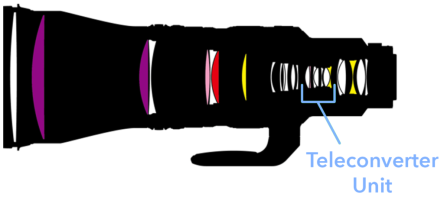
Yes, it does have to be different. A flip-out TC works when the TC is added within the lens. Notice how in the block diagram of the EF 200-400/4 that I posted above, there is a (weak) converging group behind the TC optics. The same is true for any lens with a flip-in TC. Here's the Nikon 600/4 + 1.4x, which has even more optics (but still net weak convergence) behind the TC group.

Nikon 600 + TC.png

The only way in which your statement would be correct would be for a lens to be designed to take a drop-in TC, like a really fat drop-in filter holder. There would need to be optics behind that big hole in the lens barrel. Moreover, in these expensive lenses the TCs are designed for optimal performance with each lens' optics. For example, the TC group in the Nikkor 600/4 + 1.4x has an SR element (their equivalent of Canon's BR elements aka 'blue goo'), whereas the TC group in the Nikkor 400/2.8 + 1.4x does not.

In other words, each supertele lens would need it's own specific drop-in TC, rather than having a generic drop-in TC for a series of lenses that would have more of a negative optical impact than tailor-made TCs for each lens. So even the kludgy idea you are suggesting (well, that you would have suggested if you actually understood optical design) would not happen. A dedicated TC for each lens...why make a drop-in version at all, then? That would be foolish, something that manufacturers' lens designers are not. That's why both Canon and Nikon have made lenses with flip-in TCs, not completely removable drop-in TCs.

And not separate flip-in TCs...because physics. The nice thing about physics is that it remains true even when people like you don't understand it.

You showed exactly this with the dual TC design in an earlier reply. Either one or both of the 1.4x TCs can flip out of place. When both are out of the way, the lens can still maintain infinity focus even though there is only air there now.
No. Clearly, you don't understand what I posted, or the underlying Canon patent application. More importantly, you don't understand the relevant optical concepts. A lens cannot maintain infinity focus with an extension tube behind the lens, and if all the optical elements of a TC mounted behind the lens were to move out of the optical path, you would have an empty tube behind the lens...i.e., an extension tube.

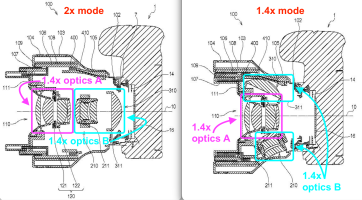
I will try to simplify with a picture of the Canon patent design that perhaps you can understand. Only one set of 1.4x TC optics flips out of place, though it does so in two pieces to minimize the size of the overall optic. When the rear split 1.4x group ('B') moves out of the optical path, the front 1.4x group ('A') slides further back into position but remains in the optical path. At no time is there an empty tube.

Get it now, or is this still too complicated for you?.png

This is still not the thing you think is happening, i.e. there is no 1x form for this design or any other. As already stated, an extension tube precludes infinity focus, so a '1x' option in a switchable TC would require reducing optics to flip in when the TC optics flip out.
  • Like
  • Wow
Reactions: 3 users
Upvote 0

Canon Shows off Interesting RF 55mm & RF 85mm F1.8 Designs

Loved the big front elements of yesteryear too.
I think people have said mirrorless/short flange distance (if that's the term) means the elements for some focal lengths can essentially be reversed, so the bigger ones are at the back? I suppose it means less glass exposed to potential scratches.
Upvote 0

Canon Shows off Interesting RF 55mm & RF 85mm F1.8 Designs

We have very different priorities, and that's perfectly fine.
Well of course :)

After I put a prime lens on my camera, I pretty much don't touch it until I take it off (I'd even say that applies to the EF 600/4 II, since I'm supporting it by the replacement RRS lens foot and not really touching the lens itself). About the only exception is manually focusing a lens for shooting the night sky (or lenses without AF, like the TS-Esand MP-E). Zoom lenses...I use the zoom ring, and that's it.
Apart from holding the camera from the lens (usually), it's not that I operate a lot of controls on the lenses either, but I do use their control rings sometimes, and I photograph exclusively handheld. I don't own lenses with custom buttons, neither VCMs with their aperture rings.
And I shoot absolutely everything using autofocus. Its smoothness can be felt in the hand and seen on the EVF. Plus, noise - or the absence of it.

External focusing designs, specially if with weird lens hoods (like the RF 35 1.8 and 28), are pretty much a vulnerability as they protrude from the lens housing. They're also more prone to allowing dust entering the lens - it doesn't take rubber gaskets for a lens to be a little more protected.

Refinement is subjective, but if you're looking for that then look for the L.
With the red ring often comes extra size, weight and, of course, the price tag.

I'm not asking a lot, I'm asking for attributes we had on gold and some silver ring EF lenses, like the EF 24 and 28mm f/2.8 IS USM, EF 35mm f/2 IS USM, EF 28mm f/1.8 USM, EF 85mm f/1.8 USM, EF 100mm f/2 USM, and probably others I'm not even aware of - all these were internal focusing and reasonably silent USM lenses with proper lens hoods.

So far, I think the RF 45mm is the only silver ring RF prime lens that is on par with that, in terms of "build quality".
Get me more lenses like that!:D Perhaps a 16mm f/1.8, a 20mm f/1.8, a 28mm f/1.8, an 85mm f/1.8...or f/2, whatever, I'm not asking for f/1.4 or f/1.2.

Like I said, I would have paid an extra 100 or 200 bucks for the same lenses (RF 16, RF 28, maybe others) with a little more refined experience.

Yeah, not me. If I want my images to have a dreamy look to them, I'll just take a long nap...
I won't say I'm fond of the dreamy look because I'm not, but I don't usually shoot at f/1.2 either (my most used aperture is definitely f/2.8, across all lenses). I go to f/2~f/1.2 when I specifically want the shallow DoF, or when available light drops significantly so, for the price, I think can live with that.
Ergonomics are great, autofocus is not annoying, I don't have to worry if something knocks it at the front, and a filter prevents dust from entering directly the lens barrel. As long as it's not raining and I'm not photographing in the dust, I'm good.
  • Like
Reactions: 1 user
Upvote 0

Report: New Canon Super Telephoto Lenses Coming in May

A 1x-1.4x switchable TC is NOT just a matter of 'adapting it into a separate teleconverter'. A teleconverter mounted behind a lens, with the optics 'flipped out of the way' would be an empty tube between the camera and the lens...that's called an extension tube, and what it does is reduce the minimum focus distance at the cost of losing the ability to focus the lens on distant subjects. Probably not what you would want with teleconverter on a telephoto lens, y'know?

That hypothetical 1x-1.4x TC would require reducing optics for the 1x setting, a completely different set of optics than the extender optics that would need to flip in when the 1.4x elements flip out. Same thing as the magical unicorn 1x-1.4x-2x TC that people have been dreaming about after someone misinterpreted a Canon patent for something completely different that happened to have 1-1.5-2x markings on the diagram.

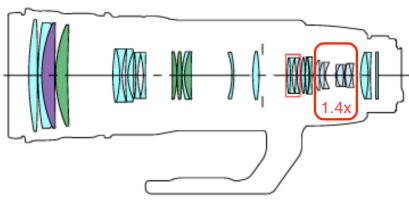
The reason a 1.4x flip in TC works in a lens is precisely because it's part of the lens design and not something that mounts behind the lens. There are lens optics that sit behind the 1.4x TC optics in the lens, as I labeled them in the EF 200-400/4, which is why the lens can maintain infinity focus with the TC flipped out.
A 1.4x TC built into a lens does not have to be any different to a separate 1.4x TC added to a lens. The lens is simply designed to focus onto the sensor without the 1.4x TC in place, and the 1.4x TC optics are designed so that they don't screw with that. You showed exactly this with the dual TC design in an earlier reply. Either one or both of the 1.4x TCs can flip out of place. When both are out of the way, the lens can still maintain infinity focus even though there is only air there now.
Upvote 0

Canon Shows off Interesting RF 55mm & RF 85mm F1.8 Designs

To me, it's the combination of everything. That includes optical performance, build quality and refinement, and the first alone is not enough. If I don't like using a product, even if it provides better image quality, I'm ditching it. For instance, I know those 24 and 35 are better than their predecessors, but I still didn't like them, so I sold both and felt glad I got rid of them.
We have very different priorities, and that's perfectly fine. Ergonomics are important, which is why I prefer bodies with an integrated grip. But lenses? After I put a prime lens on my camera, I pretty much don't touch it until I take it off (I'd even say that applies to the EF 600/4 II, since I'm supporting it by the replacement RRS lens foot and not really touching the lens itself). About the only exception is manually focusing a lens for shooting the night sky (or lenses without AF, like the TS-Esand MP-E). Zoom lenses...I use the zoom ring, and that's it.

I've never had an issue with AF that's too slow. Perhaps that's due to my usage pattern – with fast-moving subjects I'm using an L-series lens, anyway. But comparing the RF 24/1.8 STM to the RF 28-70/2L, for example (which I just did, on my R8), they go from MFD to infinity focus in about the same amount of time. I’d say the 28-70/2 focuses reasonably quickly, but it’s perhaps two ‘notches’ slower than lenses like the RF 70-200/2.8 or RF 24-105/2.8, which are among the fastest-focusing lenses. Lenses like the RF 24-105/4, RF 100/2.8 and RF 100-500 are in between. The only lens that I've used where I'd call the AF relatively slow is the EF 85/1.2L II.

Refinement is subjective, but if you're looking for that then look for the L.

The exception, to me, is the RF 45mm. Probably the worst optical performance, but good plastics, decent dimensions, proper lens hood attachment, smooth, quiet and internal autofocus. Finally, something that doesn't feel or work like a toy. It's a joy to use, I'm in! Get me more lenses like this!
Yeah, not me. If I want my images to have a dreamy look to them, I'll just take a long nap...or maybe smear a coating of vaseline on a cheap filter and put that on my lens. I mean, it's great that the RF 45/1.2 offers similar image quality to the EF 50/1.2L for a much lower cost, but I didn't have any desire for the 50/1.2L, either.
  • Like
Reactions: 1 user
Upvote 0

Canon Shows off Interesting RF 55mm & RF 85mm F1.8 Designs

I can't speak to the build quality of the RF 85/2 as I've never used it, but holding the RF 24/1.8 STM and the RF 24/1.4L VCM side by side, the build quality is actually very similar, both are very good.
In terms of optics, the RF 24/1.8, RF 28/2.8, and especially the RF 35/1.8 are better than their EF 'best modern silver ring' counterparts, for example see this 35mm comparison.
To me, it's the combination of everything. That includes optical performance, build quality and refinement, and the first alone is not enough. If I don't like using a product, even if it provides better image quality, I'm ditching it. For instance, I know those 24 and 35 are better than their predecessors, but I still didn't like them, so I sold both and felt glad I got rid of them.

I've owned or at least tried most of the lenses I mentioned (all the RF lenses, at least).

The RF 24mm f/1.8 that you mentioned: good plastics, lovely dimensions, okay-ish lead-screw STM, proper lens hood attachment, but then focuses externally and has a long focus range due to its macro abilities. Yeah, that puts me off, forget it, it's long gone.

Then the RF 35mm f/1.8: again, good plastics, lovely dimensions, but an old gear type STM that is noisy and jerky, weird lens hood, external focus, long focus range due to its macro abilities. Nah, forget it, it's gone and never to be missed.

The RF 16mm: okay-ish plastics, lovely dimensions, proper lens hood attachment, then again the old gear type STM that is noisy and jerky, and external focus. At least this one doesn't have to move its elements a lot - that helps. I tolerate it, but I'm waiting for a silver ring upgrade.

The RF 28mm: plastics are okay, dimensions are okay (not much to grab, really), its gear type STM seems a little better but not amazing, then external focus, and a weird lens hood. Similarly to the 16mm, this one doesn't have to move its elements a lot. Yeah, I tolerate it, and it's one of my favourite focal lengths, but I'm waiting for a silver ring upgrade.

The RF 50mm f/1.8 at least is cheap. Okay-ish plastics, lovely dimensions, proper lens hood attachment, then again the old gear type STM that is noisy and jerky, external focus, somewhat long focus range due to its good magnification, and pretty bad colour if you don't use auto white balance. For the price, however, I won't complain, as it is an overall better package than some of its predecessors. I'm delaying selling it because it's cheap and small, but I doubt I'll keep it.

Do I actually enjoy using any of these lenses? Do/did I feel glad that I own/owned them? Do I want to use them? No, not really.
I'll take the 28 with me because it's the only 28mm RF lens there is, not because I enjoy using it.

The exception, to me, is the RF 45mm. Probably the worst optical performance, but good plastics, decent dimensions, proper lens hood attachment, smooth, quiet and internal autofocus. Finally, something that doesn't feel or work like a toy. It's a joy to use, I'm in! Get me more lenses like this!
Upvote 0

Report: New Canon Super Telephoto Lenses Coming in May

and weigh a large number of pounds
Any new 600 f/4 is going to be expensive, but if the zoom is built as a variable TC (i.e. magnifier), rather than the more elaborate approach used in most zooms, the size hit might not be that significant. The current approach to 800 and 1200 lenses takes the magnifier approach and making it variable is not impossible. I have an interesting Vivitar 2x macro TC (in FD mount) that is a combo of a 2x TC and a variable extension tube rolled into one. With some of Canon's recent exploits, it is not unreasonable to expect that they might take a new approach. Not much doubt that any sensible way to combine several Super Telephotos into one would be a big cost saver for Canon and might even reduce the price a bit thanks to increased production volume of the single design.
  • Like
Reactions: 1 user
Upvote 0

Canon Shows off Interesting RF 55mm & RF 85mm F1.8 Designs

The RF 50/1.8 is not a reshuffle of the EF 50/1.8.
Oh, I think it is. They made one of the elements an aspherical, but it's still the same basic 6-element, 5-group, double Gauss design. In fact, Canon states, "The RF50mm F1.8 STM features an enhanced version of the highly praised optical configuration employed by the EF 50mm f/1.8 STM..."
  • Like
Reactions: 1 user
Upvote 0

Report: New Canon Super Telephoto Lenses Coming in May

As for a switchable teleconverter; I would prefer a completely separate unit. That way it can be used on other lenses and when it's needed. A built in teleconverter adds weight, length, and cost to the lens. I only need 1.4, not a fan of a 2.0 teleconverters ( my personal opinion). They have a working switchable teleconverter from the EF 200-400mm, that has shown reliability for years. Why haven't they adapted this into a separate teleconverter; there is no doubt in my mind it would sell. I would buy it.
A 1x-1.4x switchable TC is NOT just a matter of 'adapting it into a separate teleconverter'. A teleconverter mounted behind a lens, with the optics 'flipped out of the way' would be an empty tube between the camera and the lens...that's called an extension tube, and what it does is reduce the minimum focus distance at the cost of losing the ability to focus the lens on distant subjects. Probably not what you would want with teleconverter on a telephoto lens, y'know?

That hypothetical 1x-1.4x TC would require reducing optics for the 1x setting, a completely different set of optics than the extender optics that would need to flip in when the 1.4x elements flip out. Same thing as the magical unicorn 1x-1.4x-2x TC that people have been dreaming about after someone misinterpreted a Canon patent for something completely different that happened to have 1-1.5-2x markings on the diagram.

The reason a 1.4x flip in TC works in a lens is precisely because it's part of the lens design and not something that mounts behind the lens. There are lens optics that sit behind the 1.4x TC optics in the lens, as I labeled them in the EF 200-400/4, which is why the lens can maintain infinity focus with the TC flipped out.

EF 200-400.png
  • Like
Reactions: 4 users
Upvote 0

Canon Shows off Interesting RF 55mm & RF 85mm F1.8 Designs

The RF 50 was just lazy and i always hated that it was merely a reshuffled EF 50 STM which itself was just a re-dressed design going back decades.
The RF 50/1.8 is not a reshuffle of the EF 50/1.8.
If it’s a reshuffle (or rather a modern update) of anything then it’s the 40/1.7 of the 1970s Canonet rangefinder models. Incidentally that lens had a stellar reputation in its day.
Upvote 0

Canon Shows off Interesting RF 55mm & RF 85mm F1.8 Designs

That's higher end, I think he meant the old gold rings, and the best modern silver rings, like the EF 35mm f/2 IS USM, and EF 24 and 28mm f/2.8 IS USM.
I assumed so, and probably when he stated, "Essentially nearly none of the RF lenses in the "normal" focal length range make me proud to own, hold, touch, and operate them," he meant lenses that he personally owns, not lenses that are available.

He did mention the EF 85/1.8, specifically, and while I remember that lens fondly (it was one of the very first pair of lenses that I bought, back in 2009), I don't kid myself about its optical performance. That lens had wicked bad axial CA...if the Jimmy Hendrix song didn't predate the lens by 25 years, I'd have said the song was written about the lens. The fact is that the RF 85/2 delivers significantly better optical results than the EF 85/1.8.

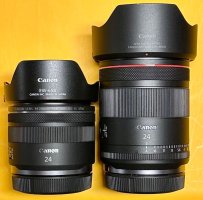
I can't speak to the build quality of the RF 85/2 as I've never used it, but holding the RF 24/1.8 STM and the RF 24/1.4L VCM side by side, the build quality is actually very similar, both are very good.

24mm lenses.jpg

In terms of optics, the RF 24/1.8, RF 28/2.8, and especially the RF 35/1.8 are better than their EF 'best modern silver ring' counterparts, for example see this 35mm comparison.
Upvote 0

Report: New Canon Super Telephoto Lenses Coming in May

Since, the current 400 & 600 primes are EF lenses adapted to the RF mount; their due for a refresh. Before the world cup would make sense, but that doesn't mean they will do it.

As for a switchable teleconverter; I would prefer a completely separate unit. That way it can be used on other lenses and when it's needed. A built in teleconverter adds weight, length, and cost to the lens. I only need 1.4, not a fan of a 2.0 teleconverters ( my personal opinion). They have a working switchable teleconverter from the EF 200-400mm, that has shown reliability for years. Why haven't they adapted this into a separate teleconverter; there is no doubt in my mind it would sell. I would buy it. SEE DISCUSSION BELOW. I've learned you can't make a generic separate switchable teleconverter.

In my opinion, since the introduction of the RF mount Canon has put the long glass needs on the back burner. During this time, Sony & Nikon have developed better options and it's time for Canon to step up. The classic example is the gap between the 100-500mm and 400/600mm primes in the "L" series lenses. If you want upgrade to 600mm or faster glass from your 100-500, your ONLY option is a $13 to 14k prime. Then there is the mythical 300-600mm that has been teased for years. This would be a great wildlife lens, if their smart enough to make it a variable aperture of f4 to 5.6. For those of us that shoot in low light and want better bokeh; a fixed f5.6 aperture is unacceptable at the 300 to 400mm range for the anticipated price of at least 7K.
  • Haha
Reactions: 1 user
Upvote 0

Report: New Canon Super Telephoto Lenses Coming in May

I would like any telephoto lens to be as light as possible. I owned the FD 400mm 2.8 and at over 6Kg with a camera body it was very difficult to use. My EF 500mm ii is much more manageable at 3.97Kg on a R6ii with adapter. Currently the RF 600mm is 3.76 with a R6ii, how much heavier is acceptable for the 'benefit' of two built in extenders. I would prefer the extenders in my backpack for when I need them rather than supporting their weight in the my left hand when I don't.
  • Like
Reactions: 1 user
Upvote 0

Canon Says it’s up to Sigma to Make Full-Frame RF Lenses

That's about all there is to say on the matter then.
I stated that before you replied that it was all about FF cameras. So clearly you felt differently prior to posting that drivel. It's almost like you felt compelled to argue the matter. Like you were unable to resist replying. Like some sort of bot...and it's obvious which sort.

Dumb Bot.png

I'd be curious how you define "helped". By being the janitor? It's a critical job to society in general but I think it might be a bit of a stretch to equate it to helping with a cancer treatment.
Yes, that was it. Always happy to put my PhD and decades of drug development experience to good use.

I volunteer at animal shelters and donate as much as I can.
It's good that you help out with small, local problems, and even better that you provide assistance to creatures with more maturity than you possess.
Upvote 0

Filter

Forum statistics

Threads
37,473
Messages
975,028
Members
24,816
Latest member
GLBDD

Gallery statistics

Categories
1
Albums
29
Uploaded media
372
Embedded media
1
Comments
25
Disk usage
1 GB