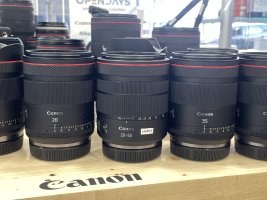
Canon Says it’s up to Sigma to Make Full-Frame RF Lenses

Canon's ways of limiting Sigma are many and complex, not least because the intellectual property levers they have operate differently in different countries. In the US, reverse-engineering a standard is usually fine. In other countries it is sometimes not. One of the things that some of the Chinese vendors got into trouble over was claiming "RF Mount" branding on their packaging. Viltrox and Samyang may have had more trouble with the copyright/trademark (different mechanism) problem than with the an engineering/mount/patent issue. In the past, we've heard narrowly-stated comments from European Canon heads that turned out to be technically true, but not the whole truth. I recall a German executive talking about this issue back in the early RF days, and everyone got needlessly excited.

Then there's the business relationship issue. Most OEM camera companies use Tamron and Sigma to provide elements of lenses, or even whole lenses. Those OEM relationships are quite important to the companies, and it's not surprising that the little firms like Viltrox were the ones making RF lense while the ones with OEM contracts aren't.

Sigma's CEO has spoken around the issue in several interviews, most notably the recent one where the Petapixel crew visited him in Japan. My impression was that he wasn't able to speak because of an active provision that prevented him from speaking. He's a stand-up guy, and I'd put more faith in what he says (or indicates he can't say) versus a whole sack of OEM company executives.
  • Like
Reactions: 1 user
Upvote 0

Canon Says it’s up to Sigma to Make Full-Frame RF Lenses

I didn't notice what day it was.


Thanks. I left out the word dedicated. I didn't touch on the rest of it because none of that is hard. I think it all has more to do with Sigma not being able to manufacture to the scale required. People grossly overestimate how many lenses SIgma sells.

We now know that it has nothing to do with Canon. There will still be the naysayers, but it doesn't matter what you tell some people.. the vacuum can be strong.
I disagree with your conclusion. Sigma already makes FF lenses that could be ported to RF. They have a mount conversion service costing about $250. I wanted them to convert two APS-C EF-M lenses to RF. They replaced the two lenses that I sent them with brand new RF lenses. They said they had RF M-mount lenses but hadn't received the conversion kits from Japan. As I recall, I got the new lenses on the days that the RF mount version became available in the U.S.

Does anybody doubt that Sigma would be overjoyed if the demand for existing FF lenses (plus a few parts) suddenly increased by, wild guess, 30%? They already know how to make lenses for the RF mount. They do it every day.
  • Like
Reactions: 1 users
Upvote 0

BIRD IN FLIGHT ONLY -- share your BIF photos here

Well, it would put the ‘fluorine’ (fluorocarbon) coating to the test. :poop::sneaky::sick:
When I visited the Isle of May with a small group of photographers, a tern shat on the front of the lens and the inside of the lenshood of one of the groups members. He had a hard time cleaning the lens and the black velvet of the lenshood. It was a Nikon, the terns did not dare shizzle on a Canon😉.
  • Haha
Reactions: 1 user
Upvote 0

Canon Says it’s up to Sigma to Make Full-Frame RF Lenses

Makes sense. I agree, it’s not the contract (license) that’s the issue here but some other business constraint. I was thinking more in terms of limited lens types (doesn’t exclude them from offering a lens, just not all possibilities) but manufacturing capacity is a real consideration.

Still, if just capacity then at worst case just add a control ring and the basic EF instruction set and call it a day for gen 1 so that the issue is more a lens mount swap like prior; go fancy for gen 2. People try too hard sometimes with all at once offerings.
  • Like
Reactions: 1 user
Upvote 0

Canon Says it’s up to Sigma to Make Full-Frame RF Lenses

All of Sigma’s current RF APS-C lenses DO have control rings: for the older ones it doubles up as the manual focus ring (same as all of Canon’s RF-S lenses) and the two newest primes and 17-40 have a separate control ring (which is used as an aperture ring on E and X mount versions). They also work with the in-camera focus scale, digital corrections, full time electronic manual focus options, and more. Older EF lenses don’t work well with IBIS either, so I don’t buy this idea that Sigma and other third parties are having to reverse engineer the RF mount.

None of the Sigma RF lenses offer autofocusing for the entire viewfinder however; anyone know if the other mount also suffer from this limitation?
  • Like
Reactions: 1 user
Upvote 0

Canon RF 300-600mm Update…. Again

Regardless, the 300-600mm might or might not come. It might be f/5.6, it might be f/4-5.6. There was going to be a 200-500mm f/4, with prototypes in the wild and rumored announcement dates. But then...there wasn't, and instead it was going to be a 300-600mm. In 2025. But then there wasn't. And now...in 2026.

I hope there is a 300-600/5.6, and your statement that you want something 'that's a bit more affordable than the current RF 600 f/4' may be reasonable as such a lens will likely be priced in between the 100-300/2.8 at $10.5K (USD) and the 600/4 at $14.5K. So if 'a bit more affordable' to you means a couple of thousand dollars cheaper, well and good. If you're hoping for a 300-600/5.6 costing <$10K USD, I suspect you're headed for disappointment even if the lens does get launched.

I'd say I'm definitely hoping for something more like $8k, and I'm fully prepared to be disappointed lol. The 100-300 f/2.8 L definitely doesn't have me optimistic on the price being below $10k, so I think you're justified in your estimate.

I don't know what the market sensitivity is to ~8k vs. ~11k for the price (in USD), but I'm definitely sensitive to that (and seemingly, others here are as well).

I hope they release some compelling long options this year. The 14mm VCM and fisheye lens were just not in my interests at all, and I have the RF 50mm f/1.2, so the 45mm wasn't for me. A longer/high-magnification macro lens capable of taking extenders would be of interest. I definitely have a bit of GAS, but need Canon to put out something compelling (and uhh... hopefully more affordable than $11k).
  • Like
Reactions: 1 users
Upvote 0

F00 conundrum

You stated (or I interpreted it that way) in another thread that the problem was solved by cleaning the contacts. Is that correct?
Nope, I believe I stated that it didn’t solve my problem (or at least, that’s what I meant to state). That was before I deleted all of that, subsequent to your post identifying the real problem of the camera in that thread being a 6D.
  • Sad
Reactions: 1 user
Upvote 0

Canon Will Continue to Expand the RF Lens Lineup at 6 to 8 Lenses a Year

In terms of third party lenses, I found over the years the following:
  • Optical quality tended to be equivalent to the better non-L Canon lenses. For example, the gold ring USM lenses. Eventually Sigma really stepped up its game and produced lenses that specifically solved Canon flaws (UWA coma, for example) and/or generally competed with mid-tier L quality (24-105L, for example). I have over time used (and sometimes owned) lenses from Sigma, Tamron, Tokina, and IRIX (non-cinema).
  • Third party compatibility has greatly varied over time, an issue which continues through today. The USB docks helped, but never assured a guarantee. It really made the investment of cash into more expensive third party lenses ($1k+, let alone $6k+) a questionable investment over a decade. In the latest example, something in cameras after the R6 / R5 broke IRIX compatibility — and all that lens series does is confirm focus plus transmit metadata (e.g., lens type). USB firmware docks on the Canon side are largely discontinued, and so with that an inevitability of camera compatibility breakage.
  • In the modern context, quality third party lenses tend to be priced similarly EF lenses anyhow. A solid Sigma costs the same as a solid EF comparable, and either one will have tradeoffs in optical quality, DLO integration, or lens barrel robustness.
  • Very few compete optically or in lens body construction with modern L RF designs.

I've yet to encounter any third part lens that competes with premium contemporary Canon lenses, and I've yet to have a friend say they have either. If someone is willing to spend $10k in any currency on a single lens I sincerely doubt the lack of third party lenses are going to cause said person to jump ship because of a missing third party line — or it's a rare, very niche situation. Canon makes a premium product that is as expensive as "L" because it caters first to professionals.

In an older IT company I worked at when getting going in the industry the president used to tell us that we had one flagship product for a market and all other products just needed to be technically eligible — that is, tick enough boxes on paper to be allowed to compete for client funds but by no means had to be better than anyone else's (or even half as good). Canon's non-premium tier probably meets the "technically eligible" definition in a modern context of other manufactures. For example, the STM non-L lenses get the job of focusing photons onto a sensor done and they're fine for what they are but they're not the reason for someone to start with Canon cameras as opposed to Sony or Nikon; rather, they make a Canon camera body equally eligible for a newcomer's cash.

I think from Canon's perspective the EF catalog, which is still present for common use cases, is a de-facto third party lens option for the RF mount. Want to save money? Sigma has a 12-24 f/4 but Canon EF has an 11-24 — align sales and they're the same effective price in Canada. Sigma has a 24-105 f/4 but Canon has an EF 24-105L II IS USM — align sales and they're the same effective price in Canada. Ditto for Tamron, and ditto for IRIX (but in IRIX's case Canon also has AF). Might some of these be optically better than EF? Sure, but there's also no assurance they'll work on the R1 II, or the R5 III — but the EF lenses will.

All of my third party lenses have been sold off, and they were all sold off for compatibility reasons. I won't buy more until they are officially supported by Canon. Not while EF exists new or like-new with warranty, at any rate.

That stated, I think the people in this forum buying $10k+ lenses need to keep in mind that many people want the experience of exotic lengths but cannot justify the lofty price of new editions. And for mediocre non-L products (not bad, just average for the industry all factors averaged out) then why not cheaper third party options? Not everything is brute force making money or having the most Instagram followers— it might be nostolgia for 1990s photography (enter Sigma's more affordable Great White or prior Great Blacks). B+ and A- for 2/3rds the cost for most people will be perfectly fine — they probably aren't editing anything so refined that A+ would make the difference anyhow.

Myself, I probably represent an aspect of this category. I am well heeled thanks decades of hard work and good fortune, but I don't buy the $10k lenses. Why? I have a farm and animals are expensive; I am an enthusiastic power lifter who spent loads of money building a sweet home gym; I like to travel; etc. Eventually I want to retire. My wife has her priorities. A- for me is good enough as a (generally) non-commercial photographer, and if Sigma offered select lenses under Canon blessing then I'd think about them in a serious way. Jump ship without? Obviously not. Consider them as alternatives to B through A- RF lenses? Sure thing.

For people much less fortunate (industry specifics, now retired, many mouths to feed, injury with medical needs in an expensive health system, etc.) these options actually might make the selection of a platform a real material matter. This being a Canon forum, I don't think it's good enough to say just go buy Sony or Nikon — obviously that's an option — but the nature of this forum is hope for the future for the Canon community. I think that just like in the EF era third party options form entry points, retirement enjoyment, etc. I don't think people should sneer as hard as they do at the possibility. Just because many of us are fortunate enough to have all Canon gear doesn't mean that's the only valid path forward. And even those of us with non-Canon gear (some of my gear is solid but not Canon) we'd like to replace them with non-$10k but better than meh options that are Canon-compliant, and if a third party makes that a better likelihood then hurray. I mean, $4.1k for a 500mm f/5.6 with weather sealing from Sigma (or their $7.7k f/4 EF mount edition still in stock) vs $11.5k for a Canon EF 500 f/4 for your average non-commercial photographer? Only an ignorant person would tell the candidate to avoid the Sigma and cough up an extra $7.4k for... what? I can't think of the reason.
  • Like
Reactions: 1 user
Upvote 0

Canon Will Continue to Expand the RF Lens Lineup at 6 to 8 Lenses a Year

IMO, Sigma is often first out of the gate. Then, some time later, Canon comes along and releases something that is typically better, but also more expensive.

Examples.
14 mm f/1.4 - the ultimate astro lens. Sigma's version came out in 2023, Canon's version came out recently.
100-300 f/2.8. Sigma's 120-300 f/2.8 OS HSM came out in 2010.

Ditto for Tamron. Their 28-75/2.8 was released in 2021 and sold very well. People liked its speed and compact design. Canon released its copycat 28-70/2.8 in 2024.
Upvote 0

Canon Will Continue to Expand the RF Lens Lineup at 6 to 8 Lenses a Year

Sigma offers attractive Art lenses at select focal lengths but the assertion that they could motivate system-switching ignores optical benchmarks, autofocus performance, ecosystem depth and system integration. Canon RF is superior in coverage, optical quality, AF speed, system cohesion and future-proofing.
I am not sure I understand to what the RF mount is superior... other mounts have pros and cons and their own areas of excellence, same as RF does

And I fail to see how opening RF to 3rd party FF AF lenses would not improve the mount's coverage and depth? After all Sigma is offering a number of lenses that have currently no equivalent in RF.
  • Like
Reactions: 1 user
Upvote 0

Canon Will Continue to Expand the RF Lens Lineup at 6 to 8 Lenses a Year

While I'm pleased with the way the RF system has been developing, I have to recognise that third-parties could always add something, and it's not just low end products.

There are now some nice lenses available for RF, but third-parties have other very competitive offers as well, being Sigma, in my opinion, the biggest "threat".

Lenses like theirs 35mm f/1.4 and f/1.2, 50mm f/1.4 and f/1.2, 28-45mm f/1.8, 28-105mm f/2.8, and now the 200mm f/2 and 300-600mm f/4, plus their Contemporary primes, for instance.

It may be your understanding that Canon offers a few lenses that are somewhat similar to these Sigma offerings, and I get that, but the thing is: some of these cost half the price of Canon's.

Is the RF 24-105mm f/2.8 twice as good as the Sigma 28-105mm f/2.8? Debatable.
Is the RF 28-70mm f/2 twice as good as the Sigma 28-45mm f/1.8? Again, debatable.
Is the RF 50mm f/1.2 twice as good as the Sigma 50mm f/1.2? Same.
Lower end 20mm? We have none.

And a lot of their lenses (most) are very robust, weather sealed (all?) and feature linear motors and internal focusing mechanisms.

Don't be mistaken, the pressure is high for Canon, as these other lens manufacturers are showing off their value daily with other lens mounts, and Sigma is doing potentially enough to motivate changing systems for many photographers.

Also, keep in mind: Sigma is a third-party manufacturer in relation to Canon, Sony, Fuji and Nikon's systems, but they are a primary manufacturer for their own cameras and the L mount. Plus all the other brands.
Sigma offers attractive Art lenses at select focal lengths but the assertion that they could motivate system-switching ignores optical benchmarks, autofocus performance, ecosystem depth and system integration. Canon RF is superior in coverage, optical quality, AF speed, system cohesion and future-proofing.
Upvote 0

Weird problem with 6D+100-400L II + 1.4x III=no AF

Durp, deleted my prior post because of course @P-visie is correct. I read R6, not 6D. The 6DII supports f/8 AF, the original 6D does not.

The 1-series supported it all along, except that a firmware update to the 1D X was required (after some complaints from pros, suspect). The 5DIII, 6DII, and other post-2013 cameras supported f/8 AF often with multiple AF points and the feature made its way down the lines.
Upvote 0

Canon EOS R7 Mark II Rumored Specifications Round-up

The biggest concern I have is: if the 20% increase in pixel density is true and a BSI sensor, I hope that the noise figure at higher ISOs (like 6400) will be much improved. … No improvement in noise figure and the R7 MII starts to become less desireable. For reasons I can't explain, no one seems to understand and discuss this.
If you want better noise performance, you need a bigger sensor. For those who understand the relevant concepts, there’s not much more to discuss. The 20% increase in pixel density will make zero difference. BSI will make zero difference.

The R5II has a much higher pixel density than the R6III, the noise performance is the same.

1775056914750.png

A larger sensor has less image noise, because it gathers more total light. Crop down the R5II to APS-C size, you lose DR (because of increased image noise), and what you get is essentially the same as the R7.

1775056758445.png
  • Like
Reactions: 3 users
Upvote 0

Canon EOS R7 Mark II Rumored Specifications Round-up

I have been writing a fair bit about the EOS R7 Mark II in recent weeks, and with good reason. It's good clickbait, and many people who may be interested haven't been following along yet.. That said, I am trying to be as truthful as I possibly can while stoking the rumors. A little hype […]

See full article...
The biggest concern I have is: if the 20% increase in pixel density is true and a BSI sensor, I hope that the noise figure at higher ISOs (like 6400) will be much improved. If no improvement, then they should not have increased the pixel density in this proposed version of the R7 unless, they specifically wanted it to be targeted towards video users and not photographers. However, the R7-MII is supposedly designed as a wildlife camera - which generally needs to be able to handle and work in poor or low light situations, often requireing high ISOs. So I will be very disappointed if the noise figure is not improved. No improvement in noise figure and the R7 MII starts to become less desireable. For reasons I can't explain, no one seems to understand and discuss this.
Upvote 0

Weird problem with 6D+100-400L II + 1.4x III=no AF

For some reason, only "MF" appears on my 6D top LCD, no AF activation on shutter. No attempt to focus. Tried mounting TC on lens, THEN on camera. Also tried mounting on BODY first, then lens. Still same. Same exact 100-400L II + 1.4x III transferred over to my EOS R and suddenly everything works perfectly. All switches in the proper position. Tried another lens on the 1.4x III + 6D and AF is working. So it's just the particular combo of the 100-400L II + 1.4x III + 6D where AF doesn't work. And yes I dismounted each individual piece and re-mounted until firm click multiple times. Any ideas? Cycled 6D on and off etc. The 100-400L II works perfectly on my Fuji bodies as well w/ and w/o the 1.4x III. Strange quirk with the 6D.

Filter

Forum statistics

Threads
37,420
Messages
972,837
Members
24,777
Latest member
EJFUDD

Gallery statistics

Categories
1
Albums
29
Uploaded media
372
Embedded media
1
Comments
25
Disk usage
1 GB