Lens Design?

Hi Alan. Yes, I understand your point. Hopefully the combination of your comments and mine will help the OP to better understand when it makes sense to use the extender. The alternative is to use a sensor with denser pixels, e.g. R7 on base lens vs R5 with 1.4x extender offers equivalent pixels on the bird and in my experience, the R7 approach (specifically with the 200-800) typically gives slightly better results. Of course, much depends on AF performance and R5 II with extender may well outperform the R7 with bare lens (but I haven't, at least yet, sprung for an R5 II). But then, there will be an R7 II ;). My real preference would be for an R5s that would provide the wider field of view AND the higher pixel density. 101 MP would be perfect (and you could capture a frame of 12k open gate video for full resolution) :ROFLMAO:.
Absolutely about the R5s, I preferred the 5DSR over the 7Dii and the Nikon D850 over the D500 APS-C, both pairs having similar pixel density. The 7D R7 with the 100-500mm is pretty close to the R5ii/R5 with the RF 200-800 as the better IQ of the 500 compensates for the theoretical higher resolution of the 800mm, which is not quite as as sharp. I really want a good R7ii.
Upvote 0

Lens Design?

@Dragon our posts crossed in the ether! In low light, you are usually in the linear region of the photonstophotos plots. One further point to note, you don't lose DR by increasing the iso by two on using the 1.4x TC although it looks like you would do at first sight. This is because the DR is measured by viewing at a specific enlarged image size, and the larger image is enlarged less to reach it, which compensates its iso being lower down on the chart.
Hi Alan. Yes, I understand your point. Hopefully the combination of your comments and mine will help the OP to better understand when it makes sense to use the extender. The alternative is to use a sensor with denser pixels, e.g. R7 on base lens vs R5 with 1.4x extender offers equivalent pixels on the bird and in my experience, the R7 approach (specifically with the 200-800) typically gives slightly better results. Of course, much depends on AF performance and R5 II with extender may well outperform the R7 with bare lens (but I haven't, at least yet, sprung for an R5 II). But then, there will be an R7 II ;). My real preference would be for an R5s that would provide the wider field of view AND the higher pixel density. 101 MP would be perfect (and you could capture a frame of 12k open gate video for full resolution) :ROFLMAO:.
  • Like
Reactions: 1 user
Upvote 0

Viltrox to make RF-S Mount lenses soon?

Viltrox has been making AF Z-mount lens since 2021 (according to ChatGPT). The Viltrox website lists 25 Z-mount lenses. I find it hard to believe that Nikon has only just discovered that Viltrox has been making Z-mount lenses without a license agreement. That license agreement must have have included IP protection.
Nikon sued Viltrox immediately after their patents got approved in China. There is no agreement between Nikon and Viltrox, and unlike Sigma or Tamron, the Viltrox lens pages do not state that their lenses are made under license.

As far as Canon goes, they will keep FF RF locked down until they are forced to do otherwise. The only paths to an open RF mount are patent invalidation, patent expiration, or a government body like the EU forcing open platforms.
Upvote 0

A Little Bit of Info on the Canon RF 20-50mm f/4L IS USM PZ

Size being similar to the 24-105mm f4L is a turn off but the weather sealing and IS are very appreciated. Now what remains to be seen is balance on an R8. Size wise I was hoping for a 14-35mm f4 size or even the RF 15-30mm size. Weight wise I can hope will not be along the lines of the 24-105mm f4L.
But you certainly know, despite software correction possibilities, that a too small lens can often mean IQ compromises.
You rarely get the butter and the money for the butter, I won't even mention the milkmaid...
Oops, I did. ;)
  • Like
Reactions: 1 user
Upvote 0

Lens Design?

@Dragon our posts crossed in the ether! In low light, you are usually in the linear region of the photonstophotos plots. One further point to note, you don't lose DR by increasing the iso by two on using the 1.4x TC although it looks like you would do at first sight. This is because the DR is measured by viewing at a specific enlarged image size, and the larger image is enlarged less to reach it, which compensates its iso being lower down on the chart.
  • Like
Reactions: 1 user
Upvote 0

Lens Design?

On my most recent trip I had, but didn't even use, the 1.4 with the 100-500 ... and found
that I was getting useful/satisfactory results from simply cropping tighter for those shots
where the bird was a small part of the frame. One of the biggest reasons why I didn't
use the 1.4 was because we were almost always "under the canopy" and that extra stop
was better (necessary?).
- Jim in the PNW
One important point about signal to noise and extenders that is not widely known is that if you increase the iso to compensate for the loss of the stop you don't decrease the signal to noise in a cropped image. Supposing you take a picture of a duck, then the S/N in the image of the duck depends on the number of photons hitting the image of the duck, not on the iso number. If you use the same f-number and shutter speed with a 1.4xTC but double the iso to compensate for the loss of brightness, the image of the duck is no noisier. That is because although the number of photons per unit area of the duck is halved by the TC, the area of the duck is doubled, which fully compensates for it. If you don't like maths arguments, think of it in another way. If you don't use the extender, the image is smaller and you have to enlarge it more, which wipes out using a lower iso. By the same reasoning, an f/9 800mm lens puts as many photons on the duck as does an f/4.5 400mm lens. So, the take home message is don't worry about the loss of a stop when using a 1.4x extender as you can just double the iso. I posted a thread on this years ago but can't find it.
  • Like
  • Wow
Reactions: 2 users
Upvote 0

Lens Design?

Neuro/all,
OK, I accept your answers. I guess. I'm not saying you are wrong. I'm saying there is a lot
about lens design that I don't understand. I do understand that the diameter of the lens is
directly related to its "light gathering" (maximum f stop). From the responses so far I
guess there is also a relationship between the length of the lens and the focal length - or
maybe that affects the image quality/usefulness ... I'm saying you -could- make a lens
that is both high focal length and physically short - but you might not like the resulting
image quality? And based upon your reply to my speculation about a mythical 500-800 I
guess I don't understand the relationship of the lower end of the focal length for a zoom -
because I have always thought that the amount of zoom was directly related to the
overall physical length of the lens.
I am not unhappy with my RF 100-500, FAR from it. My 'happiness' with the RF 200-800 is
significantly less (but that's me) due to it is too big to travel with and, again for me, is not
anywhere near as easy to hand hold and get equivalent results. Nor is it as easy to
carry (as in when I'm birding) as the 100-500. I realize these are MY perceptions.
On my most recent trip I had, but didn't even use, the 1.4 with the 100-500 ... and found
that I was getting useful/satisfactory results from simply cropping tighter for those shots
where the bird was a small part of the frame. One of the biggest reasons why I didn't
use the 1.4 was because we were almost always "under the canopy" and that extra stop
was better (necessary?).
- Jim in the PNW
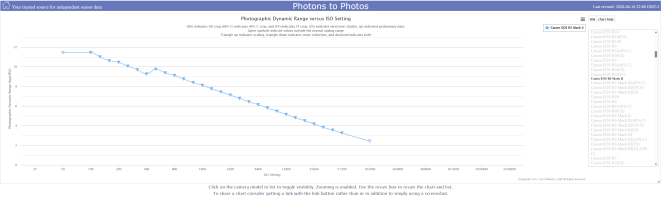
Just a note on whether to choose the extender or not. The number of photons from the bird is going to be essentially the same with or without the extender, but with the extender, you will have more pixels on the bird. If you are working in the linear portion of the DR curve, then the question is whether "smart" software will recover more detail with fewer quieter pixels or more noisier pixels. That is something you have to test empirically with the software you use. If you are in the non-linear portion of the DR curve (e.g. with your R5 II, if you were shooting at ISO 400 with the base lens and ISO 800 with the extender), then you would likely see some advantage with the extender independent of "smart" software. It is important to understand the behavior of the sensor in your specific camera and Photonstophotos.net will give you that information.


1777911603145.png
  • Like
Reactions: 1 users
Upvote 0

Lens Design?

Neuro/all,
OK, I accept your answers. I guess. I'm not saying you are wrong. I'm saying there is a lot
about lens design that I don't understand. I do understand that the diameter of the lens is
directly related to its "light gathering" (maximum f stop). From the responses so far I
guess there is also a relationship between the length of the lens and the focal length - or
maybe that affects the image quality/usefulness ... I'm saying you -could- make a lens
that is both high focal length and physically short - but you might not like the resulting
image quality? And based upon your reply to my speculation about a mythical 500-800 I
guess I don't understand the relationship of the lower end of the focal length for a zoom -
because I have always thought that the amount of zoom was directly related to the
overall physical length of the lens.
I am not unhappy with my RF 100-500, FAR from it. My 'happiness' with the RF 200-800 is
significantly less (but that's me) due to it is too big to travel with and, again for me, is not
anywhere near as easy to hand hold and get equivalent results. Nor is it as easy to
carry (as in when I'm birding) as the 100-500. I realize these are MY perceptions.
On my most recent trip I had, but didn't even use, the 1.4 with the 100-500 ... and found
that I was getting useful/satisfactory results from simply cropping tighter for those shots
where the bird was a small part of the frame. One of the biggest reasons why I didn't
use the 1.4 was because we were almost always "under the canopy" and that extra stop
was better (necessary?).
- Jim in the PNW
Upvote 0

A Little Bit of Info on the Canon RF 20-50mm f/4L IS USM PZ

I'm genuinely interested to know, what sort of shots would you use this for? I'm not very good with shorter focal lengths so it's a bit mystifying.
all purpose landscape, architecture. basically anywhere i'd use my 16-35, 17-40 etc but with more of an emphasis on a useful range i'd actually use. everyone's use is different though. i use to shoot a lot of UWA but i just can't anymore. when i look at my LR, i find myself often zooming in a bit to get to 20, 21mm or 24mm (if i'm doing ultra wide) then you have 50mm which is pretty standard, portraits, detail shots, object shots etc.
  • Like
Reactions: 1 user
Upvote 0

A Little Bit of Info on the Canon RF 20-50mm f/4L IS USM PZ

That would be a surprise. Certainly other hybrid-use lenses do so, including the RF 24-105/2.8L Z.


The 24-105/4L is only ~7 mm longer than the 14-35/4L, that doesn't bother me as either is fine to use on an R8 (in my use cases for that camera). Like you, I hope that the 20-50/4L is closer to the weight of the UWA zoom than the standard zoom, and I suspect that will be the case.

I guess we'll know in 10 days.
they'll 100% do computational tricks. for a zoom that goes to 20mm, that's how you'd keep it compact. the fact that this zoom does NOT go to 70mm, tells me that there's an emphasis here on Canon's part to keep the size as compact as possible.
Upvote 0

A Little Bit of Info on the Canon RF 20-50mm f/4L IS USM PZ

I'd love a 20-50F4, it's the lens i've always dreamed of. For me it represents my most used focal lengths. I don't care to go wider than 20 like I did in my younger years and 50 is the sweet spot for zoomed in -- one of the reasons I still use, own, and shoot a 17-40L on Canon to this day. From 20-40, it's good wide open, and actually quite great stopped down. I imagine this 20-50 F4 being an L would look as good wide open (hopefully better) than the 17-40 does stopped down. However I'm certain it'll come at a price. My guess.. $1,599 introduction.

and to parrot what you said about the zoom.. yeah i like my zooms to be mechanical
I'm genuinely interested to know, what sort of shots would you use this for? I'm not very good with shorter focal lengths so it's a bit mystifying.
Upvote 0

A Little Bit of Info on the Canon RF 20-50mm f/4L IS USM PZ

It most definitely is. It's going to depend on the stretch I think. I don't care about the stretch, but lots of others do. This would crush on the R8 for the walkaround when I want AF... but only if the zoom ring feels normal.
I'd love a 20-50F4, it's the lens i've always dreamed of. For me it represents my most used focal lengths. I don't care to go wider than 20 like I did in my younger years and 50 is the sweet spot for zoomed in -- one of the reasons I still use, own, and shoot a 17-40L on Canon to this day. From 20-40, it's good wide open, and actually quite great stopped down. I imagine this 20-50 F4 being an L would look as good wide open (hopefully better) than the 17-40 does stopped down. However I'm certain it'll come at a price. My guess.. $1,599 introduction.

and to parrot what you said about the zoom.. yeah i like my zooms to be mechanical
Upvote 0

Lens Design?

Neuro,
I don't understand your response. I'm not a lens designer - just a simple(?) user. On the surface your response
seems to be based upon "the status quo" ... it doesn't seem, to me, to address my comments about how good
today's cameras are at high ISO values and IS. Maybe I used a 'bad example' but to me I am still wondering
why we don't have "new concepts of lens design" based upon accepted high(er) ISO values and current
image stabilization ... maybe what I'm asking for is a long focal length mirror lens? Just to be perfectly
clear on my motives ... I'm a birding photographer (not a videographer) who wants "more reach" in a
lens that is -very- capable of being hand held, and of being "the only lens I take with me when traveling
around the world to take pictures of birds". So I need a lens that is light and small enough to put in my
travel backpack - which the RF 100-500, mounted on the camera, does very well. I also take my 1.4 extender
and -one- "landscape lens" (the RF 24 -105).
- Jim in the PNW
You have your lightweight travel lens, the RF 100-500mm. I use it with the 2xTC, which gives good images at 1000mm, and give a miss to my 1.4xTC. If you want something really light, the RF 100-400mm is really the best bang-for-the buck telephoto out there. I've recently posted several shots where it on the R7 is pretty close to the RF 100-500mm on the R5ii for static shots and not bad for BIF. I would like to have a lightweight prime like the Nikon Zs but if you are travelling or hiking with just one telephoto lens, a zoom wins out every time for me.
Upvote 0

Lens Design?

Neuro,
I don't understand your response. I'm not a lens designer - just a simple(?) user. On the surface your response
seems to be based upon "the status quo" ... it doesn't seem, to me, to address my comments about how good
today's cameras are at high ISO values and IS. Maybe I used a 'bad example' but to me I am still wondering
why we don't have "new concepts of lens design" based upon accepted high(er) ISO values and current
image stabilization ... maybe what I'm asking for is a long focal length mirror lens? Just to be perfectly
clear on my motives ... I'm a birding photographer (not a videographer) who wants "more reach" in a
lens that is -very- capable of being hand held, and of being "the only lens I take with me when traveling
around the world to take pictures of birds". So I need a lens that is light and small enough to put in my
travel backpack - which the RF 100-500, mounted on the camera, does very well. I also take my 1.4 extender
and -one- "landscape lens" (the RF 24 -105).
- Jim in the PNW
A mirror lens is the only way you will get to a materially smaller size than the 200-800. Canon did file some mirror lens patents a year or two ago, but so far nothing has come of them. Historically, there has been only one AF mirror lens, a 500mm f/8, first released by Minolta and then rereleased by Sony (both in A-mount). I have a large collection of mirror lenses, including some of the best, and although they are fun to play with, aside from the doughnut bokeh issue, they all exhibit a substantially narrower DOF than an equivalent refractor lens. I believe this is due to the central obstruction in the catadioptric design flattening the airy disc, so the near-in-focus area has less definition than on a similar refractor. The only other known possibility would be to design a lens using the ping-pong mirror approach that is commonly used in spotting scopes. This approach would not suffer from the loss of DOF, but I suspect it would be hard to achieve good contrast, given that the light bounces off the same mirror more than once, but at different angles. Probably the best performance with front surface mirrors, but then lifetime becomes an issue.
Upvote 0

R5II and Video Pre-Roll

Hi All,

The R5II has a feature called pre-roll where the camera records 3 or 5 seconds of video to the buffer once the feature enabled. Once in video mode, pre-roll cannot be turned on and off. Once you set pre-roll on, it is on until you turn it off in the settings. This seems odd to me as it would wastes battery and potentially overheats the camera while waiting for a particular scene to develop. This is different from how pre-capture for stills is implemented where writing to the buffer begins with a half press of the shutter button. Canon must have had a reason for implementing pre-roll as they did. But I do not understand why. Does anyone have insight on this?

Don

Filter

Forum statistics

Threads
37,473
Messages
975,062
Members
24,816
Latest member
GLBDD

Gallery statistics

Categories
1
Albums
29
Uploaded media
372
Embedded media
1
Comments
25
Disk usage
1 GB