I do wonder how diffraction in practice seems to be less of an issue for higher mp sensors than the maths would indicate.
I like f16 for having deliberate diffraction spikes for light point sources at night for instance... especially with odd numbered aperture blades.
For underwater macro work with powerful strobes, f16-f18 is common for a single shot as nailing DoF focus when moving around is really hard.
For macro on land whether on a rail or stepped in-camera then f11 seems to be a common option which should still show diffraction theoretically but in practice is more than acceptable once stacked.
It's because in real life we're not photographing test charts in controlled environments and viewing things at 200% on huge monitors. We're shooting dynamic subjects and viewing them on smaller screens where supposed IQ loss isn't noticeable, especially since such photos won't have a 1:1 we can compare f8 to f14 with.
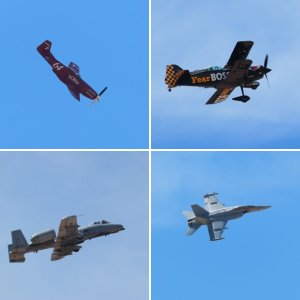
My example would be photographing aircraft in flight, specifically prop driven aircraft. To achieve prop blur you have to use a slow shutter speed, which requires at least one of 2 things: a smaller aperture and an ND filter. I've been using Manual with Auto ISO (capped at 1600 to avoid excessive noise), shutter speed 1/250 or 1/200, aperture fixed at f6.3 to avoid diffraction (on Sony APS-C f6.3 is f9.45), and a variable ND filter to cut light. I use a variable ND because light changes as aircraft pass in front of the sun. However, this is a PITA. Because I'm over-tasking myself by concentrating on tracking the planes, maintaining focus, and rotating the ND filter, quite often I end up with images that are way too underexposed and I get images with way too much noise to be keepers, or ones that are unrecoverably overexposed.. Surely my technique needs improvement, but I don't know if I ever will. What I think will work much better would be to use Shutter Priority (that's Tv to you Canon people), a fixed ND filter (probably ND8 for 3 stops), and just let the camera decide what aperture to use. It's entirely possible, likely probable, that the aperture would drop past the point where diffraction robs sharpness. Even if/when it does I'll probably get cleaner shots because I can keep my attention on tracking and focusing on the aircraft, much more important tasks than fiddling with an ND filter. I've yet to test this, and I'm anxious to, but summer in Tucson isn't the best time to hang about outside at the airport or AFB for hours on end.
Anyway, I've seen plenty of macro shots taken at equivalent F stops way beyond the point of diffraction by OM M4/3 users, like f11 to f16 (equivalent to f22-f32) and am constantly amazed at the detail that can be achieved, and whether the photos are technically diffraction limited is completely a moot point.