• UPDATE


    The forum will be moving to a new domain in the near future (canonrumorsforum.com). I have turned off "read-only", but I will only leave the two forum nodes you see active for the time being.

    I don't know at this time how quickly the change will happen, but that will move at a good pace I am sure.

    ------------------------------------------------------------

New life for EF/EF-S lenses with Raspberry Pi

Do you need a DSLR to drive an EF lens?
Or even a camera?
No...
Canon EF/EF-S lenses, meet Raspberry Pi!

  • Like
Reactions: 1 user

Ready for the Canon RF 70-200mm f/2.8L IS USM Z?

Hi ssaibal
View attachment 224588

I have tried the RF70-200mm F2.8 L IS USM Z + EXTENDER RF2x combined with R5 and R5II.

I was quite pleased with results. Here is one example of wiildlide photos. (this was taken with R5).
Excellent shot! Love the details. I think I will pitch for this lens soon. I was on a fishing boat shooting pelagic birds off the island of Pucusana in Peru today and I realized that I wasn't going full 500 end on my 100-500 as it is difficult to keep the subject in the frame in a choppy boat. And in an overcast weather like the one we had today, I would be better off with a faster lens. I already have the 1.4x TC on my 400mm lens which I could switch to the 70-200 when needed and still get f4.
Upvote 0

Laowa Announces the RF 8-15mm f/2.8 FF Zoom Fisheye

The depth of field is so great at those very short focal lengths that just guessing the distance is more than good enough for shorter distances and any long distance setting works for long distances.
At 8mm and f4 with focus at 2.00 ft, everything from 1 ft to infinity is in focus. At f8, the range is 0.5 ft to infinity.

At 15mm with focus at 2 ft, this changes to 1.5 ft to 3 ft at f/4, and 1.25 ft to 5.5 ft at f/8. If you change your focus to just over 3 ft, then everything from 1.5 ft to infinity is in focus at f/8. With a focus of 6.5 ft, everything from 3 ft to infinity is in focus at f/8. This can provide some very interesting effects.

Here's a few images of the 2000+ images taken with the EF 8-15 on a T2i, 6D over the years. I use it quite a bit less now that I have the EF 11-24. It may get a bit more usage when I want to carry a lighter load. The key is to have some foreground interest in most cases to give it depth. I use it in tight indoor spaces, hiking in the mountains, events, astrophotography and more. The first two are set for infinity focus, the last two for very close focus (nearly touching the lens) so little depth of field and curvature becomes more noticeable.

550D, ISO 100, f 11, 1/125, 10mm. Diagonal fisheye for scenery on a crop camera.
IMG_9483.jpg

6D, ISO 400, f 4, 30 sec, 15mm. Moon and stars diagonal fisheye - slight start trails from the 30sec exposure.
IMG_9576.jpg

550D, ISO 100, f 4, 1/60, 8mm. Nearly touching a horizontal log (maybe an inch away), a bit of the fisheye circle showing. 10mm gives diagonal fisheye on crop cameras like the 550D.
IMG_9623.jpg

550D, ISO 3200, f 4, 1/25 sec, 10mm. Opportunistic cat selfy nearly touching the lens, no chance to change the settings or look through the viewfinder - just held it near the floor and shot. Love the focus on the eyes - pure luck.
IMG_0475.jpg
  • Like
  • Love
Reactions: 1 users
Upvote 0

Sigma coming for Canon with an 180-800mm f/5.6-8?

Sorry, what does not compute is your understanding of patents. "Image Height" is not the vertical dimension of the image sensor, but rather it is one-half of the diameter of the image circle. The minimum diameter* of the image circle for a given format is the diagonal measure of the sensor. Plug 24mm and 36mm into the Pythagorean Theorem and you get 43.26mm, divide that by two, and you get...21.63mm. So yes, that's a full frame design.

*Note that for lenses requiring/forcing digital correction of geometric distortion, the image height can be slightly smaller than half of the sensor diagonal, because distortion correction will 'stretch' the final image to cover the corners of the sensor.

Thanks for clarification. Though if I'd read the patent I would have seen that.
Upvote 0

Can I print a 3:2 photo in the QX20?

Good morning, I want to buy the Canon SELPHY QX20 and I want to know if from the SELPHY Photo Layout application it is possible to print in 3:2 format without cropping or resizing. I have an EOS R10 camera and I want to be able to print my photos without losing part of it as it happens in the Instax.

The only thing that keeps me from buying it is the inability to find that my photos won't be resized or cropped when printed.

Thanks!

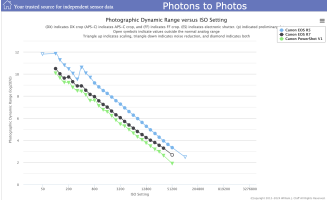
PhotonsToPhotos does the Canon EOS R5 Mark II and it’s good

I own an R5ii and owned an R5 before I sold it. My thoughts are that if you shoot fast action (sports and or wildlife), the R5ii is far superior to the R5 and pretty comparable to the Sony A1. The upgrade from the R5 to the R5ii is will worth it for this scenario.

If you shoot, landscapes, weddings, portraits or product photography, I believe you will not need an upgrade as the original R5 is a superb camera and comparable to the R5ii for this scenario.

Canon, Sony and Nikon all have excellent cameras. The days of changing systems are hard to justify in 2025.
The R5 is actually superior to the R5ii for landscapes etc. The R5 is still superb for action work but the R5ii is even better, the AF is faster and it recognises birds at even greater distances. And it has pre-capture. I am sure Canon could have done a firmware upgrade on the R5 but it chose not too to make the R5ii more attractive.
  • Like
Reactions: 1 user
Upvote 0

Canon EOS R7 Mark II: Minor Tweaks or a Major Transformation?

You can get shutter shock with both mechanical and EFCS at lower shutter speeds - yes, even with EFCS in bursts because of the closing of the shutter can shock the next frame! So, I use ES for slower speeds and for fast as well when there is no problem with rolling shutter. For action at fast speeds, there is no rolling shutter or shutter shock for mechanical and EFCS. Like many pieces of kit, there are workarounds to get the best out of it.
The shutter shock is overblown, especially after the firmware update. Sometimes I forgot to switch back to ES, EFCS/mechanical slower than 1/500 won't hurt the image.
Upvote 0

Canon RF 18-50mm f/4 IS STM Optical Design

This patent appears to be mainly about implementations of non-extending 70-200F4 for FF, with the APS-C 18-50 implementation being just an incidental output. The reason it's so long for what it does is because it is (amazingly enough) a derivative of a 70-400F4 lens layout. You can sense its telephoto origins in the convex front element: all standard zoom lenses I've ever seen use concave front elements.

My take is that it is bloody unlikely that this 18-50 will ever come to light. A non-extending 70-200F4 is more likely, as that is clearly what they're trying to develop here.
Upvote 0

Canon Announcement Delays Possible, Including The Canon EOS R6 Mark III

The most annoying thing about Canon mirrorless cameras is the focus point. With DSLRs, it was exactly one point. Now, even when selecting just one point, it's actually an area, which means it often doesn't focus where it should. It's much more imprecise than before, and this isn't an opinion, it's a fact.

From Andre's blog way back in 2010...
"Eventually, I decided to map out crosses inside each AF point, so I can focus on the subject more accurately. I placed a white sheet of paper with a small black square on the wall and moved each AF point perpendicularly to each edge of the black square until the focus light in the viewfinder started to blink, which indicated that I reached the end on the AF cross in the given direction."

"Repeating this exercise once for each of the edges gave me four shots where the inner edge of the black square indicated the end of the AF cross in each direction. I superimposed all four shots onto each other and ended up with this picture for the center AF point."

1748939568468.png
"So far so good - the cross inside the center AF point was pretty much what I expected. Note that the cross extends well beyond the red square marker in the viewfinder, which means that if there is more detail outside of the AF point marker, the camera will focus on that detail."

"After taking 72 shots and merging each four, I had the complete map of all AF points for my 7D. Let's take a look at the second one from the top in the center column, which is the one used in the sample shot above."

AF2-500x333.jpg


"Now it all makes sense - the cross inside this AF point extends well into the top AF point and the camera focused on the detail in the background rather than on the fuzzy police bear."

And:

From Canon technical advisor Chuck Westfall back in 2008 when the 5D Mark II was introduced:

"This graphic shows the relative sizes and positions of the EOS 5D Mark II's focusing points."

1748939287046.png

And from Canon upon release of the EOS 7D:

1748939723163.png

The top map is what one sees in the VF (less the numbers labeling each AF "point")

The middle is a map of the PDAF sensor array. Keep in mind that microlenses aim the light coming into the array before it falls on the sensor array.

The bottom is a map of the areas of sensitivity for all of the focus "points" superimposed on what one sees in the VF.

To the left is a guide that indicates which pairs of lines are active for which "points" as numbered in the top map. The center cross-type AF "point" is indicated by the red shading.
  • Like
Reactions: 1 user
Upvote 0

Canon’s Latest Autofocus Patent Could Make Lenses Smaller, Smoother, and Quieter

Neither is correct. Think about it: two physical things at 360 or 0 degrees apart would have to occupy the same space.

Sorry to beat a dead horse...
To answer in a slightly different way from @neuroanatomist :
In two dimensions they would be in the same place, but a lens is three dimensional.
Upvote 0

Filter

Forum statistics

Threads
37,180
Messages
964,135
Members
24,545
Latest member
shotbyfoxtrot

Gallery statistics

Categories
1
Albums
29
Uploaded media
353
Embedded media
1
Comments
25
Disk usage
982.4 MB