


Upvote
0
You are using an out of date browser. It may not display this or other websites correctly.
You should upgrade or use an alternative browser.
You should upgrade or use an alternative browser.
Filters
Show only:
Upvote
0
Has anybody gotten the 90D yet and taken it for a spin?

- By AlanF
- EOS Bodies
- 15 Replies
When we go on safari with our pair of Canons and telephoto zooms, instead of taking a short telephoto zoom for close ups, I have a Sony RX10IV which is tack sharp from 24-600mm equivalent so I can track from moderate wide angle to decent telephoto. I use the Sony for business travel as well. I use the expensive Mk IV because it has the A9’s AF so it will also do BIF. The much cheaper MK III is just as good image wise. I personally would take the Sony any day rather than my 90D plus Tamron 29-640mm equivalent. But YMMV. I used to have the Canon G3X with the same range but unfortunately it’s not nearly as good.
Upvote
0
Industry News: Sigma fp to begin shipping on October 25, 2019

- By c.d.embrey
- Industry News
- 17 Replies
Look's like compitition to Arri's Alexa Mini LF https://www.arri.com/en/camera-systems/cameras/alexa-mini-lf
Mount it on a drone, a tripod, a camera dolly, a gimbal, or even hand-hold it. Use L-mount or PL-mount lenses.
Mount it on a drone, a tripod, a camera dolly, a gimbal, or even hand-hold it. Use L-mount or PL-mount lenses.
Upvote
0
Error 70 message after Firmware 1.4 upgrade

- EOS R
- 3 Replies
Contact Canon support. Its likely that they will have to service the camera. Error 70 pertains to a board failure, that might not let the firmware update properly.
Upvote
0
RF 15-35mm F2.8 Image Quality samples up @ The Digital Picture
- By tron
- Canon Lenses
- 28 Replies
According to TDP it's about 4 to 4.5 at the extreme corners for both EF III and RF UWA 2.8 lenses.I had shot many pictures at internal spaces with my EF 2.8 III and it affected the outcome in a small set of pictures where the IQ (after correction) is worse noisewise when moving away from the center. I am thinking of applying DxO PL Prime noise reduction for these pictures. We'll see.
Of course at f/4 the situation is much better. But there are cases where 2.8 is useful. There is of course the comparison of an f/4 IS lens vs a non-stabilized f/2.8. Which is more suitable? (Opinions welcome. I do have both but I carry only one with me at a time and I encountered some dark interiors during my last trip). So this is why although a fanatic fan (pun intended!) of 5DMkIV for interior low light photography I am also very positive about the EOS R/RF15-35 combination.
EDIT: I mentioned that a small set of pictures has been affected because in the rest of the cases the photo target does not extend to cover 100% of the frame (think a statue for example). But there are cases where every UWA mm counts (think paintings and lack of space at the same time for example). In these cases it would be better to have less vignetting.
Of course at f/4 the situation is much better. But there are cases where 2.8 is useful. There is of course the comparison of an f/4 IS lens vs a non-stabilized f/2.8. Which is more suitable? (Opinions welcome. I do have both but I carry only one with me at a time and I encountered some dark interiors during my last trip). So this is why although a fanatic fan (pun intended!) of 5DMkIV for interior low light photography I am also very positive about the EOS R/RF15-35 combination.
EDIT: I mentioned that a small set of pictures has been affected because in the rest of the cases the photo target does not extend to cover 100% of the frame (think a statue for example). But there are cases where every UWA mm counts (think paintings and lack of space at the same time for example). In these cases it would be better to have less vignetting.
Upvote
0
F8 on a full frame sensor vs a crop (Hyperfocal question related to aperture)

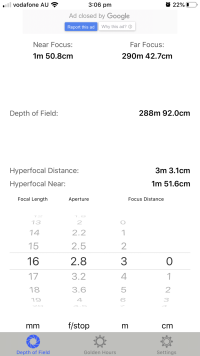
Yup, I use the Easy DoF app on my iPhone to get a quick view on DoF numbers. Here is a print screen for the 16mm, f2.8 focus distance: 3m. Resulting DoF is: 1.5m to infinityReally? My stuff isn't in focus at that wide an aperture....I need to test this out more.
Upvote
0
EOS R Tips and Tricks

Sounds like you are getting happier and happier with the horrible camera known as the EOS R.Speaking of Exposure, I'm finding that with the EVF, I'm using Exposure Compensation quite a bit less than with dSLR's. I'm staying mostly with Spot Metering, then, when it makes sense, moving the frame around a bit between subject and background (or, for example, clothing), which allows me to clearly see and choose the exact right exposure for me. At that point, I simply press AE Lock with Hold to lock it in and compose.
Sometimes the EC dial is quicker, getting my exposure where I want it without having to move the Spot Metering circle around, but sometimes this other technique, which would have been experienced guess work with an OVF, just nails it.
 I can't remember, have you got any RF glass yet? The reviews of the little RF 35mm f/1.8 are so good that I am considering it.
Upvote
0
Website Imaging Resource to close at the end of the year?

- By AaronT
- Industry News
- 3 Replies
Imaging Resources was my #1 go to sight when in the market for a new camera, going back to my 10D days. DP Review was second. I'm mostly retired, in other words not flush with cash, but I donated $10 by PayPal to the Imaging Resources. Maybe if everyone they helped along the way gave a bit it might help them stay alive. I hope they survive in some way. I would donate $10 a year to keep them going. I use Capture One and Photoshop 5 so I don't give monthly to Adobe. $10 a year to Imaging Resources benefits me more. Go Dave!
Upvote
0
Industry News: Nikon announces the Nikon Z50 APS-C mirrorless camera body & DX Z-mount lenses
- By tron
- Industry News
- 34 Replies
All these videos are quite of the blah blah type. Shouldn't people be more interested in hard facts sites like the-digital-picture, lens rentals, optical limits, etc?
Upvote
0
Further confirmation that the RF 15-35mm f/2.8L IS & RF 24-70mm f/2.8L IS are coming in September
If I take a picture of something with a large depth of field with a low f stop then it’s impossible for all to be in focus. Focus bracketing allows me to take a series of shots, sometimes 30 or more that get merged in post processing where the entire shot is in focus, or whatever part I want to be in focus is in focus.
Upvote
0
Industry News: Sony officially announces the α9 II

- By Sharlin
- Industry News
- 108 Replies
Here is an interesting tool that may suggest that there is a tangible difference in noise characteristics at ISO 6400 for cameras that we discussed.
Appears to be the resolution difference, mostly. Select the "Comp" option for an apples-to-apples comparison and the difference in noise quality all but disappears.
Upvote
0
What are the pros and cons of ISO 50 if you shoot in raw?
This past week was my first time shooting at ISO 50 because I didn't have my ND filter handy and was at 1/8000 sec shutter speed @f/1.2. I had no problems. Third photo was also at ISO 50.
Attachments



Upvote
0
Canon RF 85mm f/1.2L DS USM, RF 70-200mm f/2.8L IS USM and other accessories will be announced soon
You are absolutely correct, Michael. Solution isn’t ideal. Therefore I always shoot to multiple cards.Even when it happens during the "first kiss?"
however, saving to multiple cards via holder adapter provides some additional protection from a card failure. Not controller failure, of course.
To the same effect, and I like your intelligence, lest see what happens if shutter gives up or any other unfortunate camera fault take place during the first kiss? Oh, Schweppes....... or is it oh, Schweitzer?

Upvote
0
Dual micro SD to SD card adaptor for redundancy. Anyone have industry contacts for this one?

Can’t see camera OEMs writing firmware for this. The adaptor must look like a normal sd card but write to 2 micro sd cards Just like the pro duo adaptor. We can think of a similar situation as RAID0 configuration but drastically simplified.
The micro sd cards would need to be formatted first. One way would be to use a single micro sd card adaptor (available everywhere now). All firmware and (probably FIFO circuitry rather than server-on-chip) electronics would be on the dual adaptor
Presumably you;d want RAID 1, not RAID 0. Raid 1 is the mirroring that people here are hoping this will do; Raid 0 stripes, so that if one card goes out, they're both FUBARed. That's riskier than the situation that already exists because it's twice as likely to trash your pictures as a single card would be.

Upvote
0
Photons to photos has posted 90D DR

There is something odd about the Oly results. Photonstophotos uses the manufacturers stated isos in their graphs and not the measured ones for their charts. Oly overstates their isos by about 2/3rds stops relative to the measured ones for Canon and Sony, so Oly looks better than it really is, though they are very good. https://www.dxomark.com/Cameras/Com...us-Olympus-OM-D-E-M1-Mark-II___1072_1076_1136
Thanks...I just canceled my order for an Oly
Ok...so I've yet to have one in my shopping cart...but I had started looking at them a bit more after Andy Rouse's posts and seeing their data. I'll have to use a bit more skeptical eye. Thanks.
Upvote
0
Nikon Z50 APS-C announced

- By slclick
- Third Party Lenses
- 1 Replies
It's the M5 Mark 2 for Nikon users. But no adapting the glass, good job Nikon.
Upvote
0
Canon Celebrates Production Of 100 Million EOS-Series Interchangeable-Lens Cameras

- By Maximilian
- EOS DSLR
- 17 Replies
I am doomed!
I have too many of these 100 mio - yet not enough

I have too many of these 100 mio - yet not enough
Upvote
0
No longer doomed!
- By navastronia
- EOS Bodies
- 9 Replies
I suspect Canon thought, correctly, that the typical user of these cameras is a consumer whose best choice is using 30p (29.98) in the U.S and other NTSC countries and 25p in PAL countries because that is what their televisions use and what most basic video editors for consumers use. Thus they were trying to simplify the choice that gives the majority of the buyers of those products the best user experience.
By adding 24p as a firmware update, they can have their cake and eat it too. The average home video shooter isn't likely to do a firmware update after the purchase. The rare wanna-be filmmaker that thinks even the cheaper models should offer everything the higher models do can now STFU about no 24p on a camera they never, ever had any intention of buying even if it does offer 24p.
lol
Upvote
0
RP problem
Had to laugh. I have messed up dozens of times, but too afraid to tell it. hahaYou are no idiot. I ran into the same problem several times but do not tell it to others
Upvote
0
help buying 1st Canon(prosumer)

Yeah, if I were to recommend a camera today for video (for a first kit) it would be the Fuji XT-3. Just buy the body with standard zoom 18-55 f/2.8-4. It’s more affordable and more capable in terms of video than any Canon DSLR/MILC in 2019.
Going forward, don’t buy into a specific brand. They will all let you down, in one way or another. In terms of lenses, buy the trinity of primes (25 or 35, 50, 85 and/or 135) and buy them in PL mount (get PL adapter to fit whatever new camera you get and call it a day); learn to manual focus, it’s actually a lot of fun.
Going forward, don’t buy into a specific brand. They will all let you down, in one way or another. In terms of lenses, buy the trinity of primes (25 or 35, 50, 85 and/or 135) and buy them in PL mount (get PL adapter to fit whatever new camera you get and call it a day); learn to manual focus, it’s actually a lot of fun.
Upvote
0
Sept. BCN Rankings
- Industry News
- 6 Replies
Thanks, I missed that.I don't think they mentioned Nikon in that article. The chart shows Canon, Sony and Olympus.
Upvote
0
RF Mount 7D2 replacement? Could it happen?

- EOS Bodies
- 51 Replies
Ok. Fair call. I have often had a Tele like this on a tripod for hours at a time with wildlife on a similar fashion. But having said that I still would never run it on a tiny mirrorlbody as it would mean I can't then use the same setup as an effective mobile unit due to its poor balance. So I suppose if you never really handhold for any length of time it makes enough sense. In situations like I tend to be in it doesn't and I guess I tend to see things from that perspective.A lens can be very usable hand held for a little while. That same lens may not be as usable hand held when aimed continuously at potential subjects for several hours.
I shoot high school football with my heaviest lens on a monopod. From the sideline most of the action begins between the hash marks and is in the same general direction from my position over the course of each play.
I take that lens off the monopod for the halftime show, where potential subjects are closer to and even on the sideline and they are spread all over the field at a much wider range of angles to my position.
After halftime, I then put the lens back on the monopod for the second half, when most plays are all shot with the camera pointed in roughly the same direction.
The halftime show lasts about eight minutes for each band. I'm there mostly to shoot one of the two. The football game lasts 48 minutes on the game clock, plus the time when the clock is not running until the next play starts. Each half usually lasts around an hour to an hour and twenty minutes or so. A lens that is not too heavy to hand hold for eight minutes can be too heavy to hand hold more or less continuously for two and one half hours.
Upvote
0
Adorama launches their rebrand with new logo and web site

- By sid.safari
- Industry News
- 6 Replies
Camera stores have many products and sku's. For better shopping experience all those products have to be classified in an easy to find / navigate system. Taxonomy isn't just the classification of living things (though that is where it is popularly used). It is a scheme of classification that can be applied to any system.Taxonomy is the science of identifying, classifying, and naming living things. Could someone clarify for me how the term could apply to a camera store.
Upvote
0
Do you think the 90D is superior to the 7DII?

- EOS Bodies
- 115 Replies
No. It's to get a "picture with the subject occupying more of the total frame in the final image" with an acceptable image quality. You can get the same picture from a lower resolution sensor, but its image quality will be lower (in this case, worse than acceptable).
Which pretty much what you have previously been disagreeing with every time i said it. Gld to see you finally see it my way.
Upvote
0
Load more
Filter
Forum statistics










Gallery statistics
- Categories
- 1
- Albums
- 29
- Uploaded media
- 372
- Embedded media
- 1
- Comments
- 25
- Disk usage
- 1 GB