
You are using an out of date browser. It may not display this or other websites correctly.
You should upgrade or use an alternative browser.
You should upgrade or use an alternative browser.
Filters
Show only:


The 2020 RF lens roadmap, up to 8 new lenses coming in 2020

- Lenses
- 165 Replies
Two things of note to clarify after reading recent posts:
1. IS can be very useful even in fast lenses that don't "need" it. First, it stabilizes the finder, which is always handy. Second, as someone who shoots bleeding-edge handheld available-dark images at ISO 25000 with my 24mm f/1.4 wide open, I will take any help I can get.
2. The myth that IS degrades image quality needs to die. Some of Canon's sharpest lenses have IS. This myth is no doubt related to the myth that adding elements to a lens degrades image quality.
IS is in more and more lenses because it improves image quality by reducing the effects of camera shake.
IS only improves image quality if the amount of blur due to camera movement is greater than the amount of blur introduced by displacement of the IS lens elements from their ideal position. For IS to counteract camera movement, lens elements have to move. That means they are introducing either tilt or centering compensations that are less than ideal.
IBIS also affects IQ, but in a different way. As the sensor shifts it moves the center of the frame away from the center of the imaging circle. This will typically cause the IQ at one edge/corner of the frame to improve (because that edge/corner is now closer to the center of the image circle) while at the same time causing the IQ at the opposite edge/corner to degrade (because that edge/corner is now closer to the edge of the image circle).
Upvote
0
Patent: Canon RF 17-35mm f/4-5.6
- By uri.raz
- EOS Bodies
- 70 Replies
My pure speculation on this. I suspect the bulk of APS-C DSLR owners who buy EF lenses are buying telephoto lenses. Heck, Canon even kits some of the Rebels with EF telephotos.
Other then a crappy 75-300mm?
Upvote
0
Canon posts RF lens control ring modification information
- By GulliNL
- Canon Lenses
- 22 Replies
I mean they should have done it in the first place, I find it an omission which they could fix.
Upvote
0
Using the canon R and the BG-E22 vertical grip VERTICALLY with touch-drag

- EOS R
- 3 Replies
Thanks for the reply.
one thing to look out for with the low price in some is that I believe canon sells the grip only WITHOUT the usb charger for the lesser price.
I verified that this was a authorized dealer before I ordered it, and the grip was new and complete, including USB charger. I've been around more than a few years and know all the tricks.
They still have it for that price. I'm not sure why, their other Canon stuff is all sold at MAP.
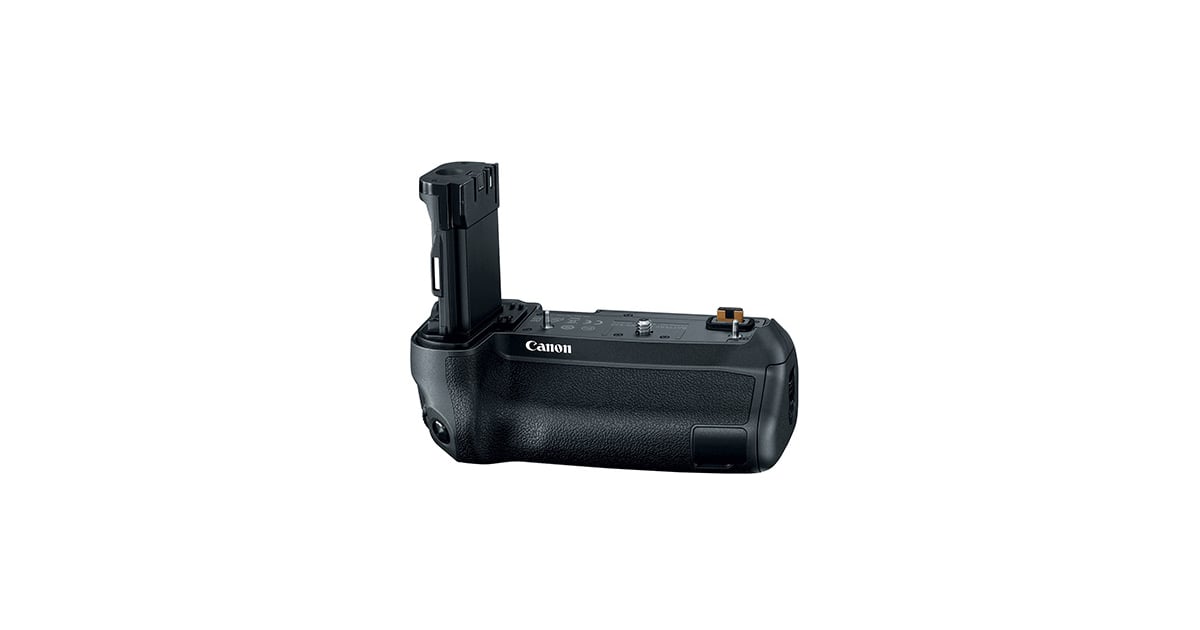
Canon 3086C002 BG-E22 Battery Grip For EOS R Camera
Buy the Canon 3086C002, BG-E22 Battery Grip for EOS R Camera at Full Compass Systems. 0% Financing and Free Shipping on thousands of items!
 www.fullcompass.com
I've transferred images to Adobe Lightroom on my phone and then to the cloud, but I don't transfer them to my NAS when shooting within range of my Wi-Fi access points.
I have very large hands, so my thumb keeps creeping onto the top ocorner of the screen, I've turned the touch bar off because it was always being activated.
Even with its flaws, I tend to use it more than my 5D MK IV because it is easier to carry. I generally don't like grips, but it helps solve a issue, so I had to compromise.
Unfortunately, all the dual Canon chargers I've owned charge sequentially, so that came as no surprise, but it was one of the first things I verified.

Upvote
0
Interesting what's happened since I got an RP.....
I've got mine set to ECO. I leave the touchscreen closed unless I need it. I turn it off immediately (if I turn off the IS to save battery, I might not remember to turn it on so just turn off the camera) if I now I'll not be taking shots for a bit (probably not necessary since it "times out" on its own) and I do almost no crimping. I've taken over 350 shots with the RF 24-105 and have battery still available.
I do wish the IS would not stay "on" and maybe a future firmware upgrade will improve that.
I have 3 batteries 'cause 1 came with the camera and I had extras from my old M days. I am planning a trip and thinking about the RP instead of my 5Div. I'd bring the RF 24-105, the EF 16-35 and the EF 100-400 vii with the RF-EF adapter. What is anyone's experience with the EF + adapter and battery life? Assuming 200-300 shots a day (and that is likely more than I'd do) and 3 batteries, would I get a couple of days worth of images between charges?
Hmmmmm. 3 battery’s over two days? Probably, if you didn’t chimp too much. Safer to plan on charging each night though. At least it’s quick and easy via usb c
I didn’t use my elf lenses much as the rf24-105 ended up stuck on the camera, but with what little I did, I didn’t see a change in battery life.
Upvote
0
If you go R/RF?
That’s why I got an R...if you just hold the R, Z6/7 and A7R, that’s the exact order of how ergonomically well designed they are IMO...the R just feels a lot better in the hand.I just got tired enough of my Sony a7r3 and ordered an R/24-105/adapter kit from B&H.. (Tried to buy locally but the store with stock doesn't take PayPal.).. For the Sony, I have the 24-105 and 70-200 F4/G zooms and Canon TS-Es in 24mm (gen.2) and 50mm (gen.3).. Will be keeping the TS-Es and the RF 24-105.. Won't be buying a tele for a while.
The R felt VERY good in my hands...MUCH better than the too-small Sony.
Upvote
0
10 Min Film shot on EOS R - Highly Impressed with this Camera for Video
Thank you for the lens information PCA. Again, nicely done video.
Don
Don
Upvote
0
Industry News: Fujifilm GFX 100 specifications leak, 100mp medium format camera on the way
- By Kit.
- Industry News
- 16 Replies
That's probably because EOS IX and similar cameras were a market failure.Funny, we never used to call 35mm format, "full frame" in the film era.
There also were 135 format film "half-frame" cameras, but too far ago for most of us to remember.
Upvote
0
Why?
- By old-pr-pix
- EOS DSLR
- 27 Replies
Absolutely. And then folks wonder why less and less value is placed on individual photographs when the skill required to produce them is diminished. Anyone can push the shutter button now and almost all the technical aspects are automated to produce a reasonable image. Next the advent of deeper AI will not only track focus but will suggest composition. While great photographers will continue to evolve and push the edges, it is the 'just average' photographers who will continue to be displaced IMHO.Sports used to be done with 4 X 5 press cameras, photography was a high skill. Automating things to bring those skills into the hands of ordinary photographers has driven the camera market. Autofocus, interchangable lenses, built-in light meters, rear lcd's, TTL viewfinders, its all about making the once difficult easier to do.
Upvote
0
Patent: Canon RF 135mm f/1.8L and other fast primes
- Patents
- 31 Replies
Yes, the physics is the same, but you're relying on physics at a vastly different scale. Refraction from lens elements results in separation of wavelengths on a µm-scale, refraction from an object in the field of view is not the same. From the standpoint of a subject LoCA results from reflection, not refraction. Consider: why is it that LoCA – no matter the source – shows up as purple and green? To (re)quote you (with typos corrected): "After all if one holds a gem up to theNo, I am not relying on different physics. But as I was implying and as you pointed out refraction when it comes to optics like elements can contribute to what you see. I know what the definition of CA is. What is the exact physics behind it? Is it not different wave lens reaching different portions of the lens, especially when the light is bend aggressively and not compensated accordingly? So I when I say that generally I wouldn’t put optical elements in the frame to judge CA such. As gems or glass or ice etc it is to eliminate a potential contribution to the result. After all if one holds a gem up to the life and twist it this way and that one can general manipulate it to see a verity of colors. That includes purple and green those it not? So gems do bend light and can be a cause of a higher than “usual” incident light into the lens, which one can’t attribute.
*There's a caveat there, that the gems need to be clear. If the gem is colored, the light from it will not be white and the way in which that light is refracted by the lens elements will be affected. But that's not the case here, as the jewelry under discussion contains only clear gems.
So if one is interested in sharpness, ISO 12233 charts are only useful for those interested in taking pictures of flat, printed subjects?Of course if this was shown for those interested in taking pictures of jewelery specifically I get it can be useful. But as a blunt example of CA control... eh, grain of salt.
Regardless, look at the jewelry LoCA image, and notice that there are purple/green-fringed gems and that the setting is also purple/green-fringed, and that the intensity of the fringing is equivalent between the two. So let me ask you again, as an applied physicist – does solid metal refract light? If it does, then it's possible you're correct. But of course, we both know it doesn't.
As I stated previously, the 'extreme case' of LoCA is a specular highlight, and it really doesn't matter if that highlight is from a gem, polished metal, or another highly reflective surface.
Here's an example from a review of the RF 50/1.2. There is LoCA on the ring, no gems required.
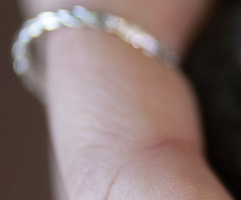
Having said that, I do agree that the LoCA on the RF 50/1.2 is very well controlled.
Upvote
0
Is it a safe place to check camera shutter count?

Old thread, but for pc users, this works great.
I picked up a pristine 1D MK IV and found that its shutter count is only 19,460.
btw, you will need to download winrar to unpack the file.
I picked up a pristine 1D MK IV and found that its shutter count is only 19,460.
btw, you will need to download winrar to unpack the file.
Upvote
0
Upvote
0
A new Canon DSLR seems to be getting teased on social media by a Canon ambassador
- EOS Bodies
- 223 Replies
I would suspect that this is Canon looking at future Sony a9 etc. and wanting to assure canon users that there is a real pro camera being tested right now. If too tight lipped for too long too many will jump ship and then it is hard to get them back. Just ask Nikon that is still struggling after Canon crushed them with the EF system. Nikon assumed that their pros would stick with them yet they were abandoned in droves until their pro market was left to rich amateurs rather than the pros along the sidelines and at major events.
It sounds like canon is trying to get ahead of that mass exodus.
The pros, in the kind of numbers that matter to Nikon and Canon, have already left the building. Not to go to Sony or Panasonic, but to a career where they can still make a living. The premium camera market today is not being driven by pros any more, it is being driven by enthusiasts and hobbyists with lots of money to spend. This sea change has been coming for a while, but seems to have reached critical mass around the time the 1D X Mark II and D5 were released.
Upvote
0
Adobe updates Lightroom Classic, adds a new texture slider and new Canon camera & lens support

- By Ozarker
- EOS Bodies
- 61 Replies
I like the texture slider too.Concidentally, I was wondering the same thing only last week: I tweaked the clarity and thought 'Whoa! That's garish. What's happened?" I was not sure if the tool had changed because it was always touted as something that tweaks midtones to improve apparent sharpness, then I wondered if it depends on the starting image in that to get a difference on an image that has good lighting, and good small-detail contrast you need to use it more heavily. But I could not escpe the feeling it was not what it used to do.
Then as soon as I used the texture it immediately felt to me that it was what Clarity used to be like. But maybe there is some auto-suggestion coming in. Whatever is happening, I really like the effect of the texture slider.
Upvote
0
Profoto announces the Profoto A1X, an On/Off-Camera Flash with Built-in AirTTL Remote

- By RayValdez360
- Third Party Lenses
- 5 Replies
Work all the weekends you want, you're still paying $500 just for bragging rights. Plenty of top line flashes that do the same thing for half the cost. So, one flash plus a backup, or a very nice label.
[/QUOTE
outside of godox v1. its a good flash. i recently finally lookedat all the pros vs. a regular speedlight. it simply works a lot better. peopel that do weddings or events that require lots of flashes would understand this better than anyone else. i dont have it but i am tired of my 600 ex batteries running low, slow recycle, no fires, and hard time getting gels on and off. then i sometimes use a profoto strobe to light a room. i have to put it in slave to get it to work
Upvote
0
EOS R and the EF 11-24 f/4 for UHD Video

EF 11-22 f/4 works well with EOS R for 4K video. The 11mm wide end cropped is still wider than what I like for video but the 22mm zoom end is close to to 37mm FOV and anything in between is usable. An advantage is that the var ND mount adapter can be used for compensating the shutter speed. This couldn't be done on other cameras, such as 5D IV.
Upvote
0
IBIS and 100mp coming to an EOS R camera? [CR2]
- By Ozarker
- EOS Bodies
- 270 Replies
Some people have no sense of humor.I said if I was a wild life photographer (I am not), I would prefer eyeAF.
Don't quote me out of context. I don't care what you use or want. You add nothing constructive to your post. Just use whatever make you happy. It just a tool. I'm not a fanboy of any brand.
Stop quoting me and respond with useless with info.

Upvote
0

Upvote
0
Sigma 18-35 1.8 art or Canon 24-70 f4l + viltrox focal reducer
- By Mark3794
- Canon Lenses
- 5 Replies
Sorry my bad i meant that i already have the speedboosterI am referring to the speed booster performance. The Canon's adapter for the M series should work perfectly as they make it. The third party speed boosters are the unknown quantity.
Upvote
0
70-300mm Lens for my R

- By Maximilian
- EOS R
- 6 Replies
To make your invest a little less hurting look at the IQ comparison at TDP....
So i guess the best option would be to sell the Tamron and buy the Canon version.
...
To me it looks like the Tamy is a little bit better at 70 mm while Canon is winning as soon as it goes mor tele. At 300 mm the gain in IQ for the Canon is obvious.
But don't expect too much profit selling your Tamy :-( . That's always the prob with 3rd party lenses. 150,- € would be a deal IMO, depending on its condition.
Some prices on ebay are ridiculously high.
Edit:
Summer promo is already live. Only L lenses are included.
Upvote
0
Canon registers a 32.5mp APS-C DSLR in Taiwan

- EOS DSLR
- 194 Replies
Absolutely. Taking a single frame from good video would produce a terrible still image as a general rule, as the shutter speeds required to produce good videography rarely match the shutter speed required to produce a good still in the same situation. While there are similarities in the art forms there are also massive differences.Comments like this always make me cringe. Stills and video are two very different animals. The essence of video is to capture motion and sound. It is to show subjects moving through space and time. Photography is about stopping time. Carving a split second out of the continuum and holding it up for examination. Certainly the technology of still and motion cameras have been converging, but the thought that you can simply carve out a single frame from a video and have a great picture betrays an ignorance of both still photography and video/film.
Upvote
0
Venua Laowa 100mm macro review by Opticallimits

Yes, monsoons the best time in Western ghats for macro photographers. Most animals(large and small) time their reproduction for monsoon season. This is what the ghats look like for 4-5 months of year.'monsoons'?


Upvote
0
Missing focus with 5D4 a little too often
There is a remote possibility that is due to the “aging” of the camera. I have a 40D that is very reliable in AF for 4 year. After that it becomes less and less reliable.Graham,
Many thanks for digging these out.
Cheers
Stoical
Upvote
0
Is anyone interested in this new EL-100?
I gave up waiting for a new model that is small and has RT. Bought a used 90-EX on Ebay for super cheap. Works great on my 6D as a little fill and the 'easy wireless' mode is actually handy too.
Upvote
0
Load more
Filter
Forum statistics









Gallery statistics
- Categories
- 1
- Albums
- 29
- Uploaded media
- 372
- Embedded media
- 1
- Comments
- 25
- Disk usage
- 1 GB