DxOMARK Shows The Progress Smartphone Cameras Have Made in the Last 5 Years

snappy604 said:
currently yes, but doesn't mean it will be in future.. which is the point I was trying to get :) Trust me, way prefer my SLR pictures, but damn it's annoying taking 20lbs of gear on a hike and more often now I'm ok with phone pics than say 3 yrs ago.

There is more options than a phone and a DSLR. Canon G9 X beats a smart phone hands down and is much smaller than a DSRL.
Upvote 0

Another Canon EF 135mm f/2L IS USM Mention [CR2]

Canon Rumors said:
We’ve received another mention of a Canon EF 135mm f/2L IS USM coming in the first half of 2018, we see the CP+ show in Japan as a good time to announce the lens.</p>
<p>We’re told production of the EF 85mm f/1.4L IS will have to meet global demand before the announcement.</p>
<p>We’re also told that the original non-IS version will remain current for some time after the new lens appears.</p>

Any more credible info out there on this lens Craig?
Upvote 0

Patent: Fingerprint ID on Your Cameras and Lenses

IglooEater said:
dsut4392 said:
IglooEater said:
unfocused said:
It better work better than iPhone finger print ID.
I’ve had the 5s and 7, while the 5s fingerprint recognition was a bit fussy (first generation) I find the 7´s to be rock solid. It’s just works-it’s reliable, and super fast. Fast enough that if I just want to get to the camera from lock screen I need to wake it up with the power button or a different finger. With my thumb it turns on and unlocks all in an instant. I’ve not really had an issue to be able to say it needs improvement asides from being fussy with water like every other touch screen I’ve ever tried.

"60% of the time, it works every time"

But if my hands have been wet for more than a brief period (swimming, kayaking, washing the dishes) or have been doing anything that involves gripping something abrasive (gardening, woodworking, building, rock climbing), it doesn't work at all.

When I say it’s fussy in water, i mean my phone is dripping because I’m in the pouring rain- not I was around water for a while .
I work in construction and my fingers are dusty, dirty, sweaty, cut, scraped, bruised, -20° cold, +40° hot, pitch black, and direct sunlight. fingerprint thingy works all the time. Just not in pouring rain. That’s probably less than 1% of the time I use my phone.

Wish I could say the same. Maybe I'll try registering a few additional prints, "sweaty thumb", "dusty thumb" and "prints all worn off climbing thumb":)
Upvote 0

Nikon Full Frame Mirrorless to Have New Z Mount

Talys said:
Mikehit said:
9VIII said:
Talys said:
AvTvM said:
Mikehit said:
How does mirrorless have higher margins when people like you expect the price of the camera to be lower because they are not going to the expense of manufacturing a mirror box/assembly?

very simple: camera makers dont and wont hand out 100% of cost savings to customers. Not even I expect to get 100% of cost savings associated with mirrorless cameras. But I do expect a "decent cut" on them ... a 50/50 split would sound fair to me. What i will definitely not accept is "LOWER cost for maker combined with HIGHER prices for customers". But i am aware that many of the "apologist" folks around here are much more lenient with their gear supplier/s ... but that is not my problem, it's theirs.

Sorry, man. That doesn't make any sense. No manufacturer in the world operates on the basis that if they save some money, they'll give you a cut of those savings :o
...

That’s how the entire electronics industry has operated for the last 50 years, otherwise you would be paying trillions of dollars for anything more than a basic calculator.

Er....have you studied, or been involved with business finance? You could charge a trillion dollars and make massive profits but you would get 0% of a massive mark-up.

The reason prices dropped is because of competition. And Sony have a unique series of products so they charge what they can and they get away with it because of the unique set of features. It will be interesting to see what happens to Sony prices a year after Canon and Nikon enter the FF mirrorless market.

ding ding ding... give the man a medal :)

That's precisely it. In many consumer electronics industries, products are sold in a highly competitive marketplace, and the price (profit) optimization curve lands you at a low profit margin. The price is highly elastic, meaning that as you increase price, the profit plummets.

The only thing that cost savings do is determine the price floor (the lowest possible selling price), because a company generally doesn't sell items at a loss.

Never, ever, does Samsung or Apple go, "the next phone/laptop/tv will cost 20% less, so we'll mark down the price by 10% to pass it on to the customers". Any pricing manager who suggested that would be laughed out the front door.

If anything, it is the opposite: with each successive generation, the goal is to reduce costs in order to increase profits. So the first generation of a product (like an Xbox or PlayStation) will set a benchmark price. Then, as time passes, the production cost will drop, without any change in the selling price. At some point, the selling price will drop (because of competitive forces and price attrition), but by then, the manufacturing cost has dramatically fallen.

These concepts aren’t complicated. The market analyses may be, but it’s easily understood by the lay person. But here’s the problem: I get the feeling a resident marketing expert might not even have familiarity with basic concepts like elasticity, channels, etc. In fact the general feel I get is that most people conflate marketing and promotion. Promotion is in actuality a part of marketing.
Upvote 0

Patent: Image Sensor Stabilization

Don Haines said:
In the great debate over which is better, stabilizing the sensor or stabilizing the lens, the answer is clear.... BOTH!

Agreed, the combination is really powerful. This was a “oh crap the moon looks cool but my tripod is in the truck and my kid hid the keys so I have to run out to shoot handheld” special. Usually since the moon is so bright it’s not an issue, but with f/11 max aperture (100-400 + 2.0 TC), I had to use a longish exposure time.

It could be a better photo, but for 800mm hand held for 1/250 and then cropped in about 1/3, it’s not half bad, thanks to a combination of lens and body stabilization.

Attachments

  • BE1E31D6-BA14-49BE-9F0E-472A5885586D.jpeg
    BE1E31D6-BA14-49BE-9F0E-472A5885586D.jpeg
    42.4 KB · Views: 486
Upvote 0

Review: Google Pixel 2 for Photography by DPReview

Sorry to break it to you guys but every RAW file is getting baked, that has been the primary source of high ISO improvements for the last 5 years.
On chip ADC, BSI, and copper wire all certainly help, but every time a new processor comes out it’s advertised as producing better high ISO with the same sensor as before, that’s all software corrections being applied to your RAW files.
Upvote 0

Fujifilm 2017 Q3 Financials are Impressive, Lead by the Instax Lineup and Not Mirrorless

HTML:
Fujifilm has released their 2017 Q3 financials, and have shown impressive growth in revenue and operating income, there are a few caveats though.</p>
<p><strong><a href="https://www.canonnews.com/the-pros-and-cons-of-leaping-to-conclusions">Canon News</a> explains:</strong></p>
<blockquote><p>…. when you investigate the details of where and what Fuji is selling and what makes up most of that money in sales, you quickly realize that most of their sales is coming from their wildly profitable and successful Instax lineup and not their mirrorless cameras.  It’s safe to assume then, that it’s unknown where the increase in operating profit is coming from because there’s too much difference in the sales data areas in Fuji’s imaging departments either by instax or electronic imaging.</p>
<p>Also, Year on Year quarterly percentages will be heavily influenced by the Kumamoto earthquake in 2016 – overly inflating year on year growth statistics.  Which is why just about every analysis we did included the earthquake as a contributing factor to some statistical information. <a href="https://www.canonnews.com/the-pros-and-cons-of-leaping-to-conclusions">Read the full article</a></p></blockquote>
<span id="pty_trigger"></span>

Is This The Man Behind the Canon PowerShot G7 X Mark III Hoax?

AvTvM said:
i will never understand the desire for a dedicated EV +/- dial on top of a camera .. when any decent Canon EOS [with big rear wheel] provides immediate access to exposure comp ... to me a totally unnecessary doubling up of physical control points.

Not to mention other "follies" like those "retro Fuji or Nikon Df style" control layouts with single-purpose dedicated wheels for anything ... instead of digital-age, context-sensitive [Av, Tv, M] front and rear dials + fully user programmable interface. the former made sense ... back in the days of mechanical cameras and film. the latter is a much better UI for digital cameras.

Take a deep breath, and embrace your limitations. It is okay for you to never understand what you don't understand.
Upvote 0

Patent: Improving Computational Photography With DPRAW

Mt Spokane Photography said:
Canon Rumors said:
The patent is quite detailed and goes a bit above our pay grade.</p><span id="pty_trigger"></span>[/q]


As noted in the patent

"[UU13J Further features and aspects of the present invention will become apparent from the following description of exemplary embodiment's with reference to the attached drawings."

That reminds me of the common comments made in my Engineering classes many years ago. They went something like "It will be self evident to the reader"

This notorious quote: "Il est facile de voir que..." ("It is therefore obvious that...") is attributed to Laplace.
Anyway, I have noticed that there is a Quad-Pixel architecture in the patent.
Upvote 0

Patent: Lens Image Stabilization Patent Shows Sensor Based Stabilization

mjg79 said:
How will they entice those with a 5DSR or 5DIV to upgrade again? Does a move from 30 or 50 megapixels to 60 or 70 megapixels actually make much difference for many people? Does improving noise by 10% at ISO6400 really have a huge impact and cause someone to buy a new camera? But suddenly finding all your fast primes are now stabilised and you can shoot at a shutter speed 3 or 4 stops slower? Suddenly finding that your IS lenses have now got a supercharged IS? I can see that being a reason to upgrade the body. No improvements to the sensor technology will yield such a big improvement.

Did the move from 21MP to 30MP actually made much difference for many people? My bet is the the lion's share of the difference was in convincing people to open their wallets. Camera manufacturers participate in the MP wars because raising resolution is the easy and profitable compared to other improvements.

I have a 5DmkIII, and had DxO Optics Pro processed mRaw, I would have shot 10MP most of the time. I prefer IBIS and cleaner high ISO over more MP.
Upvote 0

Nikon vs Canon resale values

aceflibble said:
Being in contact with a couple of chain stores and several independents—plus, of course, keeping an eye on eBay for any bargain deals—I'd say that here in the UK, Canon and Nikon's second hand markets are roughly equal; which bits of gear hold their value more or less depends on the specific model in question, with a clear divide between lenses and bodies.

For example, the Nikon 35mm sensor SLRs from ~10 years ago or so are holding their value much better than the Canon ones of the same era, especially the 5D2 which can now be bought cheaper than new entry-level APS-C SLRs. I would probably attribute this to the strong sales of the 5D2 in the first place, leading to the market then becoming flooded with them; more people bought them back then, so more people have one to sell now.
Conversely, the Canon 70-200 f/2.8 IS II costs nearly as much second hand as it does new (assuming it's in good condition, of course), while the Nikon equivalent of the same age sells for just about 60% of its original value. It's also much easier to find those Canon 70-200s in good condition, while the Nikons do tend to be a bit more worn down, even when described as being in good condition.

Cheaper stuff is more of a mixed bag. Looking at less-pro examples, the Canon 85mm f/1.8 holds its value very well, while the technically-superior-but-less-famous 100mm f/2 doesn't; for Nikon, both their mid-priced 85 and 105 lenses land right in the middle of the two Canons. None of them wear down or are any less or more tough than the others, and in practical, 'real world' terms, they're all optically up to scratch. In these cases it's a matter of raw popularity.

As a general rule, here in the UK, Nikon's pro bodies hold value better, while for lenses, it's Canon which retain value, and the same goes for condition; easy to find Canon L lenses in good condition, easy to find Nikon pro bodies in good condition. This shouldn't be at all surprising to anyone, given that the public perception for years now has been that Nikon have the superior bodies while Canon has the better lens range.

Though for what it's worth, go back 15 years and things were dead even, and go back 25 years and it was the total opposite. In another 5-10 years it'll probably be the opposite again. It's best to not worry too much about gear value in the long-term, and absolutely never think of gear as any kind of "investment". Buy what you need to get the photos you want/need. If the time comes to sell it out and you manage to get a fair chunk of the money back, think of that as a bonus. You could "invest" in the reportedly-toughest lenses and bodies on the planet, but they still won't retain their value if a front element gets smashed, a body falls out a 7th-story window, or it's all stolen. And you never know when the secondhand market will simply bottom-out, too. (That happened to Fuji cameras here very recently; bodies and lenses which had been holding their value very well suddenly dropped to bargain-basement prices and people have been really pissed off that they didn't sell their older Fujis sooner.)

About 5 years ago I sold my 500 F4 Mark I for the more than I paid for it in 2000. However by then the price of a new lens had doubled.

Thanks for the detailed reply
Upvote 0

Canon EF 85mm f/1.4L IS Review and Comparisons | Dustin

Sporgon said:
Many review sources found that the Tamron 85 SP suffered from focus shift and that could be a big practical difference between that and the Canon lens. I don't think Dustin mentions it in his review though, so I presume he didn't find it an issue during his very practical review methods, but others certainly did.

On the back of Dustin's advice on the accuracy of these latest Tamron's AF I bought the 45 SP and it's an interesting and quite versatile lens, with no FS. I find that the vast majority of people do not want portraits where just one eye is in focus, and so when close I want smaller apertures; focus shift is something I just can't tolerate.

I know Bryan kind of drilled the Tamron 85 VC over focus shift, but I've owned one since release and never actually found it to be an issue in real world shooting. It's actually the most accurately focusing third party lens I've ever used.
Upvote 0

Image Stabilization in extreme movement?

AlanF said:
Talys said:
monkey44 said:
BTW: I almost never shut off IS unless on tripod and for long exposure scenic ... IS acts as if it's off when it detects stability, usually. Of course, that also depends on the IS model ...

With a bigger lens, IS isn't even terrible on a tripod. In a lot of cases, the tripod is not perfectly steady, for example, if you haven't given it time to settle, or if it's windy.

If I'm using 1/1000 or faster, even if it's on a tripod, it's hard to see any negative effect of the IS, whereas it can save some shots (or frames) that may otherwise have been blurry. The other advantage of leaving on IS is that you don't forget to turn it back on, if you're going back and forth between tripod and not.

Canon's instruction for lenses that have tripod detection is to leave the IS on while using a tripod because it might minimise mirror/shutter shake. Arash Hazeghi always leaves on IS for BIF since it helps maintain the bird in the centre of the viewfinder and doesn't have negative IQ effects etc. I leave IS on as well, for what it's worth.

Thanks, Alan. I did not know that (about Canon's recommendation)
Upvote 0

NASA Mission Uses CANON Camera To Map The World's Largest Island

Diko said:
Mt Spokane Photography said:
Since they are remotely controlled, they must be using live view and a remote tethering software like Canon Utilities.

The shutter only opens once and closes once while in live view, so I wonder how many hours they get before a camera fails or needs service.

I doubt that. Really. My presumption is that they use a cheap web camera to review the sight of which they took photos and to keep visuals. It much more cost effective. And usually NASA ARE moderate in their spendings. ;-)

Except they describe remotely setting the camera adjustments while flying, which means some sort of thethering.
Upvote 0

Exposure Differences 5DIV vs. 1DxII

The cameras will expose differently because their exposure systems are different, and they will view some scenes differently.

My 5D MK IV over exposes indoors, but its just the scene and lighting. In a outdoor scene that is typical, it exposes perfectly.

When I use a longer lens so that the subject fills the frame, the exposure is perfect, or if I use spot exposure, the subject is properly exposed. Sometimes center weighted exposure solves the issue.

I do a trial before a shoot to find which method is giving the best exposure for the lighting and use that.

When you put two cameras side by side and they have different exposure sensors, expect to find differences for the same scene.

Here are the 1DX II Specs:

Metering modes Approx. 360,000-pixel RGB+IR metering sensor, 216-zone metering. EOS Intelligent Subject Analysis system
(1) Evaluative metering (linked to All AF point)
(2) Partial metering (approx. 6.2% of viewfinder at centre)
(3) Spot metering:
Center spot metering (approx. 1.5% viewfinder at centre)
AF point-linked spot metering
Multi-spot metering
(4) Centre weighted average metering


The 5D Mark IV Specs:

Approx. 150,000-pixel RGB+IR metering sensor, 252-zone metering. EOS Intelligent Subject Analysis system
(1) Evaluative metering (linked to All AF point)
(2) Partial metering (approx. 6.1% of viewfinder at centre)
(3) Spot metering: Center spot metering (approx. 1.3% viewfinder at centre)
AF point-linked spot metering not provided
(4) Centre weighted average metering
Upvote 0

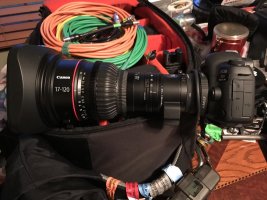
NBC Olympics Selects Canon U.S.A. to Provide Field and Studio Equipment for its Production of 2018 O

Re: NBC Olympics Selects Canon U.S.A. to Provide Field and Studio Equipment for its Production of 20

Valvebounce said:
Hi.
Thanks, I didn’t see that picture when I clicked on the link, I had many blank squares instead. Not just the one camera unless I’m mistaken!

Cheers, Graham.

Was actually the same for me (though there the 4 squares linked to different photos), because I saw it from unread posts instead of from the main page. It only shows up if you look at the home page.

It is a very impressive photo, lol. gimmegimmegimme!
Upvote 0

Filter

Forum statistics

Threads
37,440
Messages
973,650
Members
24,805
Latest member
track inspector

Gallery statistics

Categories
1
Albums
29
Uploaded media
372
Embedded media
1
Comments
25
Disk usage
1 GB