• The Canon Rumors Forum has officially been shut down as of July 10, 2026.

    All data will be deleted on September 16, 2026.

    the ad free experience will return by July 17, 2026.

Lighting and triggering setup

About remotely controlling power... well I have Bowens system that uses a remote, and sometimes it's the power, angle, modifier, combo of these... so assistants are a MUST for location shooting, and you need to test the setup beforehand as well.

As for the triggering... Cable is the best, I was sick and tired of radio triggers working with one system or the other, light meter working with one or the other, so in the end... switched back to the good old wire and had 0 issues.
Upvote 0

Back Button Focussing and AF Points

The reason I love BBF so much is that it really allows you to take advantage of full time manual focus. Otherwise, when you touch the shutter again you are fighting yourself.
It really shines with weaker AF cameras like the 5DII, as I use center point AF to grab focus, then recompose and tweak focus manually while shooting. Really increases hit rate with shallow DOF shots.
Upvote 0

Update - Product Advisory for EOS 5D Mark III LCD Illumination Exposure Issue

Jglaser757 said:
I'm not surprised by this at all. I thought this was normal. When ever I put my eye up to the lens, the exposure reading is lower than when I pull my eye away leaving the viewfinder exposed to light coming in. I always compensate for this by either covering up with my thumb or bracketing.

Clearly, you don't understand what this Product Advisory is about.

Canon provides an eyepiece cover for the 'issue' you describe...RTFM.
Upvote 0

Is Canon 5d mk 1 still a good camera?

JohanCruyff said:
That's what is happening to me: I can't convince myself that I need a new Full Frame body, so I'm keeping my 5Dc plus my EOS M when I need to shoot videos or to travel light.

The 5d3 has full res raw video capability (with Magic Lantern) so that's a decisive feature added, of course apart from everything else ML offers as it isn't available on the 5dc.

Otherwise only upgrading a body after knowing what exactly the required improvement is imho is the best advice. Much more sense putting $$$ into lenses and esp. lighting gear (1x 600rt = €500 ...). It's easy to test-drive a new camera nowadays either via rental or in a shop, if it doesn't immediately deliver the "that's worth a couple of thousand $$$" impression the money might be better saved.
Upvote 0

Best short telephoto?

unfocused said:
Okay, I'm having a really difficult time getting past the whole concept here.

The OP is planning to go to one sporting event, and wants to buy a lens based on the length of its barrel, without any consideration as to what other lenses he already owns or would like to own and what he ordinarily shoots.

I am assuming the OP is a man, BTW because no woman would be that bat-guano crazy.

That sounds all a bit presumptuous.
Upvote 0

For those expecting 7d2 sensor miracles.

Hello. Nice comparison.
I´d correct the conclusion a bit. It might be nit picking or rhetorics, but it is very important in real life: Noise amount, and noise performance are two very different things. And I believe 70D gains another stop here, because the noise is better, easier to clean up. And that makes closer to two stops overall, which means lowering the final output noise to 25% of 350D. Sounds fair to me. But we are on the edge of fall. You might consider Canon made 3,5 stops of imrovement two months later, and that is not bad at all. No car models goes 3x faster, no sportsman runs 3x fater or throws 3x further, no thing will make you 3x happier if you´re already happy.
But Intel did it, and Canon did it too!
And then in this lazy sunny day we put half empty beer bottle on the table, clean our beards and say "Nah, not enaugh Canon, not enaugh!" :-D

P.S.: Take it with ease, I wanted to make it fun.
Upvote 0

D810!!!

sagittariansrock said:
So, why is not having a low-pass filter (810) better than having one that doesn't anti-alias (800E)? I thought the low-pass filter is useful for protecting the sensor from dust... ???

dilbert said:
If your camera is in good enough condition to be sold as "mint" or "near mint" condition then you obviously haven't used it very much.

There is a difference between 'use' and 'abuse'. I sold my 2-year old iPhone 4S back to Apple and got their maximum possible buyback price (for 'mint'- which anyone who sold back to Apple will know, is pretty rare). And I used my phone every day, all the time.

Snobbish generalizations aside, these incremental improvements will send a bunch of Nikonians scurrying to pick up the last of the 800s at their current price before they are discontinued. Maybe that was the ulterior motive- to boost D800 sales!

bosshog7_2000 said:
Better lenses...yeah, as long as you don't shoot UWA...cus besides the 17mm TSE Canon is pretty weak in that regard. I'm still using my old 5D2 but I would be a pretty happy camper if Canon came out with something like the D810.

Nikon has one excellent fast UWA zoom, yes. But the other three are quite mediocre. And with the new 16-35 IS, Canon has closed that gap quite a bit (if early samples can be believed).
It is funny how people read posts on the forums and make these generalized comments! Other than a fast UWA, Nikon isn't significantly better in ANY aspect compared to Canon lenses. Head-to-head they are either close or Canon is much better. And that fast UWA isn't the paragon of lenses. Short range, difficult to use a filter, expensive, and prone to flare. How many Nikonians use the 14-24, I ask?

I never said Nikon was better than Canon in the lens dept...I qualified it with 'UWA'. And give me a break...lots of Nikonians use the 14-24...like most of them that are serious about landscape photography. Aside from that...there are considerable Canon photogs who go to the trouble and expense to use that saem Nikon lens on their Canon...surely you know this. I hope you are right about the new Canon 16-35f4...
Upvote 0

Confused, 24-70 f/2.8 or f/4?

Thank you all very, very much. Very kind of you to share your thoughts. Great feeling when you come back from work and read all these replies.

Renting the two lenses is what I will do. I've send the shop a mail and hope to hear from them very soon.
I made photos with the 15-85mm lens and I was very pleased with the results. I can imagine that both 24-70 lenses will deliver at least that quality.
I will let you know when I made my decision.
Upvote 0

Photozone Review of the 16-35mm f/4L IS

100 said:
LetTheRightLensIn said:
100 said:
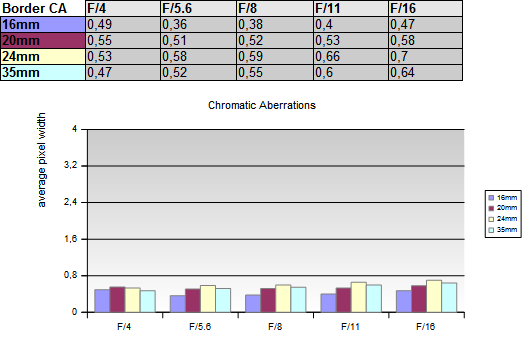
At 24mm the EF 16-35mm might be nearly distortion free but it also has the worst border and corner resolution wide open at 24mm and it has the worst chromatic aberrations throughout the aperture range.
Image distortion is not the only factor in image quality. With good lens profiles minor image distortion is not a big deal.

16-35 f/4 IS at 24mm has less CA of all types (including longitudinal purple fringing) than the 24 1.4 II or 24 2.8 non-IS (I don't know about the 24 IS CA; I know the 24 T&S II has low CA)

I meant the EF 16-35mm has the worst chromatic aberrations at 24mm compared to the other focal lengths of the lens.

ca.png


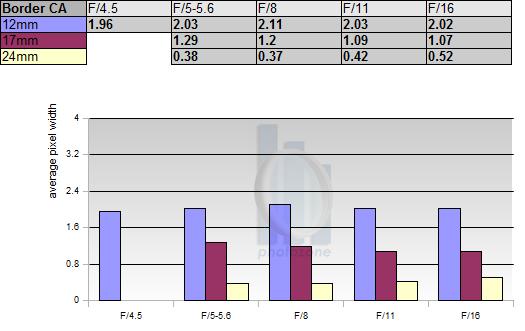
Compared to other Canon lenses the border CA of the EF 16-35mm at 24 mm is good (the TS-E 24 II is better though), but the EF 16-35mm is outperformed on Border CA by something like the Sigma AF 12-24mm at 24mm.

ca.png


9VIII wrote: They could take this exact lens formula at 24mm, remove the zoom capability, and you'd have one of the best 24mm prime lenses on the market.

If you look at image distortion that might be true but there is a lot more to a lens. The point I tried to make is that you might get one aspect nearly perfect but that usually means you have to compromise on other aspects.

But as you say it still has among the lowest lateral CA at 24mm of any lens AND it has almost zero longitudinal CA at 24mm (not many places mention that nasty type of CA)
Upvote 0

Canon EOS 5D Mark IV To Feature 4K Video?

msm said:
jrista, I don't see how this press release quantify performance. It says nothing about SNR or DR etc, it doesn't even try to claim that the sensor is competitive in those regards. It may also require hardware around it which is not feasible nor practical in todays cameras. For instance to read out and process all that data would require a lot more readout channels and processing power than what you see in a 1DX today.

Press releases may also typically be written by PR or marketing personnel written for other purposes than to scientifically describe their findings.

As for patents, I don't read them but they don't actually give any data about how well actual their actual implementations perform do they? Without that data we can not tell if its awesome or not. What seems great on paper might be bad in practice.

SNR and DR aren't the epitome of sensor performance, though. They are only factors of sensor performance. Both are heavily affected by readout noise, and it's been demonstrated that column-parallel ADC designs produce less read noise, by at least two companies now (Sony and Toshiba, and I believe other high end sensor manufacturers have similar designs in the works as well). Canon described some kind of hyperparallel on-die ADC for the 120mp APS-H.

Assuming the silicon process was the same generation as the cameras of the time it was released, it's logical to assume it has the same fundamental characteristics as the 1D IV. The 1D IV had around 45% Q.E. and the same DR limitations as all Canon cameras (due to read noise). I see no reason to assume this sensor would be significantly different in those fundamental statistics at worst, better if their highly parallelized readout offers similar improvements as Sony and Toshibas. Canon silicon hasn't really changed much over the years...the most significant improvements each generation are a few percent jump in Q.E.

Your also misunderstanding the point of using a column-parallel ADC. You actually DON'T need as much processing horsepower to read out more pixels faster when you hyperparallelize the ADC units. The problem with having too few units is each unit MUST be high powered enough to handle the hundreds of thousands or millions of pixels they have to process. That means higher frequency, and it also means more attention must be paid to the design of those units to limit the amount of noise they add to the signal (and even then, they are noisy parts because of the high frequency).

By using one ADC unit per column, each ADC can operate at a lower frequency. The lower frequency immediately offers a benefit in terms of read noise. Other techniques, such as moving the clock and driver off to a remote area of the die (like Exmor), you can reduce noise even further (Exmor took it one step farther, and used a digital form of CDS, which they claim was better than using analog CDS...however ironically they added analog CDS back into the mix with later version of Exmor for video cameras...now they do both analog and digital CDS). You trade die space for the ability to operate at a lower frequency and power. With a 180nm process, that's a no brainer. This HAS BEEN DONE...both Sony and Toshiba have working CP-ADC designs built into their CMOS sensors that are actually used in consumer products. Sony has a number of technical documents that explain how they achieved exactly what Canon describes in their 120mp APS-H papers and patents...low power high speed readout of high resolution sensors via hyperparallel ADC.

So, even though Canon's 120mp APS-H isn't in an actual consumer grade product that we can buy, it uses technology that mirrors products from other brands that we can buy, and that have been tested. The most telling are Sony security video cams that use Exmor sensors, which can operate at very high frame rates in very low light...they are not only doing high speed readout with very, very low noise and relatively high DR, they are also doing processing with image processors that are packaged to the bottom of the sensor, and wired directly to it.

To be strait, I am speculating a bit, but it's very educated speculation. It isn't like it's just 100% completely unfounded drivel. :P

msm said:
For instance Foveon sensors seem like a great technology on paper does it not? No CFA wasting away 2/3rds of the light and no demosaic algorithm interpolating data and making images soft in 100% view. Yet in real life Foveon is outperformed by standard CFA sensors, it gives the resolution but does not perform well in other aspects. Real life performance is what counts and Foveon sensors don't have it (yet, would like to see that change).

As for Foveon, I think your incorrect in your assessment. Foveon only "fails" at ONE thing: resolving power. There have been debates in the past on these forums where Foveon fans claim that because it has a 100% fill factor for all colors, that it has as much or higher RESOLUTION than bayer sensors. Those claims are wrong, as bayer sensors get largely the full benefit of the raw sensor resolution in terms of luminance...they only really suffer in color resolution and color fidelity (both areas where Foveon excels).

For what Foveon is, at it's REAL spatial resolution, they are actually very good. Their red channels are a little nosier, but their blue channels are less noisy than bayer. No surprise, given the layering order of color photodiodes in the Foveon. Even though image dimensions/resolving power for Foveon is lower than in bayer sensors, those smaller images usually exhibit high quality. I do think that color fidelity with Foveon cameras is superior to what I get with my Canon DSLRs (I just like my resolution too much to give it up :P). So I think it's unfair to claim that the real-life performance of Foveon is bad or even poor. For what it is, it's real life performance is very good.

The only drawback of Foveon is it's resolving power...and I truly believe that Sigma has done Foveon a big disservice by trying to upsell it as having more resolution than it really does, or somehow claim that because it gathers full color information per pixel that upsampling it somehow beats bayer sensors for resolution and detail. Actual real-world examples that do exactly that have proven otherwise. Foveon's problem isn't that it's bad technology...it's that Sigma owns it, and Sigma doesn't have the marketing power nor the R&D budget to really make Foveon shine and become a highly competitive alternative. Sigma is much more a lens company than a camera or sensor company, IMO. I do believe it COULD be highly competitive in the hands of a wealthier corporation that could more richly fund it's development.

Upvote 0

Filter

Forum statistics

Threads
37,480
Messages
975,426
Members
24,816
Latest member
GLBDD

Gallery statistics

Categories
1
Albums
29
Uploaded media
372
Embedded media
1
Comments
25
Disk usage
1 GB