Upvote
0
East Wind Photography said:Yes the in camera optimizations apply only to jpg and what you see on the screen. Does not manipulate raw images.
It was a mistake... but I bought it again... I haven't fixed my signature... but I did acknowledge that I missed the macro too damn much.mrsfotografie said:jdramirez said:I'm going nuts. I can't wait for the new Sigma 50mm to come out and I wind up buying a 135L for around $650...
So now I don't know what I'm going to do... maybe sell my 85mm f/1.8... maybe just wait 2 years until the 50mm art is at a price I'm willing to jump in at so I'll have both the 85 and the 135L for my low light shots... maybe I'm just nuts and I need to find a different hobby.
It's like I'm the GM of a football team... but I don't have any clear direction. I assemble a great team... that can do it all... but all too often, my great players sit the bench...
That's not true... the mkiii and the 70-200 get a ton of work... but still... I need to sleep on it.
I for the life of me can't follow why you got rid of the 100L macro... helped by the 5D3 even in low light it can do the job of the 85, 135 and does macro too unless you want extreme shallow DOF.
In the mean time I can recommend the Sigma 50 mm F/1.4 DG EX HSM ;D
I have no idea ... never heard of such a conceptslclick said:what is this thing called an 'extra' lens?
JonB8305 said:J.R. said:neuroanatomist said:J.R. said:BTW Neuro, why does LV silent shooting results in the lights not firing?
In live view mirror is up and the shutter is open, so an electronic first curtain is used. I believe live view silent shooting complicates the timing of the shutter with the flash, but I'm not positive. My speculation aside, the manual does state that a non-Canon flash will not fire if live view silent shooting is set to Mode 1 or Mode 2 (p.189 of the 5D3 manual). It is set to Mode 1 by default.
Thanks a ton for this.
did it work?
wsheldon said:dgatwood said:wsheldon said:Note that it will take 20+ seconds to transfer each RAW file, so I find the option to shoot RAW+JPEG fine (which stores both on the SD) and only transmit JPEG over wireless to the laptop works best. Just a second or two delay and they show up. Good enough for real-time client preview.
Seriously? 20 seconds to transfer a 25 MB file? That's barely 802.11b speeds. They ought to just about get that speed at close distances even with the Wi-Fi antenna unplugged.... I wonder if either Canon or the cell phone vendors are using some ancient, crufty firmware for their chipset that doesn't support 802.11g or 802.11n speeds in Ad-Hoc mode.
To clarify, that's for Wifi tethered shooting vis EOS utility to LR on a laptop, so the 20 sec includes data transfer + LR's service noticing and importing the file + rendering a quick preview image for display. I believe the 6D does 802.11b/g/n, but the laptop only supported g IIRC so n may 2x faster.
I still think RAW+JPEG with JPEG transmitted is the way to go for best results, though.
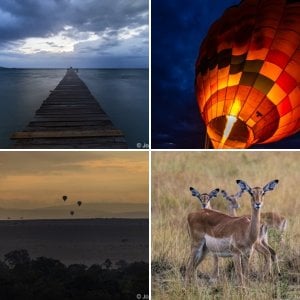
Rienzphotoz said:The second and the last image are very unique ... nice composition.
Viggo said:BL said:the DOF is only apparent on fast primes. So for my 1.2 and 1.4 lenses, it makes an enormous difference.
At 2.8, I don't notice any difference in visible DOF between stock and high precision screens, so I'm not surprised it wasn't nearly as effective on the 17 TSE.
You forget you can get supershallow dof with the TS-E, although dark VF, to see the focal plane when tilted max upwards and rotated was awesome.
privatebydesign said:Steven,
You are making far more work out of this than it is.
First, you cannot use ETTL, it just is not what ETTL is designed for. Second, taking just the small highlighted section illuminated by the hand held 600 has masses of exposure latitude because of the way you can adjust the exposure and then blend it. That is why nobody I know brackets the in hand flash, just know that you get the rough exposure you want of anything at a certain distance; I know f8 and 10 feet @ half power gives me a second story burst, at 20 feet it is a ground floor burst.
Myself, and everybody who I know that does this, just uses manual flash mode and pops away, if you don't have the remote viewing capability just keep varying your flash to subject distance, zoom setting, and angles.
But, because this question has been bugging me and you clearly don't want to go the ND filter gel route I have come up with a work around using just the 600's.
First, put the on camera unit (ST-E3-RT or 600-EX-RT) in Group mode, second, set each group to M and a different setting such that you would want to bracket, third, set the in hand flash to Group A, take the shot with the REL option. Then change the in hand flash to the next Group B, take a shot, then change the in hand flash to the next Group C, take the shot etc etc. This will give you five different exposures from the in hand flash.
Marsu42 said:Random Orbits said:Except for the time that the lenses are bricked while Sigma creates the updated firmware.
You should apply to Canon as an independent fud agent
I understand the necessity of pro shooting are different than for the rest of us, but 3rd party items don't just brick by looking at them, but only after camera fw updates. But *esp* as a pro you don't just update your fw on first day of the release and just before a shooting. You will evaluate what the changes are, and if necessary wait some, for example until 3rd party vendors updating their fw.
wsheldon said:Very nice setup. I've been following these threads as well, and decided to pull the trigger on a TVC-34L + TA-3-LB-HK leveling base to upgrade my 2-series Gitzo. Just got it yesterday - what a difference in stability! I'm 6'2" so it's also great to finally have a tripod I can use to shoot up with and lower one leg on uneven ground without having to crouch.
I decided to keep my Markins Q10 with screw clamp for now rather than spring for the BH-55, since I have a mix of plates and really like the smoothness and lower weight of the Q10 for the same or higher load rating as the BH-55. I can see trying one eventually, though, given the tremendous quality of the rest of the equipment.
Enjoy! (I know I will)
gbchriste said:yorgasor said:What?! You had icicles!? I've never seen them in NC, and now I'm in Utah this week I'm missing them!
I tried to get some photos of the ducks on a frozen Yates Mill Pond a couple weeks ago. I was up early, got all my gear together, walked out to the bridge and tried to take a picture. No CF card. GAH! I've done that so many times! Of course, I didn't have time to go home again to get the CF card. *sigh*
But I'm sure my photo would've been almost as good as yours![]()
I keep a 32GB SD card in the second slot of my 5DIII. It never comes out of the camera. It is my backup. My normal setup is shooting RAW on 8GB CF cards in Slot 1, and large JPGs to the 32GB SD is slot 2. That way I can fill up many, many 8GB RAW cards and still have room to spare on the backup SD card. While the JPGs aren't as forgiving in post processing, they are intended to be my safety valve incase something goes wrong.
I intentionally leave the SD card in the camera at all times. In my normal workflow, the images get offloaded from the CF cards on to my PC and external backup drives. Then the next time I go out and shoot, I just reformat and start over.
Having this second card has saved my bacon a couple of times. Once I went out with only one CF card because I didn't expect t shoot that much. But I hung around longer that planned and filled up the CF card before what was one of the best sunsets of the year. In that case, I just pulled the full CF card out and switched the SD card over to capture RAW. I've also forgotten to load up a CF card once or twice and having that SD card ever present save the day.
The only time the SD card comes out is if there is something on it I need that I don't have on a CF card, then it goes right back in the camera.