• The Canon Rumors Forum has officially been shut down as of July 10, 2026.

    All data will be deleted on September 16, 2026.

    the ad free experience will return by July 17, 2026.

Center and Spot Focusing

Mt Spokane Photography said:
I've used cameras for many years, its only recently that electronics has advanced enough to allow the use of multiple focus points. Its a convenience feature that lets the camera track a moving subject, or focus on a off center subject.

If you don't think you will use the other focus points, you might be better off to wait and see what a new model brings to the table.

One of the truly excellent features is AFMA, I'd avoid a camera without it. It allows you to fine tune the autofocus of your lens to your camera body. If you have a wide aperture lens, that can make a huge difference.

Don't go out and invest $$$$ in a expensive wide aperture f/1.4 or f/1.2 lens unless your camera has AFMA.
what he said.
Upvote 0

Digitalrev speculates on D7100 vs. 7D2

Don Haines said:
Exactly! Look at the image below.... it is a pileated woodpecker hoping along a fence. It is the timing that makes it an interesting picture.... a mid-air capture that is in focus... not dynamic range or iso performance.
fohtohz said:

I do find myself wishing there was more detail inside the crack directly below the bird. DR is severely lacking.

::)
Upvote 0

5d3 refurb

I can heartily recommend the Sirui P-326 monopod. My first was the Manfrotto 680B. It is very sturdy. It is also heavy, noisy and I don't care for lever locks that get snagged on stuff. The Sirui is very solid, weighs under a pound, extends to 60" and folds down to 15" (without a head). It is eminently transportable, which means you will actually have it when you need it, and it "only" costs $100. I coupled it with a Sirui L-10 head for a sturdy lightweight combo. Hope this helps.

PS: The monopod even comes with an attached compass :P

http://www.bhphotovideo.com/c/product/822252-REG/Sirui_BSRP326_P_326_6_Section_Carbon_Fiber.html
http://www.ebay.com/itm/Sirui-Aluminium-Tilt-Head-L-10-for-Monopods-including-Quick-Release-Plate-/130685434434
Upvote 0

CF card error, pictures possibly corrupt.

Mt Spokane Photography said:
If they were RAW images, make sure you have the latest updates to your editing software. Out of date software may not recognize the 5D MK III RAW files.
Make sure you download the latest Camera RAW Version. Ver 7.4 is the latest for CS6

http://www.adobe.com/support/downloads/product.jsp?product=106&platform=Windows

Thank you, it has worked. Turns out i hadn't updated it because i hadn't needed to until now.

Thanks again
Upvote 0

Real iso's?

Just a little background here.

"ISO" is an intialism that stands for an international standards body.

There is no property of photographic film or of a digital imaging chain whose actual designation is "ISO".

The ISO publishes various standards that give ways of stating what we might call the "sensitivity" of a photographic film or of a digital imaging chain.

With regard to film, the basic sensitivity metric, determined as prescribed by the appropriate ISO standard, is called the ISO speed. The name of course comes from the fact that with film of a higher sensitivity, an appropriate exposure (for given scene luminance and given aperture) is given by a shorter exposure - a "faster" exposure process.

To provide continuity with practice in the film realm, the basic metric for the sensitivity of a digital imaging chain is also called the ISO speed. (It is of course determined in a wholly different way.)

Putting aside some complications, the basic "equation" we use (for example, in an exposure meter or automatic exposure control system) to arrive at a "recommended" photographic exposure (that is, combination of exposure time and aperture) for a given scene luminance, taking into account the sensitivity of the film or digital imaging chain (as its ISO speed) is the same for either medium.

But, especially taking into account the greater sophistication of modern exposure metering and control systems, it was observed that, in the case of digital cameras, this equation typically led to a lesser exposure than was "optimal" - typically about 1/2 stop "short". This gives a less-good noise result than we might actually enjoy.

Camera manufactures could have "tweaked" the operation of their exposure control systems to "take advantage" of this in two ways:

a. Change the "equation" used for automatic exposure control.

b. Keep the equation the same but "rate" the sensor system at a lesser ISO speed than would be determined by the ISO test method.

Had they done (a), the result would have been that the internal automatic exposure system would have produced a different exposure for a given shot than would have been "recommended" by a properly-calibrated free-standing exposure meter. This would have led to complaints about "inaccuracy" of the exposure control system of the camera.

So they did (b) instead.

But of course this led knowledgeable enthusiasts to complain that the "ISO speed ratings" of the digital camera were incorrect.

So the ISO defined a new metric for the sensitivity of a digital camera chain, the ISO standard output sensitivity (ISO SOS). This is a different measure than the ISO speed. In fact, again putting aside some complications, for a given sensor chain, the ISO SOS is about "1/2 stop" less than the ISO speed. (That is, the ISO SOS is about 0.7 times the ISO speed.)

And that "solved" the problem!

Today, the sensitivity of many digital cameras is stated in terms of the ISO SOS, not the ISO speed (and that often is stated in the "specifications", although it is sometimes hard to find).

Now for a second chapter of this story, i must refer to the matter of exposure index. For our purposes we can say that exposure index is "what we tell the exposure meter is the ISO speed of the film of digital camera chain".

Going back to traditional analog exposure meters, we recall that if we want to bump the exposure the meter recommends for some reason (compensate for backlighting, perhaps), we can set the "ISO speed" dial to a lower value than the actual ISO speed of the film or digital sensor. And of course, what we set on that little dial is the exposure index (and, as I just illustrated, it is not always the ISO speed of the film or digital sensor chain).

Now, returning to recent developments in the description of digital camera sensitivity, when the ISO introduced the ISO SOS, it also introduced another new "metric", the ISO Recommended Exposure Index (ISO REI).

This is a metric that works the same way as the ISO speed or ISO SOS (as a parameter of the exposure equation). It is defined as (and I paraphrase) "the exposure index that the camera manufacturer feels will, as an input to the exposure equation, give a 'desirable' exposure result in many cases."

In many case, digital camera manufacturers now indicate that the sensitivity "ratings" of their camera (at its various "ISO" settings) are in terms of ISO REI. That is, there is not any way that these values can be "correct" of "incorrect".

As a practical matter, in most of these cases, the "ISO" ratings are actually intended to be the ISO SOS values (and often turn out to closely conform to that definition), but the manufacturers do not care to commit to that.

A more extensive discussion of this matter is given here:

http://dougkerr.net/pumpkin/articles/SOS_REI.pdf

Best regards,

Doug

Upvote 0

1D-X with Continuous RAW Video Recording ?

See the post here:

http://www.canonrumors.com/2013/01/inside-the-canon-eos-1d-c/


Third Party Firmware?
I was told by someone at Canon that they would “bring the might of its legal team” to anyone that attempts to modify at the software level, the features of an EOS-1 camera body. So I think the firmware community out there today will probably leave the EOS-1D X alone.
Upvote 0

135mm f/2.8 (or faster) manual focus lens?

When I was getting rid of some old monitors I found a Tokina 135mm f/2,8 Tele-Auto ( m42 )
very well built all metal construction ( can take a picture of it when wanted ),
super nice focus ring and for IQ and Bokeh take a look yourself.
The first picture is from an 70-200 f/2,8L IS II
100% crop at 2,8

Attachments

  • IMG_5522.jpg
    IMG_5522.jpg
    10 KB · Views: 1,035
  • IMG_5525.jpg
    IMG_5525.jpg
    10.6 KB · Views: 1,003
Upvote 0

Ok, I just snagged a 600EX-Rt, now what? (Questions on use, and going forward).

In terms of some well done youtube videos you could check out to get you started with some simple lighting ideas, this guy does it excellently:

http://www.youtube.com/user/FreePhotographyTips

Obviously he's going to be using more lights than your one 600, but since he's explaining the goal of each light, that should suffice in terms of being able to have something in mind when you're lighting your photos.
Upvote 0

Using 600EX-rt aboard

SwampYankee said:
silvestography said:
What I want to know is how you managed to get a 600ex-rt refurb. I can never seem to find them in stock! :P

Just picked up a brand new one for $499 from B&H. should be good until the end of June

So did I but I'm not too crazy about the idea of purchasing another one for that price.
Upvote 0

Zeiss 100 f/2 vs. Canon 85 f/1.2 II vs. Canon 135 f/2

ecka said:
bholliman said:
I was going to recommend the 135L, but the Zeiss is a great piece of glass. 100mm also is also closer to your 35mm. As somebody else pointed out, the gap between 35 and 135 is a big one.

+1
Every 2x in focal length results in 4x FoV. You can fit four 70mm lens frames inside one 35mm lens frame (sh :)ot from the same distance) and almost sixteen 135mm lens frames inside one 35mm lens frame.
No matter how good the Zeiss 100mm is, the Canon 135mm f/2L has great IQ AND it can autofocus which is a great plus for that focal length (until your subjects sit still).

Plus, one could get a 135mm f/2L and a 85 1/.8 (which is a very decent lens) for the price of Zeiss.

Keep in mind that the above come from someone who swears by his Zeiss Distagon 21mm 2.8.
However, I also have the above 2 mentioned Canon lenses and I am very happy with them :)
Upvote 0

Nikon 14-24 or 16-35 for Nikon D600?

hi , I am a dual system user and my main camera is currently D800E.
I 'd say do not get the Nikon 14-24 , which is really overrated , it is not that amazing.
I mean it is sharp but has terrible distortion , terrible back light performance , does not take any filter , it is huge and heavy and difficult to take care of.
so I think you might want to consider the Zeiss 18mm f3.5 or Zeiss 21mm f2.8 or Nikon 16-35f4VR.

I use the Nikon 16-35f4VR on my 5DMK2.
The 16-35f4VR is a very very practical zoom , it's got great range with VR and it is quite sharp from 16 to 32mm range and it seldom flares.
I have the Zeiss 18 and Canon 24mm TSE for my 5D2 and I have been very happy with the TSE24 and I am considering replacing my Zeiss 18mm f3.5 with the Canon 17mmf4 TSE.
Anyway, I think most of people worship about the Nikon 14-24mmf2.8GED are not owners of it , they are just reading reviews and rave about it, it is a good lens optically , no doubt about it but it is also a very tough lens to use and extremely difficult to take great care of.
Upvote 0

Will Third Party Firmware Void Your Canon Warranty?

iKenndac said:
LetTheRightLensIn said:
They are not really reverse engineering the firmware. The camera still runs the original firmware straight from Canon. It's not a replacement version that they figured out how to write themselves. There is way too much that have no clue about with how DIGIC and the sensor works to even begin such a task. They simply load the regular firmware plus hooks and extensions that they wrote from the ground up.

Yes they are — they reverse-engineered many APIs that the firmware provides to display stuff on screen, get buttons presses, etc etc etc. They wouldn't know *how* to hook into the firmware without reverse-engineering at least some of it to figure out where to hook in.

In fact, they say the project uses reverse-engineering right in their FAQ, under the "Is It Legal?" header: "This is a clean room / black box reverse engineering effort", and again under the "Is it safe?" header: "Magic Lantern was created by reverse engineering an undocumented system that controls hardware."

Yeah but come on that is in the most minimal way, obviously they have to figure out how to hook into button presses or render something to the screen if it will do anything at all. It's not like those MS-DOS clone BIOS where they reverse engineered the whole thing and none of the original BIOS code is even there at all.
Upvote 0

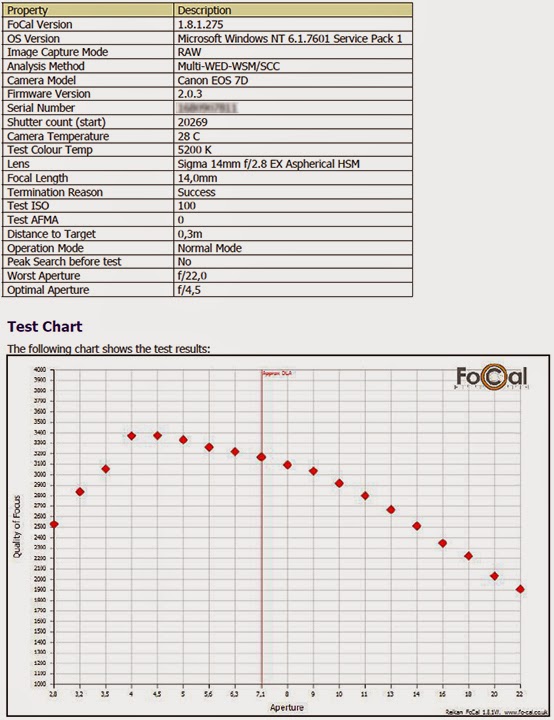
Post your Reikan FoCal 'Quality of Focus' results (all brands)

  • Open Reikan FoCal
  • Select Camera
  • Run Target Setup according to distance chart published below (click find target in target setup to verify distance)
  • Run Aperture Sharpness Test (leave everything default)
  • Save Report
  • Publish Page 2 from the report (720px height)

FoCal Test Distance Chart:
https://dl.dropbox.com/u/11469157/FoCal/Docs/FoCal%20Test%20Distance_1.0.pdf

Canon 7D + Sigma 14mm f/2.8 EX Aspherical HSM = 3373,5

Sigma%252014mm%2520f2.8%2520EX%2520Aspherical%2520HSM.jpg

6D vs. 600D with good lenses?

neuroanatomist said:
The 10-22 on APS-C is sharp into the corners, and has far less distortion (1.2%, and that's another area where EF-S wins for the 17-55, which is at 2% distortion at 17mm vs. 4.3% for the 24-105L on FF).

The 17-55 has less distortion at 24mm eq.? I did not know that!

The distortion of the 24-105 is the price you pay for the real wide end and for a slightly more reach. The 15-85 distorts a lot, too. Distortion with today's digital workflow is not such a big problem anymore.
Upvote 0

Down to the RX100 or G15...

I bought the RX100 back in February and I've been happy with it so far. I picked it up as an "take every day" option for my 5DIII. On the plus side is the IQ and small size. For me, the biggest negative is the same as another poster (verysimplejason) mentioned above--I am more familiar with Canon menus and so for me it is kind of a pain in the butt to find what I am looking for in the Sony menus. I use the wrist strap and bought a little Lowepro pouch for it.
Upvote 0

Replacement foot for 500Mk 1

eml58 said:
RGF said:
Thanks NA

neuroanatomist said:
RGF said:
Thanks. Interesting no mention of wimberley or 4th Gen or ...

Wimberley doesn't do a replacement foot for the 500/4, they recommend the P-40 plate, and you asked about a replacement foot not a plate.

The 4th Gen foot is more like a plate than a foot, but one that bolts directly onto the mount. I think they do that for the superteles so the big diameter lenses are centered over the Mongoose head (Wimberley has that issue with their Sidekick and Side Mount heads, and they recommend those flat 'feet' for the 400/600/800 lenses, but not the 500). I don't like that design, because it means you can't use the lens foot as a handle to carry the lens.

Like I said...RRS or Kirk.

Hi RGF, I've changed all my Big White feet with the RRS Foot replacement, I tried the Wimberley Plates but just wasn't satisfied with the set up, the RRS replacement feet have worked exceptionally well, very Happy. The attached is the RRS foot your looking for, I don't have experience with anything else to compare.

For loosening stuck screws I've found this works for me, Place your screwdriver head into the screw, then a sharp tap with a Hammer (sharp tap, not an all out Arnold shot), if this doesn't loosen it, try soaking the screw area in WD40 overnight.

Thanks for advise on how to loose the screw
Upvote 0

Filter

Forum statistics

Threads
37,480
Messages
975,426
Members
24,816
Latest member
GLBDD

Gallery statistics

Categories
1
Albums
29
Uploaded media
372
Embedded media
1
Comments
25
Disk usage
1 GB