I agree in the sense of practice in the field: it's not too useful unless you're shooting each format side by side and need to synchronize effect.
Exactly, and who does that, right? But again, as I think you understand, that’s not the point of the concept. The utility is
here, where we’re pressing keyboard keys and not shutter buttons, on CR and other settings where photography is discussed.
The whole point is to enable appropriate comparisons of different sized sensors. Many posts on this forum (and others) indicate a wide range of misapprehensions about some technical aspects of photography, and some of those are relevant to gear use and purchasing decisions.
Just to pick one common example, many times someone will comment that a crop sensor is better for macro photography because it gives a deeper DoF. Of course, the deeper DoF is occurring only because the camera is further from the subject, which is fine if that's what you want. But if you want maximum optical magnification (e.g. 1:1), then the camera will be at the same distance from the subject regardless of the sensor size, and the FF camera will deliver a wider FoV at that 1:1 magnification, and the crop sensor will actually have a
shallower DoF. Plus, if you're light limited (often the case if you're stopping down to gain DoF), then the crop image will have more noise at the high(ish) ISO you may be using. What all of that means is that 'I use a crop sensor for macro to get deeper DoF' is at best an oversimplification (and note that I haven't even touched on pixel density, diffraction, and other relevant concepts).
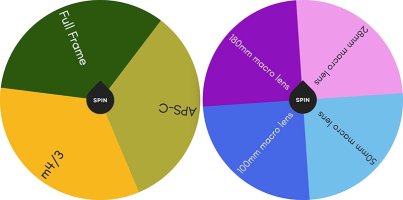
So what the concept of equivalence does is enable one to have an informed discussion and make informed decisions about photography gear and settings. Personally, I'm a big fan of information-driven discussions and data-driven decisions. I suppose there are some people who prefer the opposite, so for the above example maybe something like this would be helpful.