A New Constant f/4 Aperture RF-S Zoom Coming

You are 100% wrong. A speed booster reduces the size of the image circle, as stated by @Bob Howland . If it increased the size, it would spread the light over a larger area and be a speed reducer. A speed booster works by reducing the focal length of a lens.
Building on this response from AlanF, it might be handy if you ready the Metabones white paper on speed boosters. It's quite informative:

The Speed Booster – a New Type of Optical Attachement

You might even notice Metabones states:
[...] since the Speed Booster essentially compresses the image formed by the objective lens into a smaller size it helps to undo the cropping effect.
i.e., in effect the lens is wider relative to the physical actuality from the perspective of the sensor.
 
  • Like
Reactions: 1 user
Upvote 0
This supposed RF-s 15-70 F4 is a lens I would have gladly bought to upgrade from the EF-s 18-135 and update the EF-s 15-85.

Both are variable apertures of 3.5 - 5.6 so a constant aperture at 4 is nice.
I don't find realistic to expect such a wide range of focal length to offer F2.8 unless it's a L lens and totally not the same package of size and price (and ultimately audience)

The lack of such a lens made me upgrade to FF format but I'm glad some stuff is finally happening to the APSC side
I think from a standard consumer perspective I'd agree, but if we take the R7 it's pro turf in appropriate contexts. I think in that case bright glass design makes lots of sense, in which case a sealed edition of the 17-55 (or now 15-70) at 2.8 or better would be great just for the normality of the effective perspective range provided that would be much better than simply attaching a copy of the 24-70 or 14-35.
 
Upvote 0
It's a useful concept to understand, if only to avoid sounding foolish when making comparative statements about different cameras. I've seen many people buy into the idea that there is a free lunch, and that a smaller sensor delivers a smaller, cheaper system with no tradeoffs. For some reason, people stop that line of thought at APS-C (or m4/3 on other forums), but no one seems to carry it forward and believe that an ILC with a P&S-sized sensor would be even better than their APS-C camera body, if their logic was reasonable.
100%

The MILC market is trending up overall, but I'm not sure that fully applies to the APS-C segment. By the numbers, that segment is shrinking pretty substantially. From around 90% in the heyday of DSLRs, last year APS-C MILCs were 63% of the market. So Canon may prefer to avoid making 'too good' a range of lenses and bodies with APS-C sensors, to further drive sales of FF MILCs.
Interesting. I hadn't looked into crop market at all -- once I went full frame I never looked back. As much as I liked the reach of my crop cameras I was never ever satisfied with the noise or the hassle of cleaning it up before sharing anything remotely serious on a family or friends outing at the end of the day around the hotel room or camp site. So, while I miss my reach — I've simply compensated by getting or borrowing or renting longer lenses.

But, that stated, I acknowledge that the crop format let my family buy into the digital game when we were poor graduate students. For interchangeable cameras I wonder if it's the same game? Or is it really just smart phones and then straight to FF. A quick search shows the RP still available for only $1,099 CAD from Henry's. My kiddo was lucky enough to skip the line by inheriting my name brand retired gear.

My first DSLR was a Rebel T1i/500D, that I replaced with a 7D. I subsequently added a 5DII, and used both side by side until the 1D X delivered both FF and speed, and since then my only APS-C cameras have been M-series for the portability.
Memories. 😎

The lesson I remembered from shooting film was glass >> body.
100%. Although another lesson I learned mid-way.
 
Upvote 0
How I would have liked a replacement to the 15-85 for my R7 but sorry Canon - too late. I got tired of waiting and just three days ago picked up a Sigma 17-40 f1.8.

Yeah I know it's only 40mm at the long end but I've got it and I won't be stuffing around selling it and purchasing another lens.

But never say never I guess 🥴
I bought it as well. I took it to Japan with R7. I only took this combo and a very good combo. I am going back next month with the same combo. You will enjoy using this fast zoom morning to night. No swapping
 
Upvote 0
I think the value of equivalence is to understand the range of capabilities of a given set of equipment, and the relative compromises one makes.

My first FF DSLR was the 5Dii, and I spent a lot of money on a f2.8 trinity. I quickly discovered that unless photography was my one and only objective for the day, I hated carrying it. I much preferred to carry the APS-C DSLRs that I had before and after the 5Dii for everything other than totally dedicated photography. But what's the compromise? Well, a f2.8 lens on an APS-C body gives you about the range of capabilities as shooting no faster than f4.5 on the FF body. You give up that first f-stop and a third for a kit that's easier to carry. That's the type of tradeoff that equivalence helps to clarify.

I've since had a FF mirrorless system with f4 lenses, and don't hate it. That's about my happy place for size vs capability.

In the case of the lens that's the topic of this thread, you give up another stop of light. If you can imagine shooting no faster than f6.3 on FF, it will be about the same as that.
Only new comers might be tempted if sold as kit with R7Ii. This is not going to affect Sigma and Tamron sales as they are aimed at a different market segment. Cannon once again slow zooms for APSC cameras. Why?
 
Upvote 0
But no commercial lens is a simple lens. In a complex lens, the size of the rear and intermediate elements can scale with sensor size, as these elements determine the image circle, not the front elements that set the entrance pupil.
It is the exit pupil that determines the image circle. The important points that were in in my reply are: that the image circles from the longer telephotos are so large that an APS-C or smaller sensor lenses cannot be made significantly smaller than those for full frame - indeed the lens often has to be baffled to stop the light outside the sensor from bouncing onto the sensor; for wide angle lenses the smaller the sensor the easier it is to make complex lenses to enlarge the circle to cover the sensor - it is cheaper and easier to make a light wide angle lens for crop, however, this is offset to various degrees by needing a wider angle lens to give the same field of view.

On the other hand, at the trade-off of increased noise and increased problems with diffraction, a crop camera with a shorter length telephoto lens can give you the same reach as full frame. As I very frequently crop my FF images to less than APS-C size, the noise problems are the same for both and I am very happy to use APS-C cameras, and have an R7 along with my R5ii.
 
  • Like
Reactions: 2 users
Upvote 0
Nikon is getting lighter and smaller telephotos reducing image circle and correcting vignetting on processing. Just go further and you have more.
Can you provide an example?
Canon does that on the wide end, but not for telephoto.
If you are referring to Nikon lenses with built-in teleconverters, then those lose a stop of light when the teleconverter is activated.
 
Upvote 0
An RF-S 15-70mm F4 IS STM sounds interesting. Esp. together with an R7m2.
Would I buy it?
Likely not. I have the 18-50/2.8 from SIGMA.
I would sacrifice the high light output and the extremely compact design in exchange for a longer focal length at both ends, IS, and an OEM lens.
It would really depend on the final spec. esp. the size.
 
  • Like
Reactions: 1 user
Upvote 0
It's not f/6.3. It's a 15-70 f/4 lens with the DOF of a 15-70 f/4 lens, regardless of the size of sensor. The only reason the DOF changes is when people move forward or back or change the focal length to maintain the same FOV. I'm rather interested in this lens but I already own the 18-50 Sigma and I highly value small size and especially light weight.
Right or wrong it's how almost everyone thinks.Just go with it
 
Upvote 0
Right or wrong it's how almost everyone thinks.Just go with it
I find that the concept of equivalence is not at all useful. When taking an image with an R7 and a Sigma 18-50, I don't calculate the equivalent FF focal length and DOF. I just zoom the lens and use the DOF of the lens that I'm using and it works. One consequence is that I shoot wide open or nearly so most of the time.

I don't think that equivalence of DOF is how most people think. Equivalence seems to be an attempt of a small group of posters to say that other posters are incorrect and must be enlightened. My background is in psychology and economics so, for good or ill, that's how I see the world.
 
  • Like
Reactions: 1 users
Upvote 0
Thinking more about the 15-70/4, I find it somewhat interesting that it's not quite a direct head-to-head competitor to either of the Sigma normal zooms, but that the Tamron 17-70 IS which IS a bit more of a direct competitor never appeared for RF-S. Makes me wonder whether Canon did actively prevent Tamron from offering that lens in RF-S mount.

I still wish this would have L-grade construction, but it seems far more likely that it'll be on the level of the budget FF STM lenses.
 
  • Like
Reactions: 1 user
Upvote 0
I find that the concept of equivalence is not at all useful.
It is really important when comparing cameras with non-standard image sensor sizes.
It was really just intended for focal lengths.
The arguments start to come in when we apply depth of field.
Depth of field is not always important.
In fact, sometimes having more in focus can be an advantage.
 
  • Like
Reactions: 1 user
Upvote 0
Thinking more about the 15-70/4, I find it somewhat interesting that it's not quite a direct head-to-head competitor to either of the Sigma normal zooms, but that the Tamron 17-70 IS which IS a bit more of a direct competitor never appeared for RF-S. Makes me wonder whether Canon did actively prevent Tamron from offering that lens in RF-S mount.

I still wish this would have L-grade construction, but it seems far more likely that it'll be on the level of the budget FF STM lenses.
The absence of the 17-70 does indeed make more sense now, that was Tamron’s only mirrorless APS-C lens that didn’t directly compete against a superior Sigma alternative on RF mount, and one that would’ve been popular with the RF-S bodies lacking IBIS (4/5 currently).

If the construction isn’t L caliber, I hope it’s at least along the lines of the RF 28-70 f/2.8.
 
Upvote 0
I find that the concept of equivalence is not at all useful.
Ok. The fact that you personally don’t find it useful does not mean the concept is inaccurate, nor does it mean it’s not applicable to photography. It is both.

When taking an image with an R7 and a Sigma 18-50, I don't calculate the equivalent FF focal length and DOF.
Of course not, that’s not the point of equivalence. If you were considering replacing that R7 with a full frame or m4/3 camera, the concept of equivalence could help you decide which lens you should buy to enable you to keep taking pictures like the ones you currently take.

I don't think that equivalence of DOF is how most people think.
I'm not sure if you are just being stubborn, or you remain utterly confused about the concept (willfully, because you haven't read the links previously posted, or because you've read them and remain unable to understand the concept). It's not about "FoV equivalence' or 'DoF equivalence' or 'noise equivalence' – it's about image equivalence. FoV, DoF and noise are all characteristics of an image… and they are all affected by sensor size.

As above, the concept doesn't matter when you have a camera in your hand and you're out taking pictures. You're going to frame your shot how you want and pick your aperture for the DoF you want.

Equivalence seems to be an attempt of a small group of posters to say that other posters are incorrect and must be enlightened. My background is in psychology and economics so, for good or ill, that's how I see the world.
So in your world view, incorrect statements should not be challenged or corrected? Or if they are, no explanation should be provided?

Sensor size has no effect on images, and ignorance is bliss. Mmmmmkay.
 
Upvote 0
I find that the concept of equivalence is not at all useful. When taking an image with an R7 and a Sigma 18-50, I don't calculate the equivalent FF focal length and DOF. I just zoom the lens and use the DOF of the lens that I'm using and it works. One consequence is that I shoot wide open or nearly so most of the time.

I don't think that equivalence of DOF is how most people think. Equivalence seems to be an attempt of a small group of posters to say that other posters are incorrect and must be enlightened. My background is in psychology and economics so, for good or ill, that's how I see the world.
I agree in the sense of practice in the field: it's not too useful unless you're shooting each format side by side and need to synchronize effect. I only tend to use one or the other (my own camera is FF at this point, but my kiddo has an 80D) — but even then, it's almost like speaking different languages: unless you need to switch mid-sentance, you're thinking and doing in language A or language B but not a mix. You simply figure out what lenses achieve on your format and run with it.
 
  • Like
Reactions: 1 user
Upvote 0
Here's a really nice article that walks through an example of image equivalence:


If you're purchasing a mixture of gear, or if you're purchasing gear and want to recreate what someone else has done with different gear, or if you're in the field with different formats and attempting to achieve the same effect then this is good stuff to know.

If you have one camera and you're doing your own thing, keep calm and carry on...
 
  • Like
Reactions: 1 user
Upvote 0
Here's a really nice article that walks through an example of image equivalence:


If you're purchasing a mixture of gear, or if you're purchasing gear and want to recreate what someone else has done with different gear, or if you're in the field with different formats and attempting to achieve the same effect then this is good stuff to know.

If you have one camera and you're doing your own thing, keep calm and carry on...
I own an R6-2 and an R7 and have several lenses for each. Most of my FF lenses are EF and most of the APS-C lenses are RF. Sometimes I will go out with both bodies on a Black Rapid double harness. Typically, the longer lens is on the R7 and the shorter lens is on the R6-2, for example EF 24-105 f/4 and EF 16-35 f/4 or EF 70-200 f/4 and EF 24-105 f/4. My big complaint, the one that triggered my rant, is with DOF equivalence. As far as I'm concerned, it's a marginally useless concept, especially when trying to actually capture an image.
 
Last edited:
  • Like
Reactions: 1 user
Upvote 0
I agree in the sense of practice in the field: it's not too useful unless you're shooting each format side by side and need to synchronize effect.
Exactly, and who does that, right? But again, as I think you understand, that’s not the point of the concept. The utility is here, where we’re pressing keyboard keys and not shutter buttons, on CR and other settings where photography is discussed.

The whole point is to enable appropriate comparisons of different sized sensors. Many posts on this forum (and others) indicate a wide range of misapprehensions about some technical aspects pf photography, and some of those are relevant to gear use and purchasing decisions.

Just to pick one common example, many times someone will comment that a crop sensor is better for macro photography because it gives a deeper DoF. Of course, the deeper DoF is occurring only because the camera is further from the subject, which is fine if that's what you want. But if you want maximum optical magnification (e.g. 1:1), then the camera will be at the same distance from the subject regardless of the sensor size, and the FF camera will deliver a wider FoV at that 1:1 magnification, and the crop sensor will actually have a shallower DoF. Plus, if you're light limited (often the case if you're stopping down to gain DoF), then the crop image will have more noise at the high(ish) ISO you may be using. What all of that means is that 'I use a crop sensor for macro to get deeper DoF' is at best an oversimplification (and note that I haven't even touched on pixel density, diffraction, and other relevant concepts).

So what the concept of equivalence does is enable one to have an informed discussion and make informed decisions about photography gear and settings. Personally, I'm a big fan of information-driven discussions and data-driven decisions. I suppose there are some people who prefer the opposite, so for the above example maybe something like this would be helpful.
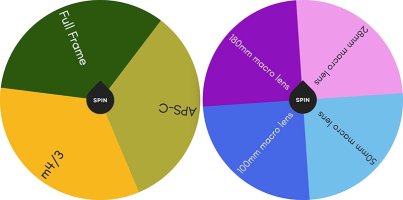

Macro Choices.jpg
 
  • Like
Reactions: 1 users
Upvote 0