A New Constant f/4 Aperture RF-S Zoom Coming

Just get a lens and test.
You can put an inferior diameter filter without vignetting or open more the diafragm without softening the corners of the image , cause you don't see the part of the image it's losening sharpness .
Test what? Just because a smaller sensor crops away the outer portion of the image circle doesn't mean a telephoto lens could be made smaller if designed for a crop sensor. That's the limitation, and that's why no manufacturer makes a long telephoto lens 'for crop sensors'.

the unused diameter, almost 1/3 at 400mm
Do you really believe that a 400mm f/4 lens 'made for an APS-C sensor' could have a 66mm front element? LOL. No...just, no.
 
  • Like
Reactions: 1 user
Upvote 0
Test what? Just because a smaller sensor crops away the outer portion of the image circle doesn't mean a telephoto lens could be made smaller if designed for a crop sensor. That's the limitation, and that's why no manufacturer makes a long telephoto lens 'for crop sensors'.
No manufacturer makes them cause there's no profitable market to do that, but integrated teleconverters are showing that you can squeeze aperture and size to get the same reach when reducing the image circle.
 
Upvote 0
No manufacturer makes them cause there's no profitable market to do that, but integrated teleconverters are showing that you can squeeze aperture and size to get the same reach when reducing the image circle.
So you don't understand optics and lens design, but you know more about marketing lenses than camera manufacturers? Lol. In the heyday of ILCs before smartphones clobbered the market, 90% of ILCs sold were APS-C DSLRs (and there were nearly 3 times as many ILCs sold per year as there are now in this 'recovering' market). Where were the EF-S and DX ≥400mm lenses then? There weren't any then, for the same reason there aren't any now. Physics.

A teleconverter reduces the image circle? No, it magnifies the central portion of the image to fill the original image circle...at the cost of a stop of light. All that says is that you can make a 400/4 or a 560/5.6 that are about the same diameter and weight. You can't make either of them 'for a crop sensor' and have them be any smaller.

Regardless, having a battle of wits with an unarmed opponent is pointless. I'm out.
 
  • Like
Reactions: 1 users
Upvote 0
So you don't understand optics and lens design, but you know more about marketing lenses than camera manufacturers? Lol. In the heyday of ILCs before smartphones clobbered the market, 90% of ILCs sold were APS-C DSLRs (and there were nearly 3 times as many ILCs sold per year as there are now in this 'recovering' market). Where were the EF-S and DX ≥400mm lenses then? There weren't any then, for the same reason there aren't any now. Physics.

A teleconverter reduces the image circle? No, it magnifies the central portion of the image to fill the original image circle...at the cost of a stop of light. All that says is that you can make a 400/4 or a 560/5.6 that are about the same diameter and weight. You can't make either of them 'for a crop sensor' and have them be any smaller.

Regardless, having a battle of wits with an unarmed opponent is pointless. I'm out.
So, you know more than Nikon's lens engineering. Go ****** yourself.
 
Upvote 0
So, you know more than Nikon's lens engineering. Go ****** yourself.
What lighter and smaller telephotos does Nikon make for their crop cameras? They have done their best to make lighter weight ones for full frame, but they haven't made any of them as smaller and lighter versions for crop because not even they can get around the laws of optics.
 
  • Like
Reactions: 1 user
Upvote 0
No manufacturer makes them cause there's no profitable market to do that, but integrated teleconverters are showing that you can squeeze aperture and size to get the same reach when reducing the image circle.
What do you mean by "reducing the image circle"? That is what a Metabone or Meike speed booster does. That is why you have to use a FF EF lens with APS-C RF body. I have one from each manufacturer and use them regularly with my 150-600 f/5-6.3 Sigma Sport lens. That lens effectively becomes a 106-426 f/3.5-4.5 but only covers an APS-C sensor..
 
Upvote 0
What lighter and smaller telephotos does Nikon make for their crop cameras? They have done their best to make lighter weight ones for full frame, but they haven't made any of them as smaller and lighter versions for crop because not even they can get around the laws of optics.
Nikon is getting lighter and smaller telephotos reducing image circle and correcting vignetting on processing. Just go further and you have more.
 
Upvote 0
What do you mean by "reducing the image circle"? That is what a Metabone or Meike speed booster does. That is why you have to use a FF EF lens with APS-C RF body. I have one from each manufacturer and use them regularly with my 150-600 f/5-6.3 Sigma Sport lens. That lens effectively becomes a 106-426 f/3.5-4.5. Then the 1.6X APS-C crop gets applied by my R7.
No, a speed booster does the opposite, got a bigger image circle of the lens and concentrate it on the little sensor. Crop sensor gets the direction of a teleconverter, ditching the exterior part of the image circle and expand that on the bigger sensor.

With the modern sharper glass and camera vignetting corrections we are getting lighter and smaller lenses doing just that, reducing the image circle that goes trough the diafragm.
 
Upvote 0
Show me a 400 mm f/4 lens that has a front element less than 100 mm in diameter and I'll show you a 400 mm lens that is smaller than f/4. If the entrance pupil is only 75 mm, assuming you still have a 400 mm lens, you have a 400 lens of approximately f/5.3. The f/stop is basically the focal length divided by the pupil. That is the mathematical definition of f/stop.

Here's a handy calculator...


Incidentally, in terms of the exposure calculation the f/stop is what it is. In terms of depth-of-field (or the shallowness thereof), the sensor size/format plays a role. That is why some people say that an f/4 lens on an APS-C camera is the equivalent of f/6.3 or 6.4 on a full frame camera. The exposure isn't different, but the apparent depth of field is.
 
Upvote 0
No, a speed booster does the opposite, got a bigger image circle of the lens and concentrate it on the little sensor. Crop sensor gets the direction of a teleconverter, ditching the exterior part of the image circle and expand that on the bigger sensor.

With the modern sharper glass and camera vignetting corrections we are getting lighter and smaller lenses doing just that, reducing the image circle that goes trough the diafragm.
You are 100% wrong. A speed booster reduces the size of the image circle, as stated by @Bob Howland . If it increased the size, it would spread the light over a larger area and be a speed reducer. A speed booster works by reducing the focal length of a lens.
 
Upvote 0
Incidentally, in terms of the exposure calculation the f/stop is what it is. In terms of depth-of-field (or the shallowness thereof), the sensor size/format plays a role. That is why some people say that an f/4 lens on an APS-C camera is the equivalent of f/6.3 or 6.4 on a full frame camera. The exposure isn't different, but the apparent depth of field is.
Yes, it plays a role. But the major way in which is plays that role is when the photographer chooses a distance further from the subject to 'match the framing'. That means moving farther away with a smaller sensor, and it's that increased distance that results in the deeper DoF. In fact, if you keep the subject distance the same then with a smaller sensor, the framing will be tighter and the DoF will actually be shallower than with a larger sensor. The underlying concept there is the circle of confusion, and that is a source of confusion for some people.
 
Upvote 0
You are 100% wrong. A speed booster reduces the size of the image circle, as stated by @Bob Howland . If it increased the size, it would spread the light over a larger area and be a speed reducer. A speed booster works by reducing the focal length of a lens.
A speed booster get a bigger image circle (all the lens needs to be wider to fulfill the sped booster) of the lens and puts it on the little sensor. Getting then more light with the same image than an full frame.

Just doing that, you see why with the same size lens a cropped sensor camera could get one stop more light or get an lighter and smaller lens with the same.
 
Upvote 0
To maintain the same DOF for same FOV with differently sized sensors and the same subject distance (update: and the same ISO), the 15-70 and 24-112 lenses must have different apertures, which means they must have different shutter speeds, which may or may not be important, depending the situation and the photographer's intent. I prefer keeping the same FOV and exposure and letting the DOF fall where it may.
That is partially correct.
- Yes, the apertures must be different, by the crop factor of 1.6 (the FF is bigger by 1.6). Notice that I multiplied the apertures for the hypothetical FF lens by this factor, but I forgot to state it explicitly.
- No, for equivalence, the shutter speeds must be the same.
- Since the aperture is smaller by 1.6, and the shutter speed is the same, the ISO must be higher by a factor of 1.6 on the FF camera.
- The total amount of light hitting the sensor is the same for both the APS-C and the FF camera is the same for both cases, since the entrance pupil is the same in both cases. The dominant factor in image quality (IQ) for modern sensors is the total number of photons hitting the sensor, therefore both sensors have the same IQ.

The bottom line: For many shooting situations, one can obtain similar results with an APS-C camera as a FF camera if the APS-C lens is one stop faster. However, if one can shoot base ISO in both cases, then the FF camera achieves ~ 1 stop advantage in IQ.
 
Upvote 0
The bottom line: For many shooting situations, one can obtain similar results with an APS-C camera as a FF camera if the APS-C lens is one stop faster. However, if one can shoot base ISO in both cases, then the FF camera achieves ~ 1 stop advantage in IQ.
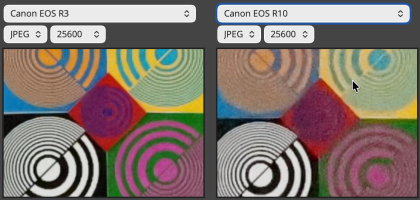
Benefits of collecting more total light, and not just at base ISO. At lower ISOs, the DR advantage is what is most noticeable - presumably what you mean by 'advantage in IQ'. At the other end of the ISO scale, the ~1.3 stops more light collected by the FF camera benefits not only DR but also image noise directly. I routinely use my R1 at ISO 25,600, a setting I wouldn't even consider with an APS-C camera.

Noisy.png
(Showing the R3 because DPR's comparator doesn't have the R1, but I also routinely used the R3 at ISO 25,600.)
 
  • Like
Reactions: 1 user
Upvote 0
None of that equivalencies are true.

APS-C F4 needs just the same exposure for the same image. Just the DOF change affirmation are something near reality, and just cause you are nearer to the subject on FF, not even 1/2 stop equivalent nearer, but you need M43 just that stop DOF lose, not APS-C.
Yes, APS-C needs the same exposure as FF. But to get an equivalent image (same exposure, FOV, DOF, motion blur, and image quality (photon noise)), different apertures and ISOs are needed. This is the formula for equivalence:

1) FF focal length = APS-C focal length * 1.6 (same FOV)
2) FF f number = APS-C f number * 1.6 (same DOF)
3) FF shutter = APS-C shutter (same motion blur)
4) FF ISO = APS-C ISO * 1.6 (this compensates for higher FF f number to get the same exposure)

IQ is the same because it is determined by the total amount of light hitting the sensor, which is determined by the entrance pupil size and the shutter speed.. The entrance pupil is the same for FF and APS-C, because entrance pupil = focal length / f number. For the FF case, both focal length and f number are multiplied by 1.6 compared to the APS-C numbers. The factor of 1.6 is in both the numerator and denominator, so it cancels out, leaving the same entrance pupil as the APS-C lens. The shutter speed is the same for both, so the amount of light is the same for both.

Here is an article written by an expert, if you don't follow my explanation.

The bottom line is that this 15-70mm f/4 lens will produce similar photos as a hypothetical 24-112mm f/6.4 full frame lens in most conditions, except where base ISO can be used in the FF camera, giving it ~ 1 stop better IQ. Therefore a FF camera will win for landscape photography most every time.

 
Upvote 0
Also, at the other end of the ISO scale the FF camera achieves better noise performance by ~1.3 stops. I routinely use my R1 at ISO 25,600, a setting I wouldn't even consider with an APS-C camera.

View attachment 228774
(Showing the R3 because DPR's comparator doesn't have the R1, but I also routinely used the R3 at ISO 25,600.)
Very true. Equivalency only holds over the range where FF ISO = crop ISO * scale factor. Breaks down at both ends of the ISO scale - I forgot about the upper end.
 
Upvote 0