How I would have liked a replacement to the 15-85 for my R7 but sorry Canon - too late. I got tired of waiting and just three days ago picked up a Sigma 17-40 f1.8.
Yeah I know it's only 40mm at the long end but I've got it and I won't be stuffing around selling it and purchasing another lens.
So the circle of confusion is another concept that you find useless? Lol. You are welcome to your own opinions, but not to your own facts. The fact is that the size of the sensor affects the circle of confusion, and the circle of confusion is one of the factors that determines DoF*.
Next, I suppose you’ll attempt some ridiculous reply about your how your personal definition of DoF doesn’t depend on the circle of confusion, or how you mean the ‘lens DoF’ as if DoF were an intrinsic property of a lens (it isn’t), or some other nonsense.
You really should avoid engaging in discussion of the technical aspects of photography. Frankly, your attempts at it are embarrassing.
Depth of field requires an image to exist, and thus requires a sensor (or other imaging medium), and the size of the sensor matters. However, the other ‘DoF’ —depth of focus— is independent of sensor size. Depth of focus is the image space counterpart to depth of field, and it’s measured in μm at the image plane. It has little relevance to general photography discussions…at least, little relevance for current cameras.
For DSLRs with dedicated phase detect AF sensors, depth of focus was the underlying basis for the specification of some AF points as ‘high precision’, requiring wider lens apertures (typically f/2.8) to achieve focus accuracy within 1/3 of the depth of focus, instead of one depth of focus for ‘standard’ (typically f/5.6) AF points.
So the circle of confusion is another concept that you find useless? Lol. You are welcome to your own opinions, but not to your own facts. The fact is that the size of the sensor affects the circle of confusion, and the circle of confusion is one of the factors that determines DoF*.
Next, I suppose you’ll attempt some ridiculous reply about your how your personal definition of DoF doesn’t depend on the circle of confusion, or how you mean the ‘lens DoF’ as if DoF were an intrinsic property of a lens (it isn’t), or some other nonsense.
You really should avoid engaging in discussion of the technical aspects of photography. Frankly, your attempts at it are embarrassing.
Depth of field requires an image to exist, and thus requires a sensor (or other imaging medium), and the size of the sensor matters. However, the other ‘DoF’ —depth of focus— is independent of sensor size. Depth of focus is the image space counterpart to depth of field, and it’s measured in μm at the image plane. It has little relevance to general photography discussions…at least, little relevance for current cameras.
For DSLRs with dedicated phase detect AF sensors, depth of focus was the underlying basis for the specification of some AF points as ‘high precision’, requiring wider lens apertures (typically f/2.8) to achieve focus accuracy within 1/3 of the depth of focus, instead of one depth of focus for ‘standard’ (typically f/5.6) AF points.
You might want to try learning something, instead of just resorting to personal attacks when your blatantly false statements are challenged with facts.
Or keep making foolish statements…it’s really your choice.
Just to pick one common example, many times someone will comment that a crop sensor is better for macro photography because it gives a deeper DoF. Of course, the deeper DoF is occurring only because the camera is further from the subject, which is fine if that's what you want. But if you want maximum optical magnification (e.g. 1:1), then the camera will be at the same distance from the subject regardless of the sensor size, and the FF camera will deliver a wider FoV at that 1:1 magnification, and the crop sensor will actually have a shallower DoF. Plus, if you're light limited (often the case if you're stopping down to gain DoF), then the crop image will have more noise at the high(ish) ISO you may be using. What all of that means is that 'I use a crop sensor for macro to get deeper DoF' is at best an oversimplification (and note that I haven't even touched on pixel density, diffraction, and other relevant concepts).
It is really important when comparing cameras with non-standard image sensor sizes.
It was really just intended for focal lengths.
The arguments start to come in when we apply depth of field.
Depth of field is not always important.
In fact, sometimes having more in focus can be an advantage.
I think this debate is simply about comapring DOF between APS-C and FF. It requires a larger aperture on APS-C to match the DOF of the equivalent field of view of FF. So if you have an APS-C 50/1.8 * it will never have the same DOF as a FF 80/1.2 for the same field of view - it would have to be a 50/0.75. That is where I think this discussion should have been targetted.
Most people using APS-C are doing so for reach (birding and other wildlife for example) or generally cheaper than FF and won't be concerned about DOF.
*or FF 50/1.8 of course
Similarly I just want a 15-85. Whilst I have a number of L Lenses for my R7 and 7DII, my ageing 15-85 whilst not optically wonderful is a great Jack of all trades lens with just that slightly longer reach. Really hoping the R7 II is a proper successor to the 7DII
I have the Sigma RF-S 17-40mm f/1.8 Art on my R7, which gives it better than parity with a 28-70mm f/2.8 RF lens on a full-frame body: it's a stop and a third faster, overcoming the noise and bokeh advantages of full-frame.
For a direct upgrade from the EF-S 17-55mm f/2.8 IS, look at Sigma's RF-S 18-50mm f/2.8 DC DN - much smaller and lighter (the size of a Campbell's soup can) and though it lacks IS, the R7's IBIS does the job.
The 17-40/1,8 is bigger and heavier - the size and weight of the RF 85mm f/2 IS Macro - but its sharpness at all focal lengths wide open and its constant f/1.8 turns the R7 into a capable challenger to a full frame camera with a standard f/2.8 zoom.
I have the Sigma RF-S 17-40mm f/1.8 Art on my R7, which gives it better than parity with a 28-70mm f/2.8 RF lens on a full-frame body: it's a stop and a third faster, overcoming the noise and bokeh advantages of full-frame.
Not better than parity. For FoV and DoF, 17-40/1.8 on 1.6x crop is equivalent to 27-64/2.9 on FF, and the noise difference between crop and FF is 1.3 stops. So…parity, but not ‘better than parity’. The 17-40/1.8 on crop is essentially equivalent to a 28-70/2.8 on FF.
Parity is a good thing, especially when paired with very good IQ. While I prefer 24-105mm (FF) as my walkaround focal range, if I were using an APS-C body as my main camera then the Sigma 17-40/1.8 would be a great lens for it.
It is really important when comparing cameras with non-standard image sensor sizes.
It was really just intended for focal lengths.
The arguments start to come in when we apply depth of field.
Sorry, but that’s completely wrong. Equivalence is relevant when comparing any sensors of different sizes.
It was and remains intended to compare images, not just focal lengths. Field of view, depth of field and noise are all characteristics of images.
The arguments seem to start when people claim to understand equivalence then show that they don’t. Q.E.D. Some people don’t like being corrected, and their opinions are loud enough to prevent them from perceiving facts.
True, but irrelevant. You could similarly say that shutter speed is not always important (and sometimes having more of it can be an advantage)…so by your apparent logic, we can just ignore shutter speed in a discussion of the exposure triangle. That would also be silly.
Most people using APS-C are doing so for reach (birding and other wildlife for example) or generally cheaper than FF and won't be concerned about DOF.
*or FF 50/1.8 of course
I suspect most people use APS-C for the second reason – lower cost systems. The small minority using crop sensors for ‘reach’ are overrepresented in a forum like this.
I disagree that APS-C buyers aren’t concerned about DoF. The various incarnations of the nifty-fifty (50/1.8) are perineal bestsellers, for example the RF 50/1.8 STM is currently #1 in mirrorless lenses on amazon.com. Since APS-C kit lenses have pretty much always covered that focal length (or close enough at 45mm), I would expect many people buy the 50/1.8 for a thinner DoF. But probably some buy it for low light use and may not even be aware that the DoF at f/1.8 may be too thin.
This sounds like it would be a good general purpose kit lens for the R7 II, they should make it a kit lens for an R10 II as well. An F/4 lens on an APS-C would be fairly decent for a lot of things. You can even mount it on a full frame RF body such as the R1 if you really want to
It's not f/6.3. It's a 15-70 f/4 lens with the DOF of a 15-70 f/4 lens, regardless of the size of sensor. The only reason the DOF changes is when people move forward or back or change the focal length to maintain the same FOV. I'm rather interested in this lens but I already own the 18-50 Sigma and I highly value small size and especially light weight.
Differences in magnification ratio to get the same viewing size from disparately sized sensors also affect Depth of Field, but not in the direction most people think. When you have to magnify more to get the same display size from a smaller sensor, you magnify everything, including blur more. Magnifying blur by a greater amount decreases depth of field.
It doesn’t scale like that, as @AlanF stated. For example, my RF 100-400mm f/8 has a front element of ~50 mm in diameter. 400 mm / 8 = 50 mm. So far so good.
If that relationship scaled across all focal lengths, my RF 10-20mm f/4 would have a front element of ~5 mm in diameter. In fact, its front element is ~60 mm in diameter, larger than that of the 100-400/8.
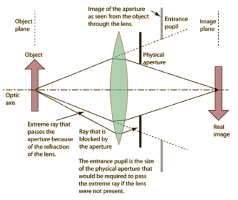
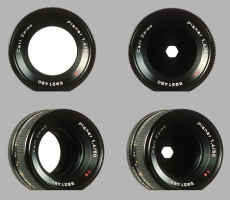
That's because the entrance pupil for wide angle lenses is not at the front, it's generally behind the aperture diaphragm. If a 20mm f/4 lens only had a 5mm diameter, it would SEVERELY vignette. A subject on the edge of the field of view must be able to "see" the edge of the entrance pupil.
When the edge of the FoV is blocked from seeing the entire EP, we get "cat's eye" bokeh and vignetting. At smaller apertures the angles are not as severe and the entire EP can be seen from the same point on the edge of the FoV.
Yeah, even on in the 10D says, 17 was tight. But the standard "kit" lens 18 was even tighter. And for all the concerns about deficiencies, its f/4 aperture was pretty useful. F/2.8 would have been better, but the 16-35 f/2.8 at the time was really not quite as good a lens. it had some really crazy flare issues.
I've had an EF 17-40mm f/4 L since around 2011. It also likes to flare and ghost if there are bright specular highlights, such as stadium light towers, in the frame. I've never used it on APS-C, though, only on FF. If I was using an APS-C body at the same time the APS-C always had the EF 70-200mm f/2.8 L IS II on it.
In my experience the EF 17-40mm f/4 L was sharper at f/4 than the EF 16-35mm f/2.8 L and the EF 16-35mm f/2.8 L II at f/4, but nowhere near as sharp at f/4 as the later EF 16-35mm f/4 L IS. As camera resolutions have increased and newer lenses with better acutance have emerged, such as the (admittedly considerably more expensive) EF 16-35mm f/2.8 L III, it's not quite the useful lens it once was.