A Prototype Full Frame Mirrorless From Canon Exists [CR1]

3kramd5 said:
dak723 said:
The point is - Leica aside - the shorter flange distance that Sony has results in BIGGER lenses.

Do you know that for a fact, or is it just supposition?

What of the throat diameter? It seems that both pieces of geometry affect the incident angle.

One can not compare apples to oranges.... Determining effect of mount on lens length, when you are talking different lens designs, different years, and different manufactures is, to say the least, non deterministic.....

Control the variables! Look at the Tamron 70-300.... Same optical formula for the Canon, Nikon, and Sony mount.... same length of lens....
 
Upvote 0
Don Haines said:
3kramd5 said:
dak723 said:
The point is - Leica aside - the shorter flange distance that Sony has results in BIGGER lenses.

Do you know that for a fact, or is it just supposition?

What of the throat diameter? It seems that both pieces of geometry affect the incident angle.

One can not compare apples to oranges.... Determining effect of mount on lens length, when you are talking different lens designs, different years, and different manufactures is, to say the least, non deterministic.....

I agree.


Control the variables! Look at the Tamron 70-300.... Same optical formula for the Canon, Nikon, and Sony mount.... same length of lens....

You didn’t control the variables affecting optical formula, you eliminated them ;D
 
Upvote 0
3kramd5 said:
Don Haines said:
3kramd5 said:
dak723 said:
The point is - Leica aside - the shorter flange distance that Sony has results in BIGGER lenses.

Do you know that for a fact, or is it just supposition?

What of the throat diameter? It seems that both pieces of geometry affect the incident angle.

One can not compare apples to oranges.... Determining effect of mount on lens length, when you are talking different lens designs, different years, and different manufactures is, to say the least, non deterministic.....

I agree.


Control the variables! Look at the Tamron 70-300.... Same optical formula for the Canon, Nikon, and Sony mount.... same length of lens....

You didn’t control the variables affecting optical formula, you eliminated them ;D

I figured that the thing to do was to find a lens that could be mounted on all three bodies, and that meant tamron, as Sigma lists Sony months as “future” othe bthat I looked at. What I think they have done is to keep most of the lens the same, but to vary the last group to focus on the flange distance for that particular mount....
 
Upvote 0
3kramd5 said:
dak723 said:
The point is - Leica aside - the shorter flange distance that Sony has results in BIGGER lenses.

Do you know that for a fact, or is it just supposition?

I am not an optical engineer, so I suppose it is supposition. Others are making the same suppositions...

https://petapixel.com/2016/04/04/sonys-full-frame-pro-mirrorless-fatal-mistake/

http://ilovehatephoto.com/2015/02/23/3-detailed-reasons-not-to-switch-to-sony-full-frame-mirrorless-system/

Yes, the articles are a couple years old, but I don't believe that the problems associated with a short flange distance have been adequately solved yet. My own experience with both the Sony A7 and A7 Ii was that the corner performance was noticeably poor with their kit 28-70 zoom (I tried 2 different copies). Using a Canon lens with the adapter to create the longer Canon flange distance gave noticeably better results. This was not a scientific test as I used different lenses, but the Canon lens was an old 28-70 (non-L) lens from the 1980's.

It should be noted that the 18mm flange distance for the APS-C Canon M cameras has difficulties as well as many of the M lenses exhibit some of the worst vignetting that some of the lens testing sites have ever seen. Shortening the flange distance and creating a greater angle for the light to hit the sensor seems to create problems. I would say that that is fact.
 
Upvote 0
dak723 said:
3kramd5 said:
dak723 said:
The point is - Leica aside - the shorter flange distance that Sony has results in BIGGER lenses.

Do you know that for a fact, or is it just supposition?

I am not an optical engineer, so I suppose it is supposition. Others are making the same suppositions...

It is not supposition to say that given an optical formula, the focal point is a fixed distance from the last glass element, and that you can't change that distance without changing the optical formula. I mean, that's a fact. It's physics.

It's not absolute that every pro Sony lens is bigger than every Canon lens. Obviously this isn't so. But many of them are this way, including really important ones that are core pro zooms, such as 24-70/2.8. At the end of the day, a whole bunch of random, pro Sony lenses will have a total length greater than the same Canons.

More pertinent to the question is that the difference in flange focal distance between E mount and EF mount is totally irrelevant in the context of the total camera size, when it comes to the vast majority of professional lenses. Because at the end of the day, what is 1 centimeter, when a 24-70/2.8 is 11cm (canon) - 13cm (sony)? Does anyone really care THAT much?

A dramatic savings in size would be instead a 70mm long lens with a maximum diameter of 50mm that's 24-70 f/2.8. If that were possible, I'd absolutely be interested in a much smaller body size that was balanced with that.

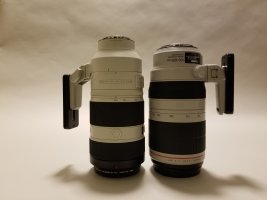
Anyways, the photo below is not supposition.
 

Attachments

  • 20180318_195501.jpg
    20180318_195501.jpg
    2.6 MB · Views: 106
Upvote 0
canon, Sony, Nikon, whoever......

They can design a lens to be shorter, but at the cost of optical performance. One of the reasons for going FF is superior image quality, so why would any of the major players compromise?

For those who value compactness higher, there are crop cameras....
 
Upvote 0
Don Haines said:
canon, Sony, Nikon, whoever......

They can design a lens to be shorter, but at the cost of optical performance. One of the reasons for going FF is superior image quality, so why would any of the major players compromise?

For those who value compactness higher, there are crop cameras....

Bingo!!!

There's absolutely nothing wrong with an APS-C body. If you want a smaller camera+body package... why not buy one of those? :D

It just makes so much more sense to me, and it is the primary reason that I can't understand the obsession over "I want a full frame mirrorless and I want it to be tiny".

Even putting quality aside, I don't think it's possible to have large aperture and a large focal range without having a large range -- because after all, you need to let in all that light.
 
Upvote 0
Relevant to this topic is an interview posted on DPR:

https://www.dpreview.com/interviews/1807023531/canon-interview-increased-competition-allows-us-to-level-up

Some interesting tidbits below. I find it interesting that Canon thinks that viewfinder and autofocus are two stumbling blocks transitioning from DSLR to mirrorless, and this is exactly what I feel after giving the A7R3 a go. The EVF is wonderful, but not quite there. And the autofocus is very good, but also, not quite there in some circumstances.

Also, they said no 4k DPAF in M50 because of price point. And new professional camera for Tokyo 2020 (and by that, I'm sure they mean 1D series, since 5D is referred to as an enthusiast camera in the same article).

The whole thing is worth a read.

How important is it for Canon to add higher-end mirrorless products to your lineup?

At Canon we have what’s called a ‘full lineup strategy’. This means that we want to satisfy all of the demands in the market, so we have mirrorless and also DSLR, which combined makes an EOS hierarchy. We want to fill the gaps to satisfy customer demands across the board.

The new M50 is an entry-level model, because that’s where the high-volume sales are. We want to establish ourselves in this market, and then move forward [from there]. In accordance with the full lineup strategy, we will be tackling [the mid-range and high-end mirrorless market] going forward.


In the past, you’ve said that you won’t introduce a high-end mirrorless product until there would be no compromises compared to DSLR technology. Are we getting close?

In the EOS hierarchy we have cameras from entry-level to professional with different features. When it comes to mirrorless cameras, we have entry-level models, and we’ve just about started on the mid-range class. What that tells you is that Canon is confident about mirrorless technology within this range of products.

But if you look at the enthusiast and high-end product class, in terms of both autofocus and viewfinder [experience], we still believe there’s some work to be done before we can achieve the level of satisfaction that our users are looking for before they could confidently move from DSLR to mirrorless. That’s where we are right now. We’re still on the path to development.

Clearly, the transition to mirrorless will be a big challenge, technically. When you look ahead to further mirrorless development, are you envisaging a new lens system?

It’s been more than 30 years since we launched our EF lens mount, and we’ve sold more than 130 million EF lenses during that time, so we can’t simply ignore that many lenses in the market. At the same time, when we look at trends in mirrorless technology, we’re considering the technical advancements that are possible. It’s a difficult question to answer, but maybe let your imagination suggest some possibilities!


The move from FD to EF in 1987 was bold but also controversial given the legacy of FD lenses and the lack of compatibility between the two platforms. Do you think that situation will happen again?

That’s a difficult question to answer. There was a lot of discussion and debate about that shift, in 1987, and we’re going through the same thing now. We want to nurture and support our [existing] EF customers and we’re in discussion about that at the moment.

Because we’re already using an electronic interface, the shift will be more gradual [than it was in 1987] so [we would better able to] maintain compatibility.

 
Upvote 0
Rocky said:
So the EF mount(44 mm flange) is a "Blessing In the sky" for Canon to minimize the effect of incident angle. EF-S lense take advantage of the smaller mirror of the APS-C camera. The EF-S lenses get deeper into the camera body to allow easier lens design

often quoted, but not true. Or only true "in theory". In practice, Canon has not bothered to produce a single EF-S lens that protrudes into the mirror box! Not even the EF-S 11-22, much less so any other EF-S lens.

EF-mount parameters were perfectly chosen by Canon (back in in 1987) and are perfectly suited for FF mirrorslappers, no discussion at all. It was the cornerstone for Canon to take market leadership back from Nikon (and their outdated, not so well chosen 1950's F-mount ... with its ridiculously narrow throat width).

But EF-mount is definitely not the best solution for digital mirrorless FF camera systems. Only a shorter FFD will allow full leverage of mirrorless concept, including but not limited to very compact camera and lenses in the most frequently used focal length range ... with extremely high IQ.

Sony has gotten FF mirrorless mount (FE) wrong. They made the mistake of pressing E-mount, which [like Canon EF-M] was designed for APS-C image circle only into forced FF-service [then called FE mount]. As a result of this [too narrow throat width coupled with slightly too short FFD] they are faced with severe limitations to lens design. This makes their FE lenses way more complex, way fatter and way more expensive than for a "really right" mirrorless FF mount.

Not even i think Canon will be "so stupid" to repeat Sony's FE mistake. :-)
 
Upvote 0
The move from FD to EF was to provide an image circle that was large enough to cover a FF sensor and to allow electronic communications between the camera and the lens. Nothing changes with mirrorless. Essentially, a mirrorless FF camera is a regular camera in live-view mode. There is no absolute compelling reason to change, so why should they?

There are some very vocal forum members who insist that Canon needs a new mount in order to make a mirrorless FF camera as small as possible. This is wrong. Making it smaller is a design choice, not an absolute requirement. If this was the the over-riding design criteria, then canon would act on it, and such a decision would have both positive and negative results.

1) it would be a smaller camera body. Depending on the person, this can be argued as a plus or a minus.

2) new mount. HUGE minus. Canon would have to start from scratch and redesign their lens lineup. Lenses designed for high quality would probably remain the same physical size, so no size savings there. New lenses designed for lower quality could be made smaller, but then again, they could do the same on the EF mount.... note that with the exception of a couple of pancakes, they have not.

3) ergonomics. HUGE minus, you have lost balance and you no longer have the real estate for the advanced controls. Touchscreen helps to mitigate this.....

In the end, if what you really want is small size, you can’t compete with an M camera and a F6.3 zoom....
 
Upvote 0
some people fail to understand that a new, short flange-distance mount is the only way to get BOTH:
* small gear: compact cameras + compact lenses in most frequently used focal length range; no this will not be the right set-up for people with large hands and large lenses. But preferably in almost all other situations.
* any size larger gear - if and as wanted. No problem at all to make camera bodies in L, XL, XXL and Texas-size

The only "compromise" involved only pertains to continued use of any existing EF lens ... in the form of a simple, compact and cheap mount adapter, with no impact at all on lens IQ. If so desired, that adapter could also be permanently attached to either a lens or to camera body.

Really don't see why this single argument (adapter for backwards compatibility) should lead to a decision that precludes taking size advantage of removed mirrorbox [and viewfinder prism].

Nobody asks for "extra-small" cameras ONLY. Some users want small, some want large/r) gear - depending on preferences and tasks/situation ... and many of us will get both: 1 small FF system and 1 large(r) one.

I really don't see why people wanting a "smaller, but high IQ and performance gear" solution should be relegated to APS-C systems only.
 
Upvote 0
AvTvM said:
some people fail to understand that a new, short flange-distance mount is the only way to get BOTH:
* small gear: compact cameras + compact lenses in most frequently used focal length range; no this will not be the right set-up for people with large hands and large lenses. But preferably in almost all other situations.
* any size larger gear - if and as wanted. No problem at all to make camera bodies in L, XL, XXL and Texas-size

The only "compromise" involved only pertains to continued use of any existing EF lens ... in the form of a simple, compact and cheap mount adapter, with no impact at all on lens IQ. If so desired, that adapter could also be permanently attached to either a lens or to camera body.

Really don't see why this single argument (adapter for backwards compatibility) should lead to a decision that precludes taking size advantage of removed mirrorbox [and viewfinder prism].

Nobody asks for "extra-small" cameras ONLY. Some users want small, some want large/r) gear - depending on preferences and tasks/situation ... and many of us will get both: 1 small FF system and 1 large(r) one.

I really don't see why people wanting a "smaller, but high IQ and performance gear" solution should be relegated to APS-C systems only.

Well, clearly somebody is failing to understand something.
 
Upvote 0
AvTvM said:
some people fail to understand that a new, short flange-distance mount is the only way to get BOTH:
* small gear: compact cameras + compact lenses in most frequently used focal length range; no this will not be the right set-up for people with large hands and large lenses. But preferably in almost all other situations.
* any size larger gear - if and as wanted. No problem at all to make camera bodies in L, XL, XXL and Texas-size

The only "compromise" involved only pertains to continued use of any existing EF lens ... in the form of a simple, compact and cheap mount adapter, with no impact at all on lens IQ. If so desired, that adapter could also be permanently attached to either a lens or to camera body.

Really don't see why this single argument (adapter for backwards compatibility) should lead to a decision that precludes taking size advantage of removed mirrorbox [and viewfinder prism].

Nobody asks for "extra-small" cameras ONLY. Some users want small, some want large/r) gear - depending on preferences and tasks/situation ... and many of us will get both: 1 small FF system and 1 large(r) one.

I really don't see why people wanting a "smaller, but high IQ and performance gear" solution should be relegated to APS-C systems only.
Right on. +10. The only problem is that Canon have to solve the issue of dark corner picture due to short flange and compact wide to normal focal length first. May be Canon should pay Leica royalty for the off-set micro lenses. 100 mm focal length and up will not have problem, regardless.
 
Upvote 0
Rocky said:
AvTvM said:
some people fail to understand that a new, short flange-distance mount is the only way to get BOTH:
* small gear: compact cameras + compact lenses in most frequently used focal length range; no this will not be the right set-up for people with large hands and large lenses. But preferably in almost all other situations.
* any size larger gear - if and as wanted. No problem at all to make camera bodies in L, XL, XXL and Texas-size

The only "compromise" involved only pertains to continued use of any existing EF lens ... in the form of a simple, compact and cheap mount adapter, with no impact at all on lens IQ. If so desired, that adapter could also be permanently attached to either a lens or to camera body.

Really don't see why this single argument (adapter for backwards compatibility) should lead to a decision that precludes taking size advantage of removed mirrorbox [and viewfinder prism].

Nobody asks for "extra-small" cameras ONLY. Some users want small, some want large/r) gear - depending on preferences and tasks/situation ... and many of us will get both: 1 small FF system and 1 large(r) one.

I really don't see why people wanting a "smaller, but high IQ and performance gear" solution should be relegated to APS-C systems only.
Right on. +10. The only problem is that Canon have to solve the issue of dark corner picture due to short flange and compact wide to normal focal length first. May be Canon should pay Leica royalty for the off-set micro lenses. 100 mm focal length and up will not have problem, regardless.

There is also the problem of convincing people to buy a mirrorless camera that requires adapters to use EF lenses when they can buy a DSLR that they can use without adapters. Then there are the people with a Canon DSLR who will not add a mirrorless camera that requires an adapter to use the lenses that are compatible with the DSLR.
 
Upvote 0
BillB said:
There is also the problem of convincing people to buy a mirrorless camera that requires adapters to use EF lenses when they can buy a DSLR that they can use without adapters. Then there are the people with a Canon DSLR who will not add a mirrorless camera that requires an adapter to use the lenses that are compatible with the DSLR.

^^This.

At issue is the target market. For entry-level APS-C mirrorless, that market is new customers – a new mount is fine, with an adapter for current system owners. But for FF mirrorless, the target market is current ILC owners. For Sony, that means pulling customers away from Canon/Nikon. But for Canon, the largest source of FF MILC buyers is current Canon dSLR owners.
 
Upvote 0
neuroanatomist said:
BillB said:
There is also the problem of convincing people to buy a mirrorless camera that requires adapters to use EF lenses when they can buy a DSLR that they can use without adapters. Then there are the people with a Canon DSLR who will not add a mirrorless camera that requires an adapter to use the lenses that are compatible with the DSLR.

^^This.

At issue is the target market. For entry-level APS-C mirrorless, that market is new customers – a new mount is fine, with an adapter for current system owners. But for FF mirrorless, the target market is current ILC owners. For Sony, that means pulling customers away from Canon/Nikon. But for Canon, the largest source of FF MILC buyers is current Canon dSLR owners.

There could be a comparability issue between a new FF mirrorless mount and the aps-c M line. An M camera will take an EF lens with an adapter, but it might be difficult to adapt lenses with the new FF mirrorless mount to an M camera
 
Upvote 0
neuroanatomist said:
BillB said:
There is also the problem of convincing people to buy a mirrorless camera that requires adapters to use EF lenses when they can buy a DSLR that they can use without adapters. Then there are the people with a Canon DSLR who will not add a mirrorless camera that requires an adapter to use the lenses that are compatible with the DSLR.

^^This.

At issue is the target market. For entry-level APS-C mirrorless, that market is new customers – a new mount is fine, with an adapter for current system owners. But for FF mirrorless, the target market is current ILC owners. For Sony, that means pulling customers away from Canon/Nikon. But for Canon, the largest source of FF MILC buyers is current Canon dSLR owners.

Sony is the best example. Their efforts to continue support of mirrorslapper A-lenses have not gotten them much. It would have been much smarter, had they just said: "end of A-mount, now!"and focused on selecting "really right" paramters for their mirrorless FF lens mount.

Existing EF-lens owners refusing to use an adapter will have to live with their decision. Their problem, not Canon's. Canon should focus on developing, making and selling a state-of-the-art mirrorless product lineup. All they need to do is mirror their DSLR universe:
EF-M is the new EF-S
EF-X is the new EF
..
people wanting to use their old glass on new cameras will have to use an adapter. Meanwhile Canon will be selling new cameras and lenses in the millions ... for some years to come ... until computational imaging fully takes over.
 
Upvote 0
BillB said:
neuroanatomist said:
BillB said:
There is also the problem of convincing people to buy a mirrorless camera that requires adapters to use EF lenses when they can buy a DSLR that they can use without adapters. Then there are the people with a Canon DSLR who will not add a mirrorless camera that requires an adapter to use the lenses that are compatible with the DSLR.

^^This.

At issue is the target market. For entry-level APS-C mirrorless, that market is new customers – a new mount is fine, with an adapter for current system owners. But for FF mirrorless, the target market is current ILC owners. For Sony, that means pulling customers away from Canon/Nikon. But for Canon, the largest source of FF MILC buyers is current Canon dSLR owners.

There could be a comparability issue between a new FF mirrorless mount and the aps-c M line. An M camera will take an EF lens with an adapter, but it might be difficult to adapt lenses with the new FF mirrorless mount to an M camera

Indeed, an issue I've raised previously.
 
Upvote 0
neuroanatomist said:
BillB said:
neuroanatomist said:
BillB said:
There is also the problem of convincing people to buy a mirrorless camera that requires adapters to use EF lenses when they can buy a DSLR that they can use without adapters. Then there are the people with a Canon DSLR who will not add a mirrorless camera that requires an adapter to use the lenses that are compatible with the DSLR.

^^This.

At issue is the target market. For entry-level APS-C mirrorless, that market is new customers – a new mount is fine, with an adapter for current system owners. But for FF mirrorless, the target market is current ILC owners. For Sony, that means pulling customers away from Canon/Nikon. But for Canon, the largest source of FF MILC buyers is current Canon dSLR owners.

There could be a comparability issue between a new FF mirrorless mount and the aps-c M line. An M camera will take an EF lens with an adapter, but it might be difficult to adapt lenses with the new FF mirrorless mount to an M camera

Indeed, an issue I've raised previously.

moot point. FF MILC lens mount should and likely will have a bit longer FFD than EF-M ... for a whole number of reasons. EOS-EF-M mount will then take EF-X lenses with a tiny adapter ring a few millimeters wide.
 
Upvote 0