
You are using an out of date browser. It may not display this or other websites correctly.
You should upgrade or use an alternative browser.
You should upgrade or use an alternative browser.
After a 50MP camera what is the next breakthrough?
- Thread starter Hector1970
- Start date


toodamnice said:Could the next big thing be 16 bit color?
To make the 11.5 stops of dynamic range shine :-> ? ... btw, if you want to try it: Magic Lantern's dual_iso module produces 16bit raw files.
Upvote
0
I wouldn't exactly call 50MP a breakthrough. I see it more as an evolution of existing technology. A breakthrough is a solution to a problem that everyone has been struggling with and no one has been able to tackle.
If you look at high MP as resulting in improved detail, well then there are a number of methods to achieve detail in shots. There is stitching with panoramic photography as well as with Tilt-shift lenses. Even today with the 70D and a tilt-shift lens you can quite easily create incredibly detailed panoramas that are in excess of 50MP. With a pan head you can create gigapixel images if desired. If you really desperately wanted high detail in a single shot then you could look into medium format options also. So in summary, I don't see 50 MP as a breakthrough.
On the positive side though, when DxOmark eventually test the camera with lenses we'll finally see the Canon lens scores improve.
The next logical step I'd like to see is updates to Canon's 35L and 50L or 50/1.4, heck Canon should just update all the 50mm primes they all have issues that can be improved upon.
If you look at high MP as resulting in improved detail, well then there are a number of methods to achieve detail in shots. There is stitching with panoramic photography as well as with Tilt-shift lenses. Even today with the 70D and a tilt-shift lens you can quite easily create incredibly detailed panoramas that are in excess of 50MP. With a pan head you can create gigapixel images if desired. If you really desperately wanted high detail in a single shot then you could look into medium format options also. So in summary, I don't see 50 MP as a breakthrough.
On the positive side though, when DxOmark eventually test the camera with lenses we'll finally see the Canon lens scores improve.
The next logical step I'd like to see is updates to Canon's 35L and 50L or 50/1.4, heck Canon should just update all the 50mm primes they all have issues that can be improved upon.
Upvote
0
kraats said:I want to throw away my nd grads. They suck. So more dynamic range and iso 12.
Bad news Im afraid even at 20 stops of DR their will be situations where people will want to use ND grads, forget how many stops unless something drastically changes your need polarizing filters and to get creamy water extended exposures with filters (up to 20 stops is possible, the Big Stopper is 10 stops). Ive always seen filters as an artistic tool not a hindrance if they were so I doubt the worlds greatest Landscape Photographers would use them. Unless CMOS sensor design changes IRNDs for 2/4K video are also here to stay.
Upvote
0

Bennymiata
Canon Rumors Premium
To me, the ultimate breakthrough will be the insertion of a chip in your brain which is able to take stills and video directly from your memories or directly as your eyes see it.
Downloads would be accomplished wirelessly.
This same device could also be your cellphone and do other things we can't even imagine yet.
But realistically for today, clean super-high iso, more dr, improved general iq and much cheaper costs.
Downloads would be accomplished wirelessly.
This same device could also be your cellphone and do other things we can't even imagine yet.
But realistically for today, clean super-high iso, more dr, improved general iq and much cheaper costs.
Upvote
0

jeffa4444 said:kraats said:I want to throw away my nd grads. They suck. So more dynamic range and iso 12.
Bad news Im afraid even at 20 stops of DR their will be situations where people will want to use ND grads, forget how many stops unless something drastically changes your need polarizing filters and to get creamy water extended exposures with filters (up to 20 stops is possible, the Big Stopper is 10 stops). Ive always seen filters as an artistic tool not a hindrance if they were so I doubt the worlds greatest Landscape Photographers would use them. Unless CMOS sensor design changes IRNDs for 2/4K video are also here to stay.
A solid ND filter like the big stopper is different than an ND grad. You could use that fine on a camera with unlimited dynamic range, as it has nothing to do with dynamic range. It has to do with allowing you to expose for longer (much longer) than you normally would...blurring motion.
A camera with 20 stops of DR would pretty much eliminate the need for graduated nd filters. That is a LOT of dynamic range. Remember, every stop DOUBLES the range of the previous. Going from 11 to 12 stops DOUBLES the range of light your camera is simultaneously sensitive to. Going from 12 to 13 stops DOUBLES the range again. Going from 13 to 14 stops DOUBLES it again. Double it six more times, and you finally reach 20 stops.
That is a truly massive amount of dynamic range. About the only thing you couldn't do with that much dynamic range would be imaging the sun setting behind a mountain well enough to pick out sunspots and flares, while simultaneously pulling out full detail in the deepest shadows of that mountain. There are a couple of celestial objects that could probably use that kind of dynamic range as well...say Orion Nebula or Andromeda Galaxy...both of those are extremely high dynamic range objects, with ultra bright cores and ultra faint outer regions.
Upvote
0
Built in RF for off-camera flash and WiFi. I want to walk around with my tablet adjusting flash power/ratios/zoom in all my groups, as well as camera settings, while checking composition in Live View, snapping photos and reviewing all from my tablet - all from the same program. Sadly, all the technology is already there, I guess there just isn't enough of a market to put money into development.
Upvote
0
For me the next breakthrough will be a 100 Megapixel camera (or 200, anywhere up to 500 is good).
DR is great, but not a game changer for me (it would be for those who think it is, but for me it's as good as 100+MP is for them).
Bigger sensors are an inevitability. The EOS mount is even big enough for a 50mm sensor as-is, if you remove the mirror.
All Canon has to do is make the sensors, and be able to sell a pro-mirrorless body.
If they make a new mount and forget about backward compatibility, I hope the sensor is at least 4x3" or at the very least IMAX (70.41x52.63mm).
I'm sick of seeing these puny 55-60mm sensors that provide barely any increase in surface area being called "Medium Format".
DR is great, but not a game changer for me (it would be for those who think it is, but for me it's as good as 100+MP is for them).
Bigger sensors are an inevitability. The EOS mount is even big enough for a 50mm sensor as-is, if you remove the mirror.
All Canon has to do is make the sensors, and be able to sell a pro-mirrorless body.
If they make a new mount and forget about backward compatibility, I hope the sensor is at least 4x3" or at the very least IMAX (70.41x52.63mm).
I'm sick of seeing these puny 55-60mm sensors that provide barely any increase in surface area being called "Medium Format".
Upvote
0
Act444 said:I think a one-stop improvement on 5D3 high ISO would be pretty significant. Imagine ISO 3200 being as clean as the 5D3 1600 which is already amazing..."wow" just thinking about it! You could even begin using lenses like the 100-400 indoors in good light.
And if they can add a few more pixels on top of that? It's going to take at least that to convince me to upgrade to the 5D4 anyway, the 5D3 is already a hell of a camera...
There are already reports from testers that there is a 1.5-2 stop gain in dynamic range, however, only at low ISO, with the 5Ds compared to the 5D Mark 3. On the flip side, they had to sacrifice high ISO quality, and the dynamic range is reduced in comparison to the Mark 3. So in other words, you're sacrificing high ISO in order to get great low ISO quality. Truly a landscape/studio camera, as usually in those settings, you stay as low an ISO as possible. I believe you can read more about in on the Northlight website.
Upvote
0

After thinking about all this for a while, and after high initial enthusiasm for the 50 Mp offerings, I think I'll be sitting tight for the lower Mp 5D Mk4 later this year. I'm expecting deeper buffer, modestly better high iso performance, low light AF boost and some incremental, generational, across the board improvements. I'll be happy if the sensor is in the 20-25 Mp range.
My main workstations would easily handle the bigger 50 Mp files as my set up is in the awesome category for effortless 4K video editing. Maybe I'll avoid the need for another higher storage capacity NAS, my current CF card capacity will still do the job and to be honest, the 5D3 files still knock my socks off and have a quality surplus that none of my clients have come anywhere near exceeding.
Canon engineers may have had it right pulling up MP counts in the low 20 Mp's with the 1Dx and 5D3. But pressure from the marketing team and a braying public to "beat Nikon" was just too strong.
-pw
My main workstations would easily handle the bigger 50 Mp files as my set up is in the awesome category for effortless 4K video editing. Maybe I'll avoid the need for another higher storage capacity NAS, my current CF card capacity will still do the job and to be honest, the 5D3 files still knock my socks off and have a quality surplus that none of my clients have come anywhere near exceeding.
Canon engineers may have had it right pulling up MP counts in the low 20 Mp's with the 1Dx and 5D3. But pressure from the marketing team and a braying public to "beat Nikon" was just too strong.
-pw
Upvote
0
9VIII said:For me the next breakthrough will be a 100 Megapixel camera (or 200, anywhere up to 500 is good).
DR is great, but not a game changer for me (it would be for those who think it is, but for me it's as good as 100+MP is for them).
Bigger sensors are an inevitability. The EOS mount is even big enough for a 50mm sensor as-is, if you remove the mirror.
All Canon has to do is make the sensors, and be able to sell a pro-mirrorless body.
If they make a new mount and forget about backward compatibility, I hope the sensor is at least 4x3" or at the very least IMAX (70.41x52.63mm).
I'm sick of seeing these puny 55-60mm sensors that provide barely any increase in surface area being called "Medium Format".
Umm, a 60mm wide, 45mm tall medium format sensor (same size as 6x4.5cm large format film) has 3.125x the surface area of a 35mm sensor. How can you possibly call that "barely" any increase in surface area? Even a 44x33mm medium format is twice the surface area, which is significant. Twice the surface area, twice the light gathering capacity. A 35mm FF sensor is is just a bit more than twice the light gathering capacity of APS-C...and look at how much that improves performance right there. Imagine having four times the light gathering capacity of APS-C...or with a 6x4.5 a whopping 6.25x the light gathering capacity.
As for IMAX-size medium format. Where are you going to get lenses that perform optimally across that entire surface area? How are you going to afford such lenses? The "normal" lens for such a sensor would be a 90-100mm lens. That would make a 300mm equivalent lens on IMAX a 540mm lens. At f/4, such a lens would still require a minimum 135mm objective...which is pretty huge. That's larger than a 300 f/2.8, it's even larger than a 500 f/4, for 35mm FF!!
Medium format cameras are expensive for a reason, and they are rare for a reason.
 I'd be surprised if Canon came out with a 44x33mm camera, let alone 60x45 or 72x53mm. Such a niche product...
Upvote
0

I would love to see a fully automated, real time afma that changes immediately with any focus point used. Couple that with improved AF speed and accuracy, that would be awesome.
sek
sek
Upvote
0
scottkinfw said:I would love to see a fully automated, real time afma that changes immediately with any focus point used. Couple that with improved AF speed and accuracy, that would be awesome.
sek
Yes, that's the sort of feature we should be looking forward to rather than an on-going megapixel race. Good one!
-pw
Upvote
0
pwp said:scottkinfw said:I would love to see a fully automated, real time afma that changes immediately with any focus point used. Couple that with improved AF speed and accuracy, that would be awesome.
sek
Yes, that's the sort of feature we should be looking forward to rather than an on-going megapixel race. Good one!
-pw
Again, this is mind-boggingly narrow sighted, to a level that almost defies belief.
For you, those are the features that are important and you are looking for. To others, we want more megapixels over other things. I myself want more megapixels than dynamic range or focus. You know why? Because I print large a lot. I love minute details in my prints. I've never had an issue with dynamic range that I couldn't correct by bracketing (remember, I'm talking about myself, not others). I focus manually using live view, so improved auto focus is not important to me.
So you need to absolutely stop making such blanket statements. Just because this is not what you want, does not mean it is not a great product for many other people. I won't be complaining when Canon introduces a lower megapixel, high ISO capable, premiere auto focus camera. Why? Well, I'm smart enough to know that even though it won't benefit me, it will benefit others.
Upvote
0

We've got to get rid of these Bayer filters. They reduce sensor efficiency and colour accuracy and make moire more prominent. They've got to go. There's big gains to be made from alternate colour sensing technologies.
I'd like to see Canon taking the multi-layer sensor concept, a la Sigma Quattro, and implement it really well in their existing system. Bring noise / sensitivity on a par with existing bodies, but surround the sensor in all the EOS lens, AF, ergonomic and RAW goodness. Canon could turn this sort of technology into a stunning mainstream camera, rather than the Sigma cult classic it currently is.
Cameras will all end up mirrorless. It is the natural architecture of a digital camera, with so much to be gained from metering, focussing and composing directly on the sensor plane. However, there are still major viewfinder and AF performance issues to be solved, so the DSLR architecture will continue to rule for a while yet. If and when the Canon flagship cameras turn mirrorless, there will be a strong incentive to preserve the EOS EF interface so the implementation might be as simple as making "live view" the exclusive mode of operation with an extremely fast EVF of imperceptible lag, on-sensor AF and electronic shutter. If the mirrorless architecture truly is superior, it will inevitably follow that the performance of high-end mirrorless, on-sensor architectures will truly surpass that of the best DSLRs. This is a little way off yet... but not far. If and when the technology is mature, mirrorless will become the norm for the most demanding photography, including medium format.
We might see pixel-level control of sensitivity, allowing on-sensor implementation of various ND filters at time of capture.
I'd like to see Canon Apple-fy its software, maintaining a firm grip on the integrity of EOS firmware but opening the system to software add-ons / apps. There's a lot to be learned from Magic Lantern functionality and Sony's approach to apps. The corporate giant just can't harvest the same imaginative innovation that a bunch of tiny software development houses can bring at their own risk. It's not just a gimmick for consumer photography, but has the capacity to integrate all sorts of functionality and information into the camera to make for better photos. It might break system ergonomics, though. Making WiFi standard would allow flagship cameras, like camera-phones, to join the ubiquitous networked world.
So my bet is that within 10 years the Canon EOS 1-series camera will be a very different sensor technology, mirrorless, and heavily software-defined.
I'd like to see Canon taking the multi-layer sensor concept, a la Sigma Quattro, and implement it really well in their existing system. Bring noise / sensitivity on a par with existing bodies, but surround the sensor in all the EOS lens, AF, ergonomic and RAW goodness. Canon could turn this sort of technology into a stunning mainstream camera, rather than the Sigma cult classic it currently is.
Cameras will all end up mirrorless. It is the natural architecture of a digital camera, with so much to be gained from metering, focussing and composing directly on the sensor plane. However, there are still major viewfinder and AF performance issues to be solved, so the DSLR architecture will continue to rule for a while yet. If and when the Canon flagship cameras turn mirrorless, there will be a strong incentive to preserve the EOS EF interface so the implementation might be as simple as making "live view" the exclusive mode of operation with an extremely fast EVF of imperceptible lag, on-sensor AF and electronic shutter. If the mirrorless architecture truly is superior, it will inevitably follow that the performance of high-end mirrorless, on-sensor architectures will truly surpass that of the best DSLRs. This is a little way off yet... but not far. If and when the technology is mature, mirrorless will become the norm for the most demanding photography, including medium format.
We might see pixel-level control of sensitivity, allowing on-sensor implementation of various ND filters at time of capture.
I'd like to see Canon Apple-fy its software, maintaining a firm grip on the integrity of EOS firmware but opening the system to software add-ons / apps. There's a lot to be learned from Magic Lantern functionality and Sony's approach to apps. The corporate giant just can't harvest the same imaginative innovation that a bunch of tiny software development houses can bring at their own risk. It's not just a gimmick for consumer photography, but has the capacity to integrate all sorts of functionality and information into the camera to make for better photos. It might break system ergonomics, though. Making WiFi standard would allow flagship cameras, like camera-phones, to join the ubiquitous networked world.
So my bet is that within 10 years the Canon EOS 1-series camera will be a very different sensor technology, mirrorless, and heavily software-defined.
Upvote
0

Machaon said:We've got to get rid of these Bayer filters. They reduce sensor efficiency and colour accuracy and make moire more prominent. They've got to go. There's big gains to be made from alternate colour sensing technologies.
I'd like to see Canon taking the multi-layer sensor concept, a la Sigma Quattro, and implement it really well in their existing system. Bring noise / sensitivity on a par with existing bodies, but surround the sensor in all the EOS lens, AF, ergonomic and RAW goodness. Canon could turn this sort of technology into a stunning mainstream camera, rather than the Sigma cult classic it currently is.
Cameras will all end up mirrorless. It is the natural architecture of a digital camera, with so much to be gained from metering, focussing and composing directly on the sensor plane. However, there are still major viewfinder and AF performance issues to be solved, so the DSLR architecture will continue to rule for a while yet. If and when the Canon flagship cameras turn mirrorless, there will be a strong incentive to preserve the EOS EF interface so the implementation might be as simple as making "live view" the exclusive mode of operation with an extremely fast EVF of imperceptible lag, on-sensor AF and electronic shutter. If the mirrorless architecture truly is superior, it will inevitably follow that the performance of high-end mirrorless, on-sensor architectures will truly surpass that of the best DSLRs. This is a little way off yet... but not far. If and when the technology is mature, mirrorless will become the norm for the most demanding photography, including medium format.
We might see pixel-level control of sensitivity, allowing on-sensor implementation of various ND filters at time of capture.
I'd like to see Canon Apple-fy its software, maintaining a firm grip on the integrity of EOS firmware but opening the system to software add-ons / apps. There's a lot to be learned from Magic Lantern functionality and Sony's approach to apps. The corporate giant just can't harvest the same imaginative innovation that a bunch of tiny software development houses can bring at their own risk. It's not just a gimmick for consumer photography, but has the capacity to integrate all sorts of functionality and information into the camera to make for better photos. It might break system ergonomics, though. Making WiFi standard would allow flagship cameras, like camera-phones, to join the ubiquitous networked world.
So my bet is that within 10 years the Canon EOS 1-series camera will be a very different sensor technology, mirrorless, and heavily software-defined.
+1
mirrorless is likely to have the next increment large enough to be considered a breakthru and that'll likely be in further improved AF tracking performance and, maybe, improved battery life.
I'd like to see a bit more competitive pressure in the crop MF or, dreaming, real MF sensors too, made suddenly affordable by a new sensor mfg process that delivers high sensitivity, hi DR and excellent color fidelity using a low cost, non-silicon based substrate. Maybe some kind of plastic with thin layers of photo-sensitive chemical layers applied to it.
 but NOT film!
 Seriously, you read it here first. electronically-sensed, photo-chemical sensels that are responsive to very narrow bands of light from near IR to near UV which can provide a hi-fidelity color response and organized in such a way (like the Foveon) that aliasing/moire doesn't occur. You expose them like film, read them like a resistance, reset them with a voltage pulse for the next shot.
Somebody get on that and sign me as co-patent holder.
Upvote
0
I'd like to see an open source firmware that can be amended with 3rd party or personal modules to end the "firmware crippling" game and "Rebel users are too dumb to be able to copy with a complex fw".
Magic Lantern has great add-ons for the stock Canon firmware, but it's a pita to program because Canon's DryOS is not documented and camera calls change all the time with newer models. With a documented sdk, even midrange users would be able to script their camera and programmers could just about everything they like with it.
Won't happen with Canon, of course, that's why some ML people are currently trying to move away from the Canon system towards a 4k axiom platform they have real access to: http://nofilmschool.com/2014/10/apertus-axiom-crowdfunding-succeeds-magic-lantern-support
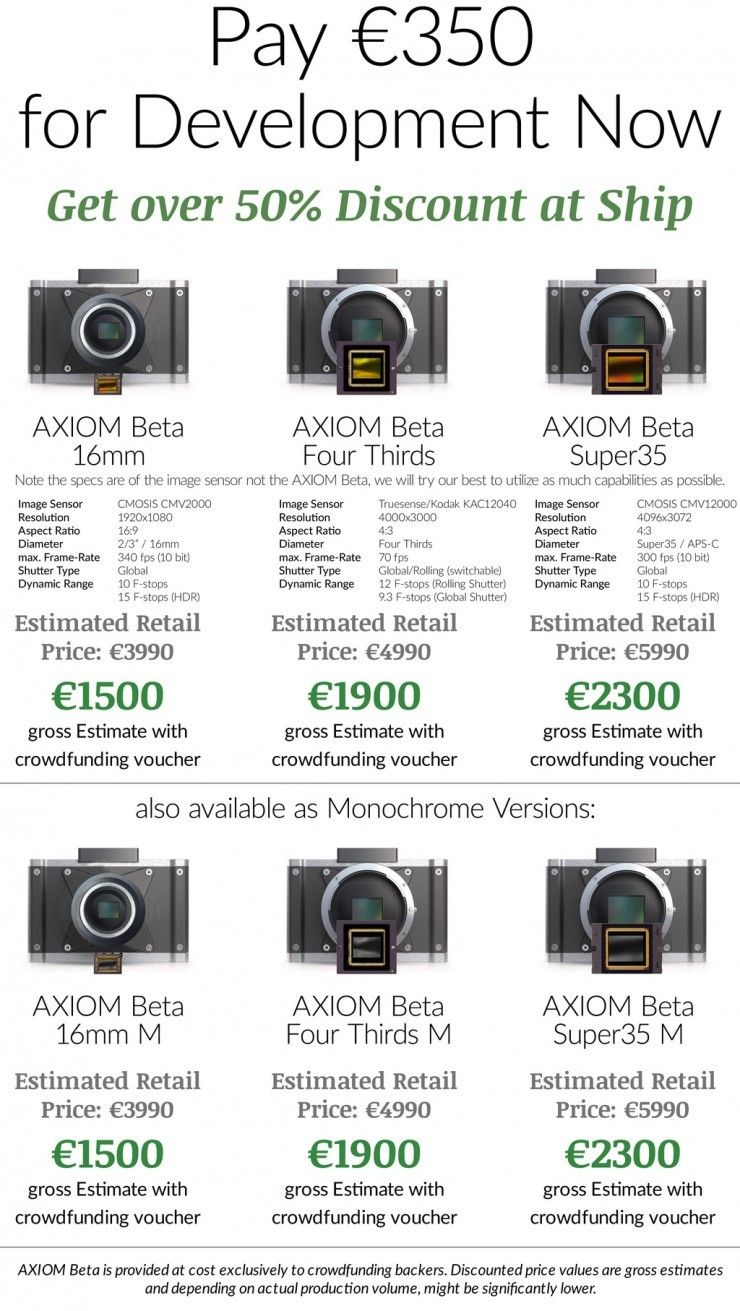
Magic Lantern has great add-ons for the stock Canon firmware, but it's a pita to program because Canon's DryOS is not documented and camera calls change all the time with newer models. With a documented sdk, even midrange users would be able to script their camera and programmers could just about everything they like with it.
Won't happen with Canon, of course, that's why some ML people are currently trying to move away from the Canon system towards a 4k axiom platform they have real access to: http://nofilmschool.com/2014/10/apertus-axiom-crowdfunding-succeeds-magic-lantern-support
Upvote
0
SoullessPolack said:[
Again, this is mind-boggingly narrow sighted, to a level that almost defies belief.
For you, those are the features that are important and you are looking for. To others, we want more megapixels over other things. I myself want more megapixels than dynamic range or focus. You know why? Because I print large a lot. I love minute details in my prints. I've never had an issue with dynamic range that I couldn't correct by bracketing (remember, I'm talking about myself, not others). I focus manually using live view, so improved auto focus is not important to me.
So you need to absolutely stop making such blanket statements. Just because this is not what you want, does not mean it is not a great product for many other people. I won't be complaining when Canon introduces a lower megapixel, high ISO capable, premiere auto focus camera. Why? Well, I'm smart enough to know that even though it won't benefit me, it will benefit others.
I take it that you don't understand that this is a forum designed for people to post their *personal* opinions on Canon related topics. That's all that is ever posted here -- a person's personal opinion/viewpoint.
The fact that you are surprised that someone posted what they would like (an opinion) questions whether you understand the purpose of these types of internet forums.
You have the ability to post *your* opinion on the topic, as do other members of this forum.
You don't have to agree, or even understand, someone else's opinion, just like we don't have to agree, or even understand, your opinion. But all opinions are welcome here.
No one, other than the Mods/owner of this site, has any authority to mandate what a forum member can and can't post.
"So you need to absolutely stop making such blanket statements" is really totally out of line.
Let's play nice and recognize that people have different opinions. An opinion you don't agree with is not necessarily "mind-boggingly narrow sighted, to a level that almost defies belief".
Would you like it if someone called your opinion that?
Upvote
0
Similar threads

- Replies
- 48
- Views
- 6K
D
- Replies
- 32
- Views
- 5K

- Replies
- 164
- Views
- 33K
- Replies
- 45
- Views
- 12K
