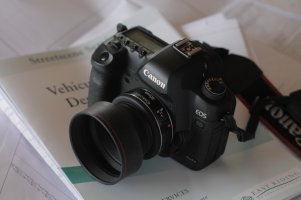
Are you using lens hoods?

How are you using lenshoods on your lenses?

  • On all your lenses

    Votes: 89 76.7%
  • On all lenses except on ultra wide angle lenses

    Votes: 10 8.6%
  • Only use hoods with lenses which are significant in size - not like the 24-70II

    Votes: 9 7.8%
  • Only on super-telephoto lenses

    Votes: 2 1.7%
  • Meh ... what's a lens hood?

    Votes: 6 5.2%

  • Total voters
    116

Rahul

Wish I had more time to shoot
Jan 28, 2015
153
0
6,006
I've seen many photographers who attach a protection filter and do not use the lens hood, while there are some who will always use the hoods, filter or no filter.

Personally, I use the hoods to prevent smudging by hands and also for protection purposes. I don't use filters though (unless it is a CPL).

Just curious, how many of us in CR space use lens hoods? If not, what are your reasons for not using the hoods?
 
I use a hood on all lenses where Canon were generous enough to provide them with the lens purchase.

You may have guessed I use the term generous facetiously. A piece of injection-moulded plastic that probably costs 10 cents to manufacture should not require an additional purchase, and I refuse to pay the exorbitant prices they ask for them.
 
Upvote 0
I use them on almost all lenses. The exceptions are the 40/2.8 and M22/2 pancake lenses, where IMO the hood design is inadequate (based on geometry), and the TS-E 17 which doesn't take a hood. I sometimes do not use the 'hood' for the MP-E 65mm, depending on my lighting setup.
 
Upvote 0
Coldhands said:
You may have guessed I use the term generous facetiously. A piece of injection-moulded plastic that probably costs 10 cents to manufacture should not require an additional purchase, and I refuse to pay the exorbitant prices they ask for them.

Maybe the felt flocking is really expensive. ;)
 
Upvote 0
hard to pick from those answers. I use them more often outdoor. When travelling and space really becomes a concern I usually take them off and just use my hand when flare becomes serious. If the hood doesn't come with the lens I never buy the official Canon hood, just cheap ones on ebay.
 
Upvote 0
Depends. Handheld, generally yes (presuming I have brought the hood). On a tripod, not so much. Most often, on a tripod means using a CPL and sometimes an ND, so no hood. And, positioning a hand held flag (by that I mean hat) to shield the end of the lens from the sun usually works.
 
Upvote 0
Always on every lens that has one indoors and outdoors, night and day-except when the camera is sitting on a tripod and I'm putting on and taking off filters (cpl, nd) I can't count the number of times I've banged the lens hood instead of my protective filter. (Protective filter to protect the lens from ME when I clean it, and to complete the weather sealing.)
 
Upvote 0
I always use hoods, as much for protection indoors from banging against stuff (I can get a little preoccupied with the shoot and consequently careless) as outdoors for shielding against stray light sources. Even when a hood isn't expressly needed, I still use it just to reinforce the habit.

I bought Canon-brand hoods for the 85/1.8 I used to own, and for the 35/2 IS I currently own. The only exception is the 50/2.5 CM, for which no hood is available. Canon provided hoods with all the other lenses.

On the other hand, I'm much less likely to use filters. I have CPLs, but rarely use them (don't have the need very often) and UVs for protection from the elements (sand, dust, salt spray, etc.), but again, an infrequent situation for me.
 
Upvote 0
Always, more for added protection than for glare. Even on the 40 pancake, I use just the metal ring from an old rubber hood. It isn't much, but will help deflect the lens away from many potentially damaging objects -- at least that's what I hope.
 
Upvote 0
neuroanatomist said:
I use them on almost all lenses. The exceptions are the 40/2.8 and M22/2 pancake lenses, where IMO the hood design is inadequate (based on geometry),

Huh ? What you on about ? ;)

(Of course you are correct regarding the Canon supplied hoods; I presume they are a triumph of marketing over practicality).

I use hoods all the time. Reading the various threads on multicoating and lens hoods I think there is a fair bit of misunderstanding as to what the main function of multicoating on lenses is for. I generally don't use filters, certainly not 'protective' filters.
 

Attachments

  • _MG_6087.JPG
    _MG_6087.JPG
    381.8 KB · Views: 170
Upvote 0
ajfotofilmagem said:
Still wonder why Canon is so petty, to sell your lenses without lens hood (except L lenses).

Just from having seen innumerable lower priced lenses that come with hoods being used either without them, or with them reversed, leads me to think they are considered insignificant enough by the vast majority of owners so them being including would unnecessarily raise the price for everybody, not just in the actual cost of the hood, but in the packaging and all the other associated costs including them would incur.

But I am a use them all the time person, but I think my fairly blunt and outspoken opinion of that is fairly widely known! Except on the 17TS-E (which can't take one) and the EF-M 22mm because I don't have a hood for it and size is the overwhelming reason I would be using it instead of a FF DSLR with a 35mm lens.
 
Upvote 0
Dylan777 said:
I use BW 007 Clear filter to protect my lenses from dust and water, plus easy cleaning. Lens hood to protect from hard bump.

Broken hood and scratchy filter are cheaper to replace ;)

People say this all the time, how many times have you seen scratched modern front elements? I have been hand cleaning my 70-200 f2.8 IS lens for nearly ten years, it has never had a filter on it and has been soaked in sea spray (many times), it has crossed deserts, been rained on more times than I could count and it doesn't have even the smallest mark on it.

Where are all these damaged front elements to support the $80 a pop 'protective' filters? Besides, there have been many instances of broken filters scratching the front elements when the front element wasn't otherwise damaged, so deduct that number of incidents from the first number, add up the cost of them and deduct the cost of all the filters and, well, you get my opinion on 'protective' filters :)

I am not saying don't do it if you want to do it, I am saying I believe it is advice that has long outlived its practical application and is just repeated parrot fashion with no modern risk/benefit calculation analysis behind it. For instance it used to be much more difficult to get lenses repaired (the parts supply) than nowadays, the coatings used to be much less durable and prone to damage from cleaning, and the actual filters used to be much cheaper, that just isn't the case now so I believe the advice isn't valid either.

Just straight maths, if you have three 77mm lenses that is $250 in 'protection' filters, well first off you'd be far better off spending that $250 on an actual insurance policy to cover for other damage as well, and secondly, $250 will get most front elements replaced anyway if you are unlucky enough to damage one, I know that you can get a 17TS-E done for that and that has to be one of the worst.

 
Upvote 0