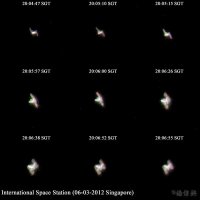
It's often easier to do these things in arcseconds. The ISS is ~63" (arcseconds) long. We can compute the number of arcseconds/pixel ("/px or asp) using this formula:
Code:
(206.265 / focalLength mm) * pixelPitch µm
For the 7D and a 200mm lens, our asp is
(206.265/200mm)*4.3 = 4.43asp. For the 5D II and a 200mm lens it's
(206.265/200)*6.4 = 6.6asp. If we take the 63" length of the ISS, and divide it by our sensors arceconds/pixel ratio, we get ~14px for the 7D and ~9.54px for the 5D II.
Now you can slap on teleconverters to get longer focal length. The 7D will suffer from the effects of diffraction and less lignt sooner, meaning the 5D II will then be more capable of using a longer focal length with a teleconverter, or for that matter stacking teleconverters (you can stack in a number of ways...2x III + 1.4x Kenko, 2x III + 25mm ext tube + 2x TC III, etc.) Let's say you use a 2x TC on the 7D and two 2x TC's on the 5D III. The 7D and 5D II are going to be producing roughly the same noise, and diffraction softening will be roughly equal (slightly more on the 5D II):
7D: (202.265/400)*4.3 = ~2.2asp
5D II: (202.265/800)*6.4 = ~1.1asp
We have a roughly equivalent IQ case here (similar amount of noise), but a much longer focal length on the 5D II. The ISS is 28px large on the 7D, but 57px large on the 5D II. Since we are talking about highly collimated light, all you need to do really is manually focus in the stars or the moon...so you could, theoretically, stack as many teleconverters as you think your pixels will handle. The larger pixels of the 5D II will handle more than the 7D before you start achieving similar results on both (diffraction blurring will eventually reach a point where the ISS is blurred the same mount on both if you just keep stacking TCs, and the 7D will simply be oversampling that blurry image more than the 5D II, albeit with more noise.)