Best Lenses for the Canon 5Ds

I remember this being a very hot topic in the Nikon world, so let's get things started.

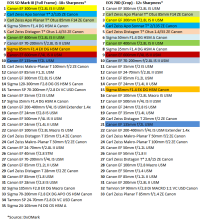
Looking at DxOMark's Sharpness scores, it seems that the best lenses assuming optimal aperture and perfect technique are going to be assuming Sharpness of 18+ on the 5DIII and 12+ on the 70D (no data for 7DII yet). I have also color coded the Top 10 on FF to see where they land on a crop sensor, which will probably be a better representation given the pixel density, which I'm guessing (I haven't done the math) will be diffraction limited around f/5.6:
 

Attachments

  • 2015-02-03 14_31_21-Microsoft Excel - Book1.png
    2015-02-03 14_31_21-Microsoft Excel - Book1.png
    64.6 KB · Views: 4,400
I'd expect that the best lens is on a existing FF will be the best on a higher MP FF.

DXO numbers are meaningless, since they are black box numbers that add some sort of unknown factors to get their magic number. This also means that their numbers may not be in the same order for a new camera model and sensor due to the unknown factor in their number.

Regardless of this, if you like your existing lens, it will be capable of sharper images with a higher MP body.
 
Upvote 0
Interesting ranking.

I'm surprised the 300 2.8 IS version I is ranked sharper than version II in a crop sensor..also that 500 F4 II is so low in the table. In addition, shouldn't the sharpest in FF maintain ranking order in crop?

Finally, having both the Zeiss 100 / 50MPs, to my untrained eye they seem both identical either in FF / crop, very very very close, unlike in DxOs ranking.
 
Upvote 0
mackguyver said:
I remember this being a very hot topic in the Nikon world, so let's get things started.

Looking at DxOMark's Sharpness scores, it seems that the best lenses assuming optimal aperture and perfect technique are going to be assuming Sharpness of 18+ on the 5DIII and 12+ on the 70D (no data for 7DII yet). I have also color coded the Top 10 on FF to see where they land on a crop sensor, which will probably be a better representation given the pixel density, which I'm guessing (I haven't done the math) will be diffraction limited around f/5.6:

I would expect a 22Mpix sensor resolving 21MPix from a lens would suggest the lens is more than 57Mpix with a "perfect" sensor, with a 50Mpix sensor I'd expect around 38Mpix effective.

Of course you also have to beleive DxO as well.
 
Upvote 0
I'm looking at ratios. I doubt any lens will ever achieve 100% for ANY sensor. Seems everything achieves about 80% on Canon 5D3 sensors, including the Sigma 50 ART, according to our buddies at DxO. All else being equal, can we then assume similar numbers on a 50MP sensor? So will that same Sigma ART yield about 40MP? Nikon's own 85mm yields 80% on the D810. Otus 85mm at 90%. So even a sh!tty lens on a 50MP sensor yielding even just 65-70% resolve will out play an Otus + D810? Yeah see this is why DxO makes you wonder....
 
Upvote 0
PureClassA said:
But but ... there aren't any lenses, especially by Canon, that will resolve a 50MP sensor!!!! ::)

I had an interesting discussion in a spanish forum on this. Can someone provide some evidence on that?

On my side I would assume that this new FF 50Mpx should put the same kind of "strain" on a lens than the 7DII, because of nearly identical pixel size, and I do get tack sharp pics on a 7DII (with some very high quality lenses)...it does not seem to me limited at all.
 
Upvote 0
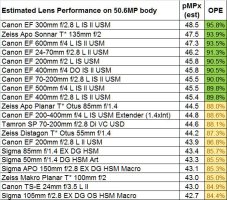
I've been working more deeply with MTF data and this is my work-in-progress table of best resolving lenses for Canon EF mount. You might notice that the Canon 300mm f/2.8 L IS USM (mk-I) is not on my table because is only available second hand. I don't have any lens data on high-res sensors without AA filter so they could deliver sharper results...

OPE is what I call optical pipeline efficiency. It is how much detail can be resolved (perceived megapixels) divided by the maximum resolution of the sensor. I'm interested to see how close my modelling is to the full scale lab measurements when they eventually become available.
 

Attachments

  • OPE.jpg
    OPE.jpg
    156.7 KB · Views: 2,993
Upvote 0
fegari said:
PureClassA said:
But but ... there aren't any lenses, especially by Canon, that will resolve a 50MP sensor!!!! ::)

I had an interesting discussion in a spanish forum on this. Can someone provide some evidence on that?

On my side I would assume that this new FF 50Mpx should put the same kind of "strain" on a lens than the 7DII, because of nearly identical pixel size, and I do get tack sharp pics on a 7DII (with some very high quality lenses)...it does not seem to me limited at all.

They aren't. I was being completely sarcastic as some folks around here are lamenting the "lack" of 50MP capable glass. I wonder if some people have never shot anything more than 18-55mm kit glass...
 
Upvote 0
StudentOfLight said:
I've been working more deeply with MTF data and this is my work-in-progress table of best resolving lenses for Canon EF mount. You might notice that the Canon 300mm f/2.8 L IS USM (mk-I) is not on my table because is only available second hand. I don't have any lens data on high-res sensors without AA filter so they could deliver sharper results...

OPE is what I call optical pipeline efficiency. It is how much detail can be resolved (perceived megapixels) divided by the maximum resolution of the sensor. I'm interested to see how close my modelling is to the full scale lab measurements when they eventually become available.

Ok, I am damn intrigued. How did you come up with such measurements? 24-70mkII outranks the Otus prime?
 
Upvote 0
Mt Spokane Photography said:
I'd expect that the best lens [...] on a existing FF will be the best on a higher MP FF.... f you like your existing lens, it will be capable of sharper images with a higher MP body.


Exactly. I'm sure Canon (or Nikon or...) would like everyone to replace all their lenses when they buy the new 50MP cameras, just as Nikon seemed to want everyone to do when they bought their first D800, but this is just marketing nonsense, isn't it? I currently have FF bodies with 12MP (Sony) 20MP (Canon) and 36MP (Sony) and lenses ranging from old manual focus, through several Canon Ls to the two Sony/Zeiss e-mount primes; all of them make sharper, more detailed images on the 36MP sensor than they do on the 20 or 12 (which isn't to say the difference is immediately obvious); and I've not seen any reason to suspect that 50MP will be any different (the resolution difference between 36 and 50 is 18%, if Thom Hogan is correct - should that matter?). That's not to say, of course, that even better lenses with greater sharpness, better corners, fewer aberrations, etc., won't make even better images, but it's surely not the case that putting, say, an 85mm 1.8 on one of the new bodies is a waste of its sensor. But I guess we'll find out for sure soon enough....
 
Upvote 0
Raptor3x, that zoom was EF 200-400not 24-70.
It would seem that long telephotos enjoy an advantage here. Narrow field of view equals less refraction needed.
Interesting that the Apo-Sonnar beats out the Oti - does focal length enter into your calculations?
Still, this is a fine list of lenses. I wonder how the Sigma Art 35 fares (just fine, I imagine).
 
Upvote 0
PureClassA said:
StudentOfLight said:
I've been working more deeply with MTF data and this is my work-in-progress table of best resolving lenses for Canon EF mount. You might notice that the Canon 300mm f/2.8 L IS USM (mk-I) is not on my table because is only available second hand. I don't have any lens data on high-res sensors without AA filter so they could deliver sharper results...

OPE is what I call optical pipeline efficiency. It is how much detail can be resolved (perceived megapixels) divided by the maximum resolution of the sensor. I'm interested to see how close my modelling is to the full scale lab measurements when they eventually become available.

Ok, I am damn intrigued. How did you come up with such measurements? 24-70mkII outranks the Otus prime?
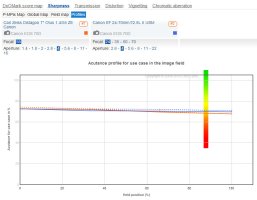
What I posted are not measurements, they are calculated estimates. All my estimates are based on each individual lens' peak detail resolving performance at a particular focal length and aperture combination. For the 24-70mm f/2.8L II USM the optimum resolving performance is achieved at 24mm f/4. For the Zeiss Otus 55mm it is at 55mm f/4. Here is a screenshot of one dataset from DxOmark. (attached)

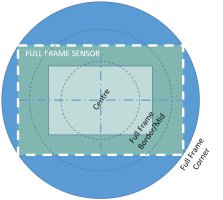
The sharpness of the Otus dips below the 24-70mm towards the corner of APS-C. (The APS-C corner is about 60% of the distance from centre to the full frame corner.) With some circle geometry you will see that the APS-C corner region generates a very significant portion of the resolving area on a full frame sensor. (attached)

Anyway, this is purely a paper exercise, what really counts is what people do in the real world. I'm sure sample variation, field curvature, chromatic aberration and some other factors can all affect the accuracy of the estimates. I'd happily agree that there are some outliers in the table but this is still a work in progress. With more data I'll be able to refine my model and hopefully correct for sample variation.

While the Otus lenses are remarkable in terms of their optimum sharpness, what is more impressive is how good they are (corner to corner) when shooting wide open.
 

Attachments

  • CompDxO-55mm-f1.4_ 24-70mm-2.8L-II.jpg
    CompDxO-55mm-f1.4_ 24-70mm-2.8L-II.jpg
    69.7 KB · Views: 187
  • Regions.jpg
    Regions.jpg
    57.8 KB · Views: 229
Upvote 0
NancyP said:
Raptor3x, that zoom was EF 200-400not 24-70.
It would seem that long telephotos enjoy an advantage here. Narrow field of view equals less refraction needed.
Interesting that the Apo-Sonnar beats out the Oti - does focal length enter into your calculations?
Still, this is a fine list of lenses. I wonder how the Sigma Art 35 fares (just fine, I imagine).
The second generation big whites are outstanding, but I guess that's what you could expect at their price point.

The 135 Sonnar T* is a stunning lens corner to corner, it delivers sharper corners than the Otus lenses. The 85 Otus is sharper than anything in the centre, but the centre portion does not contribute much pMPX to the overall resolution of the sensor.

I posted the top 20 performers for which I have some form of data. The 35 Art is just slightly further down the list. I calculated it at about 42.0 pMPx. Not shabby at all ;)
 
Upvote 0
Thanks for the charts.

I can attest to the the 300 / 2.8 being beyond sharp; while I use it mostly for sports, I have used it on some clear day landscapes with surprising detail - I rented an A7R + EF metabones last year and could paint individual leaves a couple hundred yards away at 36 MP. Along with the 70-200, ZE 100/2, ZE 50 / 2 and TS-E 24 I should have a good match with the 5DS.

I did notice that only one wide, the TS-E 24, falls on the resolution chart. I know the Sigma 35, technically a wide, is not too far off. Seems like we have some catching up to do on wides.
 
Upvote 0
takesome1 said:
Owning the 500mm L II, looking at how many lenses in the list are higher than it is, it is obvious that the rating system is flawed.

Flawed to the point that it is ridiculous.

It's 18MP+ like everything else. 80-90% resolve on the 5D3... The differences between 1-20 all within 10% or so. Even the Second list it's in the top 10. Thats...pretty damn good for a telephoto length like that. What's the matter??
 
Upvote 0
PureClassA said:
takesome1 said:
Owning the 500mm L II, looking at how many lenses in the list are higher than it is, it is obvious that the rating system is flawed.

Flawed to the point that it is ridiculous.

It's 18MP+ like everything else. 80-90% resolve on the 5D3... The differences between 1-20 all within 10% or so. Even the Second list it's in the top 10. Thats...pretty damn good for a telephoto length like that. What's the matter??

I own or have owned many of the lenses that are higher on the list. Again it's ridiculous.

What's the matter? Obviously at some point the data or tests used to arrive at the results are flawed. Or the data and tests were proper and the manner that the conclusion was drawn is flawed. You can decide which.
 
Upvote 0