C-Log Coming to EOS 5D Mark IV Confirmed [CR3]

Canon Rumors

Who Dey
Canon Rumors Premium
Jul 20, 2010
12,628
5,441
279,596
Canada
www.canonrumors.com
HTML:
Yesterday we reported we were pretty sure that the Canon EOS 5D Mark IV would get C-Log via a <del>firmware update</del> (<a href="http://www.canonrumors.com/c-log-update-to-canon-eos-5d-mark-iv-not-just-a-firmware-update/">service center update</a>) that will likely be announced at NAB next month. We can now confirm that to a certainty that it’s coming. However, we do not have a release date for the firmware.</p>
<p>We’re now asking sources if the Canon EOS-1D X Mark II will see a similar firmware update, we’ll report back on that as soon as we’re able to.</p>
<p>There has been another suggestion that Canon has been actively looking at ways to “improve” the 4K video capture crop on the EOS 5D Mark IV. We cannot confirm at this time if we’re going to see that in a firmware update.</p>
<p><em>More to come…</em></p>
<span id="pty_trigger"></span>
 
Adding C-Log, changing up the codec to not be MJPEG, and even getting the crop to 1.6x for 4k would actually be a pretty solid combo for the firmware upgrade.

Itd make it a lot more competitive with the GH5 and Sony A7 series, while also having the benefit of being a much better photo system.
 
Upvote 0
preppyak said:
Adding C-Log, changing up the codec to not be MJPEG, and even getting the crop to 1.6x for 4k would actually be a pretty solid combo for the firmware upgrade.

Itd make it a lot more competitive with the GH5 and Sony A7 series, while also having the benefit of being a much better photo system.

Couldn't of said it better myself. ;)
 
Upvote 0
This is looking like a tacit acknowledgement by Canon that they badly miscalculated on a few points with the otherwise excellent 5D MkIV which I now own and love for my stills work. When you look at the brilliantly executed Panasonic GH5 and the rapid evolution that gave rise to the GH4 then GH5, you see a company who is listening hard to intelligent user feedback and delivering in spades. C-Log will be very welcome, and if a firmware workaround for the ridiculous x1.7 crop in 4K mode, and a codec choice that delivered smaller 4K files (look to Panasonic here...) you'd see a lot of relieved Canon consumers.

As an aside, I have a GH4 and was stunned to find out very early on that 60 seconds of 4K on the GH4 took up roughly the same amount of storage as 60 seconds of 1080p on my 5D MkIII.

-pw
 
Upvote 0
preppyak said:
Adding C-Log, changing up the codec to not be MJPEG, and even getting the crop to 1.6x for 4k would actually be a pretty solid combo for the firmware upgrade.

A 1.6x crop wouldn't really make much sense as the whole point with the 1.7x crop is to read exactly a 4096x2160 center area of the sensor so there's no need to downsample. Besides, the crop basically already is 1.6x if you consider horizontal resolution only (remember, different aspect ratios!)
 
Upvote 0
pwp said:
As an aside, I have a GH4 and was stunned to find out very early on that 60 seconds of 4K on the GH4 took up roughly the same amount of storage as 60 seconds of 1080p on my 5D MkIII.

Well, one can always compress to whatever bitrate one wants... 4K resolution is pretty useless if the bitrate is close to 1080p.
 
Upvote 0
This is a step in the right direction but Canon do seem to have their heads buried in the sand when it comes to dslr video. Their dslrs are badly missing, amongst a number of things, focus peaking and better dynamic range. Not wanting to harm sales of their cine cameras is resulting in people jumping ship to Sony and Panasonic. There are plenty of dedicated filmmakers who aren't in the market for a cine camera due, for example, to the high cost and/or physical size. I believe there is room for both decent stills and video dslrs (perhaps a dedicated video dslr in the 5DIV price range - 5D C??) from Canon, if they want it.
 
Upvote 0
preppyak said:
Adding C-Log, changing up the codec to not be MJPEG, and even getting the crop to 1.6x for 4k would actually be a pretty solid combo for the firmware upgrade.

Itd make it a lot more competitive with the GH5 and Sony A7 series, while also having the benefit of being a much better photo system.

Also they would have to do something about the frame rate. If they can get the frame up to something that would let me shoot decent slow mo while retaining quality, plus all the things you mentioned, I might start having second thoughts about the GH5. I doubt that's going to happen so I will most likely still end up getting the GH5.
 
Upvote 0
wsmith96 said:
For those of us not educated in video related features, what is C-Log and what does it do for you?
I hope someone else more competent than me answers this one, but here goes:
Ever tried editing JPEG's, especially pushing and pulling highlights and shadows? They break down incredibly fast. That's because they are compressed and don't have enough data in them to handle that kind of manipulation.
Same with compressed video. One solution is to shoot RAW video, as RED cameras do. That comes with astronomically large files. The other solution is to use more of the data in your compressed file in the areas you know you'll want to push and pull (i.e.: the shadows and highlights) and less of the data where you won't need to do such manipulations. So basically you get the ability to apply some edits without compromising file size. If I understand they call it a Log because of the mathematic formula they use to assign data to the tonal range there's C-Log, S-Log, (Sony) and others.
One downside is that the footage is rather greyed-out right out of the box and will require grading to become useable. (same goes with raw footage incidentally)
 
Upvote 0
IglooEater said:
wsmith96 said:
For those of us not educated in video related features, what is C-Log and what does it do for you?
I hope someone else more competent than me answers this one, but here goes:
Ever tried editing JPEG's, especially pushing and pulling highlights and shadows? They break down incredibly fast. That's because they are compressed and don't have enough data in them to handle that kind of manipulation.
Same with compressed video. One solution is to shoot RAW video, as RED cameras do. That comes with astronomically large files. The other solution is to use more of the data in your compressed file in the areas you know you'll want to push and pull (i.e.: the shadows and highlights) and less of the data where you won't need to do such manipulations. So basically you get the ability to apply some edits without compromising file size. If I understand they call it a Log because of the mathematic formula they use to assign data to the tonal range there's C-Log, S-Log, (Sony) and others.
One downside is that the footage is rather greyed-out right out of the box and will require grading to become useable. (same goes with raw footage incidentally)

Got it - Thanks!
 
Upvote 0
Sharlin said:
Well, one can always compress to whatever bitrate one wants... 4K resolution is pretty useless if the bitrate is close to 1080p.
Actually, Canon's problem isnt bit-rate. Its a bad codec. To get the results Panasonic gets at 100mb/s, they need to use 500mb/s. Its a choice, not a necessity.

I get why Canon didnt use the codec from their C-line of cameras; but those are capable of 4:2:2 in both 50 and 100mb/s. And they could have easily done a similar codec as Panasonic/Sony, or even done their own h265 thing to keep file size down
 
Upvote 0
preppyak said:
Sharlin said:
Well, one can always compress to whatever bitrate one wants... 4K resolution is pretty useless if the bitrate is close to 1080p.
Actually, Canon's problem isnt bit-rate. Its a bad codec. To get the results Panasonic gets at 100mb/s, they need to use 500mb/s. Its a choice, not a necessity.

I get why Canon didnt use the codec from their C-line of cameras; but those are capable of 4:2:2 in both 50 and 100mb/s. And they could have easily done a similar codec as Panasonic/Sony, or even done their own h265 thing to keep file size down

MJPEG is not that bad. It offers great quality and you can always take a still from it. Plus it's very easy on the CPU. Assuming C-log is coming (i.e. some post processing / grading / transcoding will be likely involved), I would probably pick MJPEG over anything else (but not RAW of course ;) ).
 
Upvote 0
preppyak said:
Sharlin said:
Well, one can always compress to whatever bitrate one wants... 4K resolution is pretty useless if the bitrate is close to 1080p.
Actually, Canon's problem isnt bit-rate. Its a bad codec. To get the results Panasonic gets at 100mb/s, they need to use 500mb/s. Its a choice, not a necessity.

I get why Canon didnt use the codec from their C-line of cameras; but those are capable of 4:2:2 in both 50 and 100mb/s. And they could have easily done a similar codec as Panasonic/Sony, or even done their own h265 thing to keep file size down

As far as I'm aware, Samsung NX1 is the only large sensor 4k DSLR that successfully uses H.265 without any overheating issues. The GH5 might change that, but it doesn't look like it uses H.265 as the primary codec. Even Sony struggles to produce a 4k image in their cameras using h.264 without overheating.

To have H.265 encoding, it will require a massive hardware architecture redesign, it's the reason other companies are switching to smartphone processors and encoders. At the current time, it's easier to implement motion jpeg since the camera is already designed to process raw into jpeg. Personally, I'm holding on to my 5D Mark III with ML RAW and for photos and using the Panasonic GH4(and soon the 5) until Canon can catch up.
 
Upvote 0
Almost impossible to believe this will hit the 5D4 before the 1DXII. If they miss out I'd be pretty p!ssed my expensive flagship plays second fiddle.

Both models need to offer a non-mjpg format at lower bit rate in UHD ratehr Cine 4K resolution. A 200Mb/s 3840 x 2160, mp4 say would be a nice addition if you aren't focused on stills extraction.
 
Upvote 0
wsmith96 said:
IglooEater said:
wsmith96 said:
For those of us not educated in video related features, what is C-Log and what does it do for you?
I hope someone else more competent than me answers this one, but here goes:
Ever tried editing JPEG's, especially pushing and pulling highlights and shadows? They break down incredibly fast. That's because they are compressed and don't have enough data in them to handle that kind of manipulation.
Same with compressed video. One solution is to shoot RAW video, as RED cameras do. That comes with astronomically large files. The other solution is to use more of the data in your compressed file in the areas you know you'll want to push and pull (i.e.: the shadows and highlights) and less of the data where you won't need to do such manipulations. So basically you get the ability to apply some edits without compromising file size. If I understand they call it a Log because of the mathematic formula they use to assign data to the tonal range there's C-Log, S-Log, (Sony) and others.
One downside is that the footage is rather greyed-out right out of the box and will require grading to become useable. (same goes with raw footage incidentally)

Got it - Thanks!

That's kinda it :-) -- Most video video camera encode their data using a "linear" form that does a couple of things, it assigns many more code values to the tones above middle grey than those below middle grey (the quantity of encoding values, in theory, gradations, increases in the same way light does, doubling with each stop as exposure increases. So the darkest shadows have only a few possible gradations whereas the lightest "in gamut" highlights have hundreds or thousands of shades depending on bit depth(again, in theory). Typical linear encoding also ads a curve with the specific goal of creating 6-7 stops of consistent contrast in the middle of the tonal range, compressing those tones above and below that middle range. The purpose for this scheme it to make the footage look right on a typical Rec.709 display. (6-7 stops of range is also about what is possible to print on the high quality photo papers as well).

Log Gammas, in general, assign "relatively" equal amounts of code values to each stop in the available dynamic range of a captured image, and in the process, greatly expand the middle "straight line" portion (that 6-7 stops mentioned above) to 11, 12, 13 stops and more.. This produces an image that is extremely flat, without the "normal" contrast we are used to seeing in a standard linear gamma. The benefit to this type of gamma, especially in 10 or 12 bit versions, is that we have much more flexibility in the shadows and highlights (at the expense of some gradations in the middle of the curve). C-log was designed for 8-bit cameras, and so it fudges its log by slightly compressing and lifting the shadows to allow for a greater highlight range. It's very easy to grade, even without a LUT and actually looks pretty good untouched.

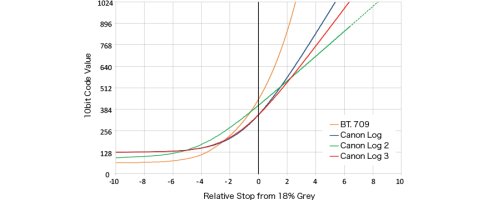
It's of course a little more complicated than all that, but here's a graph showing the code value distribution of various Canon Log gammas. Note C-Log2, which is a more traditional cineon style Log curve, and its long flat shape -- which displays the essence of what a log gamma is, versus the original C-Log, with its compressed, lifted shadows, and more sloped strait line portion, compared to the Rec.709 curve that the current 5dmark IV outputs.
 

Attachments

  • log3-graph.jpg
    log3-graph.jpg
    67.7 KB · Views: 231
Upvote 0