U
Unstill
Guest
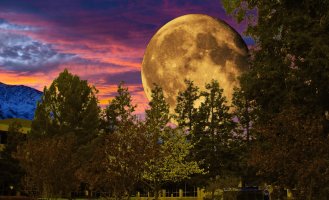
This is most definitely a composite.
1) Look at the shadow on the moon. It is off to the right side in respect to the horizon, physically impossible. When the moon rises or sets, depending on the phase, it leads or trails with the shadow toward the horizon, never exactly perpendicular, as it is in this image. When the moon reaches higher points in the sky, the shadow appears perpendicular to the horizon, due to the travel along the elliptical. If this were the actual position of the moon in the sky, and NOT a composite, the shadow would be more parallel to the horizon.
2) A super long lens was used to capture the image of the moon by itself. This can't be disputed. The background sky image was captured with a much wider angle lens, because you can see the haze at the horizon and it only takes up a small portion of the image. The long lens required to capture the moon would have compressed the haze in the sky, making it appear larger in the image. (Also, you can see differing levels of haze densities in the purple, clouds, pollution, etc, why is the moon IN FRONT OF IT? Why doesn't some of this haze occlude part of the moon?)
3) The moon is nearly full, and he claims this was taken at 6:50p, so the sun would be setting almost directly opposite of it in the sky. The moon is on the eastern horizon, the sun would be on the west. Why does it look like the sun just set in the sky right where the moon is sitting? This also supports point #1.
4) I concur with whomever mentioned 'sunny 16'. Sorry I don't recall who it was, but you're correct. At this small aperture to capture detail in the moon, even at super high ISO, it would take several seconds AT LEAST to expose all those stars, regardless of how clear a sky you have. With this long lens on the moon, several seconds would cause the moon to blur because of its orbital motion.
I've spent many a lonely, cold night trying to capture something like this and it just doesn't happen like this.
Kudos to Peter Lik for causing such a stir. Unfortunately for him, it's NOT because he's the 'Master Photographer' he claims, but a Mediocre Photoshopper at best.
Thanks for the thought-provoking post!
1) Look at the shadow on the moon. It is off to the right side in respect to the horizon, physically impossible. When the moon rises or sets, depending on the phase, it leads or trails with the shadow toward the horizon, never exactly perpendicular, as it is in this image. When the moon reaches higher points in the sky, the shadow appears perpendicular to the horizon, due to the travel along the elliptical. If this were the actual position of the moon in the sky, and NOT a composite, the shadow would be more parallel to the horizon.
2) A super long lens was used to capture the image of the moon by itself. This can't be disputed. The background sky image was captured with a much wider angle lens, because you can see the haze at the horizon and it only takes up a small portion of the image. The long lens required to capture the moon would have compressed the haze in the sky, making it appear larger in the image. (Also, you can see differing levels of haze densities in the purple, clouds, pollution, etc, why is the moon IN FRONT OF IT? Why doesn't some of this haze occlude part of the moon?)
3) The moon is nearly full, and he claims this was taken at 6:50p, so the sun would be setting almost directly opposite of it in the sky. The moon is on the eastern horizon, the sun would be on the west. Why does it look like the sun just set in the sky right where the moon is sitting? This also supports point #1.
4) I concur with whomever mentioned 'sunny 16'. Sorry I don't recall who it was, but you're correct. At this small aperture to capture detail in the moon, even at super high ISO, it would take several seconds AT LEAST to expose all those stars, regardless of how clear a sky you have. With this long lens on the moon, several seconds would cause the moon to blur because of its orbital motion.
I've spent many a lonely, cold night trying to capture something like this and it just doesn't happen like this.
Kudos to Peter Lik for causing such a stir. Unfortunately for him, it's NOT because he's the 'Master Photographer' he claims, but a Mediocre Photoshopper at best.
Thanks for the thought-provoking post!
Upvote
0