Canon’s Retro Camera is Coming as the EOS R8 Mark II

Retro is all about nostalgia.

Let's take a moment to think about what Canon's executives might wax nostalgic about?

How about a time when they had the best selling mirrorless camera system in the world?
You know, the EOS M line of cameras and EF-M lenses?

What if a "retro" R8 Mark II camera looks and feels like an EOS M camera, only it's full frame?

What if the primary lenses intended for such a camera are the uniformly sized RF VCM series, all with 67mm filter diameters and virtually identical dimensions? This would be similar to the entire EF-M line which had a near identical diameter of 61mm?
 
Upvote 0
Interestingly enough, the EOS RP and EOS R8 use the same Canon battery grip, for what that is worth.
I believe you mean the Canon EG-E1 extension grip that is compatible with both. It does not have a battery, and as @EOS 4 Life points out, Canon does not make a battery grip for the RP / R8.

I use the RRS modular L-bracket for the RP on my R8, it’s a perfect fit.
 
Upvote 0
There are lots of those out there. I recommend URTH. I think I have all of their RF mount adapters. The C/Y, FD, M39 and Leica M adapters get a lot of use. I have started to buy some K mount lenses too.
Late addition: there are even RF/LTM (Leica Thread Mount, "M39") adapters available, I have a very solid one made by Novoflex. It's a lot of fun to adapt such really vintage lenses to an EOS R camera...
 
Upvote 0
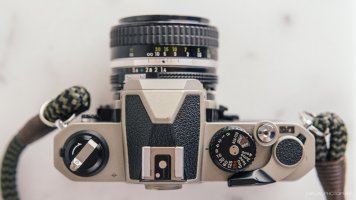
I am a bit late here, but I always have to laugh about Nikon's approach to "retro F" digital cameras. Here is the original top plate of an FM-2, a camera I used extensively before I went digital and switched to Canon:
FM-2.jpg

This I call a clean, functional classic camera design, here you have all you need for (stills) photography, that's it, the camera supports everyone who wants to frame and shoot in a flow w/o any disturbance caused by bad design.

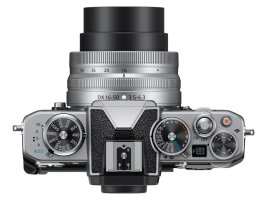
And what did Nikon with their digital retro F digital thingy bodies? Here for comparison the top plate of a Nikon zfc:
ZF thingy.jpg
WOT a MESS! Obviously, this monster is designed for naive young nerds who think that classic camera design equals a lot of wheel & button bells & whistles to get the mystic process of taking an image done. Such a chaotic design reminds me of extremely pimped vintage cars like this one:
Pimped car.jpg
I am pretty happy to read that Canon seemingly takes photography too seriously to throw such a nonsense into the market.
 
  • Haha
Reactions: 1 user
Upvote 0
Earlier today I purchased a couple of things at my local camera shop and I asked the manager about retro digital cameras like the Nikon retro series. He made the comment that if we sell two a month we are lucky. IMO that does not seem to be a very large market coming from a major retailer in the Northeastern United States.
 
Upvote 0
I was thinking of much more than a passive ‘extension tube’ FD to RF lens adapter.

It’s all predicated on the RF lens/body electrical contact interfaces and their capabilities, which I have no knowledge of. My thoughts might not be possible to implement.

The Canon FD lens mount has 4 mechanical interfaces when mounted to a compatible camera body:

  • A cylindrical ‘boss’ pin which indicates the lens’ maximum aperture and compensates for the small difference between a f-stop and T-stop.
  • A ‘tab’ lever which moves in a semi-circular ‘race’ which follows the lens’ aperture selection ring. This moves a small ‘circle’ in the camera viewfinder for ‘match needle’ light metering. (On old mechanical FD lens cameras.) This tab lever could be coupled to a mechanical encoder followed by an analog-to-digital converter to transmit the lens’ aperture setting back to the camera.
  • A very small pin which pops up when the lens’ aperture ring is moved past its minimum (smallest) setting by depressing a button on the ring to either a green circle (old) or green ‘A’ (new) index. This was used on the ‘electronic’ FD mount cameras (AE-1 etc.) to allow shutter-priority Automatic Exposure. More on this in (4)
  • A much larger tab lever which stops the lens down to its selected aperture when the camera shutter button is pressed. This allows both focusing and light metering with the lens wide open (how quaint!) An electromechanical solenoid could be incorporated into the FD/RF adapter to provide the same function. For shutter priority AE, the position of the stop down lever at shutter release needs to follow what the camera decides is the correct exposure aperture.
If all these features can be incorporated into a ‘smart’ FD to RF lens adapter, that would make a world of difference when using existing vintage Canon FD lenses.

Lens correction profiles for vintage Canon FD lenses – a whole different topic!!!
I've still got my FD lenses. And an Ed Mika adapter, but unfortunately the 600 never did focus to infinity (on EOS) even going past the infinity mark as far as it could. Still , the FD600 came with special CA colouring. Some pix took ages to upgrade in software! Though that's not needed with EF glass, fortunately. BUt I've wondered if the R7II emerges I might buy that and the FD-RF adapter, just because.
 
Upvote 0