art_d said:
Yes, but don’t you think it would seem a little unprofessional to deliver a disc full of images to a client and then single out one image and tell them “Oh, by the way, image #XXXX might look a little crappy on your monitior but it will be fine as long as you don’t print it bigger than 8x10….”?
Well, now you're talking not about delivering prints, but about delivering images the client expects to pixel peep. In effect, your client is asking you for 38" x 57" prints suitable for viewing at a distance of 12". That's something entirely different, and not generally something one expects to deliver from 135 format, regardless of the brand -- even if you can pull it off.
Honestly, I don't have a lot of sympathy. If your client is expecting shove-your-nose-in-it sharp and clean large gallery prints from every shot, you really should be shooting medium format -- and charging enough to pay for the gear and processing and time and what-not. That would also solve your dynamic range "problems," too.
More likely, you're not properly managing your clients's expectations properly and overselling what is reasonable to offer.
If you're successful at making Mercedes-quality products with Yugo-quality tooling, all the more power to you. But that's generally not how it's done, except perhaps when you're in the starving startup phase or if you're just an enthusiastic amateur. It's generally an unsustainable business model.
(I'll note: I'm right now in that world, myself. I'm doing some very demanding fine art reproduction, and with very good results. I'm pretty sure I'm getting better results than anybody else doing giclee work in the area, and that includes a major metropolitan area art museum. But the time and money it takes me to do what I do and with how long it's taken me to get where I am...well, if I didn't have a day job to pay for the bills along with this hobby, I'd long since have bankrupted myself.)
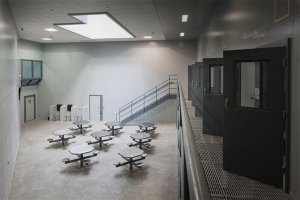
The scene does appear evenly lit to the human eye when you are standing there. That’s because of how our brain interprets things for us when we are looking at something with wide variations in dynamic range. Having stood in that very spot, I will tell you that with 100% certainty no one standing there would see the scene in the way you have presented it (which incidentally is not that far off from the lower of the bracketed exposures).
I do believe that your certainty is rather misplaced.
Every trained visual artist I've met would have seen the scene as it was, with comparatively deep shadows on the catwalk and the tables brightly lit by the skylight. And that's because they've learned to see the world around them as it is.
It's the same skill that permits them to paint (or draw, whatever), for example, a 3/4 portrait without painting both ears. Had an inmate been standing in one of the doorways in 3/4 profile to the camera, you would have "seen" both ears in exactly the same way that you "saw" her well-lit.
An artist can, of course, choose how to render the scene. He might paint the inmate exactly as he saw her, with only one ear visible. He might paint the inmate looking straight out of the frame, with both ears visible. He might emulate Picasso and paint a 3/4 profile but with both ears showing. Similarly, he might render the light as it was with the tables much brighter than the catwalk, or he might render it as you "saw" it, as if you allowed your eyes time to adapt from the one illumination to the other.
It's also my experience that photographers tend to see the light the same way, and draw from their own bags of tricks for how to deal with it. Fix the light? Blend exposures? Filters? Digital fill? Regardless, they see that the one area is light and the other dark, even if they can squint at both and make out all the details and imagine what the final blended and equally-lit scene would look like.
And that's probably the biggest thing I'm missing from your prison shot: a sense that the lighting
isn't equal throughout the whole room. I'd suggest that it's reasonable to lift the shadows to make it easier to see the detail in them -- and, similarly, to tame the highlights. But what you've done is completely equalized the two, giving the sense that the whole room is as well-lit as an art gallery.
Some difference in relative illumination would have been nice, but I'm not getting any.
Cheers,
b&