Canon Announces the Canon RF 14mm f/1.4L VCM

Lenzbuddy has custom front lens caps, from 43 to 95mm, prices from $13 to $ 20, depending on the amount of information you want on the cap.

I’m not commenting on those particular caps, but, I did once buy a replacement from cap on eBay and it turned out to have raised lettering on the inner face of the cap. I didn’t notice at the time but the real caps have indented lettering.

I have a habit of straightening the cap orientation after attaching it, which ended up rubbing the coating off the front lens element. Right in the centre of the lens. I only noticed during a trip to Namibia, where it caused ghosting and flair in my pictures. Cost me £180 to have the front element replaced. I’ve been wary of replacement caps since.
 
Upvote 0
ND is pretty much the only thing one would use in a rear gel holder these days (since color correction and effects are handled in post processing with digital).

I still have most of a sheet of 10-stop, enough to cut out another 3-4 pieces.

View attachment 227905

Canon has a downloadable template to cut the filter for the holder:

Not sure if $125 is ‘huge cost’ for you (it’s similar to a 77mm round filter and you can cut several rear filters from one piece). B&H has several densities in stock (1, 2, 3, 6.6 and 10 stop). Here’s the 10-stop that I have:
They’re not available here in the UK (at least I couldn’t find any). Once I added delivery $20, and taxes, 20%. It got expensive.

I’ve bought some clip in ND filters that will work with any lens. Not the magnetic ones.
 
Upvote 0
I’ve bought some clip in ND filters that will work with any lens. Not the magnetic ones.
I have a set of the Kolari magnetic NDs (3-, 6- and 10-stop) that I use with my R8 (had to install the metal mount plate in it) and the R1 (no plate needed). That's why I have not bothered cutting another piece out of the 10-stop gel filter (I did cut a piece from it for the rear slot of the Ef 11-24/4L).
 
  • Like
Reactions: 1 user
Upvote 0
The size of the entrance pupil of a 35mm at f1.4 is much larger (25mm) than the size of the entrance pupil of a 14mm at f1.4 (10mm). The larger entrance pupil collects more light.

Clarkvision has an explanation with examples.
No it does not. Look at Clarkvision's equation 1: light collection ∝ t * sensor_area / (f_ratio)2
The amount of light collected is proportional to the exposure time, the sensor area, and the inverse of the fstop squared. It is not proportional to the size of the entrance pupil or the focal length. Rather, it is proportional to the exposure settings (fstop, exposure time) as I pointed out in my original post.

Think of it this way. Suppose you point your camera at the stars, and suppose we have an evenly distributed star field. With a 14 mm lens, there are many more stars beaming light at your lens than there are if you had the 35 mm lens mounted. So even though the 14 mm lens has a smaller entrance pupil, it captures the same amount of light as a 35 mm lens with a larger opening does.

Now, we are talking total amount of light. On the other hand, if we have a subject with a limited size (moon, stars) then it does come down to entrance pupil size. With a longer focal length, a larger area of the sensor needs to be illuminated, which requires more light. This is the old pixels-per-duck argument.
For subjects of limited size, Clarkvision has the following equation:

The light collected from an object covering angular area Omega, Ω, e.g. the Moon, a star,a bird in a tree, a person's face, or any other object is

Light Collected = EtST ∝ A * Ω(object) * T * SE (equation 4)

where
EtST = Etendue (Et) times System efficiency (S) times exposure Time (T),
Etendue = A * Ω, also called the A Omega product,
A = lens aperture area (more precisely, the lens entrance pupil area),
A = pi * D2 /4. where D = Lens diameter (entrance pupil diameter),
D = aperture diameter = focal length / f-ratio,
pi = 3.14159,
Ω (Omega) is the solid angle of the object,
T is the exposure time, and
SE= system efficiency = optics transmission * fill factor * quantum efficiency.
So for objects of limited size, the light collected is proportional to the entrance pupil size.
 
Upvote 0
No it does not. Look at Clarkvision's equation 1: light collection ∝ t * sensor_area / (f_ratio)2
The amount of light collected is proportional to the exposure time, the sensor area, and the inverse of the fstop squared. It is not proportional to the size of the entrance pupil or the focal length. Rather, it is proportional to the exposure settings (fstop, exposure time) as I pointed out in my original post.

Think of it this way. Suppose you point your camera at the stars, and suppose we have an evenly distributed star field. With a 14 mm lens, there are many more stars beaming light at your lens than there are if you had the 35 mm lens mounted. So even though the 14 mm lens has a smaller entrance pupil, it captures the same amount of light as a 35 mm lens with a larger opening does.

Now, we are talking total amount of light. On the other hand, if we have a subject with a limited size (moon, stars) then it does come down to entrance pupil size. With a longer focal length, a larger area of the sensor needs to be illuminated, which requires more light. This is the old pixels-per-duck argument.
For subjects of limited size, Clarkvision has the following equation:


So for objects of limited size, the light collected is proportional to the entrance pupil size.
You have not read the complete text, it states “Clearly equation 1 fails”.
 
Upvote 0
No it does not. Look at Clarkvision's equation 1: light collection ∝ t * sensor_area / (f_ratio)2
Did you read the words immediately before that equation?

Another method of calculating light collection advocated by another "internet expert" is…

Clearly, the use of “internet expert” in quotes is a clue to the validity (i.e., lack thereof) of the equation that follows, despite which you dutifully reposted that equation here. Does that mean you’re also an “internet expert”? Hint: it’s not a flattering appellation.
 
  • Like
Reactions: 1 user
Upvote 0
Did you read the words immediately before that equation?


Clearly, the use of “internet expert” in quotes is a clue to the validity (i.e., lack thereof) of the equation that follows, which you dutifully reposted here. Does that mean you’re also an “internet expert”? Hint: it’s not a flattering appellation.
Clark starts with equation 1, says that it falls apart for unevenly lit scenes or subjects of limited size, and then works his way to equation 4 which takes into account subjects of a limited angular size.
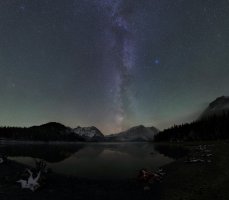
Am I an internet expert? I dunno. I just like to shoot stars every so often. When I do, I shoot a grid and use a stitcher. In my experience, when optimizing control points, the errors get larger with closer subjects, which is due to parallax.

KanUpperLakeStereographic.jpg
 
  • Like
Reactions: 1 users
Upvote 0
Clark starts with equation 1, says that it falls apart for unevenly lit scenes or subjects of limited size, and then works his way to equation 4 which takes into account subjects of a limited angular size.
Fair, but of course starscapes (even fields of stars) are unevenly lit scenes.

I just like to shoot stars every so often.
Excellent shot!
 
Upvote 0
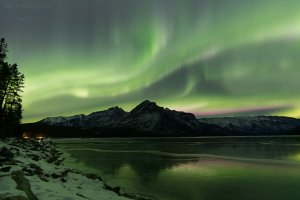
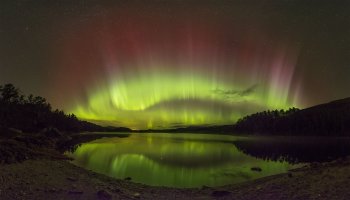
Here is some aurora, which I shot a few weeks ago (Jan 20). I used my 16/2.8, single frame. Would I have liked a 14/1.4? Heck yea. But suppose you already have a 24/1.4, then you can get pretty close by shooting two adjacent frames and stitching. You have to be quick in reframing, though. A friend of mine does this with excellent results. He was shooting beside me that evening and I have seen his composite images. You can't tell they're stitched.

The other bit about stitching is that it's easy to vary the projection (e.g. cylindrical, stereographic). One downside about rectilinear lenses is the area distortion. Sometimes straight lines are not needed.

6305MinnewankaSwirl.jpg
 
Upvote 0