Canon Confirms Development of High Megapixel Camera

Lee Jay said:
StudentOfLight said:
As for your post on why smaller pixels win, how about this: 20MP, at 200mm f/4 which is sharper?
http://www.the-digital-picture.com/Reviews/ISO-12233-Sample-Crops.aspx?Lens=458&Camera=963&Sample=0&FLI=0&API=3&LensComp=458&CameraComp=819&SampleComp=0&FLIComp=0&APIComp=3

I'll remind you of a phrase in your original question: "...for the same sensor area...". Obviously, those images are not from the same sensor area.
I apologize, if I had seen this post earlier then I would have clarified sooner and perhaps we would have avoided talking at cross-purposes. I agree with you that sensors with higher pixel density, create higher resolution files when shot from the same distance, using the same focal length, and we ignore the impact of AA-filters.
 
Upvote 0
photonius said:
Lee Jay said:
vscd said:
There is no problem of pixel size.

<physics>There is. </physics>

Yeah...let's talk about that.

I decided to calculate diffraction-limited resolution. Here are the assumptions: Green light (550nm), Bayer full-frame sensor, AA filter, MTF10 cutoff. Here are the results:

f-stop Maximum MP count
1.4 8,333
2.0 4,167
2.8 2,083
4.0 1,042
5.7 521
8.0 260
11.3 130
16.0 65
22.6 33
32.0 16

So, does that seem like a problem to you for the foreseeable future?


your calculations seem off. For FF at f/4.0 a 115 Mp sensor would be diffraction limit.
see
http://www.luminous-landscape.com/tutorials/resolution.shtml

I don't know where you got that number, but it doesn't appear on that page and the numbers on that page are pretty consistent with my numbers.

For example, for MTF9 (I used MTF10) and 555nm light (I used 550nm light) they get a cycles/mm number of 373 at f/4. They use 2 pixels per cycle (which is bunk) and I used something a little higher (can't remember if it was 2.5 or 3 at the moment). But 373 cycles/mm for a full-frame sensor would equate to 751MP for 2.5 pixels per cycle or 1,082MP for 3 pixels per cycle. I got 1,042MP so I probably used 3 pixels per cycle for the calculations I did above.
 
Upvote 0
raptor3x said:
bdunbar79 said:
Just as a benchmark, that site also claims that sensor size has no real meaningful effect on DOF.

They're correct, the only way sensor size directly affects DOF is due to the relationship between circle of confusion and sensor size.

So then there is some some effect.

We assume a constant viewing/output size. Most DOF calculators assume that and have a set CoC value for each sensor size. Magnification is therefore different and if I'm standing at 15 meters away from a subject and shoot with a 70D with a 100mm lens, at f/3.2, then I have a DOF value. If I merely switch cameras to a 5D3, keep everything else the same, I get a different DOF. The 5D3 requires less magnification to our output size and therefore has a deeper DOF than in the 70D in those conditions. Even at equal subject size, the DOF is different. It might not be the actual sensor doing this but it is certainly an effect and certainly affects DOF.

But that's not the point of this thread and I don't want to go here.

My point is how simplistic that site is. Personally I'd trust Lee Jay's calculations over theirs', but that's just me.
 
Upvote 0
Lee Jay said:
raptor3x said:
bdunbar79 said:
Just as a benchmark, that site also claims that sensor size has no real meaningful effect on DOF.

They're correct, the only way sensor size directly affects DOF is due to the relationship between circle of confusion and sensor size.

Which is a totally legitimate, real, and not-ignorable way.

True...but it's a relatively minor effect, in the opposite direction from and totally overwhelmed by the effect which most people consider (changing distance/focal length, which obviously is not directly an effect of sensor size).
 
Upvote 0
neuroanatomist said:
Lee Jay said:
raptor3x said:
bdunbar79 said:
Just as a benchmark, that site also claims that sensor size has no real meaningful effect on DOF.

They're correct, the only way sensor size directly affects DOF is due to the relationship between circle of confusion and sensor size.

Which is a totally legitimate, real, and not-ignorable way.

True...but it's a relatively minor effect, in the opposite direction from and totally overwhelmed by the effect which most people consider (changing distance/focal length, which obviously is not directly an effect of sensor size).

It's not minor. It's linear with sensor size (smaller sensor = smaller DOF). Changing focal length of subject distance is quadratic in the other direction (longer focal lengths for larger sensors mean smaller DOF) which is why the combined result is linear (inversely proportional, actually) in the opposite direction (larger sensors have smaller DOF) for the same framing. This holds true for DOF<<SD or, equivalently, SD<<HD.
 
Upvote 0
neuroanatomist said:
Lee Jay said:
raptor3x said:
bdunbar79 said:
Just as a benchmark, that site also claims that sensor size has no real meaningful effect on DOF.

They're correct, the only way sensor size directly affects DOF is due to the relationship between circle of confusion and sensor size.

Which is a totally legitimate, real, and not-ignorable way.

True...but it's a relatively minor effect, in the opposite direction from and totally overwhelmed by the effect which most people consider (changing distance/focal length, which obviously is not directly an effect of sensor size).

exactly!

and if we make a FF camera with the exact same pixel pitch as an APS-C camera, what happens to the depth of field? if you take the central 40 percent out of the FF image, it should be absolutely identical to the APS-C image... including DOF..
 
Upvote 0
Don Haines said:
neuroanatomist said:
Lee Jay said:
raptor3x said:
bdunbar79 said:
Just as a benchmark, that site also claims that sensor size has no real meaningful effect on DOF.

They're correct, the only way sensor size directly affects DOF is due to the relationship between circle of confusion and sensor size.

Which is a totally legitimate, real, and not-ignorable way.

True...but it's a relatively minor effect, in the opposite direction from and totally overwhelmed by the effect which most people consider (changing distance/focal length, which obviously is not directly an effect of sensor size).

exactly!

and if we make a FF camera with the exact same pixel pitch as an APS-C camera, what happens to the depth of field?

Nothing.

if you take the central 40 percent out of the FF image, it should be absolutely identical to the APS-C image... including DOF..

True, but then it isn't a full-frame image.
 
Upvote 0
photonius said:
Lee Jay said:
vscd said:
There is no problem of pixel size.

<physics>There is. </physics>

Yeah...let's talk about that.

I decided to calculate diffraction-limited resolution. Here are the assumptions: Green light (550nm), Bayer full-frame sensor, AA filter, MTF10 cutoff. Here are the results:

f-stop Maximum MP count
1.4 8,333
2.0 4,167
2.8 2,083
4.0 1,042
5.7 521
8.0 260
11.3 130
16.0 65
22.6 33
32.0 16

So, does that seem like a problem to you for the foreseeable future?


your calculations seem off. For FF at f/4.0 a 115 Mp sensor would be diffraction limit.
see
http://www.luminous-landscape.com/tutorials/resolution.shtml


He is probably using Rayleigh (MTF9) rather than MTF50. At Rayleigh you can resolve more detail, but it is at ultra low contrast, so fine differences in detail require intense scritinization to detect with the human eye. Personally I prefer using MTF50, as that's the standard contrast level for the very, very vast majority of photographic systems testing, and has been for years.


That said, neither case is wrong...so long as your clear about what MTF contrast level your basing your numbers on. In Lee Jays's numbers, it's all MTF9 (or maybe MTF0, sometimes he uses that as well...although that is entirely irrelevant for regular daytime photography, the only time it really applies is when analyzing multiple star diffraction patterns at excessively high magnification). In your case, I'm guessing it's MTF50.
 
Upvote 0
jrista said:
photonius said:
Lee Jay said:
vscd said:
There is no problem of pixel size.

<physics>There is. </physics>

Yeah...let's talk about that.

I decided to calculate diffraction-limited resolution. Here are the assumptions: Green light (550nm), Bayer full-frame sensor, AA filter, MTF10 cutoff. Here are the results:

f-stop Maximum MP count
1.4 8,333
2.0 4,167
2.8 2,083
4.0 1,042
5.7 521
8.0 260
11.3 130
16.0 65
22.6 33
32.0 16

So, does that seem like a problem to you for the foreseeable future?


your calculations seem off. For FF at f/4.0 a 115 Mp sensor would be diffraction limit.
see
http://www.luminous-landscape.com/tutorials/resolution.shtml


He is probably using Rayleigh (MTF9) rather than MTF50. At Rayleigh you can resolve more detail, but it is at ultra low contrast, so fine differences in detail require intense scritinization to detect with the human eye. Personally I prefer using MTF50, as that's the standard contrast level for the very, very vast majority of photographic systems testing, and has been for years.


That said, neither case is wrong...so long as your clear about what MTF contrast level your basing your numbers on. In Lee Jays's numbers, it's all MTF9 (or maybe MTF0, sometimes he uses that as well...although that is entirely irrelevant for regular daytime photography, the only time it really applies is when analyzing multiple star diffraction patterns at excessively high magnification). In your case, I'm guessing it's MTF50.

You know, my assumptions were all up there.
 
Upvote 0
Looks like I'm the only one who's looking forward to a high MP 5DM4. Add in GPS and the 7DM2's focus and I'm sold. Canon needs to respond to the competition. So many Canon users have defected to Sony and Fujitsu because Canon is no longer meeting their needs.
 
Upvote 0
Lee Jay said:
raptor3x said:
bdunbar79 said:
Just as a benchmark, that site also claims that sensor size has no real meaningful effect on DOF.

They're correct, the only way sensor size directly affects DOF is due to the relationship between circle of confusion and sensor size.

Which is a totally legitimate, real, and not-ignorable way.

Agreed, and the article in question spends several paragraphs talking about this. The other poster implied either that LL didn't understand the effect of CoC on DOF or that there was some other factor that directly related sensor size to DOF.
 
Upvote 0
"Northlight has been told that the high resolution camera coming from Canon will be based on the 4.2 micron pixel design of the Canon EOS 7D Mark II"

I sure hope not, since that means it won't touch Exmor. And if Canon has struggles to get 8 year old tech at that res at decent yield at FF that's really pretty discouraging.

Hopefully this is just more nonsense rumors.

Although the talk from Canon about how there is the high ISO camp and then there is the high MP camp sounds discouraging on all fronts. Not a peep about DR either.
 
Upvote 0
neuroanatomist said:
LetTheRightLensIn said:
And yet wildlife guys sure seem to love the high density sensors.

Do they? Are 'wildlife guys' flocking to the D800/810 or a7R? Not that I've seen. But I do see a lot of crop bodies used by 'wildlife guys'. Now...is that because of the higher pixel density, or is it because of the real crop factor advantage – lower cost? I suspect the latter, even if not everyone is willing to admit it.

Yeah they do. Lots use 7D/7D2 type high density APS-C cams or used the 1D4 (the highest density larger frame cam at the time).

I never said they were flocking to the A7R for wildlife. That has some feebleness as a general use camera.

The D810 is quite nice in that you can get your awesome landscape camera AND a very nice wildlife camera all in one without having to drag along a second body. I don't know that strict wildlife shooters are dumping off high density APS-C cams or 1D4 for it, but the extra reach is surely being appreciated by those buying into a new general camera and maybe even by those getting a first wildlife cam.

Sure aps-c gets you more reach for less money. There is nothing wrong with that. Why it is so high and mighty to shoot with an 800mm lens instead? PLUS, it also can mean weight savings and if you can get away with a smaller super-tele that can be a heck of a bonus so many consider it a flat out plus never mind the cost. Plus, there are many times when even 800mm is that much reach, so the density can often be a flat out plus even never mind the cost.
 
Upvote 0
jrista said:
neuroanatomist said:
LetTheRightLensIn said:
And yet wildlife guys sure seem to love the high density sensors.

Do they? Are 'wildlife guys' flocking to the D800/810 or a7R? Not that I've seen. But I do see a lot of crop bodies used by 'wildlife guys'. Now...is that because of the higher pixel density, or is it because of the real crop factor advantage – lower cost? I suspect the latter, even if not everyone is willing to admit it.


Quite a few birders now use the D810 for it's higher resolution and "crop mode" option with higher frame rate. The results are pretty amazing, especially with dark birds with white highlights, like Loons, against brighter backgrounds.

yes
 
Upvote 0
cmh716 said:
Looks like I'm the only one who's looking forward to a high MP 5DM4. Add in GPS and the 7DM2's focus and I'm sold. Canon needs to respond to the competition. So many Canon users have defected to Sony and Fujitsu because Canon is no longer meeting their needs.

Is hard to please everyone with a single body, and I also question the numbers who are switching to other brands. Forums are rarely a good indicator of what the average buyer is or is not doing. People complain loudkly in forums and yet Canon sales remain good. Just as CMH desires a high MP FF sensor, I am quite the opposite. The last thing I want is a crop sensor appearance to my FF files. I am perfectly happy with Canon making a 52+ MP FF camera body for those who desire it. But if this becomes the 5 series I won't be buying another 5 series body in near future and may have to save and consider a 1 Series.

The 5D3 was an all around good for a lot of things body while perhaps not specializing in any one thing. It has a maximum frame rate of 6 fps (cuts down to about 4 fps as battery weakens) and a very good AF. Its 22 MP has never shorted me when doing landscapes and printing fairly large though I never go beyond 20 x 30 inches. It has sufficient frame rate that it is acceptable shooting action (birds and running dogs). File sizes in RAW are about 30 MB, large but acceptable, and computer processing time is fine.

A 52 MP FF sensor would turn into what, another 2.5 fps camera body? Maybe 3.5 fps? Why not just use the old 7D AF system with improved sensitivity because such a camera would be totally unsuitable for action. Noise would be very visible when viewed at any decent % viewing on screen and when a bird is cropped out of the center of the photo high ISO noise would also be more visible on screen. I would just as soon have a medium format camera if I wanted to do 50+ MP landscapes where high ISO is not a concern or frames per second.

All this just shows that different people have different wants and to produce any camera body to please the masses is impossible. I hope this body does come out for those desiring it. I also pray it is NOT a 5D MkIV. I really do not want to pay $6800 for a body but going forward I may not have other good options. The 5D3 is really a great all around camera body and is a good little brother to the 1d-X. My 3 pennies worth!
 
Upvote 0
neuroanatomist said:
Lee Jay said:
The question is whether dividing the same sensor area into lots of smaller pixels or a smaller number of larger pixels will result in better resolution. Some people above erroneously claim that there will be little or no difference for various reasons (technique, lens sharpness, whatever). So, that one is about the same focal length and subject distance just with a different number of pixels (see the title of the thread).

There will be more pixels on the subject. Whether those additional pixels result in significant additional measurable spatial resolution depends on many factors. Practically speaking, the increased resolution generally falls well short of what one would extrapolate from the difference in pixel size, in many cases so far short as to result in no significant gain from the smaller pixels (in other words, the gain is small enough to not be readily observable in everyday shooting/viewing).

The extra reach from the 7D (top and bottom) seems pretty clear to me over the 5D2 and 5D3 (middle) no?

https://farm8.staticflickr.com/7502/15529699533_ca4db67669_o.jpg

So much for all of the talk by a few that the extra reach is just a myth.

Also note I say this as someone who no longer even owns the APS-C camera so it's not like I'm defending what I own. At times I do miss my APS-C and I will readily admit it. But it was too much money for me at the moment to carry a 5D3 plus an APS-C. That is something a bit cool about the D810 type cameras, you get your FF (and at top most quality) and then you can go into a crop mode and get a decent reach (if a bit shy of top aps-c) and decent fps all in one body. The 5D2 was sort of like that a bit when it first came out since the aps-c were topped by the 40D then which only had a bit more reach and bit more speed.
 
Upvote 0
LetTheRightLensIn said:
jrista said:
neuroanatomist said:
LetTheRightLensIn said:
And yet wildlife guys sure seem to love the high density sensors.

Do they? Are 'wildlife guys' flocking to the D800/810 or a7R? Not that I've seen. But I do see a lot of crop bodies used by 'wildlife guys'. Now...is that because of the higher pixel density, or is it because of the real crop factor advantage – lower cost? I suspect the latter, even if not everyone is willing to admit it.
\

When I rented a D800 and 5D3 to decide which to buy, I specifically hated the smaller pixels of the D800 when cropping. The larger 5D3 pixels do VERY well when cropping a bird and the resulting picture had a better sense of depth to each feather. To my eyes smaller pixels do not do nearly as well when cropping and with birds you often have to crop significantly.

At the time I rented I was all caught up in forum hype about how Canon was sucking and Nikon's D800 was a wonder. D800 was a good body but the 5D3 simply sang to me quickly and thus I bought it and pray the larger pixels do not go away anytime soon.


Quite a few birders now use the D810 for it's higher resolution and "crop mode" option with higher frame rate. The results are pretty amazing, especially with dark birds with white highlights, like Loons, against brighter backgrounds.

yes
 
Upvote 0
LetTheRightLensIn said:
"Northlight has been told that the high resolution camera coming from Canon will be based on the 4.2 micron pixel design of the Canon EOS 7D Mark II"

I sure hope not, since that means it won't touch Exmor.

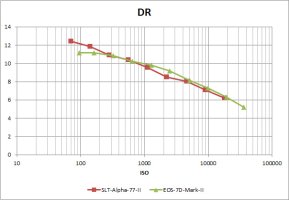
7DII versus A77II (Exmor). Seems like the 7DII wins at all ISOs above 200, which is where it counts.
 

Attachments

  • A77 II versus 7D II.jpg
    A77 II versus 7D II.jpg
    79 KB · Views: 633
Upvote 0