Canon EOS 5D Mark IV Achieves Best Canon Sensor Score at DXO

jrista said:
You might be better off waiting anyway. The current price is, IMHO, ridiculous. I purchased my 5D III a couple years after it's initial release for $2650. The price will hold until the initial furor about it fades, then it will start dropping. By 18 months, you should be able to find it for more reasonable prices.

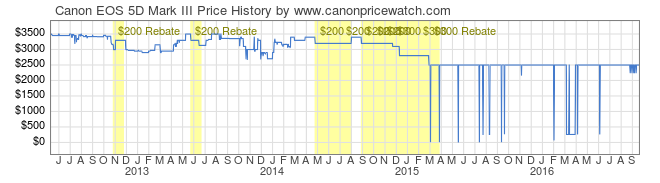
Good advice, but don't hold your breath on that. See the price plot over time below-- the 5D3 has somewhat legendarily held its price when compared against other Canon models. Further, those little low dips in price were folks at B&H and Adorama playing games and violating minimum pricing, which Canon famously cracked down on a few years ago.

Don't get me wrong -- the price will go down, but not as precipitously as the 6D or other more consumer-oriented models.

- A
 

Attachments
  • 03868-Canon-EOS-5D-Mark-III-price-graph.png
    03868-Canon-EOS-5D-Mark-III-price-graph.png
    71.1 KB · Views: 1,055
Upvote 0
ejenner said:
ahsanford said:
I think a number of 5D3 folks not planning on upgrading may have an uncomfortable morning...
Exactly what I was thinking - about myself.

Looks like my 5DIII just turned into a POS :( ....
If this is what you really think then go to your pc and take a look at your most beloved photos you shot with it.
Of course a new tool is more sexy than the old one and GAS might be tempting.
But then return to reality and think to yourself that 0,5 ev in comparison is not even 5% improvement coming from about 13 ev. Will this change your world of photography? NO!

And now go out taking excellent pictures with your excellent (old) tool ;)
 
Upvote 0
Question for lucky Canon 5D mark IV owners that own Sekonic 758 or 478 Light Meter as well:

have you had a chance to create your Sekonic Light Meter 5D mark IV custom camera profile?

all this talk about 13EV DR is great but I am very interested to know what Sekonic DTS software consider the camera dynamic range really is?

hint : my Canon 6D was messured to have 6.5EV DR (10 to 250 RGB) and 5.3EV of shadows clipping point to highlights clipping point range. (-2.3EV from shadows clipping point to mid grey and +3.0EV mid grey to higlihts clipping point, thats from 20 to 245 RGB)
 
Upvote 0
Alex_M said:
Question for lucky Canon 5D mark IV owners that own Sekonic 758 or 478 Light Meter as well:

have you had a chance to create your Sekonic Light Meter 5D mark IV custom camera profile?

all this talk about 13EV DR is great but I am very interested to know what Sekonic DTS software consider the camera dynamic range really is?

hint : my Canon 6D was messured to have 6.5EV DR (10 to 250 RGB) and 5.3EV of shadows clipping point to highlights clipping point range. (-2.3EV from shadows clipping point to mid grey and +3.0EV mid grey to higlihts clipping point, thats from 20 to 245 RGB)

Are you sure that was DR and not SNR?

Plus, however you are measuring, your measuring in 8-bit, which would cap the maximum measurable DR to 8 stops, whereas the camera is 14-bit, which would allow up to 14 stops of DR. Additionally, the 13.6 stops of DR is on a normalized scale...at native size, it would be less. (Although certainly not 6.5 stops!0

My guess is you are actually measuring SNR, rather than DR. DR is pretty simple: 20 * log(FWC/RN)
 
Upvote 0
ejenner said:
ahsanford said:
I think a number of 5D3 folks not planning on upgrading may have an uncomfortable morning...
Exactly what I was thinking - about myself.

Looks like my 5DIII just turned into a POS :(. I'm happy with it and 1/2 stop DR wouldn't have swayed me, but I know what will happen now. I will spend 18 months trying to convince myself I don't need it to finally break down and buy it when I could have been using it for all that time. Sort of did that with the 5DII, then the 5DIII came out and did the same.

Maybe this time will be different. 5DIII IQ is good really, as is the AF which was my biggest issue with the 5DII.

But... if DR and high ISO is really that much better........

Bollocks, here we go again. :'(
Resistance is futile ;D
 
Upvote 0
Act444 said:
privatebydesign said:
Please post a screen shot of the comparison images that drove you to your conclusions.

The following shots are from DPP. Both feature a comparison window featuring the studio scene pic from DPR. RAW files downloaded and loaded into DPP 4.5. 5D3 pic on the left, 5D4 pic on the right. Noise reduction turned off, sharpening set to 0 on both images (option unchecked). Focus is on the green foliage for reference. You can also see that the FL & exposure on both is the same (1/40, f5.6, ISO 100, 85mm). 1st shot shows 5D3 shot selected, 2nd shot shows 5D4 shot selected (to show that settings are indeed the same)

Now, at equivalent sizes the 5D4 will have the edge, and the MP difference is still enough to put the 5D4 ahead overall...but when I view both images at 1:1, it seems to me 5D4 has a softer appearance...I dunno, am I seeing things?? Have my eyes turned on me?

to compare different sized pixels on a one to one basis is an entirely fallacious concept.

...hmm, Is it though? Maybe I'm doing something wrong, but I will next include the 5D3 vs. the 5DS (not the R) to show what I'm getting at here. Unlike with the 5D4, when both are viewed at 1:1 you can CLEARLY see the 5DS resolving detail with similar crispness as the 5D3. This leads me to draw the conclusion that the 5D4 has a stronger AA filter than both the 5D3 AND 5DS...and DPR seems to more or less agree as well:

"It's a similar story if you compare the 5D Mark IV with the higher resolution EOS 5DS R or even the EOS 5DS, whose low pass filter appears to be weaker than the IV's." - DPR 5D4 Review, Image Quality Section. (Emphasis added)

Following up on this post:

The following adjustments are needed to that 5D4 file to bring it up to the sharpness level of the 5D3:

- Turn DLO on (takes a couple seconds), and make sure it's set all the way to 100
- Raise sharpness by 0.5 units

Those two tweaks more or less equalize the 5D4 with the unmodified 5D3 file - after that, it looks pretty good! The 5D4 improvements can be much more clearly seen after these adjustments. The 5DS/R clearly has both beat, as expected.
 
Upvote 0
Act444 said:
Act444 said:
privatebydesign said:
Please post a screen shot of the comparison images that drove you to your conclusions.

The following shots are from DPP. Both feature a comparison window featuring the studio scene pic from DPR. RAW files downloaded and loaded into DPP 4.5. 5D3 pic on the left, 5D4 pic on the right. Noise reduction turned off, sharpening set to 0 on both images (option unchecked). Focus is on the green foliage for reference. You can also see that the FL & exposure on both is the same (1/40, f5.6, ISO 100, 85mm). 1st shot shows 5D3 shot selected, 2nd shot shows 5D4 shot selected (to show that settings are indeed the same)

Now, at equivalent sizes the 5D4 will have the edge, and the MP difference is still enough to put the 5D4 ahead overall...but when I view both images at 1:1, it seems to me 5D4 has a softer appearance...I dunno, am I seeing things?? Have my eyes turned on me?

to compare different sized pixels on a one to one basis is an entirely fallacious concept.

...hmm, Is it though? Maybe I'm doing something wrong, but I will next include the 5D3 vs. the 5DS (not the R) to show what I'm getting at here. Unlike with the 5D4, when both are viewed at 1:1 you can CLEARLY see the 5DS resolving detail with similar crispness as the 5D3. This leads me to draw the conclusion that the 5D4 has a stronger AA filter than both the 5D3 AND 5DS...and DPR seems to more or less agree as well:

"It's a similar story if you compare the 5D Mark IV with the higher resolution EOS 5DS R or even the EOS 5DS, whose low pass filter appears to be weaker than the IV's." - DPR 5D4 Review, Image Quality Section. (Emphasis added)

Following up on this post:

The following adjustments are needed to that 5D4 file to bring it up to the sharpness level of the 5D3:

- Turn DLO on (takes a couple seconds), and make sure it's set all the way to 100
- Raise sharpness by 0.5 units

Those two tweaks more or less equalize the 5D4 with the unmodified 5D3 file - after that, it looks pretty good! The 5D4 improvements can be much more clearly seen after these adjustments. The 5DS/R clearly has both beat, as expected.

This just illustrates what I always say about comparisons. In post everything off is unrealistic whereas each file processed to an optimum level for that camera is realistic, that is what I need to see because that is what I will be selling people.

If you process 5D MkIV files optimally they hold better detail have more dynamic range and lower noise at any iso than a 5D MkIII file at same sized output. And for me that is also key, I don't care what pixel level image quality is like, I don't sell pixels, I sell 16" x 24"'s etc.

The 5D MkIV files have better dynamic range and less noise at any iso than the 5DS/R's too, but they don't have as much detail (which should be no surprise to anybody apart from maybe Dilbert) as long as the iso is low enough to not eat all that detail.
 
Upvote 0
Like I said before, we all have different desires, expectations, etc.

My general point still stands though: from where I sit (not anyone else!), the 5D4 files need additional work to look optimal than the 5D3 files do (longer workflow, reminds me of my 7D), due to what appears to be a stronger AA filter. But, ultimately at the end of the day, a better result can be achieved due to the higher MP count and expanded editing latitude. Just depends on the end goal, that's all.

And at higher ISOs, I've noticed DLO just adds undesirable artifacts - to both camera files. Works well for lower ISO settings though (best at 800 or lower). Dialing back the default NR on the 5D4 files I find to be a virtual necessity as for some reason DPP is heavy-handed at the default setting. Oddly enough, I find the 5D3 files contain enough detail to not need to mess with the default NR settings unless above 6400 (which is rare since I cap auto ISO at 6400 anyway).

All that said, I'm beginning to warm up to it a bit more, still not worth the asking price though. Maybe I'll consider when the price comes down or there's a rebate.

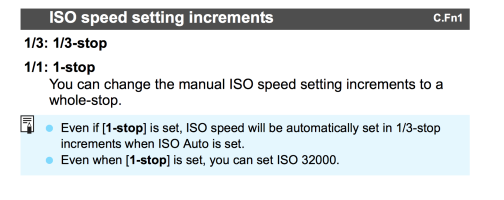
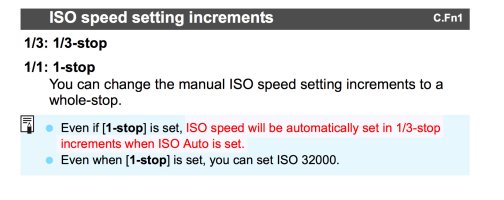
What would be awesome is if you can set auto ISO in 1/3 stop increments instead of the normal full stop. Like, maybe setting the cap at 8,000 if that squeaks by?
 
Upvote 0
Act444 said:
Like I said before, we all have different desires, expectations, etc.

My general point still stands though: from where I sit (not anyone else!), the 5D4 files need additional work to look optimal than the 5D3 files do (longer workflow, reminds me of my 7D).........

No it doesn't. My point is every single digital image you have ever looked at has been processed. Yu are saying it will take more time to process 5D MkIV files, I say it won't. Don't you use custom import settings?

When you get a new camera you have a play with it and work out basic required processing, I make custom dual illuminate camera profiles and optimize a capture sharpening setting, I also always switch lens corrections and remove CA as a starting point. I then create an Import Preference and apply that on import to every file that is taken by that camera. This is part of my familiarity process and takes no additional time, but if you want to I'll do it for you in 1 hour and charge you $30 for the Import Preset that includes custom camera profile.

5D MkIV, or any other camera, then takes no additional time to process, all images start at an optimized position and none of it is destructive. For instance when I move an image to PS I turn off any LR sharpening as I find for specific output purposes PS can do a better job, or in LR I might turn lens corrections off if I wan the natural lens vignette and I haven't cropped off center.
 
Upvote 0
I use DPP to process images, not Lightroom or Photoshop. I typically only use the most basic of editing functions and have found that for what I do, DPP is good enough for 99% of my PP needs, and no need to spend hundreds on Adobe software. I have tested alternative workflows such as DXO Optics Pro and overall I prefer DPP color rendition, processing speed, etc. although DXO wins on noise handling.

I'm currently exploring ways to fix certain default settings to images taken with a particular camera (or ISO setting, or certain lens), but haven't figured it out yet. The closest I get is saving a custom "recipe" to apply to a group of photos, which works well or photos taken in similar environments. If any DPP users know any tricks, please share!

That page in the manual, if I'm not mistaken, is for setting ISO on a general scale (the 5D3 has that tidbit as well). However, it does not seem to refer to being able to set AUTO ISO to that level of precision - but if someone who has a 5D4 can test this out, I'd greatly appreciate it :)
 
Upvote 0
I have shot only a few images now and am still a tyro for DPP but have found some primitive settings for easy use. I set the 5DIV for "fine" picture style for jpegs, which I have been taking in parallel with RAW. I have default for the RAW conversion of 4 strength, 1 fineness and 1 for threshold for sharpening and 4 for each of noise reduction, which work well for my usual iso range of 640-1250 and give better sharpness than the in-camera conversion to jpegs.
 
Upvote 0
Act444 said:
I use DPP to process images, not Lightroom or Photoshop. I typically only use the most basic of editing functions and have found that for what I do, DPP is good enough for 99% of my PP needs, and no need to spend hundreds on Adobe software. I have tested alternative workflows such as DXO Optics Pro and overall I prefer DPP color rendition, processing speed, etc. although DXO wins on noise handling.

I'm currently exploring ways to fix certain default settings to images taken with a particular camera (or ISO setting, or certain lens), but haven't figured it out yet. The closest I get is saving a custom "recipe" to apply to a group of photos, which works well or photos taken in similar environments. If any DPP users know any tricks, please share!

That page in the manual, if I'm not mistaken, is for setting ISO on a general scale (the 5D3 has that tidbit as well). However, it does not seem to refer to being able to set AUTO ISO to that level of precision - but if someone who has a 5D4 can test this out, I'd greatly appreciate it :)

You can do the same thing in DPP. Just create a custom Picture Style, done via the free software, then either use that in camera, yep you can load it to your camera and or DPP.

Or make a custom 'Recipe' and apply as a batch, but custom Picture Styles are faster IMO.

Read the box. It says "ISO speed will be automatically set in 1/3-stop increments when ISO-Auto is set."
 

Attachments

  • Screen-Shot-2016-09-19-at-11.26.52-AM.jpg
    Screen-Shot-2016-09-19-at-11.26.52-AM.jpg
    227.2 KB · Views: 159
Upvote 0
sebasan said:
I don't like what i am seeing here (really i like it because the difference with the 5DIII is minimal).
I don't know if this method is better than DxO.

http://www.photonstophotos.net/Charts/PDR.htm#Canon%20EOS%205D%20Mark%20IV

Those charts are based on the authors PDR, or Photographic Dynamic Range. To understand the differences relative to engineering DR (a more standard method), read this:

http://www.photonstophotos.net/GeneralTopics/Sensors_&_Raw/Sensor_Analysis_Primer/Engineering_and_Photographic_Dynamic_Range.htm
 
Upvote 0
jrista said:
sebasan said:
I don't like what i am seeing here (really i like it because the difference with the 5DIII is minimal).
I don't know if this method is better than DxO.

http://www.photonstophotos.net/Charts/PDR.htm#Canon%20EOS%205D%20Mark%20IV

Those charts are based on the authors PDR, or Photographic Dynamic Range. To understand the differences relative to engineering DR (a more standard method), read this:

http://www.photonstophotos.net/GeneralTopics/Sensors_&_Raw/Sensor_Analysis_Primer/Engineering_and_Photographic_Dynamic_Range.htm

Yes, and the difference beetween sensors is aprox the same that DxO.
The 5DIV (in my opinion) still is the best all-rounder camera, having in count that the A7RII sensor is slighty better but is far behind in autofocus performance.
 
Upvote 0
sebasan said:
jrista said:
sebasan said:
I don't like what i am seeing here (really i like it because the difference with the 5DIII is minimal).
I don't know if this method is better than DxO.

http://www.photonstophotos.net/Charts/PDR.htm#Canon%20EOS%205D%20Mark%20IV

Those charts are based on the authors PDR, or Photographic Dynamic Range. To understand the differences relative to engineering DR (a more standard method), read this:

http://www.photonstophotos.net/GeneralTopics/Sensors_&_Raw/Sensor_Analysis_Primer/Engineering_and_Photographic_Dynamic_Range.htm

Yes, and the difference beetween sensors is aprox the same that DxO.
The 5DIV (in my opinion) still is the best all-rounder camera, having in count that the A7RII sensor is slighty better but is far behind in autofocus performance.

I don't think the A7 series is far behind. I think it's on par, just like Canon is on par with Nikon. I think the main thing is, the Sony AF system works differently, so you can't use it the same way as you use the Canon AF system. Once you learn how the Sony system works, it is just as effective.
 
Upvote 0
jrista said:
sebasan said:
jrista said:
sebasan said:
I don't like what i am seeing here (really i like it because the difference with the 5DIII is minimal).
I don't know if this method is better than DxO.

http://www.photonstophotos.net/Charts/PDR.htm#Canon%20EOS%205D%20Mark%20IV

Those charts are based on the authors PDR, or Photographic Dynamic Range. To understand the differences relative to engineering DR (a more standard method), read this:

http://www.photonstophotos.net/GeneralTopics/Sensors_&_Raw/Sensor_Analysis_Primer/Engineering_and_Photographic_Dynamic_Range.htm

Yes, and the difference beetween sensors is aprox the same that DxO.
The 5DIV (in my opinion) still is the best all-rounder camera, having in count that the A7RII sensor is slighty better but is far behind in autofocus performance.

I don't think the A7 series is far behind. I think it's on par, just like Canon is on par with Nikon. I think the main thing is, the Sony AF system works differently, so you can't use it the same way as you use the Canon AF system. Once you learn how the Sony system works, it is just as effective.

I'd say it depends on what you're doing. In the studio environment, I often find the sony more effective than my canon (5D3, mind you, I don't own the 5D4 and haven't used my 1Dx). The eyeAF is like black magic... when it works. But it also has a strong propensity to hunt.

When shooting long lenses, the canon is significantly better. If and when sony comes up with long native e-mount glass, it may close the gap somewhat, but the bodies may not have the power to drive heavy elements as effectively as canon SLRs. Perhaps they should offer up a battery compartment on superteles (not joking).
 
Upvote 0
3kramd5 said:
jrista said:
sebasan said:
jrista said:
sebasan said:
I don't like what i am seeing here (really i like it because the difference with the 5DIII is minimal).
I don't know if this method is better than DxO.

http://www.photonstophotos.net/Charts/PDR.htm#Canon%20EOS%205D%20Mark%20IV

Those charts are based on the authors PDR, or Photographic Dynamic Range. To understand the differences relative to engineering DR (a more standard method), read this:

http://www.photonstophotos.net/GeneralTopics/Sensors_&_Raw/Sensor_Analysis_Primer/Engineering_and_Photographic_Dynamic_Range.htm

Yes, and the difference beetween sensors is aprox the same that DxO.
The 5DIV (in my opinion) still is the best all-rounder camera, having in count that the A7RII sensor is slighty better but is far behind in autofocus performance.

I don't think the A7 series is far behind. I think it's on par, just like Canon is on par with Nikon. I think the main thing is, the Sony AF system works differently, so you can't use it the same way as you use the Canon AF system. Once you learn how the Sony system works, it is just as effective.

I'd say it depends on what you're doing. In the studio environment, I often find the sony more effective than my canon (5D3, mind you, I don't own the 5D4 and haven't used my 1Dx). The eyeAF is like black magic... when it works. But it also has a strong propensity to hunt.

When shooting long lenses, the canon is significantly better. If and when sony comes up with long native e-mount glass, it may close the gap somewhat, but the bodies may not have the power to drive heavy elements as effectively as canon SLRs. Perhaps they should offer up a battery compartment on superteles (not joking).

Yes, I was thinking in a most demanding scene with a telephoto and a fast subject.
 
Upvote 0