

rfdesigner said:If you shoot raw, then stick with ISO100 and be prepared to "underexpose" then fix in post.
well that's not good advice!

Upvote
0
rfdesigner said:If you shoot raw, then stick with ISO100 and be prepared to "underexpose" then fix in post.
joejohnbear said:You mean the indie and low-end commercial video guys. It's just one segment of the market. Not everyone is making money off of youtube videos. That said, I wouldn't mind cool trickle down features, just saying there's already a higher end cinema market. With competitive pressure, Canon will trickle down features through firmware updates, but if there's no competitor, then why is the onus on Canon to give all their high end features for a lower price? The C300 is very popular with documentary filmmakers and film schools for a reason.
LetTheRightLensIn said:joejohnbear said:Because there are a lot of people who can't afford Super-35 cameras dedicated for video like the FS-700, FS-100, C100,300,500 and are hoping for features from top end features to trickle down to "cheap" cameras as soon as in their dreams. That said, the Canon DSLR's do suck for video IF you don't publish to web. ML takes care of it, but you pay tooth through nail for actual first-party support on real video cameras instead of dula purpose DSLR's/video cameras. Remember, 5d mk ii was more than enough to start the "DSLR" video revolution, but mark my words, that revolution was unintentional and more than over now that Canon has released their own cinema cameras. When prodded, they'll release more features, but as of now there are no competitors at the same price point, despite what people will try to tell you.
The worst thing to ever happen to the amazing DSLR video revolution Canon accidentally created was when Canon marketing realized they had something good. And if people think some of the posters in these forums are harsh on Canon you should hear what the video guys say about the way Canon squashed and squandered their DSLR video revolution.
joejohnbear said:Look up some of Thom Hogan's articles on the approaches of different camera companies to the market. Canon is the most fiscally conservative, offering advances in features that don't cost them as much monetarily in arms races to higher megapixels, etc. Nikon loads up DR and megapixels on their D3100->3200 models and it doesn't necessarily work better at attracting consumers. People like us who are technical and get into the specs, sure, but the average camera user is interested in convenience of use more than anything else. The point and shoot market disappeared and all the camera companies are going for higher price point and shoots and MILC's now. That's probably not the way to "save" the camera industry, and they'll need something more like Apple where they use current technologies to make cameras more convenient than ever, but that's a separate tangent and long topic to cover here. Also something Hogan discusses.
Also, ask an engineer working in product development who's worked closely with marketing, they'll tell you the same thing about releasing products over time. Part of my background is that I was first taught my technical basics by a NASA engineer, so this is part of the knowledge he taught me on how tech companies stay alive.
takesome1 said:joejohnbear said:Like I said, it's more than R&D. Canon took a fiscally conservative approach because of their perception of decreased demand due to the recession, so they released less of their R&D at once because they perceived less demand for cameras period. Not the best move for us when we want more features, but it's one of the things to do when an economy tanks. See Thom Hogan's articles on the recession and how it affects camera companies. Meanwhile, Nikon's autofocusing is good enough, but behind for f/1.4 aperture lenses shot wide open. Plusses and minuses with both companies. Canon's sensor is good enough, but behind on DR and low ISO noise. Their 5DIII high ISO is better than the D800. D810 might push high iso better. A7s is the best on market. Camera bodies continually lap each other, it's no big deal, as I've said before. Sony does better sensors but doesn't do so well having fully well-rounded lens systems and professional services to back it up.
dilbert said:joejohnbear said:Fair point, but I think DR-commentators aren't giving Canon credit for improving vastly in a lot of other areas. Also, I think the length of the cycle has more to do with the stock market crashing and the recession starting in 2008, the year before the 7D was released I believe.
...
That's rubbish. R&D of cameras takes years, including at least 6 to 12 months just for testing and bug fixing.
Find the announcement of the C300, which was said to be Canon's fastest ever digital camera development. From inception to market, that was 2 to 3 years, so it seems reasonable to expect that a normal DSLR takes 3 to 5 years to develop and bring to market.
That whole idea is bull. If you withhold technology for years when you do release it is obsolete.
The opposite is true. If Canon had superior technology when the economy was at its worse they would have released it. If the economy is bad and you have superior technology you release it at that point. The reason you do it is to crush your competition who are struggling. In the long term the recession wouldn't matter to Canon, they make up any short fall when the economy is good again.
Canon didn't bring it to the market because Canon didn't have it.
Go back four years and you will see that Cameras were not getting hit hard five years ago. Technology reached a point it was comparable with film finally and many people were switching. The economy tanked for Canon when the PS sales died off. Go back and look at profits, Canon's profits went south because of the PS market. They were having great years when the economy was in the tank. Even in the bad years they spent the same on R&D (yen relative to dollar) and made money.
takesome1 said:While Nero's comments were not on the serious side, I am not aware of the vast improvements Canon has made in other areas that would be demonstrated with the specs listed for the 7D II. To me it looks like a rehash using existing components.
Nothing ground breaking yet, maybe when the announcement is official Canon will reveal something we do not see on the surface of the specs.

takesome1 said:Five years ago Canon's product was superior to Nikons. They let Nikon catch up. If what you say is true I am not sure how that plays out as sound business strategy.
neuroanatomist said:takesome1 said:Five years ago Canon's product was superior to Nikons. They let Nikon catch up. If what you say is true I am not sure how that plays out as sound business strategy.
You're right, it's a terrible business strategy. That's why, over the past five years Canon has steadily lost dSLR market share to Nikon, and Canon is no longer the market leader by a significant margin.
Oh, wait...Nikon hasn't gained market share, and Canon is still the dSLR market leader by a significant margin.
I guess Canon's business strategy is sound, although your opinion of it is apparently not.
Ebrahim Saadawi said:rfdesigner said:If you shoot raw, then stick with ISO100 and be prepared to "underexpose" then fix in post.
well that's not good advice!
rfdesigner said:Ebrahim Saadawi said:rfdesigner said:If you shoot raw, then stick with ISO100 and be prepared to "underexpose" then fix in post.
well that's not good advice!
Care to explain why shooting at ISO100 but underexposed by 2 stops is worse than shooting at ISO400 on a Nikon 800/600 series?
Numbers are useful here.
pknight said:joejohnbear said:I'm just tired of hearing people talk about gear they've never touched in their life,
I agree. Let's shut this thread down.

EOS AE1 said:neuroanatomist said:takesome1 said:Five years ago Canon's product was superior to Nikons. They let Nikon catch up. If what you say is true I am not sure how that plays out as sound business strategy.
You're right, it's a terrible business strategy. That's why, over the past five years Canon has steadily lost dSLR market share to Nikon, and Canon is no longer the market leader by a significant margin.
Oh, wait...Nikon hasn't gained market share, and Canon is still the dSLR market leader by a significant margin.
I guess Canon's business strategy is sound, although your opinion of it is apparently not.
Who says Nikon is the only competition?
Someone who is not a Sport/Action shooter better buys a smaller Fuji or Olympus camera theses days.
They offer nearly Canons APS-C quality and are great for portraits and travel.
I can not recommend Canon Rebels to family and friends anymore. :-[
For what they do they are big Dinosaurs.
EOS AE1 said:rfdesigner said:Ebrahim Saadawi said:rfdesigner said:If you shoot raw, then stick with ISO100 and be prepared to "underexpose" then fix in post.
well that's not good advice!
Care to explain why shooting at ISO100 but underexposed by 2 stops is worse than shooting at ISO400 on a Nikon 800/600 series?
Numbers are useful here.
To get the best out of the sensor you best shoot ETTR (expose to the right).
Underexposure will only result in losing tonal values.
PureClassA said:EOS AE1 said:neuroanatomist said:takesome1 said:Five years ago Canon's product was superior to Nikons. They let Nikon catch up. If what you say is true I am not sure how that plays out as sound business strategy.
You're right, it's a terrible business strategy. That's why, over the past five years Canon has steadily lost dSLR market share to Nikon, and Canon is no longer the market leader by a significant margin.
Oh, wait...Nikon hasn't gained market share, and Canon is still the dSLR market leader by a significant margin.
I guess Canon's business strategy is sound, although your opinion of it is apparently not.
Who says Nikon is the only competition?
Someone who is not a Sport/Action shooter better buys a smaller Fuji or Olympus camera theses days.
They offer nearly Canons APS-C quality and are great for portraits and travel.
I can not recommend Canon Rebels to family and friends anymore. :-[
For what they do they are big Dinosaurs.
Yes they are... unless you're a professional who needs a real lens and a great system. Please. Hang up the "Canon is old and obsolete" sort of tripe. It's ridiculous. You like something else better? That's ok. But folks on here acting like Canon is some old man in a wheel chair sputtering along is just absurd.
EOS AE1 said:neuroanatomist said:takesome1 said:Five years ago Canon's product was superior to Nikons. They let Nikon catch up. If what you say is true I am not sure how that plays out as sound business strategy.
You're right, it's a terrible business strategy. That's why, over the past five years Canon has steadily lost dSLR market share to Nikon, and Canon is no longer the market leader by a significant margin.
Oh, wait...Nikon hasn't gained market share, and Canon is still the dSLR market leader by a significant margin.
I guess Canon's business strategy is sound, although your opinion of it is apparently not.
Who says Nikon is the only competition?
Someone who is not a Sport/Action shooter better buys a smaller Fuji or Olympus camera theses days.
They offer nearly Canons APS-C quality and are great for portraits and travel.
I can not recommend Canon Rebels to family and friends anymore. :-[
For what they do they are big Dinosaurs.
rfdesigner said:EOS AE1 said:rfdesigner said:Ebrahim Saadawi said:rfdesigner said:If you shoot raw, then stick with ISO100 and be prepared to "underexpose" then fix in post.
well that's not good advice!
Care to explain why shooting at ISO100 but underexposed by 2 stops is worse than shooting at ISO400 on a Nikon 800/600 series?
Numbers are useful here.
To get the best out of the sensor you best shoot ETTR (expose to the right).
Underexposure will only result in losing tonal values.
Ah.. you're not seeing what I'm getting at.
Lets say
Readout Noise = 40 electrons at 100ISO and 20electrons at 200ISO and 10electrons at 400ISO, 7electrons at 800ISO and 6electrons at 1600ISO... (low ISO being ADC dynamic range limited, high ISO being sensor limited)
not dissimilar to my 30D.
The SNR for the same amount of light is almost identical at 800ISO as it is at 1600ISO.. but 800ISO gives you more headroom... this is what I do for low light "people" photography where playing around isn't possible.
now if you're ETTRing then yup that may be optimal.. but that isn't exactly what I'm talking about... although it's all related.
Point is on the Nikon 800/600 series.. the readout noise at ISO100 is going to be pretty much identical to ISO1600 etc. because the readout amplifiers/ADC of the camera has massive dynamic range... the SNR, and so on is all dependant on the amount of light more or less regardless of ISO... might as well give maximum dynamic range (ISO100) and then just grab as much light as the situation allows, only limiting the light once you hit the ADCs rail.
EOS AE1 said:rfdesigner said:EOS AE1 said:rfdesigner said:Ebrahim Saadawi said:rfdesigner said:If you shoot raw, then stick with ISO100 and be prepared to "underexpose" then fix in post.
well that's not good advice!
Care to explain why shooting at ISO100 but underexposed by 2 stops is worse than shooting at ISO400 on a Nikon 800/600 series?
Numbers are useful here.
To get the best out of the sensor you best shoot ETTR (expose to the right).
Underexposure will only result in losing tonal values.
Ah.. you're not seeing what I'm getting at.
Lets say
Readout Noise = 40 electrons at 100ISO and 20electrons at 200ISO and 10electrons at 400ISO, 7electrons at 800ISO and 6electrons at 1600ISO... (low ISO being ADC dynamic range limited, high ISO being sensor limited)
not dissimilar to my 30D.
The SNR for the same amount of light is almost identical at 800ISO as it is at 1600ISO.. but 800ISO gives you more headroom... this is what I do for low light "people" photography where playing around isn't possible.
now if you're ETTRing then yup that may be optimal.. but that isn't exactly what I'm talking about... although it's all related.
Point is on the Nikon 800/600 series.. the readout noise at ISO100 is going to be pretty much identical to ISO1600 etc. because the readout amplifiers/ADC of the camera has massive dynamic range... the SNR, and so on is all dependant on the amount of light more or less regardless of ISO... might as well give maximum dynamic range (ISO100) and then just grab as much light as the situation allows, only limiting the light once you hit the ADCs rail.
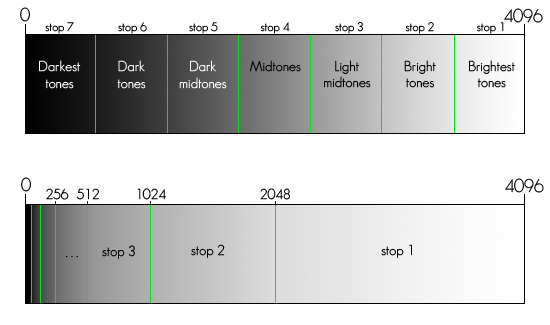
Noise is not the problem from 100 to 400 ISO but when you loose 50% of your tonal values it is.
rfdesigner said:EOS AE1 said:rfdesigner said:EOS AE1 said:rfdesigner said:Ebrahim Saadawi said:rfdesigner said:If you shoot raw, then stick with ISO100 and be prepared to "underexpose" then fix in post.
well that's not good advice!
Care to explain why shooting at ISO100 but underexposed by 2 stops is worse than shooting at ISO400 on a Nikon 800/600 series?
Numbers are useful here.
To get the best out of the sensor you best shoot ETTR (expose to the right).
Underexposure will only result in losing tonal values.
Ah.. you're not seeing what I'm getting at.
Lets say
Readout Noise = 40 electrons at 100ISO and 20electrons at 200ISO and 10electrons at 400ISO, 7electrons at 800ISO and 6electrons at 1600ISO... (low ISO being ADC dynamic range limited, high ISO being sensor limited)
not dissimilar to my 30D.
The SNR for the same amount of light is almost identical at 800ISO as it is at 1600ISO.. but 800ISO gives you more headroom... this is what I do for low light "people" photography where playing around isn't possible.
now if you're ETTRing then yup that may be optimal.. but that isn't exactly what I'm talking about... although it's all related.
Point is on the Nikon 800/600 series.. the readout noise at ISO100 is going to be pretty much identical to ISO1600 etc. because the readout amplifiers/ADC of the camera has massive dynamic range... the SNR, and so on is all dependant on the amount of light more or less regardless of ISO... might as well give maximum dynamic range (ISO100) and then just grab as much light as the situation allows, only limiting the light once you hit the ADCs rail.
Noise is not the problem from 100 to 400 ISO but when you loose 50% of your tonal values it is.
And how do you lose 50% of your tonal values when the SNR per colour channel is more or less identical?
EOS AE1 said:And the Rebels look less and less like a good alternative for average Joe.
EOS AE1 said:rfdesigner said:EOS AE1 said:rfdesigner said:EOS AE1 said:rfdesigner said:Ebrahim Saadawi said:rfdesigner said:If you shoot raw, then stick with ISO100 and be prepared to "underexpose" then fix in post.
well that's not good advice!
Care to explain why shooting at ISO100 but underexposed by 2 stops is worse than shooting at ISO400 on a Nikon 800/600 series?
Numbers are useful here.
To get the best out of the sensor you best shoot ETTR (expose to the right).
Underexposure will only result in losing tonal values.
Ah.. you're not seeing what I'm getting at.
Lets say
Readout Noise = 40 electrons at 100ISO and 20electrons at 200ISO and 10electrons at 400ISO, 7electrons at 800ISO and 6electrons at 1600ISO... (low ISO being ADC dynamic range limited, high ISO being sensor limited)
not dissimilar to my 30D.
The SNR for the same amount of light is almost identical at 800ISO as it is at 1600ISO.. but 800ISO gives you more headroom... this is what I do for low light "people" photography where playing around isn't possible.
now if you're ETTRing then yup that may be optimal.. but that isn't exactly what I'm talking about... although it's all related.
Point is on the Nikon 800/600 series.. the readout noise at ISO100 is going to be pretty much identical to ISO1600 etc. because the readout amplifiers/ADC of the camera has massive dynamic range... the SNR, and so on is all dependant on the amount of light more or less regardless of ISO... might as well give maximum dynamic range (ISO100) and then just grab as much light as the situation allows, only limiting the light once you hit the ADCs rail.
Noise is not the problem from 100 to 400 ISO but when you loose 50% of your tonal values it is.
And how do you lose 50% of your tonal values when the SNR per colour channel is more or less identical?
Because that´s how digital image files work.
When you underexpose and have all your data sitting at the left side of your histogram, you will have less tonal values.
http://digital-photography-school.com/exposing-to-the-right/
neuroanatomist said:EOS AE1 said:And the Rebels look less and less like a good alternative for average Joe.
Perhaps. But MILCs seem even less good to that 'average Joe'.


