
E
EOS AE1
Guest
rfdesigner said:EOS AE1 said:rfdesigner said:EOS AE1 said:rfdesigner said:EOS AE1 said:rfdesigner said:Ebrahim Saadawi said:rfdesigner said:If you shoot raw, then stick with ISO100 and be prepared to "underexpose" then fix in post.
well that's not good advice!
Care to explain why shooting at ISO100 but underexposed by 2 stops is worse than shooting at ISO400 on a Nikon 800/600 series?
Numbers are useful here.
To get the best out of the sensor you best shoot ETTR (expose to the right).
Underexposure will only result in losing tonal values.
Ah.. you're not seeing what I'm getting at.
Lets say
Readout Noise = 40 electrons at 100ISO and 20electrons at 200ISO and 10electrons at 400ISO, 7electrons at 800ISO and 6electrons at 1600ISO... (low ISO being ADC dynamic range limited, high ISO being sensor limited)
not dissimilar to my 30D.
The SNR for the same amount of light is almost identical at 800ISO as it is at 1600ISO.. but 800ISO gives you more headroom... this is what I do for low light "people" photography where playing around isn't possible.
now if you're ETTRing then yup that may be optimal.. but that isn't exactly what I'm talking about... although it's all related.
Point is on the Nikon 800/600 series.. the readout noise at ISO100 is going to be pretty much identical to ISO1600 etc. because the readout amplifiers/ADC of the camera has massive dynamic range... the SNR, and so on is all dependant on the amount of light more or less regardless of ISO... might as well give maximum dynamic range (ISO100) and then just grab as much light as the situation allows, only limiting the light once you hit the ADCs rail.
Noise is not the problem from 100 to 400 ISO but when you loose 50% of your tonal values it is.
And how do you lose 50% of your tonal values when the SNR per colour channel is more or less identical?
Because that´s how digital image files work.
When you underexpose and have all your data sitting at the left side of your histogram, you will have less tonal values.
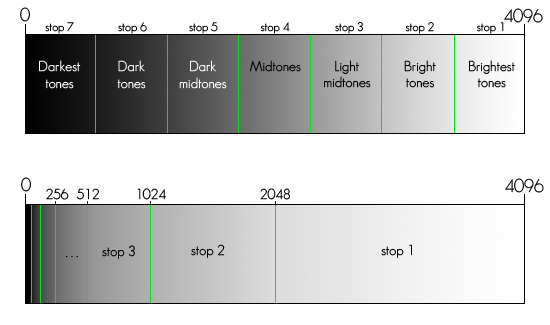
http://digital-photography-school.com/exposing-to-the-right/
Sorry to break it to you.. but if your noise covers the bottom couple of bits of the ADC (and readout noise will be present in the bright bits too) then simply throwing away more and more bits of your ADC converting a very noisy signal does not improve the SNR.
IMPORTANT: SNR isn't just Bight/Dark ratio.. it's also manifest in Bright/"noise texture in the bright bit" ratio.
I think you're aware of this but aren't sure how to model it?..
If you have a Bright bit that is say 200electrons, and noise of 10 electrons you will see a "texture" in the bright area at about 1/20th of the brightness.. devoting more and more ADC bits to that texture won't make the picture any better.
Again you don´t seem to get it. So try it yourself.
Underexposure by two Stops to get a small noise advantage is not a good thing to do.
Upvote
0


