Canon's Rumored 75mp Camera To Have a Non Bayer Multilevel Sensor?

Status
Not open for further replies.
bchernicoff said:
Pi said:
bchernicoff said:
What I am wondering is what current-technology equivalent mp value would a 75 megaphotosite sensor maps to in terms of resolved detail?

Hard to say because there is no single measure or resolution and therefore, no way to compare different sensors based on a single number.

I think line pairs per millimeter is pretty standard and directly comparable.

Except the problem is most reviewers don't (or can't) compare using the exact same lens, much less the exact same physical lens (due to different lens mounts).
 
Upvote 0
bchernicoff said:
What I am wondering is what current-technology equivalent mp value would a 75 megaphotosite sensor maps to in terms of resolved detail?

Theoretically thats dependent on what you shoot - gray gets picked up by all sites and you get the full resolution. Pure colored red fabrics for example otoh are a nightmare, only a quarter of the sites and repeating patterns that can cause artifacts.
Practically: Even at ISO100 whether a 5D3 or D800 give you more usable resolution depends on about everything but the sensor... ;)
25MP RGB and a sync speed that avoids motion blur and cuts ambient light enough to avoid narrow apertures/shortens flash duration plus a Canons current glass/AF? Sounds great!
 
Upvote 0
bchernicoff said:
Pi said:
bchernicoff said:
What I am wondering is what current-technology equivalent mp value would a 75 megaphotosite sensor maps to in terms of resolved detail?

Hard to say because there is no single measure or resolution and therefore, no way to compare different sensors based on a single number.

I think line pairs per millimeter is pretty standard and directly comparable.

At what loss of contrast (MTF)? Measured in what way: slanted edge or something else? If so, how slanted is the slanted edge? Demosaiced or not? At what channel (color)? Vertical, horizontal resolution, or something else?

DXO used to publish much more "diversified" data. The numbers/curves depended a lot on the color, for example, not to mention on the MTF value.
 
Upvote 0
Pi said:
At what loss of contrast (MTF)? Measured in what way: slanted edge or something else? If so, how slanted is the slanted edge? Demosaiced or not? At what channel (color)? Vertical, horizontal resolution, or something else?

DXO used to publish much more "diversified" data. The numbers/curves depended a lot on the color, for example, not to mention on the MTF value.

I think MTF 50 is fairly standard. As to what color channel, the final demosaiced RGB image of a black and white subject is fine. Color artifacts from demosaicing affects contrast, so that is taken into account.

I think you are WAY over thinking what I was asking. I will rephrase. "Asking semi-rhetorically, I wonder what megapixel class of bayer filter camera this new camera will compare to in terms of line pairs per millimeter at MTF 50. 30-ish? 40-ish? 50-ish?"
 
Upvote 0
bchernicoff said:
I wonder what megapixel class of bayer filter camera this new camera will compare to in terms of line pairs per millimeter at MTF 50. 30-ish? 40-ish? 50-ish?"
For "close enough" something in the D800-Range, about 35MP or so would give you a stable and close approximation. For an accurate solution your looking more in the PhaseOne IQ bracket.
 
Upvote 0
bchernicoff said:
Pi said:
At what loss of contrast (MTF)? Measured in what way: slanted edge or something else? If so, how slanted is the slanted edge? Demosaiced or not? At what channel (color)? Vertical, horizontal resolution, or something else?

DXO used to publish much more "diversified" data. The numbers/curves depended a lot on the color, for example, not to mention on the MTF value.

I think MTF 50 is fairly standard. As to what color channel, the final demosaiced RGB image of a black and white subject is fine. Color artifacts from demosaicing affects contrast, so that is taken into account.

I think you are WAY over thinking what I was asking. I will rephrase. "Asking semi-rhetorically, I wonder what megapixel class of bayer filter camera this new camera will compare to in terms of line pairs per millimeter at MTF 50. 30-ish? 40-ish? 50-ish?"

Until recently, DXO considered MTF 10 to be "the standard", measured on the G channel, at 5 degrees slope, not demosaiced. So you see that their definition of what was standard differed a lot from yours. As a result, there was very clear jump in resolution, from, say 12m to 15mp, then to 18mp, same lens. Then they decided to change the metric. Now, a 36mp sensor does not look that different from a 21/22mp one. The new (secret) metric seems to emphasize more higher MTF values, and might react differently to, say, aliasing; or the angle.

I am afraid that you are the one oversimplifying it. :)
 
Upvote 0
bchernicoff said:
Maybe I was using the term spatial resolution wrong. I understand that an AA filter and the debayering algorithm reduce actual resolved detail compared to an ideal 25mp sensor with no color or AA filters at all. The problem is that we have gotten used to relating resolved detail to mp count with today's sensors.

That is indeed the problem. Not trying to pick on anyone here because everyone does it, but it's incorrect to say that a sensor with X MP yields less then X MP. MP is nothing more then the output of the photo sites on the sensor. It's not actually a statement of the sensor's resolution, only a statement of the sensor's physical dimensions which are generally a decent proxy for resolution.

What I am wondering is what current-technology equivalent mp value would a 75 megaphotosite sensor maps to in terms of resolved detail? The Sigma cameras certainly resolve more detail than a camera with a traditional 15mp sensor does (like the 50D). I doubt it's comparable to 30mp as they claim, but it's surely better then 15mp.

It's going to vary with target detail color. It's going to vary at different MTF points. And it's going to vary based on RAW converter and whether or not you sharpen the Bayer file and by how much.

That said, Imaging Resource got 2,200 LPH of "strong detail" (MTF50?) out of the Sigma DP1 Merrill. They said complete extinction (MTF10?) did not occur even at 4,000 LPH. By comparison on their test, the 50D hit 1,800 / 2,600. (I put a question mark by the MTF values because I'm not sure if those are the values IR actually uses.) So for strong detail this would suggest the Foveon is 20% better, but for extinction resolution it would suggest over 50% better.

It should be noted that later versions of ACR yield higher extinction resolution numbers. Redoing the test with the 50D and the latest version of ACR may yield higher numbers, though there is clearly some advantage to Foveon in any case.

Of course, the Foveon advantage is nothing like the 14 stop DR advantage of the Nikon D800. If you haven't already done so, burn all your other equipment in a fire and purchase the D800 ;D

 
Upvote 0
unfocused said:
This is fun to speculate about, but honestly, if past performance is any indicator of future accuracy, I wouldn't be putting any money on predictions from Northlight Images.

They, like CR report rumors from sources that have been right in the past, as well as ones from new sources. The rumor sites protect their sources very carefully, some of them do have inside information.

At any given time, lots of different prototypes of cameras and lenses are being tested by Canon employees. Once a prototype is given to photographers to test, then the odds of it being eventually released rise, but are still not high.
 
Upvote 0
Pi said:
I am afraid that you are the one oversimplifying it. :)

Perhaps not eventually. Certainly for now, it's speculation and WAGs. But should Canon actually come out with a 75 MP (25 MP) Foveon-type sensor, we could measure LP/mm and/or SQF directly (i.e., with Imatest), and compare that to Bayer sensors with the exact same lens. Or maybe not - I'm assuming data from existing FF sensors can be plotted and extrapolated to simulate higher MP sensors that don't exist, but I haven't actually tried it.
 
Upvote 0
dtaylor said:
bchernicoff said:
Maybe I was using the term spatial resolution wrong. I understand that an AA filter and the debayering algorithm reduce actual resolved detail compared to an ideal 25mp sensor with no color or AA filters at all. The problem is that we have gotten used to relating resolved detail to mp count with today's sensors.

That is indeed the problem. Not trying to pick on anyone here because everyone does it, but it's incorrect to say that a sensor with X MP yields less then X MP. MP is nothing more then the output of the photo sites on the sensor. It's not actually a statement of the sensor's resolution, only a statement of the sensor's physical dimensions which are generally a decent proxy for resolution.

What I am wondering is what current-technology equivalent mp value would a 75 megaphotosite sensor maps to in terms of resolved detail? The Sigma cameras certainly resolve more detail than a camera with a traditional 15mp sensor does (like the 50D). I doubt it's comparable to 30mp as they claim, but it's surely better then 15mp.

It's going to vary with target detail color. It's going to vary at different MTF points. And it's going to vary based on RAW converter and whether or not you sharpen the Bayer file and by how much.

That said, Imaging Resource got 2,200 LPH of "strong detail" (MTF50?) out of the Sigma DP1 Merrill. They said complete extinction (MTF10?) did not occur even at 4,000 LPH. By comparison on their test, the 50D hit 1,800 / 2,600. (I put a question mark by the MTF values because I'm not sure if those are the values IR actually uses.) So for strong detail this would suggest the Foveon is 20% better, but for extinction resolution it would suggest over 50% better.

It should be noted that later versions of ACR yield higher extinction resolution numbers. Redoing the test with the 50D and the latest version of ACR may yield higher numbers, though there is clearly some advantage to Foveon in any case.

Of course, the Foveon advantage is nothing like the 14 stop DR advantage of the Nikon D800. If you haven't already done so, burn all your other equipment in a fire and purchase the D800 ;D

That last comment is humorous, thank you. Especially since you're saying 14 stop advantage, as in the notorious proponents of the D800's sensor, are so vigorous in their zealousness, that it is almost as if they're saying there is an additional 14 stops advantage over Canon counterparts. 13+14= 27 stops !!

I hadn't considered that the 75mp sensor could be a "foveon" type sensor. Does Sigma not hold the patent on the technique? Or can Canon develop such a sensor without infringing anything, if it never goes into production? I recall the rumor about Canon's possible development of one.

I've owned both the 50D and a Sigma DP2 (4.6 MP). I have no doubt the Merrill sensor can out-resolve the 50D, as you just pointed out in the test results above. The generation 1 sensor came quasi-close to the 50D's resolution. I used ACR 6.4 to develop the RAW files. It was about 12 to 14mp before things got slightly soft, but I scaled one file up to 80 MP, and to me it might be usable for a print at 240 dpi, if you didn't view it closer than 30 inches or so. Of course there were color anomalies, but they weren't obvious.

If any of you would like me to attempt to post that 80 MP jpeg, let me know. (Or if you would like me to scale it to a lesser extreme like 40 MP). It's an infinity focus shot done from atop a local mountain. Compositionally it's not mind blowing...I just snapped it while I was visiting someone.
 
Upvote 0
CarlTN said:
Does Sigma not hold the patent on the technique?
That would depend on what exactly was patented. The more you go into detail the easier its to do the same thing just different enough, the other way around you have to deal with prior art or significance.
Patents protect someones commercial interests, in research you still can use everything in there - one reason some inventions aren't patented: you gamble on the actual secret staying a secret instead of telling them exactly what they aren't allowed to do...for a while.
 
Upvote 0
dtaylor said:
That said, Imaging Resource got 2,200 LPH of "strong detail" (MTF50?) out of the Sigma DP1 Merrill. They said complete extinction (MTF10?) did not occur even at 4,000 LPH. By comparison on their test, the 50D hit 1,800 / 2,600. (I put a question mark by the MTF values because I'm not sure if those are the values IR actually uses.) So for strong detail this would suggest the Foveon is 20% better, but for extinction resolution it would suggest over 50% better.

It should be noted that later versions of ACR yield higher extinction resolution numbers. Redoing the test with the 50D and the latest version of ACR may yield higher numbers, though there is clearly some advantage to Foveon in any case.

This is very interesting and why I asked my question in the first place. Even if this camera never comes to market it would be very interesting to see what the advantages and disadvantages were.

Warning, somewhat off topic:
I know it will never happen, but it would be so cool to see digital bodies become more film like. I'm talking about interchangeable sensors. Obviously, sensors work in concert with other integrated circuits so it would have to be an interchangeable sensor/processor board with a common bus to work with various bodies. But how neat would it be if you could have a light compact body (including mirror assembly, af, light metering, lcd, etc) as well as something 1DX style for high fps, weather sealing, etc. AND then have different sensor cards that worked with either body to choose from based on what you were shooting... a large megapixel sensor for landscapes and studio work or something with big photosites for low-light work. New sensors could bring new imaging features while new bodies would bring new AF, metering, wifi, gps, etc features.

Suppose this were how it worked today. Imagine this scenario: You have the choice of a 5D Mk II, 5D Mk III, 6D, 1DsMk III, or 1D X body independent of your choice among those sensors. Imagine you have bought into the Canon system in 2008 with 5D Mk II body and its 21.1mp sensor. Now the 5D Mk III line launches as body only, sensor only, or as a kit. You could choose to only upgrade the body and use the existing sensor to gain improved AF, construction, light metering with the trade off being you would still be limited to 3.9fps (I realize this sensor did 6fps in the 1Ds Mk3, but even in my imagined scenario Canon software locks some features out of non 1D bodies). I think a lot of people who upgraded from 5D Mk II to III would choose this path to save some money. Now imagine this hypothetical 75megaphotosite sensor comes out and it's S___ past ISO 400. If that's the actual case, Canon may well decide it's not ready to go on the market, that it couldn't really survive as a whole product. However, it might succeed just as a sensor card upgrade.

I DO realize there are a ton of challenges with what I am suggesting but this is not pie in the sky stuff. Honestly, the biggest challenge might be how it would shake up the pricing/shopping paradigm we currently have. Difficulty forecasting how many of each component they would sell and calculating a break even price on their development costs, etc... that sort of thing.
 
Upvote 0
bchernicoff said:
I know it will never happen, but it would be so cool to see digital bodies become more film like. I'm talking about interchangeable sensors. Obviously, sensors work in concert with other integrated circuits so it would have to be an interchangeable sensor/processor board with a common bus to work with various bodies.

Actually you can buy just that, even trade in outdated sensors at a vastly more attractive rate then their retail cost.
Thats how things work in 645, even rather cross brand friendly. But try to explain that to the average store chain customer who is already uneasy with the interchangeable lens paradigm.
 
Upvote 0
neuroanatomist said:
Pi said:
I am afraid that you are the one oversimplifying it. :)

Perhaps not eventually. Certainly for now, it's speculation and WAGs. But should Canon actually come out with a 75 MP (25 MP) Foveon-type sensor, we could measure LP/mm and/or SQF directly (i.e., with Imatest), and compare that to Bayer sensors with the exact same lens. Or maybe not - I'm assuming data from existing FF sensors can be plotted and extrapolated to simulate higher MP sensors that don't exist, but I haven't actually tried it.

Perhaps you can then tell me which is sharper: the 5D or the 60D? I have seen a comparison on dpreview which can support either conclusion, depending what you are looking at (and it is not AF or DOF problem).
 
Upvote 0
dtaylor said:
That said, Imaging Resource got 2,200 LPH of "strong detail" (MTF50?) out of the Sigma DP1 Merrill. They said complete extinction (MTF10?) did not occur even at 4,000 LPH.
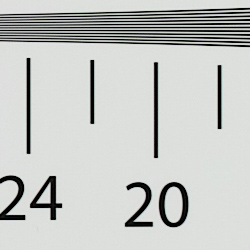
What they actually measure is aliasing:

ZDP1MhRES-V.jpg
 
Upvote 0
Status
Not open for further replies.