Deep Sky Astrophotography (Gear Discussion)

Re: Deep Sky Astrophotography

I had a chat with Astronomik in the past about their narrowband filters and fast lenses. I think the e-mails are on my work account so I can't find it right now. Although their website rates them as usable from f/2.8, they said f/2.0 was ok. Any benefit from going even faster will reduce.

I did a lot of my early attempts with the 135L wide open. Note the lens is rather horrible for wideband imaging as the red focus is some way off that of green/blue. It is fine for narrowband.

If you go for only light pollution filters like the CLS, that should be less affected by extreme speed but I haven't tried it.

And finally, I didn't realised they did full frame clip filters now! Shall have to have a look. Requiring mirror lock up isn't a big deal. People like using USB connection to help with focusing so you see what the sensor sees. My biggest problem now is, do I really want to modify my 5D2?... probaby not, I've not gathered a single night sky photon this winter. Must stop being lazy! Not a great hobby if you don't like the cold.

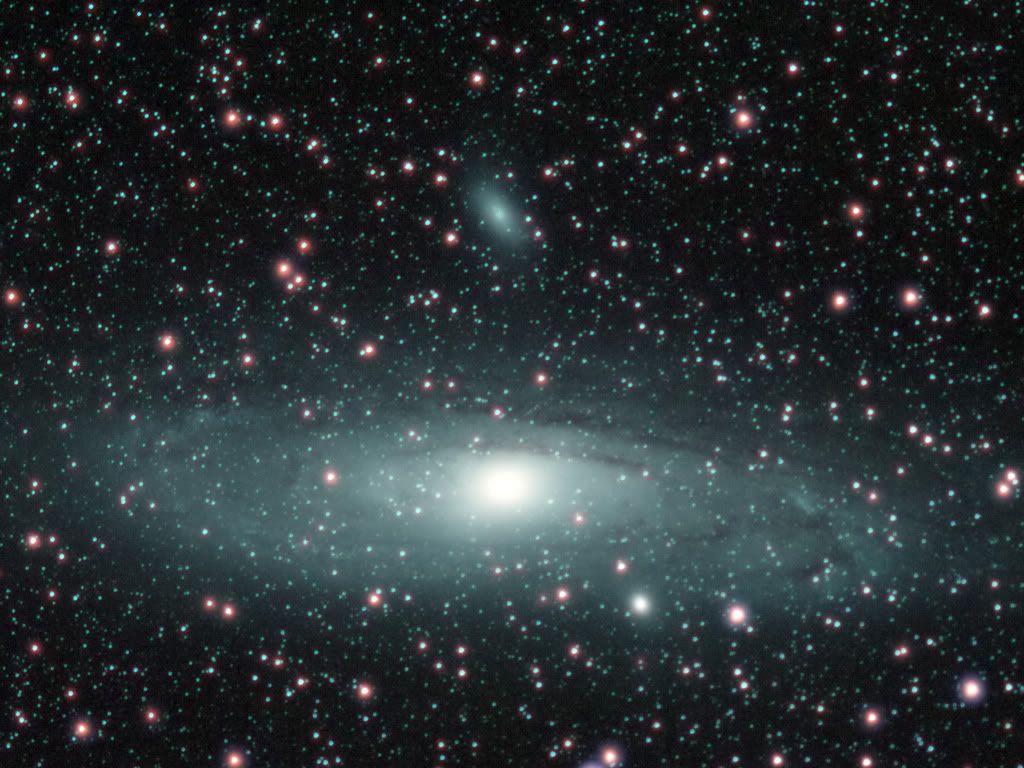
Edit: here's one of my early attempts at Andromeda galaxy with the 135L at f/2, CLS filter on 600D (unmodified). 100% crop, processed. I have got a bit better since then... :)
andro-doubleset-1024c.jpg
 
Upvote 0
Re: Deep Sky Astrophotography

This is imho the most inspirational thread I have read in this forum for quite a while!

I have never tried astrophoto myself (except when I was lucky to borrow the 800/5.6 with a 2xIII TC to take picture of the moon, but that would hardly count as the moon is very bright so the exposure time is very short).

I have been reading this whole thread on my ipad retina, and it has quite good resolution. However, due to the restrictions on image size here in CR, I would have loved to see full resolution images of your beautiful pictures if you guys have posted them somewhere else? :)
 
Upvote 0
Re: Deep Sky Astrophotography

lol said:
Edit: here's one of my early attempts at Andromeda galaxy with the 135L at f/2, CLS filter on 600D (unmodified). 100% crop, processed. I have got a bit better since then... :)

andro-doubleset-1024c.jpg

I'd have been very happy with that! Andromeda is a target I've struggled with. Partly because it's hard to locate (no very bright nearby stars) and partly my filter seems to bring out hydrogen emission nebulae much better than galaxies or reflection nebulae (e.g. the Pleiades).

Incidentally, the 135L is a lens I've considered as my next step for this work. Would you recommend it? The 100L macro has done pretty good service so far, but I'd love more reach (and as I say, the 500L II is too heavy for my tracking mount).
 
Upvote 0
Re: Deep Sky Astrophotography

scyrene said:
weixing said:
Any problem when you use those fast lens with the Astronomik filters?? I thought they are design for f3.8 to f15...

By the way, now they have clip on filters for Canon 5D and 6D full frame camera, but I think you had to lock the mirror in up position to install the filters, so might not be that useful if you need the viewfinder to aim.

Is that right? I'll have to see - using the 5DIII would improve things a lot. One thing that's relevant in any case is the Astronomik EOS clip filters (for 1.6 crop bodies) actually fit into the super telephoto lens rear filter holder (on my 500 II at least). Sadly my tracking mount can't handle the weight of that lens and body combination, so I've never made much use of it - but it's worth knowing.

As for aperture, I suspect it's the reason I get a lot of halos around stars. They are, as you say, rated for medium to narrow apertures (by lens standards). With the UHC filter, many stars get bright magenta halos, which can be a pain to remove if your main subject is a red/pink nebula. Nonetheless, other than that, I've found no problems, and a tradeoff worth making in my experience.

Hmm! I'll have to check out Astronomik's filters for the supertelephoto lenses. I have the 600/4 L II, which is basically like a good Apochromatic refractor. I have my eye on the Celestron CGEM DX mount, which is about $1200 alone, and it should be able to hold my lens and camera quite easily. Having a light pollution filter would make it a lot easier for me to do some deep sky astrophotography without having to find time to drive an hour or so out of town to find clean dark skies. Thanks for the tip!

scyrene said:
lol said:
Edit: here's one of my early attempts at Andromeda galaxy with the 135L at f/2, CLS filter on 600D (unmodified). 100% crop, processed. I have got a bit better since then... :)

andro-doubleset-1024c.jpg

I'd have been very happy with that! Andromeda is a target I've struggled with. Partly because it's hard to locate (no very bright nearby stars) and partly my filter seems to bring out hydrogen emission nebulae much better than galaxies or reflection nebulae (e.g. the Pleiades).

Incidentally, the 135L is a lens I've considered as my next step for this work. Would you recommend it? The 100L macro has done pretty good service so far, but I'd love more reach (and as I say, the 500L II is too heavy for my tracking mount).

Ditto! I'd have been happy with that, too! That is really quite good for just the 135L. I guess I would have gone with a different white balance, but that is a pretty darn nice photo! Out of curiosity...did you use a tracking mount? Signal strength looks pretty good in that shot...a hell of a lot better than I've ever been able to get with my 100mm f/2.8. Stars are nice and round, too...something I've never been able to get without tracking.
 
Upvote 0
Re: Deep Sky Astrophotography

Quasimodo said:
This is imho the most inspirational thread I have read in this forum for quite a while!

I have never tried astrophoto myself (except when I was lucky to borrow the 800/5.6 with a 2xIII TC to take picture of the moon, but that would hardly count as the moon is very bright so the exposure time is very short).

I have been reading this whole thread on my ipad retina, and it has quite good resolution. However, due to the restrictions on image size here in CR, I would have loved to see full resolution images of your beautiful pictures if you guys have posted them somewhere else? :)

Glad your finding it inspirational! :) I find the sky to be quite inspiring in and of itself. :D

Regarding larger resolution images, personally, I don't have anything really high resolution. You can find all my work at jonrista.com, and the images there will be a little higher resolution. I downsample them all right now to reduce noise (at full size, they really don't look all that good.) Once I am able to get a tracking mount, I hope to produce MUCH larger and more detailed images, and I'll happily share them. Not sure when that will be, though...few months away at least, if not the end of the year.
 
Upvote 0
Re: Deep Sky Astrophotography

jrista said:
Hmm! I'll have to check out Astronomik's filters for the supertelephoto lenses. I have the 600/4 L II, which is basically like a good Apochromatic refractor. I have my eye on the Celestron CGEM DX mount, which is about $1200 alone, and it should be able to hold my lens and camera quite easily. Having a light pollution filter would make it a lot easier for me to do some deep sky astrophotography without having to find time to drive an hour or so out of town to find clean dark skies. Thanks for the tip!

Ditto! I'd have been happy with that, too! That is really quite good for just the 135L. I guess I would have gone with a different white balance, but that is a pretty darn nice photo! Out of curiosity...did you use a tracking mount? Signal strength looks pretty good in that shot...a hell of a lot better than I've ever been able to get with my 100mm f/2.8. Stars are nice and round, too...something I've never been able to get without tracking.

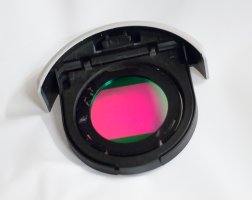
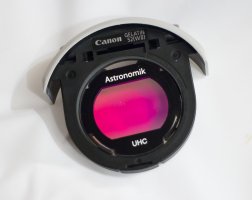
I've posted a couple of pics here to show how it works. The filters are almost exactly the same size as the glass window in the filter holder, so you just balance/wedge it in there. It can fall out (into the lens!) so you have to be careful, although it can be retrieved with difficulty.

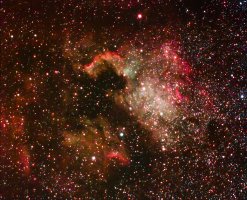
I've also included my best shot so far, since others are including photos. It's the North America Nebula with the 50D, UHC clip filter, and 100L macro + Kenko 2x teleconverter. Magic Lantern for bulb time lapse, which automates the capture process once it's aligned. Hand stacked and processed in Gimp, finished in Lightroom. 136x1mins at ISO 6400.

On the subject of star shape, the clip filter deforms bright stars to the shape of its opening - roughly a circle with the top and bottom cut off - at least shooting at wider apertures. And the coloured haloes only appear around medium-brightness stars, not the faintest, nor the very brightest. Not quite sure why.
 

Attachments

  • IMG_6310-1-1.jpg
    IMG_6310-1-1.jpg
    272 KB · Views: 2,481
  • IMG_6311-2-1.jpg
    IMG_6311-2-1.jpg
    287.1 KB · Views: 2,735
  • 11156784966_398f803f9c_b.jpg
    11156784966_398f803f9c_b.jpg
    957.3 KB · Views: 2,569
Upvote 0
Re: Deep Sky Astrophotography

I've used various astro software over the years, but I think only once or twice did I manually stack images. I do all my stacking with DeepSkyStacker - free and quick to learn. The resulting 16 bit tiff is opened in Adobe Camera Raw, tweaked and sent to Photoshop for final work. I typically take 90 second exposures but sometimes shorter exposures for brighter objects like globulars and planetary nebulae. I've been off work for two weeks and had ONE night suitable for any kind of astro work, and not very well suited at that, upper atmosphere turbulence was horrible and I was doing some imaging of Jupiter. Comparing the use of a modified webcam to the crop video with a 60D for a Registax presentation with my local astronomy club next week. I use a 60D, an astro modified 40D and once the weather clears I'll be using a 6D. I have assorted clip filters for the 40D, they allow me to image from my light-polluted back yard. The 40D is somewhat noisy and prone to banding, but the trade off is Ha sensitivity. I gotta believe a modified 6D would be exquisite for astro.

I would love to have a cooled CCD imager, but it's difficult to justify to myself, let alone SWMBO. Our observing season in the FL Panhandle is just too short, and the CCD would be suitable for ONLY astronomy, unlike a DSLR.

Without tracking, I only shoot wide field or time lapse. I've got two CG5 GOTO mounts, one carries a C8 and the other a small refractor with a piggybacked camera/telephoto combo. I've a non-GOTO fork-mounted C9.25 that tracks phenomenally well....but that scope seems to get 5lbs heavier every year. (I realize this isn't a 'for sale' site, but if anyone with a younger/stronger back is visiting NW Florida and interested yer welcome to come take a look.)

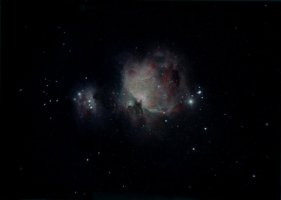
Here's an assortment of images, the Trapezium with un-modified 40D (C9.25 with 2XTC), M51 with un-modified 60D (C8 with f/6.3 focal reducer) and the rest with a modified 40D (300mm/4L or 4 inch f/5 refractor).

Other such stuff is at pbase(dot)com/emagowan/astrophotography
 

Attachments

  • M51_LR.jpg
    M51_LR.jpg
    1.3 MB · Views: 2,560
  • M42_Trapezium_short_exposures.jpg
    M42_Trapezium_short_exposures.jpg
    24.6 KB · Views: 2,511
  • M42_40_OIII.jpg
    M42_40_OIII.jpg
    82.6 KB · Views: 2,521
  • HH01_small.jpg
    HH01_small.jpg
    400.2 KB · Views: 2,575
Upvote 0
Re: Deep Sky Astrophotography

The Andromeda I posted was, as said, one of my older ones. I've since paid more attention to removing the blue hue. That shot was more to show the 135L and red halo around brighter stars which hinders its use if you want to do multiple colour channels at once.

Since I didn't mention it, that was at 1 minute exposures. That does need tracking, and I used the Astrortac at the time. I don't have notes on the ISO used but I normally leave it pretty high, either 1600 or 3200. For sure, once you can get a bit of exposure time thrown at it, it helps a lot with getting the dark stuff out. Then repeat the exposures as much as you can to get the noise down.

I played with DSS early on, but never really got on with it. I've gone to PixInsight but it isn't cheap and has more of a learning curve to it.


Here's a more recent attack on it. 450D with all filters removed. Astronomik CLS-CCD. Sigma 120-300 f/2.8 OS EX at 300mm f/2.8. 2 minute exposures. Note the stars don't suffer the red glow the 1235L does.

Due to the light pollution where I live, I can't do really long exposures even with filters. I can perhaps get 4 minutes usefully with a narrowband filter at f/2.8, after which I'm just picking up the noise floor.

If I stop being lazy, I really want to have a go with the Rosette nebula with the 300/2.8. I've only tried that with the 135L in the past and it is rather small in it.
 
Upvote 0
Re: Deep Sky Astrophotography

Thanks emag, scyrene, lol for your contributions! Great stuff! I'm really feeling the pain of not having a tracking mount. I think I'll pick one up, along with a basic spotting scope, for use with my 600mm lens + 2x TC until I have the chance to buy an actual telescope. I love Celestron's mounts....I might pick up the basic CGEM to start.

lol said:
I played with DSS early on, but never really got on with it. I've gone to PixInsight but it isn't cheap and has more of a learning curve to it.

I hear PixInsight is pretty good. I also hear good things about Nebulosity. I've read through Nebulosity's manual, it sounds pretty powerful. I'll check out PixInsight next. DSS is an ok tool for being free, but it has it's limitations, and tweaking the final result can be a real pain. A more powerful tool, even if it costs money, would be well worth it.

lol said:
Here's a more recent attack on it. 450D with all filters removed. Astronomik CLS-CCD. Sigma 120-300 f/2.8 OS EX at 300mm f/2.8. 2 minute exposures. Note the stars don't suffer the red glow the 1235L does.

Due to the light pollution where I live, I can't do really long exposures even with filters. I can perhaps get 4 minutes usefully with a narrowband filter at f/2.8, after which I'm just picking up the noise floor.

Looks great! I'll have to look more into light pollution filters. I live fairly close to Denver, and there can be quite a LOT of light pollution here...so I am not sure if it would really be worth it. At ISO 3200, I can only expose for maybe 10-15 seconds before it really doesn't become any more worth while to expose longer, because the light pollution shifts the entire histogram right (lifts the black level considerably).

Don Haines said:
Still playing and learning......

Single frame, or stack from a web cam? If you have a web cam, you might try setting up some kind of contraption to attach it to your lens, and let it rip for about a minute. Then, you can use the tool Registax to identify the best frames, stack em, and you can get some really AMAZING planetary results. Each individual frame looks super crappy, but people have been creating some truly awesome, and often highly detailed, results with Registax and around 1000-1500 frames from basic web cams. Even some RGB astrocams like Celestron's Skyris is just a webcam in a more advanced enclosure with astro-specific features.
 
Upvote 0
Re: Deep Sky Astrophotography

jrista said:
Don Haines said:
Still playing and learning......

Single frame, or stack from a web cam? If you have a web cam, you might try setting up some kind of contraption to attach it to your lens, and let it rip for about a minute. Then, you can use the tool Registax to identify the best frames, stack em, and you can get some really AMAZING planetary results. Each individual frame looks super crappy, but people have been creating some truly awesome, and often highly detailed, results with Registax and around 1000-1500 frames from basic web cams. Even some RGB astrocams like Celestron's Skyris is just a webcam in a more advanced enclosure with astro-specific features.
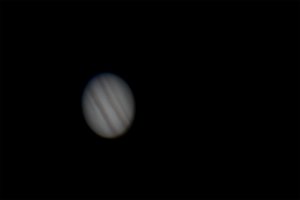
60D shooting video through an 8 inch telescope.... 1900 frames extracted from the video and run through registax. The atmospheric distortion was really bad that night and all the frames are poor, but the result was much better than any individual frame.

I want to try digiscoping through the telescope, but for the last two months the only times it has been clear at night the temperature has been -25C or colder.... Right now it is freezing rain, tomorrow night is supposed to be minus 29.... A wild winter!
 
Upvote 0
Re: Deep Sky Astrophotography

Don Haines said:
jrista said:
Don Haines said:
Still playing and learning......

Single frame, or stack from a web cam? If you have a web cam, you might try setting up some kind of contraption to attach it to your lens, and let it rip for about a minute. Then, you can use the tool Registax to identify the best frames, stack em, and you can get some really AMAZING planetary results. Each individual frame looks super crappy, but people have been creating some truly awesome, and often highly detailed, results with Registax and around 1000-1500 frames from basic web cams. Even some RGB astrocams like Celestron's Skyris is just a webcam in a more advanced enclosure with astro-specific features.
60D shooting video through an 8 inch telescope.... 1900 frames extracted from the video and run through registax. The atmospheric distortion was really bad that night and all the frames are poor, but the result was much better than any individual frame.

Ah, so you are using Registax. Great program! I've tried using my 7D video to image Jupiter...I can't get the same kind of results others get with even just a webcam jury-rigged to a telescope. I think part of it is that the web cams have really tiny pixels which capture enough detail, where as my 7D has pixels that are about 2x - 3x larger...and it's video is pretty crappy.

Don Haines said:
I want to try digiscoping through the telescope, but for the last two months the only times it has been clear at night the temperature has been -25C or colder.... Right now it is freezing rain, tomorrow night is supposed to be minus 29.... A wild winter!

Yeah, crazy winter indeed. It was around 10°C two days ago. The last couple of days, it's been below zero here in Colorado! Right now it is -26.5°C! :o *shivvvver* We got about 8-10 inches of snow, the most we've had all winter (previous high was 3"), and it is still snowing. At least we haven't had any freezing rain yet...although I hear the north east region of the US is slated for some nasty freezing rain and sleet, then more sub-zero weather after that, making for some terrible driving conditions.
 
Upvote 0
Re: Deep Sky Astrophotography

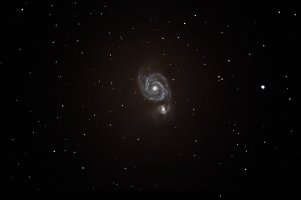
Last night was one of the rare nights this winter I've been able to use the scope, and only for about 3 hours at that, the seeing went to crap by 9PM. A shot of M81 (bottom) and M82 (top). The bright star in M82 is a supernova that became visible in January. About 12 million light years away.....I may be front focusing a few million miles. Taken with a 6D through an 8 inch scope, 1260mm effective focal length, f/6.3. Stack of 10 shots, each 30 seconds. I had some (operator) issues with my mount so there's a bit of trailing in the image.
 

Attachments

  • M81_82resize.jpg
    M81_82resize.jpg
    1.1 MB · Views: 1,933
Upvote 0
Re: Deep Sky Astrophotography

lol said:
I had a chat with Astronomik in the past about their narrowband filters and fast lenses. I think the e-mails are on my work account so I can't find it right now. Although their website rates them as usable from f/2.8, they said f/2.0 was ok. Any benefit from going even faster will reduce.

I did a lot of my early attempts with the 135L wide open. Note the lens is rather horrible for wideband imaging as the red focus is some way off that of green/blue. It is fine for narrowband.

If you go for only light pollution filters like the CLS, that should be less affected by extreme speed but I haven't tried it.

And finally, I didn't realised they did full frame clip filters now! Shall have to have a look. Requiring mirror lock up isn't a big deal. People like using USB connection to help with focusing so you see what the sensor sees. My biggest problem now is, do I really want to modify my 5D2?... probaby not, I've not gathered a single night sky photon this winter. Must stop being lazy! Not a great hobby if you don't like the cold.

Edit: here's one of my early attempts at Andromeda galaxy with the 135L at f/2, CLS filter on 600D (unmodified). 100% crop, processed. I have got a bit better since then... :)

andro-doubleset-1024c.jpg

Very nice!
 
Upvote 0
Re: Deep Sky Astrophotography

To all,

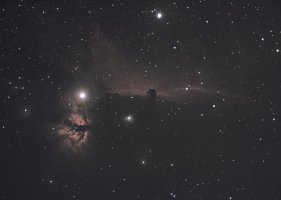
Here's a wide-field image of the Galactic Dark Horse Nebula. Numerous dark nebula come together to form a horse if rotate clock-wise 90 degrees. This was taken with a modified Canon 5D2 and a Canon 200mm f/2.0L stopped down to f/4.0. It is an integration of 25 four-minute exposures. It was calibrated using six dark frames, twenty biases, and twenty flats. All calibration and processing was done in PixInsight.

Thanks for looking,

Wade
 

Attachments

  • galactic_dark_horse_nebula_dslr_200mm.jpg
    galactic_dark_horse_nebula_dslr_200mm.jpg
    206.5 KB · Views: 1,844
Upvote 0
Re: Deep Sky Astrophotography

wearle said:
To all,

Here's a wide-field image of the Galactic Dark Horse Nebula. Numerous dark nebula come together to form a horse if rotate clock-wise 90 degrees. This was taken with a modified Canon 5D2 and a Canon 200mm f/2.0L stopped down to f/4.0. It is an integration of 25 four-minute exposures. It was calibrated using six dark frames, twenty biases, and twenty flats. All calibration and processing was done in PixInsight.

Thanks for looking,

Wade

Lovely, makes me wonder what a higher rez version of your image (or part of it) would look like...
 
Upvote 0
Re: Deep Sky Astrophotography

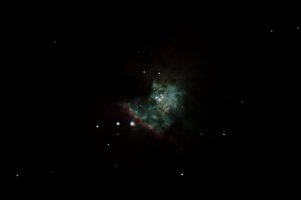
Some really beaut pics in this thread. Unfortunately, I don't have a tracking mount, and I wondered what was possible with a 5D3 + 300mm f4. While it's nothing flash, I was impressed what could be recorded in a 1 second exposure @ 3,200 ISO :)

Orion Nebula.
378A9604_Orion_Nebula.jpg
 
Upvote 0