
Do you need a really high ISO?

lo lite said:
Besisika said:
lo lite said:
I guess at some point I'll have to rent a 1D X and try for myself … ;)
+1
Besides, low light body is not the only one solution. Whenever you can use flash, that I found always the best one.
If flash is not allowed, then yes. You can go the path of a better lens as well. So, rent ones before buying. It is hard to buy in order to own them all. I very often rent lenses for special need.

I am not such a friend of using a flash as it in most cases destroys the atmosphere. Besides using it for artistic purposes like here of course: https://www.flickr.com/photos/lo_lite/sets/72157645482355359/
Not sure what you mean by "destroys the atmosphere". Are you referring to bothering people? Or the quality of light.
If you refer to the second, remember that studio photos are made mainly with flashes (strobes) and I would say that the majority of fashion and beauty shots are flash based while these are the most advanced in terms of lighting requirement.
Flashes allows you to get the quality, power and direction as you wish.
My Idol is Neil van Niekerk. Check his work if you haven't yet.
Like many, I prefer window light but you won't have it always (or always you never have it when you need it). I shoot 1DX but whenever it is allowed, I choose using flash all the time in low lighting condition.
Many photographers are considered light controlling freaks and I can consider myself one of them. Whenever the light is too weak, too harsh or in the wrong direction; I ask for permission and pull out my strobes.
 
Upvote 0
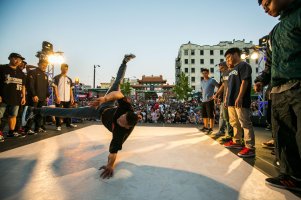
I photograph a lot of dance competitions where my Shutter speed must be at least 1/500 and Aperture is at f2.8 on a 5dmk3 (any faster aperture and I risk being out of focus too often). Since many competitions are in poorly lit environments I often have to rely on ISO 3200 - 6400.

Attached Image settings:
1/400, f4, ISO 3200 (no noise reduction in post - to illustrate the out of camera noise levels)
Lens: Canon 16-35 f2.8 v2
Camera: 5Dmk3
 

Attachments

  • 2014 ID Night Market BBoy Exhibition_0596.jpg
    2014 ID Night Market BBoy Exhibition_0596.jpg
    308.8 KB · Views: 207
Upvote 0
JMZawodny said:
sgs8r said:
Interesting reading, though somehow the estimated ISO of 500-1000 for the eye seems low. Informally, I imagine sitting out on a patio on a summer night (or in a dimly lit restaurant or bar) and trying to capture what I see with a camera. I don't think ISO 800 will get the job done. Maybe ISO 6400 on a newer camera.

Here's a possible experiment: In a low-light situation, set up an optometrist's eye chart and determine the smallest line you can read. Then take a camera with a 50mm (or equivalent) lens at f/1.4 (not really sure what makes sense here) and 1/60 and shoot the chart at various ISOs. Make prints with minimal postprocessing and view them in good light at a distance where chart image subtends the same angle as the original chart. And determine the smallest line you can read on each one. Then the ISO of the chart where the smallest readable line matches your performance in the original test would be one measure of the eye's ISO.

Why limit it to 1/60th of a second? The brain has a profound ability to filter noise and integrate signals. I'm not sure what the appropriate exposure should be for such a comparison. Perhaps we would need the observer to have their exposure limited with a shutter as well in order to make this a fair comparison.

The 1/60 assumed the camera was hand-held ("bio-stabilized", like the eye :)). With a tripod, arbitrarily long exposure times would be possible but that would assume a stationary subject. Again, I'm envisioning trying to capture what the eye sees. The eye (once adapted) doesn't require a long exposure or a stationary subject. So 1/60 seemed a reasonable value. Particularly for this type of ad hoc, apples-to-oranges type of comparison.
 
Upvote 0
There was a comment that light falls off at an inverts square standpoint as one backs away from a subject. That is true if you are using on-camera flash. With existing light there is no change in the brightness of the subject regardless of distance to the camera. The subject gets smaller, bit its brightness doesn't change at all. Take the moon as an example. It is really far away from the camera, but the exposure is the same as one would use to take a picture of a person standing 10 feet away in sunlight. (There are some variables here depending on whether the moon is in the umbra or penumbra shadow from the earth, but I am talking about a more general case of a sun-lit moon.)
 
Upvote 0
nc0b said:
There was a comment that light falls off at an inverts square standpoint as one backs away from a subject. That is true if you are using on-camera flash. With existing light there is no change in the brightness of the subject regardless of distance to the camera.

That is correct because it still follows the inverse square law. This can be one of the more difficult things to learn about off camera flash. It is the distance from the light source (sun or flash) to the subject that is important, not the distance from the camera to the subject.
 
Upvote 0