DPreview First impression review 5D IV

Jack Douglas said:
If Rishi is willing to take them to heart, there are valid points being made that will help him to improve and and we're not talking about Canon praise here, just equal treatment. That would be a good outcome.

It's like a kid being king of the castle and a dozen others climbing up to knock him off. That is unproductive and serves no purpose, and so we should simply continue to give useful suggestions, maybe sometimes with a little less harshness.

Jack

But my question is: is anyone willing to take to heart the points I've made in response to many of the points raised here? Last I checked, you admitted to not really reading all the content of my posts. I know there's a lot of content here, but I've spent countless hours reading and responding to those made by others here, incorporating useful feedback when it's actually valid/useful, but mostly responding to skewed/erroneous claims made (mostly by neuro) to fit a preconceived narrative to discredit us so as to not have to accept any critical remark we make on cameras that are sacred to forum members here.

Which means: I've actually read much of the feedback/points made here. But it feels like few have read my points. And those who have (there are some of you that have) do at least, to their credit, respond with 'good points'. Thank you, by the way.

The rest of you: please read my points before summarily judging and hastily responding. And thanks to those who are polite.
 
Upvote 0
rishi_sanyal said:
Jack Douglas said:
If Rishi is willing to take them to heart, there are valid points being made that will help him to improve and and we're not talking about Canon praise here, just equal treatment. That would be a good outcome.

It's like a kid being king of the castle and a dozen others climbing up to knock him off. That is unproductive and serves no purpose, and so we should simply continue to give useful suggestions, maybe sometimes with a little less harshness.

Jack

But my question is: is anyone willing to take to heart the points I've made in response to many of the points raised here? Last I checked, you admitted to not really reading all the content of my posts. I know there's a lot of content here, but I've spent countless hours reading and responding to those made by others here, incorporating useful feedback when it's actually valid/useful, but mostly responding to skewed/erroneous claims made (mostly by neuro) to fit a preconceived narrative to discredit us so as to not have to accept any critical remark we make on cameras that are sacred to forum members here.

Which means: I've actually read much of the feedback/points made here. But it feels like few have read my points. And those who have (there are some of you that have) do at least, to their credit, respond with 'good points'. Thank you, by the way.

The rest of you: please read my points before summarily judging and hastily responding. And thanks to those who are polite.

No you haven't. You argue semantics, ad nauseum, meanwhile you avoid any mention of many of the points that have been raised about you.

My pet peeve is the 5dsr image you used to demonstrate poor dr, we both know that is a dishonest representation of the cameras capabilities. Now I am not saying more dr isn't useful on occasions, but to try to say that is the best that camera could do in that situation and it is a failure because of that is dishonest.

Post the RAW and prove me wrong.
 
Upvote 0
Rishi, I generally do read it all, except this thread was becoming so negative it kind of turned me off.

I know the feeling. I authored a programmable logic book a few years back and requested a review from an Altera trained prof. The review came back pretty harsh and some of the criticisms clearly weren't justified but many were. It took a day or two but I stepped out of my box and allowed myself to see that there was lots I needed to rewrite, and that I did, with a little humbler attitude.

Someone has mentioned semantics and I have also, some time back. It's possible to get in trouble in the way comments are phrased, even though in your mind the description is 100% accurate and valid. My daughter who is now an MD had no clue about electronics but helped me a lot proof reading.

Do your best, don't get discouraged! :)

Jack
 
Upvote 0
rishi_sanyal said:
Or, after a comment on iTR's foibles: "But if you can follow the action yourself with a chosen AF point or zone, the camera will reward you with a very high amount of in-focus 'keepers.'"

[quote author=Rishi @ DPR]
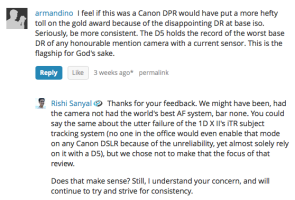
You could say the same about the utter failure of the 1D X II's iTR subject tracking system (no one in the office would even enable that mode on any Canon DSLR because of the unreliability, yet almost solely rely on it with a D5), but we chose not to make that the focus of that review.
[/quote]

[quote author=Carey Rose, Dan Bracaglia @ DPR]
I started off the day shooting with the 70-200mm with the camera set to Auto Point Selection, which utilizes iTR....

When shooting in the Auto Point Selection AF mode with the area selection set to manual, you can simply choose any one of the 61 points as your starting place. Once a subject passes over that point, or once you've placed your selected point over your subject, hit the AF-on button and the camera should lock focus and track the subject.

Depending on which way I anticipated the rider coming into frame, I set my initial AF point just off centered toward their side of entry. In most cases, the 1D X Mark II was able to pick up on a rider entering the frame and maintain consistent focus. This was likely helped by the fact that I often panned along with motorcyclists due to the very fast speeds in which they were zipping by. Shooting in this manner gave me a very high hit rate.

The un-edited images in the above roll-over are part of a 36-frame burst shot using the method described above. These five images were taken toward the end of the burst as the rider passed by, however all 36 were perfectly in focus.
[/quote]

Yes, iTR is so unreliable that it gives a very high hit rate. Delivering 36 of 36 shots perfectly in focus...yes, that sounds like "utter failure." Not that you're biased, or anything.
 

Attachments

  • Utter Failure.png
    Utter Failure.png
    87.7 KB · Views: 707
Upvote 0
neuroanatomist said:
Yes, iTR is so unreliable that it gives a very high hit rate. Delivering 36 of 36 shots perfectly in focus...yes, that sounds like "utter failure." Not that you're biased, or anything.

I'll add to that my personal tests thus far with my new 1DX2 in video mode using iTR DPAF tracking during filming is VERY VERY good, and my three kids have been giving it a serious workout running around the yard. Oh wait... Nikon can't even do that at all...even for the 3 minute recording time on the D5
 
Upvote 0
PureClassA said:
neuroanatomist said:
Yes, iTR is so unreliable that it gives a very high hit rate. Delivering 36 of 36 shots perfectly in focus...yes, that sounds like "utter failure." Not that you're biased, or anything.

I'll add to that my personal tests thus far with my new 1DX2 in video mode using iTR DPAF tracking during filming is VERY VERY good, and my three kids have been giving it a serious workout running around the yard. Oh wait... Nikon can't even do that at all...even for the 3 minute recording time on the D5

Rishi has heaped praise on DPAF for video. Kinda like, "See, I have a ________ friend."

But speaking of AF, Rishi has repeatedly pointed out how the f/8 AF capabilities of the 1D X II are well-covered in the 1D X II review, and when I mentioned the convenient omission 'simple oversight' in the 1D X II vs. D5 comparison article, that was corrected. But, where are the D5's f/8 capabilities discussed in the D5 review? The manage to include a cute little slam on Canon's iTR at the end of a footnote, but conveniently omit a discussion of f/8 from the D5 review, much less discuss Canon's advantage in that area. I'm sure some Nikon-shooters use f/8 TC combos (I know several), so why avoid the topic? Oh, I know...another cherry-picked, simple oversight.
 
Upvote 0
neuroanatomist said:
I'm sure some Nikon-shooters use f/8 TC combos (I know several), so why avoid the topic? Oh, I know...another simple oversight.

Begging the (DPP grade) question "Why would anyone use a Nikon anything for serious telephoto work like birding and wildlife and sports without the basic ability to AF when using teleconverters?" ... Oh crap wait... 70-80% of those shooters do not use Nikon.

DPP feels to me like it's become a Consumer Reports repository of consumer grade reviews seemingly focusing (no pun intended) on a particular set of sensor measurements.
 
Upvote 0
To be fair, the D5 actually can focus with all of its AF points at f/8, Nikon advertises only a select few work in the middle but at least on my D500 all of them work with my 200-500+1.4TC at f/8. Nikon doesn't restrict them like Canon does (in all but the 1DX2 and 5D4). And in my testing the outer points do work at f/8 in outdoor light.

Also the D5 now has 30min recording for 4K.
 
Upvote 0
neuroanatomist said:
rishi_sanyal said:
Or, after a comment on iTR's foibles: "But if you can follow the action yourself with a chosen AF point or zone, the camera will reward you with a very high amount of in-focus 'keepers.'"

[quote author=Rishi @ DPR]
You could say the same about the utter failure of the 1D X II's iTR subject tracking system (no one in the office would even enable that mode on any Canon DSLR because of the unreliability, yet almost solely rely on it with a D5), but we chose not to make that the focus of that review.

[quote author=Carey Rose, Dan Bracaglia @ DPR]
I started off the day shooting with the 70-200mm with the camera set to Auto Point Selection, which utilizes iTR....

When shooting in the Auto Point Selection AF mode with the area selection set to manual, you can simply choose any one of the 61 points as your starting place. Once a subject passes over that point, or once you've placed your selected point over your subject, hit the AF-on button and the camera should lock focus and track the subject.

Depending on which way I anticipated the rider coming into frame, I set my initial AF point just off centered toward their side of entry. In most cases, the 1D X Mark II was able to pick up on a rider entering the frame and maintain consistent focus. This was likely helped by the fact that I often panned along with motorcyclists due to the very fast speeds in which they were zipping by. Shooting in this manner gave me a very high hit rate.

The un-edited images in the above roll-over are part of a 36-frame burst shot using the method described above. These five images were taken toward the end of the burst as the rider passed by, however all 36 were perfectly in focus.
[/quote]

Yes, iTR is so unreliable that it gives a very high hit rate. Delivering 36 of 36 shots perfectly in focus...yes, that sounds like "utter failure." Not that you're biased, or anything.
[/quote]

Oh, I see - so one example in isolation represents the entire performance of that system? Nevermind the very person that wrote that exact phrase concluded at the end of that very piece that iTR is comparatively unreliable (having used the D5 after the photographers switched off)? Hmm, I wonder why? Maybe even as a non-scientist he's intelligent enough to know that one example doesn't constitute the entirety of performance?

Did you say you were a scientist? Only in your offline life, then?

Consider that in the a7R II review we have an entire rollover showing Lock-on AF nailing every shot in our bike test. Yet we know from actually using the camera that Lock-on is not actually all that reliable in day to day shooting. So we dug into it, talking to Sony engineers about it as well, and concluded that with our isolated biker example, Lock-on, which gave up, defaulted to subject tracking based off of phase information only (what Canon weights their subject tracking to as well, we suspect) - which works great for isolated bikers, but not for complex scenes.

By your logic, we shouldn't have concluded, as we did, that Lock-on is unreliable, because hey we had a 100% hit-rate in that one rollover. Right? And yet we didn't - we did the more responsible thing: test, test, test, use in the real-world, rinse and repeat. Which led us to our pretty harsh criticism of Lock-on, in pretty much every Sony review.

Can't hear anything negative about Canon, can you? But we're definitely the ones that are biased...
 
Upvote 0
neuroanatomist said:
PureClassA said:
neuroanatomist said:
Yes, iTR is so unreliable that it gives a very high hit rate. Delivering 36 of 36 shots perfectly in focus...yes, that sounds like "utter failure." Not that you're biased, or anything.

I'll add to that my personal tests thus far with my new 1DX2 in video mode using iTR DPAF tracking during filming is VERY VERY good, and my three kids have been giving it a serious workout running around the yard. Oh wait... Nikon can't even do that at all...even for the 3 minute recording time on the D5

Rishi has heaped praise on DPAF for video. Kinda like, "See, I have a ________ friend."

But speaking of AF, Rishi has repeatedly pointed out how the f/8 AF capabilities of the 1D X II are well-covered in the 1D X II review, and when I mentioned the convenient omission 'simple oversight' in the 1D X II vs. D5 comparison article, that was corrected. But, where are the D5's f/8 capabilities discussed in the D5 review? The manage to include a cute little slam on Canon's iTR at the end of a footnote, but conveniently omit a discussion of f/8 from the D5 review, much less discuss Canon's advantage in that area. I'm sure some Nikon-shooters use f/8 TC combos (I know several), so why avoid the topic? Oh, I know...another cherry-picked, simple oversight.

When one camera brings a new feature that no other camera has, it doesn't automatically become the standard by which other cameras are judged. That'd be stupid. And if we did that, we'd be calling out every Canon, Pentax, Sony, Panasonic, Olympus, Fuji camera for not having highlight-weighted metering (HWM). Again, that'd be stupid. Rather, HWM is called out in the Nikon reviews as a pro.

When a good proportion of cameras exhibit a new feature that is useful to enough users, it starts to set a standard, and an expectation, and then only is it pointed out as a negative if a camera doesn't have it.

Make sense? If we didn't work this way, we'd suddenly start knocking all Canon cameras for not having dual-gain architecture for increased high ISO DR. We don't. But now that almost all Sony and Nikon cameras are starting to get it, we might, because then it becomes a standard. But we probably won't, unless we decide it affects a wide enough array of users.

Which gets me to my next point: add to all this the fact that F8 autofocus affects an arguably narrow group of 600mm+ shooters. We're not going to start counting it as a con in every DSLR suddenly because the 1D X II has it. If Canon now sets it as a standard across all their cameras over their next couple of cameras, we might revisit this discussion.

And if arbitrage is right... then...

There is actual thoughtful reasoning behind what we do. But you just love jumping to the conclusion that fits your preconceived narrative, not actually think, or heaven forbid ask, about what our actual thought processes might be. Reminds me of this one news organization that couldn't be bothered to check their facts... or has become really good at ignoring the ones that don't fit their narrative...
 
Upvote 0
privatebydesign said:
rishi_sanyal said:
Jack Douglas said:
If Rishi is willing to take them to heart, there are valid points being made that will help him to improve and and we're not talking about Canon praise here, just equal treatment. That would be a good outcome.

It's like a kid being king of the castle and a dozen others climbing up to knock him off. That is unproductive and serves no purpose, and so we should simply continue to give useful suggestions, maybe sometimes with a little less harshness.

Jack

But my question is: is anyone willing to take to heart the points I've made in response to many of the points raised here? Last I checked, you admitted to not really reading all the content of my posts. I know there's a lot of content here, but I've spent countless hours reading and responding to those made by others here, incorporating useful feedback when it's actually valid/useful, but mostly responding to skewed/erroneous claims made (mostly by neuro) to fit a preconceived narrative to discredit us so as to not have to accept any critical remark we make on cameras that are sacred to forum members here.

Which means: I've actually read much of the feedback/points made here. But it feels like few have read my points. And those who have (there are some of you that have) do at least, to their credit, respond with 'good points'. Thank you, by the way.

The rest of you: please read my points before summarily judging and hastily responding. And thanks to those who are polite.

No you haven't. You argue semantics, ad nauseum, meanwhile you avoid any mention of many of the points that have been raised about you.

My pet peeve is the 5dsr image you used to demonstrate poor dr, we both know that is a dishonest representation of the cameras capabilities. Now I am not saying more dr isn't useful on occasions, but to try to say that is the best that camera could do in that situation and it is a failure because of that is dishonest.

Post the RAW and prove me wrong.

No, it's not, and I'm tired of arguing this with you. All you and others have done is raise completely invalid points about how because the flash and background exposure are independent, I could've nailed the perfect exposure.

What does the flash have to do with this?? ???

I never once talked about the model exposure. I said that in order to protect the gradient in the sky, I chose an exposure that placed them near, but not at, clipping. In which case the foreground falls to darkness. The foreground, not the model. Tonemapping that foreground, which is no longer illuminated by light so long after sunset, brings into the image noise on a camera with limited dynamic range (limited for that scene). Just like

There's nothing surprising about that. We all already know old Canon sensors were challenged in DR for such scenes - half an hour to 45 min after sunset is one of the highest dynamic range scenes you could come across. Same issue in my tulip image here: https://www.dpreview.com/articles/3673531883/dxomark-eos-5ds-r-sensor-is-highest-ranked-canon-sensor-yet/2

... the only difference there being I perfectly ETTR'd the tulip shot, because I had the time to do so via bracketing. The next 1/3 EV longer exposure clipped skies/clouds irrecoverably. With the model shot, I had a tad more headroom in the Raw, despite the camera indicating clipped channels. But that's beside the point - it's unreasonable for anyone but an armchair forum troll to expect an actual photographer to perfectly ETTR (getting the brightest tones you care about within 1/3 EV of clipping) anything but static studio/landscape imagery. Without the tools that no camera maker but Phase One provides (Raw channel clipping in-camera), you simply will not perfectly ETTR every shot. So there were actually two points I was trying to make: (1) even a perfectly ETTR'd shot of a scene like that challenges the dynamic range of the 5DS; furthermore, (2) actual photographers who don't sit there with a computer and RawDigger to check that RGGB 14-bit Raw values are approaching, but not exceeding, clipping also benefit from extended latitude for those sorts of scenes where the photographer wants to ensure the colors in the sky aren't lost while actually, you know, trying to take pictures. That is, direct the model/set up the lighting/focus/compose, etc.

Armchair forum critics are completely disconnected with the realities actual pro photographers face. Tell a pro wedding photographer to perfectly nail exposure so that Raw green channel values are exactly within a 1/3 of a stop of clipping, and he/she will laugh.

Oh, and someone else (you?) blamed me for blaming the camera's automatic choice of exposure. ??? That shot was exposed completely manually. How could I be blaming the camera's auto exposure?

I have little interest in engaging in such irrational arguments (it's too bad - for my own health - that I have enough of an interest to respond at all...)

 
Upvote 0
rishi_sanyal said:
privatebydesign said:
rishi_sanyal said:
Jack Douglas said:
If Rishi is willing to take them to heart, there are valid points being made that will help him to improve and and we're not talking about Canon praise here, just equal treatment. That would be a good outcome.

It's like a kid being king of the castle and a dozen others climbing up to knock him off. That is unproductive and serves no purpose, and so we should simply continue to give useful suggestions, maybe sometimes with a little less harshness.

Jack

But my question is: is anyone willing to take to heart the points I've made in response to many of the points raised here? Last I checked, you admitted to not really reading all the content of my posts. I know there's a lot of content here, but I've spent countless hours reading and responding to those made by others here, incorporating useful feedback when it's actually valid/useful, but mostly responding to skewed/erroneous claims made (mostly by neuro) to fit a preconceived narrative to discredit us so as to not have to accept any critical remark we make on cameras that are sacred to forum members here.

Which means: I've actually read much of the feedback/points made here. But it feels like few have read my points. And those who have (there are some of you that have) do at least, to their credit, respond with 'good points'. Thank you, by the way.

The rest of you: please read my points before summarily judging and hastily responding. And thanks to those who are polite.

No you haven't. You argue semantics, ad nauseum, meanwhile you avoid any mention of many of the points that have been raised about you.

My pet peeve is the 5dsr image you used to demonstrate poor dr, we both know that is a dishonest representation of the cameras capabilities. Now I am not saying more dr isn't useful on occasions, but to try to say that is the best that camera could do in that situation and it is a failure because of that is dishonest.

Post the RAW and prove me wrong.

No, it's not, and I'm tired of arguing this with you. All you and others have done is raise completely invalid points about how because the flash and background exposure are independent, I could've nailed the perfect exposure.

What does the flash have to do with this?? ???

I never once talked about the model exposure. I said that in order to protect the gradient in the sky, I chose an exposure that placed them near, but not at, clipping. In which case the foreground falls to darkness. The foreground, not the model. Tonemapping that foreground, which is no longer illuminated by light so long after sunset, brings into the image noise on a camera with limited dynamic range (limited for that scene). Just like

There's nothing surprising about that. We all already know old Canon sensors were challenged in DR for such scenes - half an hour to 45 min after sunset is one of the highest dynamic range scenes you could come across. Same issue in my tulip image here: https://www.dpreview.com/articles/3673531883/dxomark-eos-5ds-r-sensor-is-highest-ranked-canon-sensor-yet/2

... the only difference there being I perfectly ETTR'd the tulip shot, because I had the time to do so via bracketing. The next 1/3 EV longer exposure clipped skies/clouds irrecoverably. With the model shot, I had a tad more headroom in the Raw, despite the camera indicating clipped channels. But that's beside the point - it's unreasonable for anyone but an armchair forum troll to expect an actual photographer to perfectly ETTR (getting the brightest tones you care about within 1/3 EV of clipping) anything but static studio/landscape imagery. Without the tools that no camera maker but Phase One provides (Raw channel clipping in-camera), you simply will not perfectly ETTR every shot. So there were actually two points I was trying to make: (1) even a perfectly ETTR'd shot of a scene like that challenges the dynamic range of the 5DS; furthermore, (2) actual photographers who don't sit there with a computer and RawDigger to check that RGGB 14-bit Raw values are approaching, but not exceeding, clipping also benefit from extended latitude for those sorts of scenes where the photographer wants to ensure the colors in the sky aren't lost while actually, you know, trying to take pictures. That is, direct the model/set up the lighting/focus/compose, etc.

Armchair forum critics are completely disconnected with the realities actual pro photographers face. Tell a pro wedding photographer to perfectly nail exposure so that Raw green channel values are exactly within a 1/3 of a stop of clipping, and he/she will laugh.

Oh, and someone else (you?) blamed me for blaming the camera's automatic choice of exposure. ??? That shot was exposed completely manually. How could I be blaming the camera's auto exposure?

I have little interest in engaging in such irrational arguments (it's too bad - for my own health - that I have enough of an interest to respond at all...)

Yet another perfect example of Rishi's discursive replies littered with misinformation and strawmen arguments.

Show me one instance where I have mentioned the exposure on the model other than to say it isn't relevant. Indeed in the counter example I posted when we first jousted over this I didn't include a model as it is irrelevant to what you are demonstrating.

Or where I said anything about auto exposure. Strawman upon strawman.

Mind you, if you had used auto exposure AV mode and ETTL it would have done a better job than you did. You would have got a longer shutter speed that would have only impacted your background exposure and the ETTL would have taken care of your subject exposure.

I only ever said you were being dishonest about your background exposure and I still believe that to be true. Don't waffle, I will apologize if I am wrong. Post the RAW file that demonstrates the background is just below clipped highlights and the shadows lift was necessary. You said this was a 'real world example of where the camera would let a user down', prove it, post the RAW file.

I might be an armchair critic of reviewers, but I am also a pro photographer. I do a little consulting engineering and yacht crew training, but over 80% of my income is from photography. I shoot weddings without fear with cameras well below 5DS capabilities.
 
Upvote 0
rishi_sanyal said:
Oh, I see - so one example in isolation represents the entire performance of that system? Nevermind the very person that wrote that exact phrase concluded at the end of that very piece that iTR is comparatively unreliable (having used the D5 after the photographers switched off)? Hmm, I wonder why? Maybe even as a non-scientist he's intelligent enough to know that one example doesn't constitute the entirety of performance?

Did you say you were a scientist? Only in your offline life, then?

You sure do like to put words in others' mouths, don't you? No, one example is not necessarily representative. But, if you recall basic scientific method, a hypothesis can never be proven, only disproven. If your hypothesis is that iTR is, in your own words an, "utter failure," then the example of 36 of 36 frames in perfect focus is the experiment that disproves the hypothesis. Quod erat demonstrandum.
 
Upvote 0
rishi_sanyal said:
neuroanatomist said:
PureClassA said:
neuroanatomist said:
Yes, iTR is so unreliable that it gives a very high hit rate. Delivering 36 of 36 shots perfectly in focus...yes, that sounds like "utter failure." Not that you're biased, or anything.

I'll add to that my personal tests thus far with my new 1DX2 in video mode using iTR DPAF tracking during filming is VERY VERY good, and my three kids have been giving it a serious workout running around the yard. Oh wait... Nikon can't even do that at all...even for the 3 minute recording time on the D5

Rishi has heaped praise on DPAF for video. Kinda like, "See, I have a ________ friend."

But speaking of AF, Rishi has repeatedly pointed out how the f/8 AF capabilities of the 1D X II are well-covered in the 1D X II review, and when I mentioned the convenient omission 'simple oversight' in the 1D X II vs. D5 comparison article, that was corrected. But, where are the D5's f/8 capabilities discussed in the D5 review? The manage to include a cute little slam on Canon's iTR at the end of a footnote, but conveniently omit a discussion of f/8 from the D5 review, much less discuss Canon's advantage in that area. I'm sure some Nikon-shooters use f/8 TC combos (I know several), so why avoid the topic? Oh, I know...another cherry-picked, simple oversight.

When one camera brings a new feature that no other camera has, it doesn't automatically become the standard by which other cameras are judged. That'd be stupid. And if we did that, we'd be calling out every Canon, Pentax, Sony, Panasonic, Olympus, Fuji camera for not having highlight-weighted metering (HWM). Again, that'd be stupid. Rather, HWM is called out in the Nikon reviews as a pro.

When a good proportion of cameras exhibit a new feature that is useful to enough users, it starts to set a standard, and an expectation, and then only is it pointed out as a negative if a camera doesn't have it.

Make sense? If we didn't work this way, we'd suddenly start knocking all Canon cameras for not having dual-gain architecture for increased high ISO DR. We don't. But now that almost all Sony and Nikon cameras are starting to get it, we might, because then it becomes a standard. But we probably won't, unless we decide it affects a wide enough array of users.

Which gets me to my next point: add to all this the fact that F8 autofocus affects an arguably narrow group of 600mm+ shooters. We're not going to start counting it as a con in every DSLR suddenly because the 1D X II has it. If Canon now sets it as a standard across all their cameras over their next couple of cameras, we might revisit this discussion.

And if arbitrage is right... then...

There is actual thoughtful reasoning behind what we do. But you just love jumping to the conclusion that fits your preconceived narrative, not actually think, or heaven forbid ask, about what our actual thought processes might be. Reminds me of this one news organization that couldn't be bothered to check their facts... or has become really good at ignoring the ones that don't fit their narrative...
Canon doesn't do 3d focusing in all of their Cameras either. There is so much emphasis on 3D/itr focusing in your reviews, how much percentage of users do you think are using this feature? How many of users in recent olympics are using 3d focusing / iTR for capturing the event with 1dx2 and D5. Regarding F8 focus support, Nikon and Canon keep on adding more focus points supporting F8 in each iteration. It is not something new. It is just that Canon suddenly added all F8 focus points. I feel like, I am wasting your time by asking lot of unnecessary questions.
 
Upvote 0
arbitrage said:
To be fair, the D5 actually can focus with all of its AF points at f/8, Nikon advertises only a select few work in the middle but at least on my D500 all of them work with my 200-500+1.4TC at f/8. Nikon doesn't restrict them like Canon does (in all but the 1DX2 and 5D4). And in my testing the outer points do work at f/8 in outdoor light.

Also the D5 now has 30min recording for 4K.
That is good to know. I wish DPR did some testing with f/8 len set up between D5 and 1dx2 (D500 and 7d2) and show the findings.
 
Upvote 0
rishi_sanyal said:
When one camera brings a new feature that no other camera has, it doesn't automatically become the standard by which other cameras are judged. That'd be stupid.

Yes, that would be stupid. You've already told us what sets the standards. Except the standard for low ISO DR, because, well, lots of cameras, even crop sensor cameras like the 80D, are better at that. Low ISO DR is so important that you've developed several new tests and metrics to demonstrate it. But you know, for the D5, well, having less of it is 'not a huge problem' for real world shooting. But there you go...standards. Some have them, others don't.
 

Attachments

  • Setting the Standard.png
    Setting the Standard.png
    18.5 KB · Views: 561
Upvote 0
rishi_sanyal said:
So there were actually two points I was trying to make: (1) even a perfectly ETTR'd shot of a scene like that challenges the dynamic range of the 5DS; furthermore, (2) actual photographers who don't sit there with a computer and RawDigger to check that RGGB 14-bit Raw values are approaching, but not exceeding, clipping also benefit from extended latitude for those sorts of scenes where the photographer wants to ensure the colors in the sky aren't lost while actually, you know, trying to take pictures. That is, direct the model/set up the lighting/focus/compose, etc.

Armchair forum critics are completely disconnected with the realities actual pro photographers face. Tell a pro wedding photographer to perfectly nail exposure so that Raw green channel values are exactly within a 1/3 of a stop of clipping, and he/she will laugh.

In that case, what's an actual pro wedding photographer to do when trying to take pictures in challenging exposure situations if he/she is shooting with the standard-setting Nikon D5? Oh, wait...it's not going to be a huge problem in that real world situation, even though it's a evidently a bona fide problem for the poor sap who picked the 5Ds. Same low ISO DR, different impact. But no bias.
 
Upvote 0
rishi_sanyal said:
I have little interest in engaging in such irrational arguments (it's too bad - for my own health - that I have enough of an interest to respond at all...)

Dan: Are you coming down into the pit of DR? Mark II's got his strength back. I'm starting him on the machine tonight.

Rishi: [sincerely] Dan, you know how much I love watching you work, but I've got Sony's 500th anniversary to plan, my Pentax review to arrange, Canon to murder and Nikon to frame for it; I'm swamped.

Dan:
 

Attachments

  • GetSomeRest.png
    GetSomeRest.png
    475.8 KB · Views: 565
Upvote 0